checking oil GMC CANYON 2012 Owner's Manual
[x] Cancel search | Manufacturer: GMC, Model Year: 2012, Model line: CANYON, Model: GMC CANYON 2012Pages: 404, PDF Size: 5.25 MB
Page 251 of 404
Black plate (7,1)GMC Canyon Owner Manual - 2012
Vehicle Care 10-7
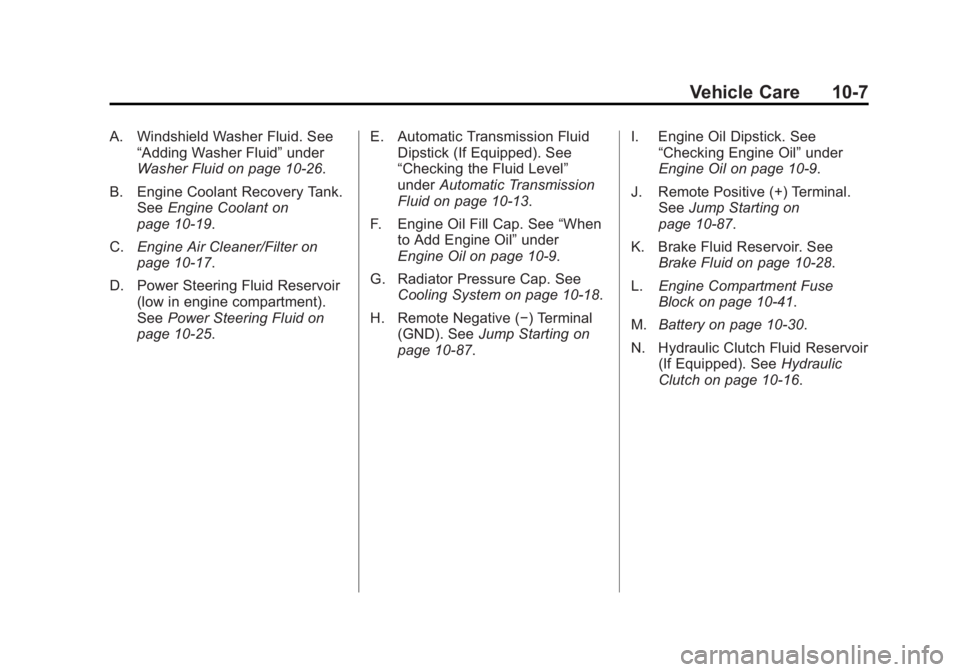
A. Windshield Washer Fluid. See“Adding Washer Fluid” under
Washer Fluid on page 10‑26.
B. Engine Coolant Recovery Tank. See Engine Coolant on
page 10‑19.
C. Engine Air Cleaner/Filter on
page 10‑17.
D. Power Steering Fluid Reservoir (low in engine compartment).
See Power Steering Fluid on
page 10‑25. E. Automatic Transmission Fluid
Dipstick (If Equipped). See
“Checking the Fluid Level”
under Automatic Transmission
Fluid on page 10‑13.
F. Engine Oil Fill Cap. See “When
to Add Engine Oil” under
Engine Oil on page 10‑9.
G. Radiator Pressure Cap. See Cooling System on page 10‑18.
H. Remote Negative (−) Terminal (GND). See Jump Starting on
page 10‑87. I. Engine Oil Dipstick. See
“Checking Engine Oil” under
Engine Oil on page 10‑9.
J. Remote Positive (+) Terminal. See Jump Starting on
page 10‑87.
K. Brake Fluid Reservoir. See Brake Fluid on page 10‑28.
L. Engine Compartment Fuse
Block on page 10‑41.
M. Battery on page 10‑30.
N. Hydraulic Clutch Fluid Reservoir (If Equipped). See Hydraulic
Clutch on page 10‑16.
Page 253 of 404
Black plate (9,1)GMC Canyon Owner Manual - 2012
Vehicle Care 10-9
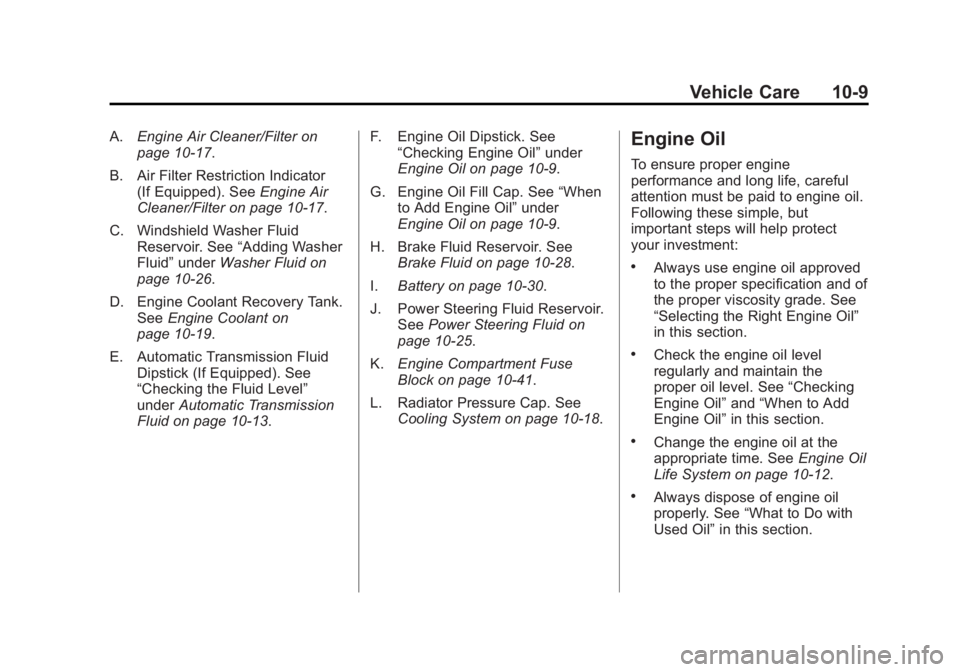
A.Engine Air Cleaner/Filter on
page 10‑17.
B. Air Filter Restriction Indicator (If Equipped). See Engine Air
Cleaner/Filter on page 10‑17.
C. Windshield Washer Fluid Reservoir. See “Adding Washer
Fluid” under Washer Fluid on
page 10‑26.
D. Engine Coolant Recovery Tank. See Engine Coolant on
page 10‑19.
E. Automatic Transmission Fluid Dipstick (If Equipped). See
“Checking the Fluid Level”
under Automatic Transmission
Fluid on page 10‑13. F. Engine Oil Dipstick. See
“Checking Engine Oil” under
Engine Oil on page 10‑9.
G. Engine Oil Fill Cap. See “When
to Add Engine Oil” under
Engine Oil on page 10‑9.
H. Brake Fluid Reservoir. See Brake Fluid on page 10‑28.
I. Battery on page 10‑30.
J. Power Steering Fluid Reservoir. See Power Steering Fluid on
page 10‑25.
K. Engine Compartment Fuse
Block on page 10‑41.
L. Radiator Pressure Cap. See Cooling System on page 10‑18.Engine Oil
To ensure proper engine
performance and long life, careful
attention must be paid to engine oil.
Following these simple, but
important steps will help protect
your investment:
.Always use engine oil approved
to the proper specification and of
the proper viscosity grade. See
“Selecting the Right Engine Oil”
in this section.
.Check the engine oil level
regularly and maintain the
proper oil level. See “Checking
Engine Oil” and“When to Add
Engine Oil” in this section.
.Change the engine oil at the
appropriate time. See Engine Oil
Life System on page 10‑12.
.Always dispose of engine oil
properly. See “What to Do with
Used Oil” in this section.
Page 254 of 404
Black plate (10,1)GMC Canyon Owner Manual - 2012
10-10 Vehicle Care
Checking Engine Oil
It is a good idea to check the engine
oil level at each fuel fill. In order to
get an accurate reading, the vehicle
must be on level ground. The
engine oil dipstick handle is a yellow
loop. SeeEngine Compartment
Overview on page 10‑6 for the
location of the engine oil dipstick.
Obtaining an accurate oil level
reading is essential:
1. If the engine has been running recently, turn off the engine and
allow several minutes for the oil
to drain back into the oil pan.
Checking the oil level too soon
after engine shutoff will not
provide an accurate oil level
reading.
2. Pull out the dipstick and clean it with a paper towel or cloth, then
push it back in all the way.
Remove it again, keeping the tip
down, and check the level.
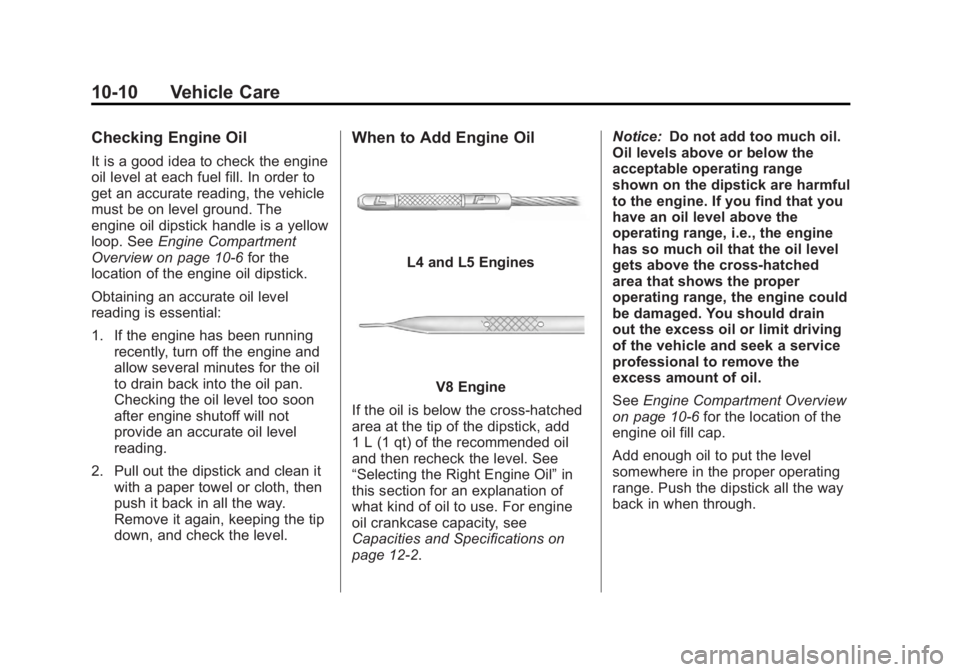
When to Add Engine Oil
L4 and L5 Engines
V8 Engine
If the oil is below the cross-hatched
area at the tip of the dipstick, add
1 L (1 qt) of the recommended oil
and then recheck the level. See
“Selecting the Right Engine Oil” in
this section for an explanation of
what kind of oil to use. For engine
oil crankcase capacity, see
Capacities and Specifications on
page 12‑2. Notice:
Do not add too much oil.
Oil levels above or below the
acceptable operating range
shown on the dipstick are harmful
to the engine. If you find that you
have an oil level above the
operating range, i.e., the engine
has so much oil that the oil level
gets above the cross-hatched
area that shows the proper
operating range, the engine could
be damaged. You should drain
out the excess oil or limit driving
of the vehicle and seek a service
professional to remove the
excess amount of oil.
See Engine Compartment Overview
on page 10‑6 for the location of the
engine oil fill cap.
Add enough oil to put the level
somewhere in the proper operating
range. Push the dipstick all the way
back in when through.
Page 257 of 404
Black plate (13,1)GMC Canyon Owner Manual - 2012
Vehicle Care 10-13
Automatic Transmission
Fluid
When to Check and Change
Automatic Transmission Fluid
A good time to check the automatic
transmission fluid level is when the
engine oil is changed.
Change the fluid and filter at the
intervals listed inMaintenance
Schedule on page 11‑3, and be sure
to use the transmission fluid listed in
Recommended Fluids and
Lubricants on page 11‑13.
How to Check Automatic
Transmission Fluid
Because this operation can be a
little difficult, it may be decided to
have this done at the dealer service
department.
If not taken to the dealer, be sure
to follow all the instructions here,
or a false reading on the dipstick
could result. Notice:
Too much or too
little fluid can damage the
transmission. Too much can
mean that some of the fluid could
come out and fall on hot engine
parts or exhaust system parts,
starting a fire. Too little fluid
could cause the transmission to
overheat. Be sure to get an
accurate reading if checking the
transmission fluid.
Wait at least 30 minutes before
checking the transmission fluid level
if the vehicle has been driven:
.When outside temperatures are
above 32°C (90°F).
.At high speed for quite a while.
.In heavy traffic —especially in
hot weather.
.While pulling a trailer.
To get the right reading, the fluid
should be at normal operating
temperature, which is 82°C to 93°C
(180°F to 200°F). Get the vehicle warmed up by
driving about 24 km (15 mi) when
outside temperatures are above
10°C (50°F). If it is colder than 10°C
(50°F), drive the vehicle in 3 (Third)
until the engine temperature gauge
moves and then remains steady for
10 minutes.
A cold fluid check can be made
after the vehicle has been sitting for
eight hours or more with the engine
off, but this is used only as a
reference. Let the engine run at
idle for five minutes if outside
temperatures are 10°C (50°F) or
more. If it is colder than 10°C
(50°F), the engine may have to idle
longer. Should the fluid level be low
during this cold check, check the
fluid hot before adding fluid.
Checking the fluid hot gives a more
accurate reading of the fluid level.
Page 259 of 404
Black plate (15,1)GMC Canyon Owner Manual - 2012
Vehicle Care 10-15
How to Add Automatic
Transmission Fluid
Refer to the Maintenance Schedule
to determine what kind of
transmission fluid to use.
SeeRecommended Fluids and
Lubricants on page 11‑13.
Add fluid only after checking the
transmission fluid while it is hot.
A cold check is used only as a
reference. If the fluid level is low,
add only enough of the proper fluid
to bring the level up to the HOT area
for a hot check. It does not take
much fluid, generally less than
0.5 L (1 pt). Do not overfill.
Notice: Use of the incorrect
automatic transmission fluid may
damage the vehicle, and the
damages may not be covered by
the vehicle warranty. Always use
the automatic transmission fluid
listed in Recommended Fluids
and Lubricants on page 11‑13.
.After adding fluid, recheck the
fluid level as described under
“How to Check Automatic
Transmission Fluid,” earlier in
this section.
.When the correct fluid level is
obtained, push the dipstick back
in all the way; then flip the
handle down to lock the dipstick
in place.
Manual Transmission
Fluid
When to Check
A good time to check the manual
transmission fluid is when the
engine oil is changed. However, the
fluid in the manual transmission
does not require changing.
How to Check
Because this operation can be a
little difficult, it may be decided to
have this done at the dealer service
department.
If not taken to the dealer, be sure to
follow all the instructions here, or a
false reading on the dipstick could
result.
Notice: Too much or too
little fluid can damage the
transmission. Too little fluid
could cause the transmission to
overheat. Be sure to get an
accurate reading if checking the
transmission fluid.
Page 265 of 404
Black plate (21,1)GMC Canyon Owner Manual - 2012
Vehicle Care 10-21
Checking Coolant
The vehicle must be on a level
surface when checking the
coolant level.
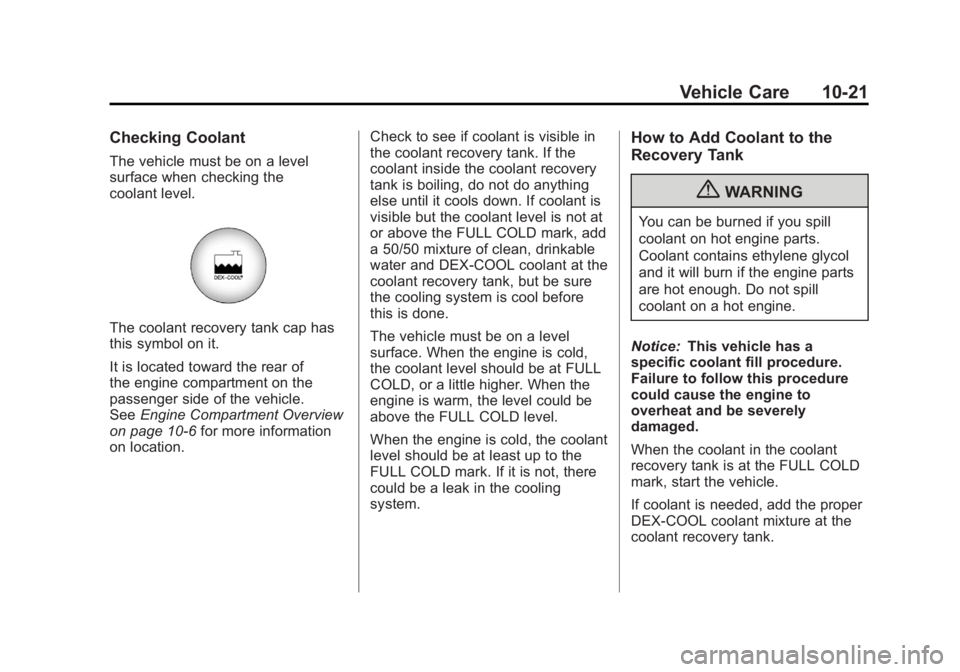
The coolant recovery tank cap has
this symbol on it.
It is located toward the rear of
the engine compartment on the
passenger side of the vehicle.
SeeEngine Compartment Overview
on page 10‑6 for more information
on location. Check to see if coolant is visible in
the coolant recovery tank. If the
coolant inside the coolant recovery
tank is boiling, do not do anything
else until it cools down. If coolant is
visible but the coolant level is not at
or above the FULL COLD mark, add
a 50/50 mixture of clean, drinkable
water and DEX-COOL coolant at the
coolant recovery tank, but be sure
the cooling system is cool before
this is done.
The vehicle must be on a level
surface. When the engine is cold,
the coolant level should be at FULL
COLD, or a little higher. When the
engine is warm, the level could be
above the FULL COLD level.
When the engine is cold, the coolant
level should be at least up to the
FULL COLD mark. If it is not, there
could be a leak in the cooling
system.
How to Add Coolant to the
Recovery Tank
{WARNING
You can be burned if you spill
coolant on hot engine parts.
Coolant contains ethylene glycol
and it will burn if the engine parts
are hot enough. Do not spill
coolant on a hot engine.
Notice: This vehicle has a
specific coolant fill procedure.
Failure to follow this procedure
could cause the engine to
overheat and be severely
damaged.
When the coolant in the coolant
recovery tank is at the FULL COLD
mark, start the vehicle.
If coolant is needed, add the proper
DEX-COOL coolant mixture at the
coolant recovery tank.
Page 273 of 404
Black plate (29,1)GMC Canyon Owner Manual - 2012
Vehicle Care 10-29
Checking Brake Fluid
Check brake fluid by looking at the
brake fluid reservoir. SeeEngine
Compartment Overview on
page 10‑6.
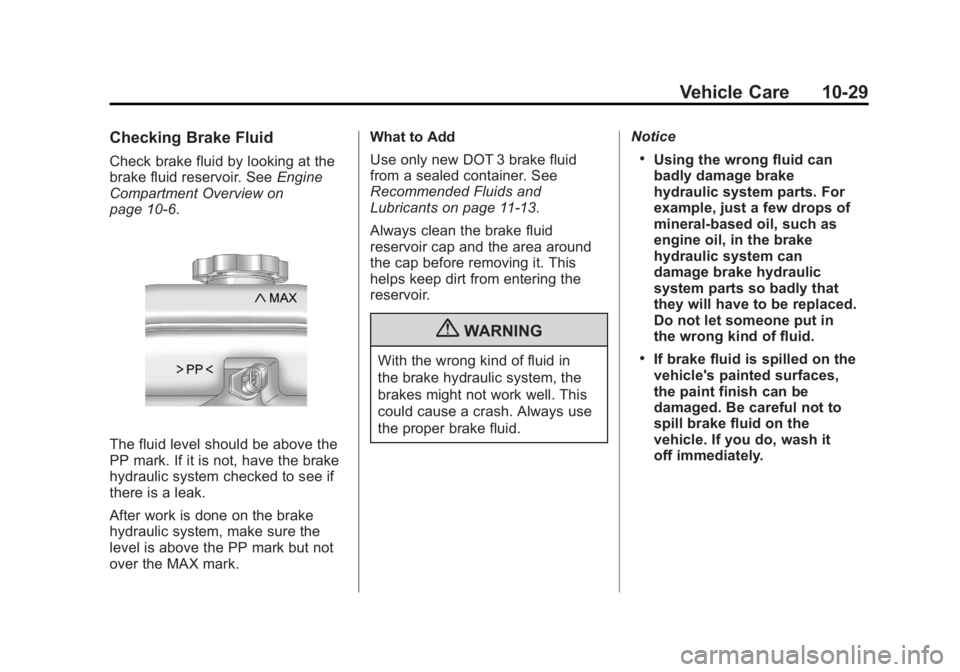
The fluid level should be above the
PP mark. If it is not, have the brake
hydraulic system checked to see if
there is a leak.
After work is done on the brake
hydraulic system, make sure the
level is above the PP mark but not
over the MAX mark. What to Add
Use only new DOT 3 brake fluid
from a sealed container. See
Recommended Fluids and
Lubricants on page 11‑13.
Always clean the brake fluid
reservoir cap and the area around
the cap before removing it. This
helps keep dirt from entering the
reservoir.
{WARNING
With the wrong kind of fluid in
the brake hydraulic system, the
brakes might not work well. This
could cause a crash. Always use
the proper brake fluid.
Notice
.Using the wrong fluid can
badly damage brake
hydraulic system parts. For
example, just a few drops of
mineral-based oil, such as
engine oil, in the brake
hydraulic system can
damage brake hydraulic
system parts so badly that
they will have to be replaced.
Do not let someone put in
the wrong kind of fluid.
.If brake fluid is spilled on the
vehicle's painted surfaces,
the paint finish can be
damaged. Be careful not to
spill brake fluid on the
vehicle. If you do, wash it
off immediately.