instrument cluster GMC CANYON 2016 Owner's Guide
[x] Cancel search | Manufacturer: GMC, Model Year: 2016, Model line: CANYON, Model: GMC CANYON 2016Pages: 392, PDF Size: 5.31 MB
Page 248 of 392
GMC Canyon Owner Manual (GMNA-Localizing-U.S/Canada-9159361) -
2016 - crc - 8/25/15
Driving and Operating 247
right, move your hand to the right.
Always back up slowly and,
if possible, have someone
guide you.
Making TurnsCaution
Making very sharp turns while
trailering could cause the trailer to
come in contact with the vehicle.
The vehicle could be damaged.
Avoid making very sharp turns
while trailering.
When turning with a trailer, make
wider turns than normal. Do this so
the trailer will not strike soft
shoulders, curbs, road signs, trees,
or other objects. Avoid jerky or
sudden maneuvers. Signal well in
advance.
If the trailer turn signal bulbs burn
out, the arrows on the instrument
cluster will still flash for turns. It is
important to check occasionally to
be sure the trailer bulbs are still
working.
Driving on Grades
Reduce speed and shift to a lower
gear before starting down a long or
steep downgrade. If the
transmission is not shifted down, the
brakes might get hot and no longer
work well.
Vehicles can tow in D (Drive). Shift
the transmission to a lower gear if
the transmission shifts too often
under heavy loads and/or hilly
conditions.
The Tow/Haul Mode may be used if
the transmission shifts too often.
See Tow/Haul Mode 0223
ii.
When towing at high altitude on
steep uphill grades, consider the
following: Engine coolant will boil at
a lower temperature than at normal
altitudes. If the engine is turned off
immediately after towing at high
altitude on steep uphill grades, the
vehicle may show signs similar to
engine overheating. To avoid this,
let the engine run while parked,
preferably on level ground, with the
transmission in P (Park) for a few minutes before turning the engine
off. If the overheat warning comes
on, see
Engine Overheating 0271
ii.
Parking on Hills
{Warning
Parking the vehicle on a hill with
the trailer attached can be
dangerous. If something goes
wrong, the rig could start to move.
People can be injured, and both
the vehicle and the trailer can be
damaged. When possible, always
park the rig on a flat surface.
If parking the rig on a hill: 1. Press the brake pedal, but do not shift into P (Park) yet. Turn
the wheels into the curb if
facing downhill or into traffic if
facing uphill.
2. Have someone place chocks under the trailer wheels.
3. When the wheel chocks are in place, release the regular
brakes until the chocks absorb
the load.
Page 254 of 392
GMC Canyon Owner Manual (GMNA-Localizing-U.S/Canada-9159361) -
2016 - crc - 8/25/15
Driving and Operating 253
Press this button on the center
stack to turn on and off the Tow/
Haul Mode.
This indicator light on the instrument
cluster comes on when the Tow/
Haul Mode is on.
Tow/Haul is a feature that assists
when pulling a heavy trailer or a
large or heavy load. SeeTow/Haul
Mode 0223
ii.
Tow/Haul is designed to be most
effective when the vehicle and
trailer combined weight is at least
75 percent of the vehicle's Gross
Combined Weight Rating (GCWR).
See “Weight of the Trailer” under
Trailer Towing 0248
ii. Tow/Haul is
most useful under the following
driving conditions:
. When pulling a heavy trailer or a
large or heavy load through
rolling terrain. .
When pulling a heavy trailer or a
large or heavy load in
stop-and-go traffic.
. When pulling a heavy trailer or a
large or heavy load in busy
parking lots where improved low
speed control of the vehicle is
desired.
Operating the vehicle in Tow/Haul
when lightly loaded or with no trailer
at all will not cause damage.
However, there is no benefit to the
selection of Tow/Haul when the
vehicle is unloaded. Such a
selection when unloaded may result
in unpleasant engine and
transmission driving characteristics
and reduced fuel economy. Tow/
Haul is recommended only when
pulling a heavy trailer or a large or
heavy load.
If the vehicle has a diesel engine,
the Tow/Haul button activates the
exhaust brake system
simultaneously. See “Exhaust
Brake” in the Duramax diesel
supplement.
Trailer Sway
Control (TSC)
Vehicles with StabiliTrak have a
TSC feature. Trailer sway is
unintended side-to-side motion of a
trailer while being towed. If the
vehicle is towing a trailer and the
TSC detects that sway is increasing,
the vehicle brakes are selectively
applied at each wheel, to help
reduce excessive trailer sway. If the
vehicle is equipped with the
Integrated Trailer Brake Control
(ITBC) system, and the trailer has
the electric actuated brake system,
StabiliTrak may also apply the trailer
brakes.
If TSC is enabled, the Traction
Control System (TCS)/StabiliTrak
warning light will flash on the
instrument cluster. Vehicle speed
must be reduced. If trailer sway
continues, StabiliTrak can reduce
engine torque to help slow the
vehicle. See Traction Control/
Electronic Stability Control 0231
ii.
Page 272 of 392
GMC Canyon Owner Manual (GMNA-Localizing-U.S/Canada-9159361) -
2016 - crc - 8/25/15
Vehicle Care 271
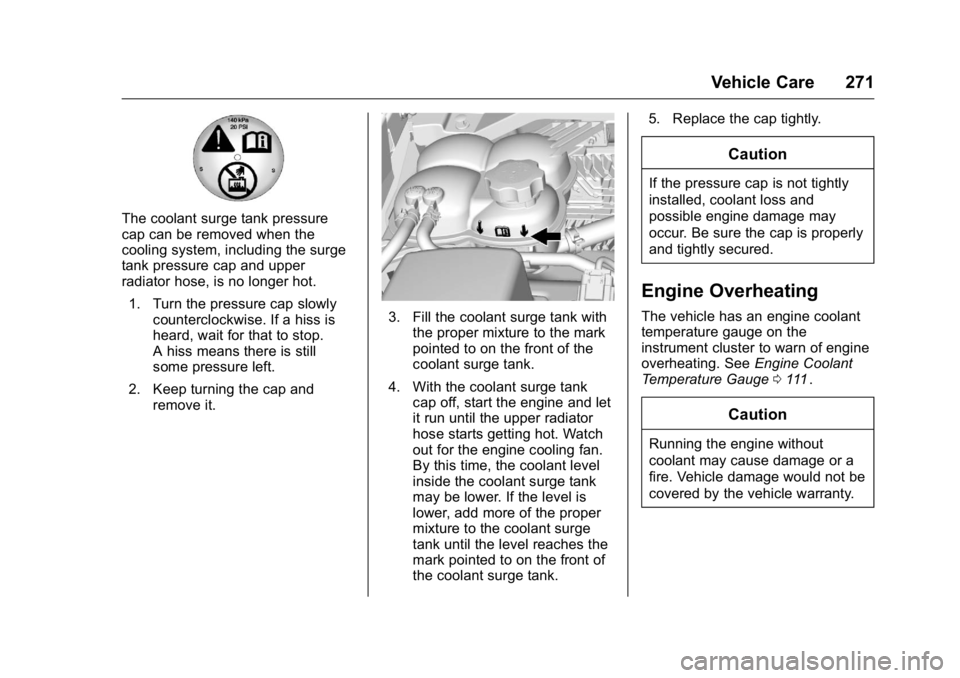
The coolant surge tank pressure
cap can be removed when the
cooling system, including the surge
tank pressure cap and upper
radiator hose, is no longer hot.1. Turn the pressure cap slowly counterclockwise. If a hiss is
heard, wait for that to stop.
A hiss means there is still
some pressure left.
2. Keep turning the cap and remove it.
3. Fill the coolant surge tank withthe proper mixture to the mark
pointed to on the front of the
coolant surge tank.
4. With the coolant surge tank cap off, start the engine and let
it run until the upper radiator
hose starts getting hot. Watch
out for the engine cooling fan.
By this time, the coolant level
inside the coolant surge tank
may be lower. If the level is
lower, add more of the proper
mixture to the coolant surge
tank until the level reaches the
mark pointed to on the front of
the coolant surge tank. 5. Replace the cap tightly.
Caution
If the pressure cap is not tightly
installed, coolant loss and
possible engine damage may
occur. Be sure the cap is properly
and tightly secured.
Engine Overheating
The vehicle has an engine coolant
temperature gauge on the
instrument cluster to warn of engine
overheating. See
Engine Coolant
Temperature Gauge 0111
ii.
Caution
Running the engine without
coolant may cause damage or a
fire. Vehicle damage would not be
covered by the vehicle warranty.
Page 291 of 392
GMC Canyon Owner Manual (GMNA-Localizing-U.S/Canada-9159361) -
2016 - crc - 8/25/15
290 Vehicle Care
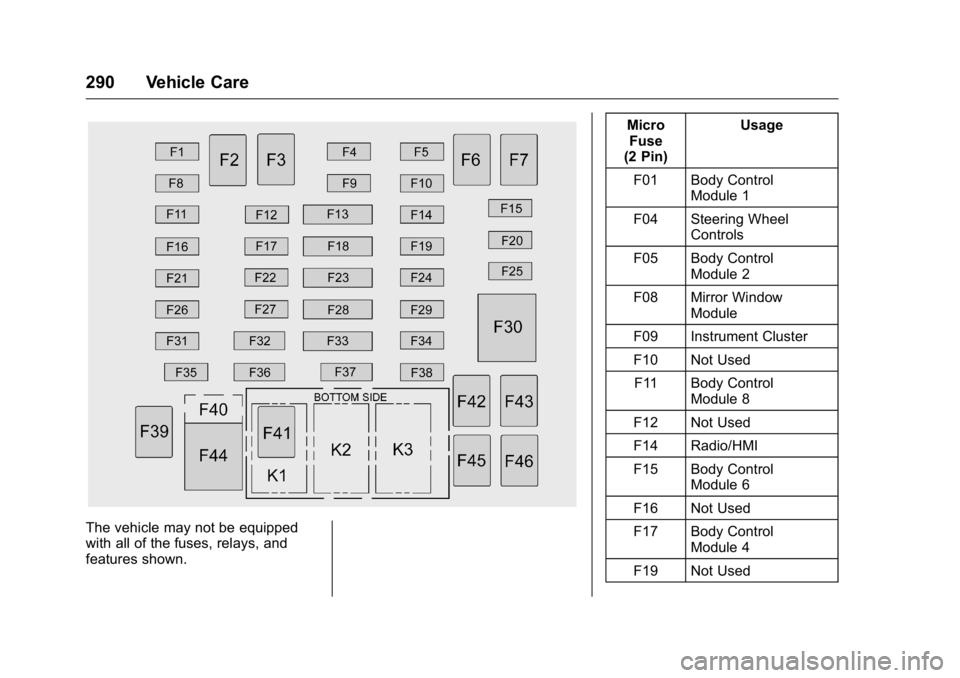
The vehicle may not be equipped
with all of the fuses, relays, and
features shown.Micro
Fuse
(2 Pin) Usage
F01 Body Control Module 1
F04 Steering Wheel Controls
F05 Body Control Module 2
F08 Mirror Window Module
F09 Instrument Cluster
F10 Not Used F11 Body Control Module 8
F12 Not Used
F14 Radio/HMI
F15 Body Control Module 6
F16 Not Used
F17 Body Control Module 4
F19 Not Used
Page 302 of 392
GMC Canyon Owner Manual (GMNA-Localizing-U.S/Canada-9159361) -
2016 - crc - 8/25/15
Vehicle Care 301
(TPMS) that illuminates a low tire
pressure telltale when one or more
of your tires is significantly
under-inflated.
Accordingly, when the low tire
pressure telltale illuminates, you
should stop and check your tires as
soon as possible, and inflate them
to the proper pressure. Driving on a
significantly under-inflated tire
causes the tire to overheat and can
lead to tire failure. Under-inflation
also reduces fuel efficiency and tire
tread life, and may affect the
vehicle's handling and stopping
ability.
Please note that the TPMS is not a
substitute for proper tire
maintenance, and it is the driver's
responsibility to maintain correct tire
pressure, even if under-inflation has
not reached the level to trigger
illumination of the TPMS low tire
pressure telltale.
Your vehicle has also been
equipped with a TPMS malfunction
indicator to indicate when the
system is not operating properly.
The TPMS malfunction indicator iscombined with the low tire pressure
telltale. When the system detects a
malfunction, the telltale will flash for
approximately one minute and then
remain continuously illuminated.
This sequence will continue upon
subsequent vehicle start-ups as
long as the malfunction exists.
When the malfunction indicator is
illuminated, the system may not be
able to detect or signal low tire
pressure as intended. TPMS
malfunctions may occur for a variety
of reasons, including the installation
of replacement or alternate tires or
wheels on the vehicle that prevent
the TPMS from functioning properly.
Always check the TPMS malfunction
telltale after replacing one or more
tires or wheels on your vehicle to
ensure that the replacement or
alternate tires and wheels allow the
TPMS to continue to function
properly.
See
Tire Pressure Monitor
Operation 0301
ii.
See Radio Frequency Statement
0 367
ii.
Tire Pressure Monitor
Operation
This vehicle may have a Tire
Pressure Monitor System (TPMS).
The TPMS is designed to warn the
driver when a low tire pressure
condition exists. TPMS sensors are
mounted onto each tire and wheel
assembly, excluding the spare tire
and wheel assembly. The TPMS
sensors monitor the air pressure in
the tires and transmit the tire
pressure readings to a receiver
located in the vehicle.
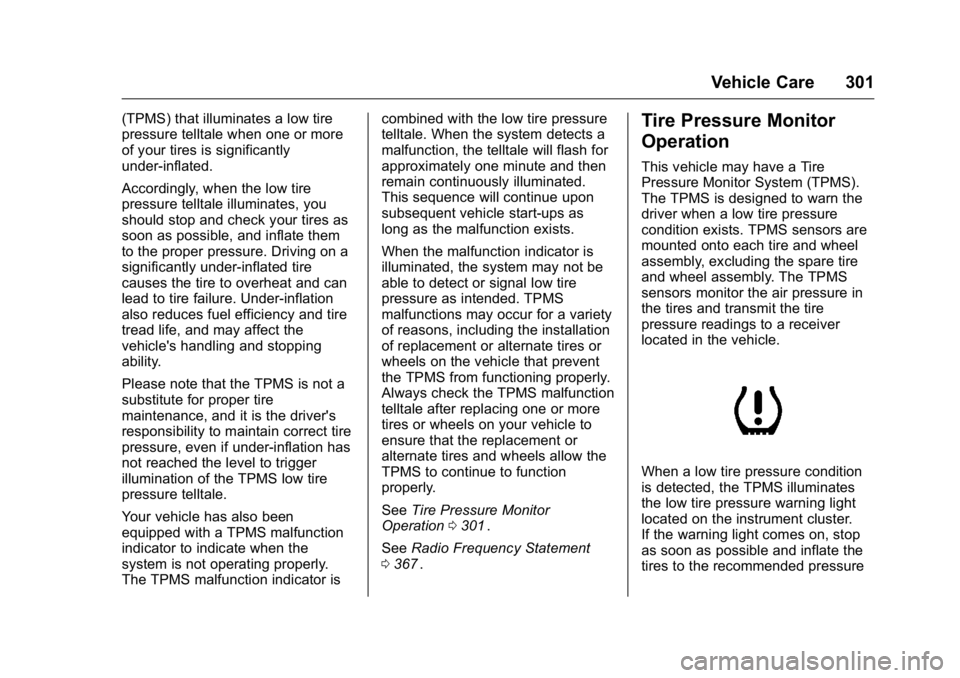
When a low tire pressure condition
is detected, the TPMS illuminates
the low tire pressure warning light
located on the instrument cluster.
If the warning light comes on, stop
as soon as possible and inflate the
tires to the recommended pressure
Page 337 of 392
GMC Canyon Owner Manual (GMNA-Localizing-U.S/Canada-9159361) -
2016 - crc - 8/25/15
336 Vehicle Care
fluid will decrease the life of the
transfer case and/or axles and
should be replaced.
Sheet Metal Damage
If the vehicle is damaged and
requires sheet metal repair or
replacement, make sure the body
repair shop applies anti-corrosion
material to parts repaired or
replaced to restore corrosion
protection.
Original manufacturer replacement
parts will provide the corrosion
protection while maintaining the
vehicle warranty.
Finish Damage
Quickly repair minor chips and
scratches with touch-up materials
available from your dealer to avoid
corrosion. Larger areas of finish
damage can be corrected in your
dealer's body and paint shop.
Chemical Paint Spotting
Airborne pollutants can fall upon
and attack painted vehicle surfaces
causing blotchy, ring-shaped
discolorations, and small, irregulardark spots etched into the paint
surface. Refer to
“Finish Care”
previously in this section.
Interior Care
To prevent dirt particle abrasions,
regularly clean the vehicle's interior.
Immediately remove any soils.
Newspapers or dark garments can
transfer color to the vehicle’s
interior.
Use a soft bristle brush to remove
dust from knobs and crevices on the
instrument cluster. Using a mild
soap solution, immediately remove
hand lotions, sunscreen, and insect
repellent from all interior surfaces or
permanent damage may result.
Use cleaners specifically designed
for the surfaces being cleaned to
prevent permanent damage. Apply
cleaners directly to the cleaning
cloth. Do not spray cleaners on any
switches or controls. Remove
cleaners quickly. Before using cleaners, read and
follow to all safety instructions on
the label. While cleaning the interior,
open the doors and windows to get
proper ventilation.
To prevent damage, do not clean
the interior using the following
cleaners or techniques:
.
Never use a razor or any other
sharp object to remove a soil
from any interior surface.
. Never use a brush with stiff
bristles.
. Never rub any surface
aggressively or with too much
pressure.
. Do not use laundry detergents or
dishwashing soaps with
degreasers. For liquid cleaners,
use approximately 20 drops per
3.8 L (1 gal) of water.
A concentrated soap solution will
create streaks and attract dirt.
Do not use solutions that contain
strong or caustic soap.
. Do not heavily saturate the
upholstery when cleaning.
Page 349 of 392
GMC Canyon Owner Manual (GMNA-Localizing-U.S/Canada-9159361) -
2016 - crc - 8/25/15
348 Service and Maintenance
.To avoid break-down or failure to
start the vehicle, maintain a
battery with full cranking power.
. Trained dealer technicians have
the diagnostic equipment to test
the battery and ensure that the
connections and cables are
corrosion-free.
Belts
. Belts may need replacing if they
squeak or show signs of
cracking or splitting.
. Trained dealer technicians have
access to tools and equipment
to inspect the belts and
recommend adjustment or
replacement when necessary.
Brakes
Brakes stop the vehicle and are
crucial to safe driving.
. Signs of brake wear may include
chirping, grinding, or squealing
noises, or difficulty stopping. .
Trained dealer technicians have
access to tools and equipment
to inspect the brakes and
recommend quality parts
engineered for the vehicle.
Fluids
Proper fluid levels and approved
fluids protect the vehicle’s systems
and components. See
Recommended Fluids and
Lubricants 0350
iifor GM approved
fluids.
. Engine oil and windshield
washer fluid levels should be
checked at every fuel fill.
. Instrument cluster lights may
come on to indicate that fluids
may be low and need to be
filled.
Hoses
Hoses transport fluids and should
be regularly inspected to ensure
that there are no cracks or leaks.
With a multi-point inspection, your
dealer can inspect the hoses and
advise if replacement is needed. Lamps
Properly working headlamps,
taillamps, and brake lamps are
important to see and be seen on
the road.
.
Signs that the headlamps need
attention include dimming, failure
to light, cracking, or damage.
The brake lamps need to be
checked periodically to ensure
that they light when braking.
. With a multi-point inspection,
your dealer can check the lamps
and note any concerns.
Shocks and Struts
Shocks and struts help aid in control
for a smoother ride.
. Signs of wear may include
steering wheel vibration, bounce/
sway while braking, longer
stopping distance, or uneven
tire wear.
. As part of the multi-point
inspection, trained dealer
technicians can visually inspect
the shocks and struts for signs
Page 384 of 392

GMC Canyon Owner Manual (GMNA-Localizing-U.S/Canada-9159361) -
2016 - crc - 8/25/15
Index 383
Check (cont'd)Malfunction Indicator
Engine Light . . . . . . . . . . . . . . . . .114
Child Restraints
Infants and Young Children . . . . . 70
Lower Anchors and Tethersfor Children . . . . . . . . . . . . . . . . . . . 75
Older Children . . . . . . . . . . . . . . . . . . 68
Securing . . . . . . . . . . . . . . . . . . . . 89, 95
Systems . . . . . . . . . . . . . . . . . . . . . . . . 72
Cleaning Exterior Care . . . . . . . . . . . . . . . . . 331
Interior Care . . . . . . . . . . . . . . . . . . 336
Climate Control Systems . . . . . . . 186
Air Conditioning . . . . . . . . . . . . . . 186
Automatic . . . . . . . . . . . . . . . . . . . . . 188
Heating . . . . . . . . . . . . . . . . . . . . . . . 186
Clock . . . . . . . . . . . . . . . . . . . . . . . . . . . 103
Cluster, Instrument . . . . . . . . 106, 108
Clutch, Hydraulic . . . . . . . . . . . . . . . 266
Collision Damage Repair . . . . . . . 364
Compact Spare Tire . . . . . . . . . . . . 322
Compartments
Storage . . . . . . . . . . . . . . . . . . . . . . . . . 98
Compass . . . . . . . . . . . . . . . . . . . . . . . 103 Messages . . . . . . . . . . . . . . . . . . . . 129
Connections OnStar
®. . . . . . . . . . . . . . . . . . . . . . 373 Control . . . . . . . . . . . . . . . . . . . . . . . . . 233
Traction and Electronic
Stability . . . . . . . . . . . . . . . . . . . . . 231
Control Light Hill Descent . . . . . . . . . . . . . . . . . . .117
Control of a Vehicle . . . . . . . . . . . . . 194
Convex Mirrors . . . . . . . . . . . . . . . . . . 36
Coolant Engine . . . . . . . . . . . . . . . . . . . . . . . . 269
Engine Temperature Gauge . . . 111
Cooling System . . . . . . . . . . . . . . . . . 268
Engine Messages . . . . . . . . . . . . 130
Courtesy Transportation Program . . . . . . . . . . . . . . . . . . . . . . . 363
Cruise Control . . . . . . . . . . . . . . . . . . 234 Light . . . . . . . . . . . . . . . . . . . . . . . . . . 121
Cupholders . . . . . . . . . . . . . . . . . . . . . . 98
Customer Assistance . . . . . . . . . . . 360 Offices . . . . . . . . . . . . . . . . . . . . . . . . 359
Text Telephone (TTY)Users . . . . . . . . . . . . . . . . . . . . . . . 360
Customer Information Service PublicationsOrdering Information . . . . . . . . 366
Customer Satisfaction
Procedure . . . . . . . . . . . . . . . . . . . . . 357
D
Damage Repair, Collision . . . . . . . 364
Danger, Warning, and Caution . . . . 2
Data Recorders, Event . . . . . . . . . 369
Daytime RunningLamps (DRL) . . . . . . . . . . . . . . . . . . 143
Defensive Driving . . . . . . . . . . . . . . . 193
Delayed Locking . . . . . . . . . . . . . . . . . 32
Diagnostics OnStar
®. . . . . . . . . . . . . . . . . . . . . . 375
Distracted Driving . . . . . . . . . . . . . . . 193
Dome Lamps . . . . . . . . . . . . . . . . . . . 147
Door Ajar Light . . . . . . . . . . . . . . . . . . . . . 121
Ajar Messages . . . . . . . . . . . . . . . 129
Delayed Locking . . . . . . . . . . . . . . . . 32
Locks . . . . . . . . . . . . . . . . . . . . . . . . . . . 31
Power Locks . . . . . . . . . . . . . . . . . . . . 32
Drive Belt Routing, Engine . . . . . . 356
Driver Information
Center (DIC) . . . . . . . . . . . . . 122, 125
Driving Characteristics andTowing Tips . . . . . . . . . . . . . . . . . 245
Defensive . . . . . . . . . . . . . . . . . . . . . 193
Drunk . . . . . . . . . . . . . . . . . . . . . . . . . 193
For Better Fuel Economy . . . . . . . 23
Hill and Mountain Roads . . . . . . 201
Page 386 of 392

GMC Canyon Owner Manual (GMNA-Localizing-U.S/Canada-9159361) -
2016 - crc - 8/25/15
Index 385
Fuel (cont'd)Filling a Portable Fuel
Container . . . . . . . . . . . . . . . . . . . 245
Filling the Tank . . . . . . . . . . . . . . . 243
Foreign Countries . . . . . . . . . . . . 243
Gauge . . . . . . . . . . . . . . . . . . . . . . . . .110
Low Fuel Warning Light . . . . . . . 120
Requirements, California . . . . . 242
System Messages . . . . . . . . . . . . 131
Full-Size Spare Tire . . . . . . . . . . . . 323
Fuses . . . . . . . . . . . . . . . . . . . . . . . . . . 285 Engine Compartment FuseBlock . . . . . . . . . . . . . . . . . . . . . . . . 285
Instrument Panel Fuse
Block . . . . . . . . . . . . . . . . . . . . . . . . 289
G
GaugesEngine Coolant
Temperature . . . . . . . . . . . . . . . . . 111
Fuel . . . . . . . . . . . . . . . . . . . . . . . . . . .110
Odometer . . . . . . . . . . . . . . . . . . . . . .110
Speedometer . . . . . . . . . . . . . . . . . .110
Tachometer . . . . . . . . . . . . . . . . . . . .110
Trip Odometer . . . . . . . . . . . . . . . . .110
Warning Lights and Indicators . . . . . . . . . . . . . . . . . . . 105
General Information
Service and Maintenance . . . . . 340 General Information (cont'd)
Towing . . . . . . . . . . . . . . . . . . . . . . . . 245
Vehicle Care . . . . . . . . . . . . . . . . . . 256
Glove Box . . . . . . . . . . . . . . . . . . . . . . . 98
GM Mobility Reimbursement
Program . . . . . . . . . . . . . . . . . . . . . . . 361
H
Halogen Bulbs . . . . . . . . . . . . . . . . . . 281
Hazard Warning Flashers . . . . . . . 145
Head Restraints . . . . . . . . . . . . . . . . . 44
HeadlampsAiming . . . . . . . . . . . . . . . . . . . . . . . . 281
Automatic . . . . . . . . . . . . . . . . . . . . . 144
Bulb Replacement . . . . . . . . . . . . 281
Daytime RunningLamps (DRL) . . . . . . . . . . . . . . . . 143
Flash-to-Pass . . . . . . . . . . . . . . . . . 143
Headlamps, Front Turn Signal, Sidemarker, and
Parking Lamps . . . . . . . . . . . . . . 282
High-Beam On Light . . . . . . . . . . 121
High/Low Beam Changer . . . . . 143
Lamps On Reminder . . . . . . . . . 121
Heated Front Seats . . . . . . . . . . . . . . 47
Heated Mirrors . . . . . . . . . . . . . . . . . . . 37
Heater Engine Coolant . . . . . . . . . . . . . . . 214 Heating and Air
Conditioning . . . . . . . . . . . . . . 186, 188
High-Beam On Light . . . . . . . . . . . . 121
Hill and Mountain Roads . . . . . . . . 201
Hill Descent Control (HDC) . . . . . 233
Hill Descent Control Light . . . . . . . 117
Hill Start Assist (HSA) . . . . . . . . . . 231
Home Page . . . . . . . . . . . . . . . . . . . . . 152
Hood . . . . . . . . . . . . . . . . . . . . . . . . . . . 258
Horn . . . . . . . . . . . . . . . . . . . . . . . . . . . . 102
How to Wear Safety Belts Properly . . . . . . . . . . . . . . . . . . . . . . . . 51
Hydraulic Clutch . . . . . . . . . . . . . . . . 266
I
Ignition Positions . . . . . . . . . . . . . . . 211
Ignition Transmission Lock Check . . . . . . . . . . . . . . . . . . . . . . . . . 279
Immobilizer . . . . . . . . . . . . . . . . . . . . . . 35
Indicator Vehicle Ahead . . . . . . . . . . . . . . . . .118
Infants and Young Children, Restraints . . . . . . . . . . . . . . . . . . . . . . 70
Infotainment . . . . . . . . . . . . . . . . . . . . 149
Infotainment System . . . . . . . . . . . . 370
Instrument Cluster . . . . . . . . . 106, 108
Interior Rearview Mirrors . . . . . . . . . 38