overheating GMC CANYON 2023 User Guide
[x] Cancel search | Manufacturer: GMC, Model Year: 2023, Model line: CANYON, Model: GMC CANYON 2023Pages: 371, PDF Size: 7.41 MB
Page 263 of 371
GMC Canyon/Canyon Denali Owner Manual (GMNA-Localizing-U.S./Canada/
Mexico-16510661) - 2023 - CRC - 11/29/22
262 Vehicle Care
Caution
If the air cleaner/filter is off, dirt can
easily get into the engine, which could
damage it. Always have the air
cleaner/filter in place when driving.
Cooling System
The cooling system allows the engine to
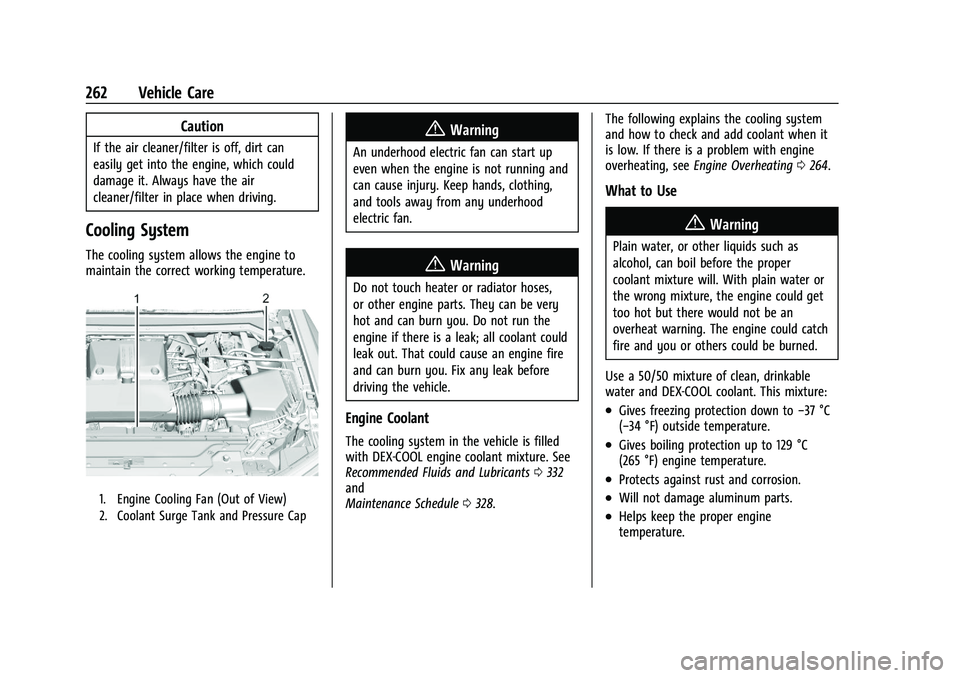
maintain the correct working temperature.
1. Engine Cooling Fan (Out of View)
2. Coolant Surge Tank and Pressure Cap
{Warning
An underhood electric fan can start up
even when the engine is not running and
can cause injury. Keep hands, clothing,
and tools away from any underhood
electric fan.
{Warning
Do not touch heater or radiator hoses,
or other engine parts. They can be very
hot and can burn you. Do not run the
engine if there is a leak; all coolant could
leak out. That could cause an engine fire
and can burn you. Fix any leak before
driving the vehicle.
Engine Coolant
The cooling system in the vehicle is filled
with DEX-COOL engine coolant mixture. See
Recommended Fluids and Lubricants0332
and
Maintenance Schedule 0328. The following explains the cooling system
and how to check and add coolant when it
is low. If there is a problem with engine
overheating, see
Engine Overheating 0264.
What to Use
{Warning
Plain water, or other liquids such as
alcohol, can boil before the proper
coolant mixture will. With plain water or
the wrong mixture, the engine could get
too hot but there would not be an
overheat warning. The engine could catch
fire and you or others could be burned.
Use a 50/50 mixture of clean, drinkable
water and DEX-COOL coolant. This mixture:
.Gives freezing protection down to −37 °C
(−34 °F) outside temperature.
.Gives boiling protection up to 129 °C
(265 °F) engine temperature.
.Protects against rust and corrosion.
.Will not damage aluminum parts.
.Helps keep the proper engine
temperature.
Page 265 of 371
GMC Canyon/Canyon Denali Owner Manual (GMNA-Localizing-U.S./Canada/
Mexico-16510661) - 2023 - CRC - 11/29/22
264 Vehicle Care
Warning (Continued)
including the pressure cap, is hot. Wait
for the cooling system and pressure cap
to cool.
Caution
Failure to follow the specific coolant fill
procedure could cause the engine to
overheat and could cause system
damage. If coolant is not visible in the
surge tank, contact your dealer.
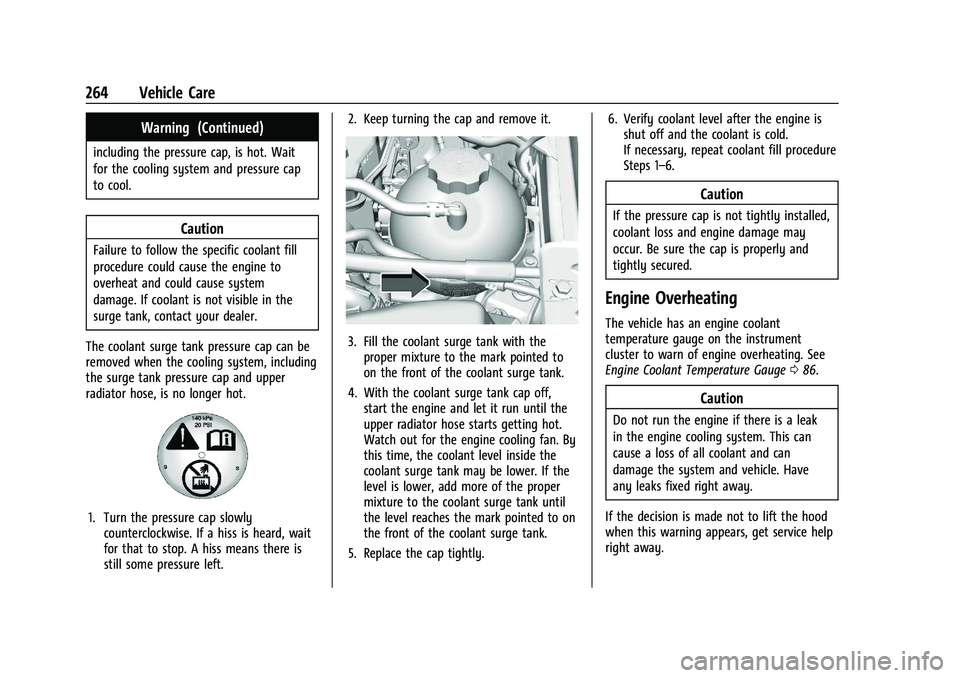
The coolant surge tank pressure cap can be
removed when the cooling system, including
the surge tank pressure cap and upper
radiator hose, is no longer hot.
1. Turn the pressure cap slowly counterclockwise. If a hiss is heard, wait
for that to stop. A hiss means there is
still some pressure left. 2. Keep turning the cap and remove it.
3. Fill the coolant surge tank with the
proper mixture to the mark pointed to
on the front of the coolant surge tank.
4. With the coolant surge tank cap off, start the engine and let it run until the
upper radiator hose starts getting hot.
Watch out for the engine cooling fan. By
this time, the coolant level inside the
coolant surge tank may be lower. If the
level is lower, add more of the proper
mixture to the coolant surge tank until
the level reaches the mark pointed to on
the front of the coolant surge tank.
5. Replace the cap tightly. 6. Verify coolant level after the engine is
shut off and the coolant is cold.
If necessary, repeat coolant fill procedure
Steps 1–6.
Caution
If the pressure cap is not tightly installed,
coolant loss and engine damage may
occur. Be sure the cap is properly and
tightly secured.
Engine Overheating
The vehicle has an engine coolant
temperature gauge on the instrument
cluster to warn of engine overheating. See
Engine Coolant Temperature Gauge 086.
Caution
Do not run the engine if there is a leak
in the engine cooling system. This can
cause a loss of all coolant and can
damage the system and vehicle. Have
any leaks fixed right away.
If the decision is made not to lift the hood
when this warning appears, get service help
right away.
Page 266 of 371
GMC Canyon/Canyon Denali Owner Manual (GMNA-Localizing-U.S./Canada/
Mexico-16510661) - 2023 - CRC - 11/29/22
Vehicle Care 265
If the decision is made to lift the hood,
make sure the vehicle is parked on a level
surface.
Then check to see if the engine cooling fan
is running. If the engine is overheating, the
fan should be running. If it is not, do not
continue to run the engine and have the
vehicle serviced.
If Steam Is Coming from the Engine
Compartment
{Warning
Steam and scalding liquids from a hot
cooling system are under pressure.
Turning the pressure cap, even a little,
can cause them to come out at high
speed and you could be burned. Never
turn the cap when the cooling system,
including the pressure cap, is hot. Wait
for the cooling system and pressure cap
to cool.
If No Steam Is Coming from the Engine
Compartment
If an engine overheat warning is displayed
but no steam can be seen or heard, the
problem may not be too serious. Sometimes
the engine can get a little too hot when the
vehicle:
.Climbs a long hill on a hot day.
.Stops after high-speed driving.
.Idles for long periods in traffic.
If the overheat warning is displayed with no
sign of steam: 1. Turn the air conditioning off.
2. Turn the heater on to the highest temperature and to the highest fan
speed. Open the windows as necessary.
3. When it is safe to do so, pull off the road, shift to P (Park) or N (Neutral), and
let the engine idle.
If the engine coolant temperature gauge is
no longer in the overheat zone, the vehicle
can be driven. Continue to drive the vehicle
slowly for about 10 minutes. Keep a safe
distance from the vehicle in front. If the
warning does not come back on, continue to
drive normally and have the cooling system
checked for proper fill and function. If the warning continues, pull over, stop, and
park the vehicle right away.
If there is no sign of steam, idle the engine
for three minutes while parked. If the
warning is still displayed, turn off the
engine until it cools down.
Engine Fan
If the vehicle has a clutched engine cooling
fan, when the clutch is engaged, the fan
spins faster to provide more air to cool the
engine. In most everyday driving conditions,
the fan is spinning slower and the clutch is
not fully engaged. This improves fuel
economy and reduces fan noise. Under
heavy vehicle loading, trailer towing, and/or
high outside temperatures, the fan speed
increases as the clutch more fully engages,
so an increase in fan noise may be heard.
This is normal and should not be mistaken
as the transmission slipping or making extra
shifts. It is merely the cooling system
functioning properly. The fan will slow down
when additional cooling is not required and
the clutch disengages.
This fan noise may also be heard when
starting the engine. It will go away as the
fan clutch partially disengages.
Page 285 of 371
GMC Canyon/Canyon Denali Owner Manual (GMNA-Localizing-U.S./Canada/
Mexico-16510661) - 2023 - CRC - 11/29/22
284 Vehicle Care
FusesUsage
F39 DRIVER POWER SEAT –
Power Seat Driver
F40 PASSENGER POWER SEAT –
Power Seat Co-Driver
F41 APO CONSOLE –Auxiliary
DC Power Outlet Row 1
F42 –
Wheels and Tires
Tires
Every new GM vehicle has high-quality
tires made by a leading tire
manufacturer. See the warranty manual
for information regarding the tire
warranty and where to get service. For
additional information refer to the tire
manufacturer.
{Warning
.Poorly maintained and improperly
used tires are dangerous.
.Overloading the tires can cause
overheating as a result of too
much flexing. There could be a
blowout and a serious crash. See
Vehicle Load Limits 0162.
.Underinflated tires pose the same
danger as overloaded tires. The
resulting crash could cause serious
injury. Check all tires frequently to
maintain the recommended
pressure. Tire pressure should be
checked when the tires are cold.
.Overinflated tires are more likely
to be cut, punctured, or broken by
a sudden impact —such as when
hitting a pothole. Keep tires at the
recommended pressure.
.Worn or old tires can cause a
crash. If the tread is badly worn,
replace them.
(Continued)
Warning (Continued)
.Replace any tires that have been
damaged by impacts with
potholes, curbs, etc.
.Improperly repaired tires can cause
a crash. Only your dealer or an
authorized tire service center
should repair, replace, dismount,
and mount the tires.
.Do not spin the tires in excess of
56 km/h (35 mph) on slippery
surfaces such as snow, mud, ice,
etc. Excessive spinning may cause
the tires to explode.
Winter Tires
This vehicle was not originally equipped
with winter tires. Winter tires are designed
for increased traction on snow and
ice-covered roads. Consider installing winter
tires on the vehicle if frequent driving on ice
or snow covered roads is expected. See your
dealer for details regarding winter tire
availability and proper tire selection. Also,
see Buying New Tires 0298.
Page 291 of 371
GMC Canyon/Canyon Denali Owner Manual (GMNA-Localizing-U.S./Canada/
Mexico-16510661) - 2023 - CRC - 11/29/22
290 Vehicle Care
molded into the sidewall of the tire.
SeeUniform Tire Quality Grading
0 300.
Vehicle Capacity Weight
:The number
of designated seating positions
multiplied by 68 kg (150 lbs) plus the
rated cargo load. See Vehicle Load
Limits 0162.
Vehicle Maximum Load on the Tire
:
Load on an individual tire due to curb
weight, accessory weight, occupant
weight, and cargo weight.
Vehicle Placard
:A label permanently
attached to a vehicle showing the
vehicle's capacity weight and the
original equipment tire size and
recommended inflation pressure. See
“Tire and Loading Information Label”
under Vehicle Load Limits 0162.
Tire Pressure
Tires need the correct amount of air
pressure to operate effectively.
{Warning
Neither tire underinflation nor
overinflation is good. Underinflated
tires, or tires that do not have
enough air, can result in:
.Tire overloading and overheating,
which could lead to a blowout
.Premature or irregular wear
.Poor handling
.Reduced fuel economy for
internal combustion engine
vehicles
.Reduced range for electric vehicles
Overinflated tires, or tires that have
too much air, can result in:
.Unusual wear
.Poor handling
.Rough ride
.Needless damage from road
hazards The Tire and Loading Information label
on the vehicle indicates the original
equipment tires and the correct cold
tire inflation pressures. The
recommended pressure is the minimum
air pressure needed to support the
vehicle's maximum load carrying
capacity.
For additional information regarding
how much weight the vehicle can carry,
and an example of the Tire and Loading
Information label, see
Vehicle Load
Limits 0162. How the vehicle is loaded
affects vehicle handling and ride
comfort. Never load the vehicle with
more weight than it was designed to
carry.
When to Check
Check the pressure of the tires once a
month or more.
Do not forget the spare, if the vehicle
has one. See Full-Size Spare Tire 0311
for additional information.
Page 296 of 371
GMC Canyon/Canyon Denali Owner Manual (GMNA-Localizing-U.S./Canada/
Mexico-16510661) - 2023 - CRC - 11/29/22
Vehicle Care 295
Repeat Step 7 until all tires have been
deflated. Same steps can be followed for
inflating all tires to target pressure.
While in Air Down Mode, after all tires have
been deflated lower than the vehicle’s
recommended tire pressure, the low tire
pressure warning light and the DIC warning
message may come on for all tires.
Due to late air adjustment in a tire, the tire
pressure may change by 4 to 8 kpa (0.6 to
1.2 psi) after a few minutes, once you have
stopped deflation.
Ensure that the target pressure you select is
above or below your vehicle’s current tire
pressures by a least 20 kpa (3 psi).
If the tire is underinflated or overinflated by
more than 35 kPa (5 psi) from the target
pressure you selected in Step 6, the horn
will sound multiple times and the turn
signal lamp will continue to flash for several
seconds after tire pressure adjustment stops.
To correct the pressure, while the turn
signal lamp is still flashing, add air to inflate
the tire or briefly press the center of the
valve stem to deflate the tire. When the
target pressure you selected in Step 6 is
reached, the horn sounds once and the turn
signal lamp will stop flashing and turn solid
for several seconds before turning off. If the turn signal lamp does not flash within
15 seconds after starting to inflate the tire,
the Air Down Mode has not been activated
or is not working.
If the hazard warning flashers are on, the
Air Down Mode visual feedback will not
work properly.
The Air Down Mode will not work properly
under the following conditions:
.There is interference from an external
device or transmitter.
.The air pressure from the inflation device
is not sufficient to inflate the tire.
.There is a malfunction in the TPMS.
.There is a malfunction in the horn or turn
signal lamps.
.The TPMS sensor identification code is not
registered to the system.
.The TPMS sensor battery is low.
.The vehicle is not in P (Park).
.The vehicle is off.
.START was not pressed after selecting the
target tire pressure in the Air Down
Mode app.
If the Air Down Mode does not operate due
to TPMS interference, move the vehicle
about 1 m (3 ft) back or forward and try again. If the Air Down Mode is not working,
use a tire pressure gauge to confirm tire
pressure.
{Warning
Neither tire underinflation nor
overinflation is good. Underinflated
tires, or tires that do not have
enough air, can result in:
.Tire overloading and overheating,
which could lead to a blowout
.Premature or irregular wear
.Poor handling
.Reduced fuel economy for
internal combustion engine
vehicles
.Reduced range for electric vehicles
Overinflated tires, or tires that have
too much air, can result in:
.Unusual wear
.Poor handling
.Rough ride
.Needless damage from road
hazards
Page 362 of 371
GMC Canyon/Canyon Denali Owner Manual (GMNA-Localizing-U.S./Cana-
da/Mexico-16510661) - 2023 - CRC - 11/29/22
Index 361
DoorAjar Light . . . . . . . . . . . . . . . . . . . . . . . . . . . . . . . 98
Delayed Locking . . . . . . . . . . . . . . . . . . . . . . . . 14
Locks . . . . . . . . . . . . . . . . . . . . . . . . . . . . . . . . . . . . 13
Power Locks . . . . . . . . . . . . . . . . . . . . . . . . . . . . 14
Drive Belt Routing, Engine . . . . . . . . . . . . . . . 337
Drive Systems Four-Wheel Drive . . . . . . . . . . . . . . . . . . . . . . 270
Driver Assistance Systems . . . . . . . . . . . . . . . . . . . . 206
Information Center (DIC) . . . . . . . . . . . 98, 100
Mode Control . . . . . . . . . . . . . . . . . . . . . . . . . . 187
Mode Control Light . . . . . . . . . . . . . . . . . . . . . 95
Teen . . . . . . . . . . . . . . . . . . . . . . . . . . . . . . . . . . . . 137
Driving Assistance Systems . . . . . . . . . . . . . . . . . . . . 215
Better Fuel Economy . . . . . . . . . . . . . . . . . . . 150
Characteristics and Towing Tips . . . . . . . . 227
Defensive . . . . . . . . . . . . . . . . . . . . . . . . . . . . . . . 151
Distracted . . . . . . . . . . . . . . . . . . . . . . . . . . . . . 150
Hill and Mountain Roads . . . . . . . . . . . . . . 159
If the Vehicle is Stuck . . . . . . . . . . . . . . . . . . 161
Impaired . . . . . . . . . . . . . . . . . . . . . . . . . . . . . . . . 151
Loss of Control . . . . . . . . . . . . . . . . . . . . . . . . 153
Off-Road . . . . . . . . . . . . . . . . . . . . . . . . . . . . . . . 153
Off-Road Recovery . . . . . . . . . . . . . . . . . . . . . 152
Vehicle Load Limits . . . . . . . . . . . . . . . . . . . . 162
Wet Roads . . . . . . . . . . . . . . . . . . . . . . . . . . . . . 159 Driving (cont'd)
Winter . . . . . . . . . . . . . . . . . . . . . . . . . . . . . . . . . 160
Dual Automatic Climate Control System . . . . 144
E
ElectricParking Brake . . . . . . . . . . . . . . . . . . . . . . . . . . 183
Parking Brake Light . . . . . . . . . . . . . . . . . . . . . 91
Electrical Equipment, Add-On . . . . . . . . . . . . . . . . . . . . 251
System Overload . . . . . . . . . . . . . . . . . . . . . . 276
Electrical System Engine Compartment Fuse Block . . . . . . . 277
Fuses and Circuit Breakers . . . . . . . . . . . . . 277
Instrument Panel Fuse Block . . . . . . . . . . . 281
Electronic Stability Control (ESC) Off
Light . . . . . . . . . . . . . . . . . . . . . . . . . . . . . . . . . . . . 95
Emergency OnStar . . . . . . . . . . . . . . . . . . . . . . . . . . . . . . . . . 351
Engine Air Cleaner/Filter . . . . . . . . . . . . . . . . . . . . . . 261
Air Filter Life System . . . . . . . . . . . . . . . . . . 260
Check Light (Malfunction Indicator) . . . . . 89
Compartment Overview . . . . . . . . . . . . . . . . 256
Coolant Temperature Gauge . . . . . . . . . . . . 86
Coolant Temperature Warning Light . . . . 95
Cooling System . . . . . . . . . . . . . . . . . . . . . . . . 262 Engine (cont'd)
Drive Belt Routing . . . . . . . . . . . . . . . . . . . . . 337
Exhaust . . . . . . . . . . . . . . . . . . . . . . . . . . . . . . . . 174
Fan . . . . . . . . . . . . . . . . . . . . . . . . . . . . . . . . . . . . 265
Heater . . . . . . . . . . . . . . . . . . . . . . . . . . . . . . . . . 170
Oil Life System . . . . . . . . . . . . . . . . . . . . . . . . 259
Oil Pressure Gauge . . . . . . . . . . . . . . . . . . . . . 84
Oil Pressure Light . . . . . . . . . . . . . . . . . . . . . . . 96
Oil Temperature Gauge . . . . . . . . . . . . . . . . . 85
Overheating . . . . . . . . . . . . . . . . . . . . . . . . . . . 264
Power Messages . . . . . . . . . . . . . . . . . . . . . . . 108
Running While Parked . . . . . . . . . . . . . . . . . 174
Starting . . . . . . . . . . . . . . . . . . . . . . . . . . . . . . . . 169
Entry Lighting . . . . . . . . . . . . . . . . . . . . . . . . . . . . 114
Equipment, Towing . . . . . . . . . . . . . . . . . . . . . . 236
Event Data Recorders . . . . . . . . . . . . . . . . . . . . 348
Exit Lighting . . . . . . . . . . . . . . . . . . . . . . . . . . . . . . 114
Extended Parking . . . . . . . . . . . . . . . . . . . . . . . . .174
Extender, Seat Belt . . . . . . . . . . . . . . . . . . . . . . . 39
Exterior Cargo Lamps . . . . . . . . . . . . . . . . . . . . . . . . . . . . 113
Lamp Controls . . . . . . . . . . . . . . . . . . . . . . . . . 109
Lamps Off Reminder . . . . . . . . . . . . . . . . . . . 110
Lighting Battery Saver . . . . . . . . . . . . . . . . . . 115
Page 366 of 371
GMC Canyon/Canyon Denali Owner Manual (GMNA-Localizing-U.S./Cana-
da/Mexico-16510661) - 2023 - CRC - 11/29/22
Index 365
Multi-band Antenna . . . . . . . . . . . . . . . . . . . . . . 123
Multi-Point Vehicle Inspection (MPVI) . . . . 330
N
NavigationConnected Services . . . . . . . . . . . . . . . . . . . . 355
Destination . . . . . . . . . . . . . . . . . . . . . . . . . . . . 125
Symbols . . . . . . . . . . . . . . . . . . . . . . . . . . . . . . . 125
Using the System . . . . . . . . . . . . . . . . . . . . . . 124
New Vehicle Break-In . . . . . . . . . . . . . . . . . . . . 167
O
Odometer . . . . . . . . . . . . . . . . . . . . . . . . . . . . . . . . 82 Trip . . . . . . . . . . . . . . . . . . . . . . . . . . . . . . . . . . . . . 82
Off-Road App . . . . . . . . . . . . . . . . . . . . . . . . . . . . . . . . . . . . 158
Driving . . . . . . . . . . . . . . . . . . . . . . . . . . . . . . . . 153
Lamps . . . . . . . . . . . . . . . . . . . . . . . . . . . . . . . . . . 112
Recovery . . . . . . . . . . . . . . . . . . . . . . . . . . . . . . . 152
Oil Engine . . . . . . . . . . . . . . . . . . . . . . . . . . . . . . . . . 257
Engine Oil Life System . . . . . . . . . . . . . . . . . 259
Engine Oil Pressure Gauge . . . . . . . . . . . . . . 84
Pressure Light . . . . . . . . . . . . . . . . . . . . . . . . . . 96
Older Children, Restraints . . . . . . . . . . . . . . . . . . 51
Online Account . . . . . . . . . . . . . . . . . . . . . . . . . . 340
OnStar . . . . . . . . . . . . . . . . . . . . . . . . . . . . . . . . . . . 349 Additional Information . . . . . . . . . . . . . . . . . 352
Overview . . . . . . . . . . . . . . . . . . . . . . . . . . . . . . 350 OnStar Emergency . . . . . . . . . . . . . . . . . . . . . . . . 351
OnStar Security . . . . . . . . . . . . . . . . . . . . . . . . . . . 351
Outlets
Power . . . . . . . . . . . . . . . . . . . . . . . . . . . . . . . . . . 75
Overheating, Engine . . . . . . . . . . . . . . . . . . . . . 264
Overview . . . . . . . . . . . . . . . . . . . . . . . . . . . . . . . . . 117 Instrument Panel . . . . . . . . . . . . . . . . . . . . . . . . 4
P
Park
Assist . . . . . . . . . . . . . . . . . . . . . . . . . . . . . 208, 213
Shifting Into . . . . . . . . . . . . . . . . . . . . . . . . . . . . 172
Shifting Out of . . . . . . . . . . . . . . . . . . . . . . . . . 173
Parking Brake and P (Park) MechanismCheck . . . . . . . . . . . . . . . . . . . . . . . . . . . . . . . . . 271
Extended . . . . . . . . . . . . . . . . . . . . . . . . . . . . . . 174
Over Things That Burn . . . . . . . . . . . . . . . . . . 173
Parking or Backing Assistance Systems . . . . . . . . . . . . . . . . . . . . 208
Passenger
Airbag Status Indicator . . . . . . . . . . . . . . . . . 88
Compartment Air Filter . . . . . . . . . . . . . . . . 148
Sensing System . . . . . . . . . . . . . . . . . . . . . . . . . 45
Pedestrian Ahead Indicator . . . . . . . . . . . . . . . 94
Perchlorate Materials Requirements, California . . . . . . . . . . . . . . . . . . . . . . . . . . . . . . 253 Phone
Apple CarPlay and Android Auto . . . . . . . 133
Bluetooth . . . . . . . . . . . . . . . . . . . . . . . . . . 129, 130
Port USB . . . . . . . . . . . . . . . . . . . . . . . . . . . . . . . . . . . . 123
Positioning Vehicle . . . . . . . . . . . . . . . . . . . . . . . . . . . . . . . . 126
Power Door Locks . . . . . . . . . . . . . . . . . . . . . . . . . . . . . . 14
Mirrors . . . . . . . . . . . . . . . . . . . . . . . . . . . . . . . . . 19
Outlets . . . . . . . . . . . . . . . . . . . . . . . . . . . . . . . . . 75
Protection, Battery . . . . . . . . . . . . . . . . . . . . . . 115
Retained Accessory (RAP) . . . . . . . . . . . . . . . 172
Seat Adjustment . . . . . . . . . . . . . . . . . . . . . . . . 26
Windows . . . . . . . . . . . . . . . . . . . . . . . . . . . . . . . . 21
Pregnancy, Using Seat Belts . . . . . . . . . . . . . . 39
Privacy
Vehicle Data Recording . . . . . . . . . . . . . . . . 347
Problems with Route Guidance . . . . . . . . . . . 127
Program Courtesy Transportation . . . . . . . . . . . . . . . 343
Prohibited Fuels . . . . . . . . . . . . . . . . . . . . . . . . . 225
Proposition 65 Warning California . . . . . . . . . . . . . . . . . . . . . . . . . . . . . . . . . 1
Proposition 65 Warning, California . . . . . . . . 312
Publication Ordering Information . . . . . . . . 345