towing GMC ENVOY 2003 Owner's Guide
[x] Cancel search | Manufacturer: GMC, Model Year: 2003, Model line: ENVOY, Model: GMC ENVOY 2003Pages: 442, PDF Size: 3.1 MB
Page 287 of 442

{CAUTION:
It can be dangerous to get out of your vehicle
if the shift lever is not fully in PARK (P) with
the parking brake ®rmly set. Your vehicle
can roll.
If you have left the engine running, the vehicle
can move suddenly. You or others could be
injured. To be sure your vehicle won't move,
even when you're on fairly level ground, use
the steps that follow.
Always put the shift lever fully in PARK (P)
with the parking brake ®rmly set.
If the transfer case on four-wheel drive
vehicles is in NEUTRAL, your vehicle will be
free to roll, even if your shift lever is in
PARK (P). So, be sure the transfer case is in a
drive gear Ð not in NEUTRAL.
See ªFour-Wheel Drive (Automatic Transfer
Case)º in the Index.
When You Are Ready to Leave After
Parking on a Hill
1. Apply your regular brakes and hold the pedal down
while you:
·start your engine,
·shift into a gear, and
·release the parking brake.
2. Let up on the brake pedal.
3. Drive slowly until the trailer is clear of the chocks.
4. Stop and have someone pick up and store the
chocks.
Maintenance When Trailer Towing
Your vehicle will need service more often when you're
pulling a trailer. See the Maintenance Schedule for more
on this. Things that are especially important in trailer
operation are automatic transmission ¯uid (don't over®ll),
engine oil, axle lubricant, belt(s), cooling system and
brake system. Each of these is covered in this manual,
and the Index will help you ®nd them quickly. If
you're trailering, it's a good idea to review these sections
before you start your trip.
Check periodically to see that all hitch nuts and bolts
are tight.
4-59
Page 288 of 442

Trailer Wiring Harness
Your vehicle may be equipped with the seven-wire
trailer towing harness. This harness has a seven-pin
universal heavy-duty trailer connector that is attached to
a bracket on the hitch platform.The seven-wire harness contains the following trailer
circuits:
·Yellow: Left Stop/Turn Signal
·Dark Green: Right Stop/Turn Signal
·Brown: Running Lamps
·White: Ground
·Light Green: Back-up Lamps
·Red: Battery Feed
·Dark Blue: Electric Brakes
If you need to tow a light-duty trailer with a standard
four-way round pin connector, an adapter connector is
available from your dealer.
Your vehicle may also be equipped with wiring for an
electric trailer brake controller. These wires are located
inside the vehicle on the driver's side under the
instrument panel. These wires should be connected to
an electric trailer brake controller by your dealer or
a quali®ed service center.
4-60
Page 309 of 442

To inspect or replace the ®lter and reset the indicator (if
equipped), do the following:
1. Remove the screws on the engine cleaner/®lter and
lift off the cover.
2. Remove the air cleaner/®lter from the housing. Care
should be taken to dislodge as little dirt as possible.
3. Install the new engine air cleaner/®lter.
4. Reinstall the cover and tighten the screws.
{CAUTION:
Operating the engine with the air cleaner/®lter
off can cause you or others to be burned. The
air cleaner not only cleans the air, it helps to
stop ¯ame if the engine back®res. If it isn't there
and the engine back®res, you could be burned.
Don't drive with it off, and be careful working on
the engine with the air cleaner/®lter off.
Notice:If the air cleaner/®lter is off, a back®re can
cause a damaging engine ®re. And, dirt can
easily get into your engine, which will damage it.
Always have the air cleaner/®lter in place when
you're driving.
Automatic Transmission Fluid
When to Check and Change
A good time to check your automatic transmission ¯uid
level is when the engine oil is changed.
Change both the ¯uid and ®lter every 50,000 miles
(83 000 km) if the vehicle is mainly driven under one or
more of these conditions:
·In heavy city traffic where the outside temperature
regularly reaches 90ÉF (32ÉC) or higher.
·In hilly or mountainous terrain.
·When doing frequent trailer towing.
·Uses such as found in taxi, police or delivery
service.
If you do not use your vehicle under any of these
conditions, change the ¯uid and ®lter every
100,000 miles (166 000 km).
5-21
Page 323 of 442

6. Start the engine and let it run until you can feel the
upper radiator hose getting hot. Watch out for the
engine cooling fan.
7. By this time, the coolant level inside the radiator
®ller neck may be lower. If the level is lower, add
more of the proper DEX-COOL
žcoolant mixture
through the ®ller neck until the level reaches
the base of the ®ller neck.
8. Then replace the pressure cap. At any time during
this procedure if coolant begins to ¯ow out of the
®ller neck, reinstall the pressure cap. Be sure
the pressure cap is hand-tight.
Engine Fan Noise
This vehicle has a clutched engine cooling fan. When
the clutch is engaged, the fan spins faster to provide
more air to cool the engine. In most everyday driving
conditions the clutch is not engaged. This improves fuel
economy and reduces fan noise. Under heavy vehicle
loading, trailer towing, and/or high outside temperatures,
the fan speed increases when the clutch engages. So
you may hear an increase in fan noise. This is
normal and should not be mistaken as the transmission
slipping or making extra shifts. It is merely the cooling
system functioning properly. The fan will slow down
when additional cooling is not required and the clutch
disengages.
You may also hear this fan noise when you start the
engine. It will go away as the fan clutch disengages.
5-35
Page 355 of 442
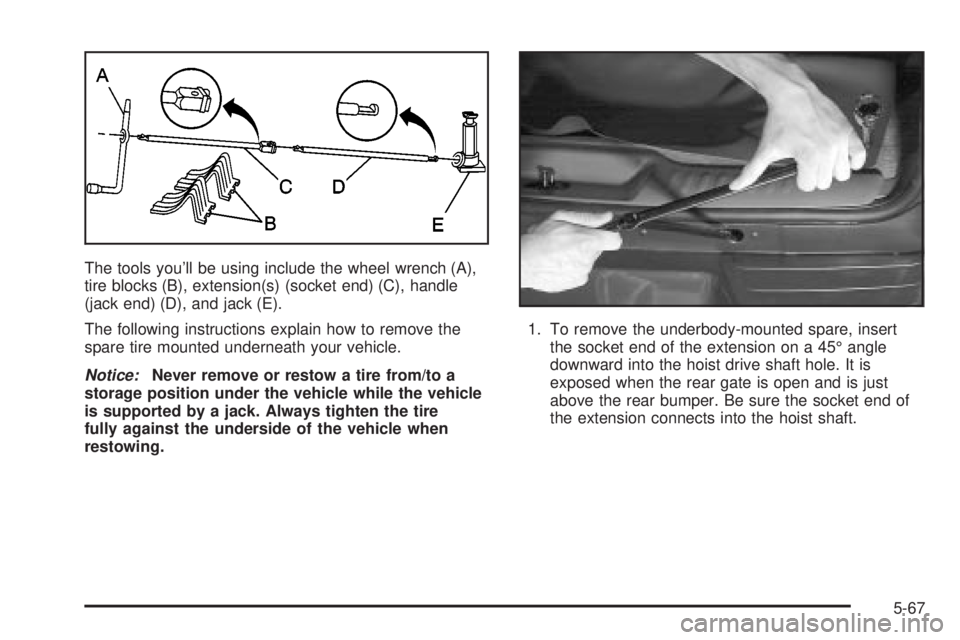
The tools you'll be using include the wheel wrench (A),
tire blocks (B), extension(s) (socket end) (C), handle
(jack end) (D), and jack (E).
The following instructions explain how to remove the
spare tire mounted underneath your vehicle.
Notice:Never remove or restow a tire from/to a
storage position under the vehicle while the vehicle
is supported by a jack. Always tighten the tire
fully against the underside of the vehicle when
restowing.1. To remove the underbody-mounted spare, insert
the socket end of the extension on a 45É angle
downward into the hoist drive shaft hole. It is
exposed when the rear gate is open and is just
above the rear bumper. Be sure the socket end of
the extension connects into the hoist shaft.
5-67
Page 400 of 442

50,000 Miles (83 000 km)
qChange automatic transmission ¯uid and ®lter if the
vehicle is mainly driven under one or more of these
conditions:
þ In heavy city traffic where the outside
temperature regularly reaches 90ÉF (32ÉC) or
higher.
þ In hilly or mountainous terrain.
þ When doing frequent trailer towing.
þ Uses such as found in taxi, police or delivery
service.
If you do not use your vehicle under any of these
conditions, change the ¯uid and ®lter at 100,000 miles
(166 000 km).
qAutomatic Transfer Case Only: Change transfer case
¯uid.
52,500 Miles (87 500 km)
qCheck rear/front axle ¯uid level and add ¯uid as
needed. Check constant velocity joints and axle seals
for leaking.
qRotate tires. See
Tire Inspection and Rotation on
page 5-55for proper rotation pattern and additional
information.(See footnote +.)
60,000 Miles (100 000 km)
qCheck rear/front axle ¯uid level and add ¯uid as
needed. Check constant velocity joints and axle seals
for leaking.
qRotate tires. See
Tire Inspection and Rotation on
page 5-55for proper rotation pattern and additional
information.(See footnote +.)
qReplace fuel ®lter.An Emission Control Service. (See
footnote ².)
qReplace engine air cleaner ®lter on vehicles without
a restriction indicator. If equipped with a change
indicator, inspect the indicator. If necessary, replace
the ®lter. If vehicle is driven in dusty/dirty conditions,
inspect the change indicator (if equipped) at every
engine oil change. See
Engine Air Cleaner/Filter on
page 5-20for more information.An Emission
Control Service. (See footnote ².)
67,500 Miles (112 500 km)
qCheck rear/front axle ¯uid level and add ¯uid as
needed. Check constant velocity joints and axle seals
for leaking.
qRotate tires. See
Tire Inspection and Rotation on
page 5-55for proper rotation pattern and additional
information.(See footnote +.)
6-8
Page 402 of 442
100,000 Miles (166 000 km)
qV8 Engine Only: Inspect spark plug wires.An
Emission Control Service.
qReplace spark plugs.An Emission Control Service.
qChange automatic transmission ¯uid and ®lter if
the vehicle is mainly driven under one or more
of these conditions:
þ In heavy city traffic where the outside
temperature regularly reaches 90ÉF (32ÉC) or
higher.
þ In hilly or mountainous terrain.
þ When doing frequent trailer towing.
þ Uses such as found in taxi, police or delivery
service.
qIf you haven't used your vehicle under severe service
conditions listed previously and, therefore, haven't
changed your automatic transmission ¯uid, change
both the ¯uid and ®lter
qAutomatic Transfer Case Only: Change transfer case
¯uid.
qV8 Engine Only: Inspect Positive Crankcase
Ventilation (PCV) valve.
An Emission Control Service.
150,000 Miles (240 000 km)
qDrain, ¯ush and re®ll cooling system (or every
60 months since last service, whichever occurs ®rst).
See
Engine Coolant on page 5-24for what to use.
Inspect hoses. Clean radiator, condenser, pressure
cap and neck. Pressure test the cooling system
and pressure cap.
An Emission Control Service.
qInspect engine accessory drive belt.An Emission
Control Service.
6-10
Page 419 of 442
GM Mobility Program for Persons
with Disabilities
This program, available to
quali®ed applicants, can
reimburse you up to
$1,000 toward aftermarket
driver or passenger
adaptive equipment you
may require for your
vehicle (hand controls,
wheelchair/scooter
lifts, etc.).
This program can also provide you with free resource
information, such as area driver assessment centers and
mobility equipment installers. The program is available
for a limited period of time from the date of vehicle
purchase/lease. See your dealer for more details or call
the GM Mobility Assistance Center at 1-800-323-9935.
Text telephone (TTY) users, call 1-800-833-9935.
GM of Canada also has a Mobility Program. Call
1-800-GM-DRIVE (463-7483) for details. All TTY users
call 1-800-263-3830.
Roadside Assistance Program
GMC's Roadside Assistance Provides stranded owners
with over-the-phone roadside repairs, location of the
nearest GMC dealer or the following special services:
Flat Tire Change:Installation of spare tire will be
covered at no charge (customer is responsible for repair
or replacement of tire).
Fuel Delivery:Delivery of enough fuel for the customer
to get to the nearest service station (up to $5.00)
will be covered.
Jump Start:No-start situations which require a battery
jump start will be covered at no charge.
Lock Out:Replacement keys or locksmith service will be
covered at no charge if you are unable to gain entry
into your vehicle. Delivery of the replacement key will be
covered within 10 miles (16 km).
Emergency Towing Service:Towing to the nearest GMC
dealer for warranty related disablements will be
covered.
7-5
Page 430 of 442
Convenience Net............................................2-49
Coolant.........................................................3-41
Engine Temperature Gage............................3-41
Heater, Engine............................................2-22
Cooling System..............................................5-29
Cruise Control Light........................................3-47
Cruise Control................................................3-12
Current and Past Model Order Forms................7-11
Customer Assistance Information........................ 7-7
Courtesy Transportation.................................. 7-7
Customer Assistance for Text Telephone
(TTY) Users.............................................. 7-4
Customer Assistance Offices........................... 7-4
Customer Satisfaction Procedure..................... 7-2
GM Mobility Program for Persons with
Disabilities................................................ 7-5
Reporting Safety Defects to General Motors....7-10
Reporting Safety Defects to the Canadian
Government.............................................. 7-9
Reporting Safety Defects to the United
States Government.................................... 7-9
Roadside Assistance Program......................... 7-5
Service Publications Ordering Information........7-10
D
Daytime Running Lamps (DRL).........................3-16
Defensive Driving............................................. 4-2
Defogging and Defrosting.........................3-22, 3-27Delayed Locking............................................... 2-9
Dinghy Towing................................................4-46
Doing Your Own Service Work........................... 5-3
Dome Lamp Override......................................3-18
Dome Lamps.................................................3-19
Door............................................................... 2-9
Delayed Locking........................................... 2-9
Locks.......................................................... 2-8
Power Door Locks......................................... 2-9
Programmable Automatic Door Locks.............2-10
Rear Door Security Locks.............................2-12
DRIVER DOOR AJAR.....................................3-62
Driver Information Center (DIC).........................3-50
DIC Operation and Displays..........................3-51
DIC Warnings and Messages........................3-60
Driver............................................................1-14
Position, Safety Belt.....................................1-14
Driving Across an Incline..................................4-24
Driving Downhill..............................................4-23
Driving in Mud, Sand, Snow or Ice....................4-26
Driving in Water..............................................4-27
Driving On Grades..........................................4-58
Driving on Off-Road Hills.................................4-19
Driving on Snow or Ice....................................4-40
Driving Through Deep Standing Water...............4-31
Driving Through Flowing Water.........................4-32
Driving Uphill..................................................4-20
Driving with a Trailer.......................................4-56
Driving..........................................................4-28
At Night.....................................................4-28
4
Page 435 of 442

Light (cont.)
Reduced Engine Power................................3-47
Safety Belt Reminder...................................3-37
Security.....................................................3-46
Service Four-Wheel-Drive Warning Light.........3-48
Loading Your Vehicle for Off-Road Driving..........4-16
Loading Your Vehicle.......................................4-47
Locking Rear Axle...........................................4-10
Lockout Protection..........................................2-12
Locks............................................................. 2-9
Delayed Locking........................................... 2-9
Door........................................................... 2-8
Leaving Your Vehicle....................................2-12
Lockout Protection.......................................2-12
Power Door.................................................. 2-9
Programmable Automatic Door Locks.............2-10
Rear Door Security Locks.............................2-12
Loss of Control...............................................4-14
Low Fuel Warning Light...................................3-50
Luggage Carrier..............................................2-48
Lumbar........................................................... 1-2
Power Controls............................................. 1-2
M
Maintenance, Normal Replacement Parts..........5-104
Maintenance Schedule.....................................6-11
At Each Fuel Fill.........................................6-11
At Least Once a Month................................6-11Maintenance Schedule (cont.)
At Least Once a Year..................................6-13
At Least Twice a Year..................................6-12
Brake System Inspection..............................6-17
Engine Cooling System Inspection.................6-17
Exhaust System Inspection...........................6-16
Fuel System Inspection................................6-16
How This Section is Organized....................... 6-3
Introduction.................................................. 6-2
Maintenance Requirements............................. 6-2
Part A - Scheduled Maintenance Services......... 6-4
Part B - Owner Checks and Services.............6-11
Part C - Periodic MaintenanceInspections......6-16
Part D - Recommended Fluids and
Lubricants...............................................6-18
Part E - Maintenance Record........................6-20
Scheduled Maintenance................................. 6-5
Steering, Suspension and Front Drive Axle
Boot and Seal Inspection..........................6-16
Transfer Case and Front Axle (Four-Wheel
Drive) Inspection......................................6-17
Using Your................................................... 6-4
Your Vehicle and the Environment................... 6-2
Maintenance When Trailer Towing.....................4-59
Making Turns.................................................4-57
Malfunction Indicator Light................................3-42
Matching Transmitter(s) to Your Vehicle............... 2-6
Memory Seat.................................................2-51
9