mirror GMC ENVOY 2005 Owner's Guide
[x] Cancel search | Manufacturer: GMC, Model Year: 2005, Model line: ENVOY, Model: GMC ENVOY 2005Pages: 502, PDF Size: 2.77 MB
Page 290 of 502
If you have the Traction Assist System, remember: It
helps avoid only the acceleration skid. If you do not have
this system, or if the system is off, then an acceleration
skid is also best handled by easing your foot off the
accelerator pedal.
If your vehicle starts to slide, ease your foot off the
accelerator pedal and quickly steer the way you want
the vehicle to go. If you start steering quickly enough,
your vehicle may straighten out. Always be ready
for a second skid if it occurs.
Of course, traction is reduced when water, snow, ice,
gravel, or other material is on the road. For safety, you
will want to slow down and adjust your driving to
these conditions. It is important to slow down on slippery
surfaces because stopping distance will be longer and
vehicle control more limited.
While driving on a surface with reduced traction, try
your best to avoid sudden steering, acceleration,
or braking, including engine braking by shifting to a
lower gear. Any sudden changes could cause the tires
to slide. You may not realize the surface is slippery
until your vehicle is skidding. Learn to recognize warning
clues — such as enough water, ice, or packed snow
on the road to make a mirrored surface — and
slow down when you have any doubt.
Remember: Any anti-lock brake system (ABS) helps
avoid only the braking skid.Off-Road Driving with Your
Four-Wheel-Drive Vehicle
This off-road guide is for vehicles that have four-wheel
drive. Also, seeBraking on page 4-6. If your vehicle
does not have four-wheel drive, you should not
drive off-road unless you are on a level, solid surface.
Off-road driving can be great fun. But it does have some
denite hazards. The greatest of these is the terrain itself.
“Off-roading” means you have left the great North
American road system behind. Traffic lanes are not
marked. Curves are not banked. There are no
road signs. Surfaces can be slippery, rough, uphill or
downhill. In short, you have gone right back to nature.
Off-road driving involves some new skills. And that is why
it is very important that you read this guide. You will nd
many driving tips and suggestions. These will help make
your off-road driving safer and more enjoyable.
4-16
Page 309 of 502
Freeway Driving
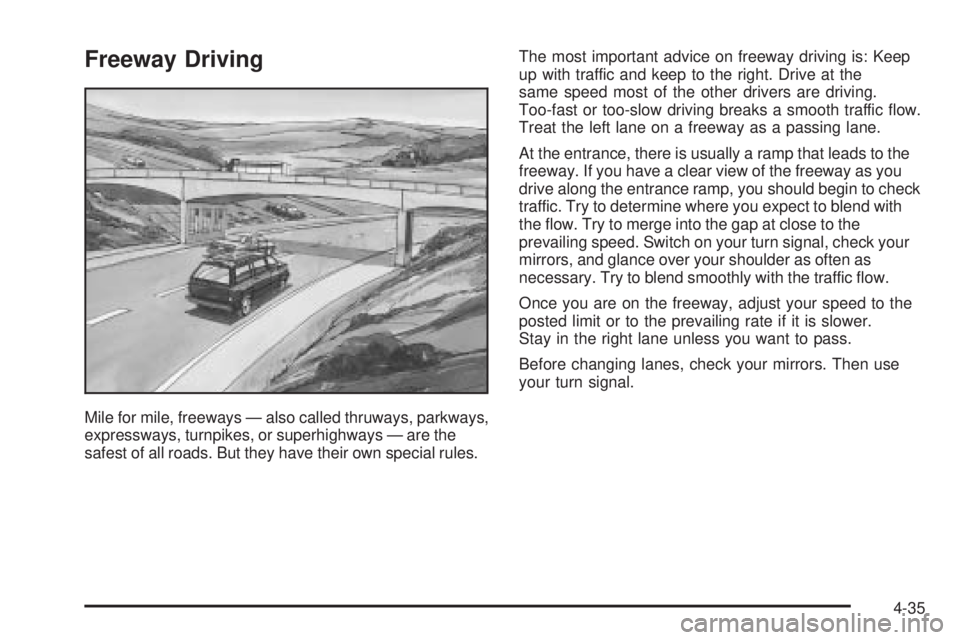
Mile for mile, freeways — also called thruways, parkways,
expressways, turnpikes, or superhighways — are the
safest of all roads. But they have their own special rules.The most important advice on freeway driving is: Keep
up with traffic and keep to the right. Drive at the
same speed most of the other drivers are driving.
Too-fast or too-slow driving breaks a smooth traffic ow.
Treat the left lane on a freeway as a passing lane.
At the entrance, there is usually a ramp that leads to the
freeway. If you have a clear view of the freeway as you
drive along the entrance ramp, you should begin to check
traffic. Try to determine where you expect to blend with
the ow. Try to merge into the gap at close to the
prevailing speed. Switch on your turn signal, check your
mirrors, and glance over your shoulder as often as
necessary. Try to blend smoothly with the traffic ow.
Once you are on the freeway, adjust your speed to the
posted limit or to the prevailing rate if it is slower.
Stay in the right lane unless you want to pass.
Before changing lanes, check your mirrors. Then use
your turn signal.
4-35
Page 311 of 502
Highway Hypnosis
Is there actually such a condition as highway hypnosis?
Or is it just plain falling asleep at the wheel? Call it
highway hypnosis, lack of awareness, or whatever.
There is something about an easy stretch of road with the
same scenery, along with the hum of the tires on the
road, the drone of the engine, and the rush of the wind
against the vehicle that can make you sleepy. Do not
let it happen to you! If it does, your vehicle can leave the
road in less than a second, and you could crash and
be injured.
What can you do about highway hypnosis? First, be
aware that it can happen.
Then here are some tips:
Make sure your vehicle is well ventilated, with a
comfortably cool interior.
Keep your eyes moving. Scan the road ahead and
to the sides. Check your mirrors and your
instruments frequently.
If you get sleepy, pull off the road into a rest,
service, or parking area and take a nap, get some
exercise, or both. For safety, treat drowsiness
on the highway as an emergency.
Hill and Mountain Roads
Driving on steep hills or mountains is different from
driving in at or rolling terrain.
4-37
Page 338 of 502
Before you start, check all trailer hitch parts and
attachments, safety chains, electrical connection, lamps,
tires and mirror adjustment. If the trailer has electric
brakes, start your vehicle and trailer moving and then
apply the trailer brake controller by hand to be sure
the brakes are working. This lets you check your
electrical connection at the same time.
During your trip, check occasionally to be sure that the
load is secure, and that the lamps and any trailer
brakes are still working.
Following Distance
Stay at least twice as far behind the vehicle ahead as
you would when driving your vehicle without a trailer.
This can help you avoid situations that require
heavy braking and sudden turns.
Passing
You’ll need more passing distance up ahead when
you’re towing a trailer. And, because you’re a good deal
longer, you’ll need to go much farther beyond the
passed vehicle before you can return to your lane.
Backing Up
Hold the bottom of the steering wheel with one hand.
Then, to move the trailer to the left, just move that hand
to the left. To move the trailer to the right, move your
hand to the right. Always back up slowly and, if possible,
have someone guide you.
Making Turns
Notice:Making very sharp turns while trailering
could cause the trailer to come in contact with the
vehicle. Your vehicle could be damaged. Avoid
making very sharp turns while trailering.
When you’re turning with a trailer, make wider turns than
normal. Do this so your trailer won’t strike soft shoulders,
curbs, road signs, trees or other objects. Avoid jerky or
sudden maneuvers. Signal well in advance.
4-64
Page 496 of 502

Locks
Delayed Locking........................................... 2-9
Door........................................................... 2-8
Lockout Protection.......................................2-12
Programmable Automatic Door Locks............... 2-9
Rear Door Security Locks.............................2-12
Loss of Control...............................................4-15
Low Fuel Warning Light...................................3-51
Luggage Carrier..............................................2-55
Lumbar
Power Controls............................................. 1-2
M
Maintenance Schedule
Additional Required Services........................... 6-6
At Each Fuel Fill........................................... 6-9
At Least Once a Month.................................. 6-9
At Least Once a Year..................................6-10
Introduction.................................................. 6-2
Maintenance Footnotes.................................. 6-7
Maintenance Record....................................6-15
Maintenance Requirements............................. 6-2
Normal Maintenance Replacement Parts.........6-14
Owner Checks and Services........................... 6-9Maintenance Schedule (cont.)
Recommended Fluids and Lubricants.............6-12
Scheduled Maintenance................................. 6-4
Using Your................................................... 6-2
Your Vehicle and the Environment................... 6-2
Malfunction Indicator Light................................3-42
Memory Seat.................................................2-60
Message
DIC Warnings and Messages........................3-55
Mirrors
Manual Rearview Mirror................................2-36
Manual Rearview Mirror with Compass...........2-36
Manual Rearview Mirror with Compass
and Temperature..............................2-41, 3-35
Manual Rearview Mirror with OnStar®.............2-36
Manual Rearview Mirror with OnStar®
and Compass..........................................2-39
Manual Rearview Mirror with OnStar®,
Compass, and Temperature Display............2-43
Outside Convex Mirror.................................2-47
Outside Curb View Assist Mirror....................2-46
Outside Heated Mirrors................................2-47
Outside Manual Mirrors................................2-45
Outside Power Mirrors..................................2-46
MyGMLink.com................................................ 7-4
8
Page 497 of 502
N
Navigation/Radio System................................3-134
New Vehicle Break-In......................................2-18
Normal Maintenance Replacement Parts............6-14
O
Odometer......................................................3-34
Odometer, Trip...............................................3-34
Off-Road Recovery..........................................4-13
Oil
Change Engine Oil Light...............................3-46
Engine.......................................................5-16
Pressure Gage............................................3-45
Older Children, Restraints................................1-26
Online Owner Center........................................ 7-4
OnStar
®System.............................................2-47
Operating Your All-Wheel-Drive Vehicle Off
Paved Roads..............................................4-16
Other Warning Devices...................................... 3-6
Outlet Adjustment............................................3-28
Outside
Convex Mirror.............................................2-47
Curb View Assist Mirror................................2-46
Heated Mirrors............................................2-47
Manual Mirrors............................................2-45
Power Mirrors.............................................2-46
Overhead Console..........................................2-54Owner Checks and Services.............................. 6-9
Owners, Canadian............................................... ii
P
Park (P)
Shifting Into................................................2-31
Shifting Out of............................................2-33
Parking
Brake........................................................2-30
Over Things That Burn.................................2-33
Passenger Airbag Status Indicator.....................3-37
Passenger Sensing System..............................1-58
Passing.........................................................4-14
Passlock
®......................................................2-18
Personalization, Climate Controls......................3-31
Power
Accessory Outlets........................................3-19
Electrical System.........................................5-96
Lumbar Controls........................................... 1-2
Rear Quarter Windows.................................2-16
Reduced Engine Light..................................3-47
Retained Accessory (RAP)............................2-19
Seat............................................................ 1-2
Steering Fluid.............................................5-36
Windows....................................................2-15
Pretensioners, Safety Belt................................1-26
Programmable Automatic Door Locks.................. 2-9
Programming the HomeLink
®Transmitter...........2-50
9
Page 498 of 502

Q
Questions and Answers About Safety Belts.........1-13
R
Radiator Pressure Cap....................................5-28
Radios..........................................................3-65
Care of Your Cassette Tape Player...............3-137
Care of Your CD and DVD Player................3-139
Care of Your CDs and DVDs.......................3-138
Navigation/Radio System.............................3-134
Radio with Cassette and CD.........................3-93
Radio with CD....................................3-66, 3-77
Radio with Six-Disc CD..............................3-107
Rear Seat Audio........................................3-134
Setting the Time..........................................3-65
Theft-Deterrent..........................................3-135
Understanding Reception............................3-137
Rainsense™ Wipers.......................................... 3-9
Reading Lamps..............................................3-19
Rear Axle......................................................5-47
Locking......................................................4-11
Rear Climate Control System............................3-28
Rear Compartment Storage Panel/Cover............2-56
Rear Door Security Locks................................2-12
Rear Floor Storage Lid....................................2-58
Rear Safety Belt Comfort Guides......................1-23Rear Seat Audio (RSA)..................................3-134
Rear Seat Entertainment System.....................3-121
Rear Seat Operation......................................... 1-5
Rear Seat Passengers, Safety Belts..................1-21
Rearview Mirror with Compass..........................2-36
Rearview Mirror with Compass and Temperature........
2-41, 3-35
Rearview Mirror with OnStar®...........................2-36
Rearview Mirror with OnStar®and Compass.......2-39
Rearview Mirror with OnStar®, Compass, and
Temperature Display....................................2-43
Rearview Mirrors.............................................2-36
Reclining Seatbacks.......................................... 1-3
Recommended Fluids and Lubricants.................6-12
Recreational Vehicle Towing.............................4-51
Reduced Engine Power Light............................3-47
Remote Keyless Entry System............................ 2-5
Remote Keyless Entry System, Operation............ 2-6
Removing the Flat Tire and Installing the
Spare Tire..................................................5-75
Removing the Spare Tire and Tools...................5-72
Replacement Bulbs.........................................5-51
Reporting Safety Defects
Canadian Government..................................7-12
General Motors...........................................7-13
United States Government............................7-12
Restraint System Check
Checking Your Restraint Systems...................1-64
10