exhaust GMC ENVOY 2007 User Guide
[x] Cancel search | Manufacturer: GMC, Model Year: 2007, Model line: ENVOY, Model: GMC ENVOY 2007Pages: 562, PDF Size: 3 MB
Page 370 of 562
Driving with a Trailer
{CAUTION:
If you have a rear-most window open and
you pull a trailer with your vehicle, carbon
monoxide (CO) could come into your
vehicle. You can not see or smell CO. It can
cause unconsciousness or death. See
Engine Exhaust on page 131. To maximize
your safety when towing a trailer:
Have your exhaust system inspected
for leaks, and make necessary repairs
before starting on your trip.
Keep the rear-most windows closed.
If exhaust does come into your vehicle
through a window in the rear or another
opening, drive with your front, main
heating or cooling system on and with
the fan on any speed. This will bring
fresh, outside air into your vehicle.
CAUTION: (Continued)
CAUTION: (Continued)
Do not use the climate control setting for
maximum air because it only recirculates
the air inside your vehicle. SeeDual
Climate Control System on page 186.
Towing a trailer requires a certain amount of
experience. Before setting out for the open road,
you’ll want to get to know your rig. Acquaint
yourself with the feel of handling and braking with
the added weight of the trailer. And always
keep in mind that the vehicle you are driving is
now a good deal longer and not nearly as
responsive as your vehicle is by itself.
Before you start, check all trailer hitch parts and
attachments, safety chains, electrical connection,
lamps, tires and mirror adjustment. If the trailer
has electric brakes, start your vehicle and
trailer moving and then apply the trailer brake
controller by hand to be sure the brakes are
working. This lets you check your electrical
connection at the same time.
370
Page 381 of 562
California Proposition 65 Warning
Most motor vehicles, including this one, contain
and/or emit chemicals known to the State of
California to cause cancer and birth defects or
other reproductive harm. Engine exhaust,
many parts and systems (including some inside
the vehicle), many uids, and some component
wear by-products contain and/or emit these
chemicals.
Doing Your Own Service Work
{CAUTION:
You can be injured and your vehicle could
be damaged if you try to do service work
on a vehicle without knowing enough
about it.
Be sure you have sufficient knowledge,
experience, the proper replacement
parts, and tools before you attempt any
vehicle maintenance task.
Be sure to use the proper nuts, bolts,
and other fasteners. English and metric
fasteners can be easily confused. If you
use the wrong fasteners, parts can later
break or fall off. You could be hurt.
If you want to do some of your own service work,
you will want to use the proper service manual.
It tells you much more about how to service your
vehicle than this manual can. To order the
proper service manual, seeService Publications
Ordering Information on page 545.
381
Page 402 of 562
How to Check Automatic Transmission
Fluid
Because this operation can be a little difficult, you
may choose to have this done at the dealership
service department.
If you do it yourself, be sure to follow all the
instructions here, or you could get a false reading
on the dipstick.
Notice:Too much or too little uid can
damage your transmission. Too much can
mean that some of the uid could come out
and fall on hot engine parts or exhaust system
parts, starting a re. Too little uid could
cause the transmission to overheat. Be sure to
get an accurate reading if you check your
transmission uid.
Wait at least 30 minutes before checking the
transmission uid level if you have been driving:
When outside temperatures are above
90°F (32°C).
At high speed for quite a while.
In heavy traffic — especially in hot weather.
While pulling a trailer.To get the right reading, the uid should be at
normal operating temperature, which is 180°F to
200°F (82°C to 93°C).
Get the vehicle warmed up by driving about
15 miles (24 km) when outside temperatures are
above 50°F (10°C). If it is colder than 50°F (10°C),
drive the vehicle in THIRD (3) until the engine
temperature gage moves and then remains steady
for 10 minutes.
A cold uid check can be made after the vehicle
has been sitting for eight hours or more with
the engine off, but this is used only as a reference.
Let the engine run at idle for ve minutes if
outside temperatures are 50°F (10°C) or more. If it
is colder than 50°F (10°C), you may have to idle
the engine longer. Should the uid level be
low during this cold check, you must check the
uid hot before adding uid. Checking the uid hot
will give you a more accurate reading of the
uid level.
402
Page 489 of 562
Sheet Metal Damage
If the vehicle is damaged and requires sheet metal
repair or replacement, make sure the body
repair shop applies anti-corrosion material to parts
repaired or replaced to restore corrosion
protection.
Original manufacturer replacement parts will
provide the corrosion protection while maintaining
the warranty.
Finish Damage
Any stone chips, fractures or deep scratches in
the nish should be repaired right away. Bare
metal will corrode quickly and may develop into
major repair expense.
Minor chips and scratches can be repaired with
touch-up materials available from your dealer.
Larger areas of nish damage can be corrected
in your dealer’s body and paint shop.
Underbody Maintenance
Chemicals used for ice and snow removal and dust
control can collect on the underbody. If these are
not removed, corrosion and rust can develop on the
underbody parts such as fuel lines, frame, oor pan,
and exhaust system even though they have
corrosion protection.
At least every spring, ush these materials from the
underbody with plain water. Clean any areas where
mud and debris can collect. Dirt packed in close
areas of the frame should be loosened before being
ushed. Your dealer or an underbody car washing
system can do this for you.
Chemical Paint Spotting
Some weather and atmospheric conditions can
create a chemical fallout. Airborne pollutants can
fall upon and attack painted surfaces on the vehicle.
This damage can take two forms: blotchy,
ring-shaped discolorations, and small, irregular
dark spots etched into the paint surface.
Although no defect in the paint job causes this, GM
will repair, at no charge to the owner, the surfaces
of new vehicles damaged by this fallout condition
within 12 months or 12,000 miles (20 000 km) of
purchase, whichever occurs rst.
489
Page 510 of 562

Additional Required Services
The following services should be performed at the rst maintenance service (IorII) after the indicated
miles (kilometers) shown for each item.
Additional Required Services
Service and Miles (Kilometers)25,000
(40 000)50,000
(80 000)75,000
(120 000)100,000
(160 000)125,000
(200 000)150,000
(240 000)
Inspect fuel system for damage
or leaks.• •••••
Inspect exhaust system for loose
or damaged components.• •••••
Replace engine air cleaner lter.
SeeEngine Air Cleaner/Filter
on page 400.•••
Change automatic transmission
uid and lter (severe service).
See footnotes (g) and (h).•••
Change automatic transmission
uid and lter (normal service).
See footnote (g).•
Automatic transfer case only: Change
transfer case uid.See footnote (g).•••
Replace spark plugs.An Emission
Control Service.•
510
Page 552 of 562
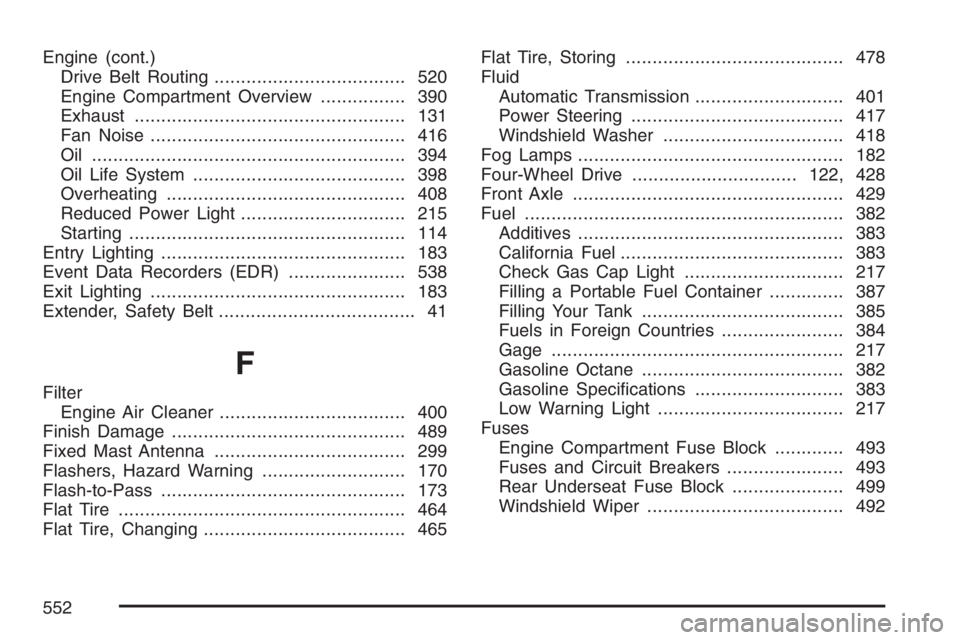
Engine (cont.)
Drive Belt Routing.................................... 520
Engine Compartment Overview................ 390
Exhaust................................................... 131
Fan Noise................................................ 416
Oil ........................................................... 394
Oil Life System........................................ 398
Overheating............................................. 408
Reduced Power Light............................... 215
Starting.................................................... 114
Entry Lighting.............................................. 183
Event Data Recorders (EDR)...................... 538
Exit Lighting................................................ 183
Extender, Safety Belt..................................... 41
F
Filter
Engine Air Cleaner................................... 400
Finish Damage............................................ 489
Fixed Mast Antenna.................................... 299
Flashers, Hazard Warning........................... 170
Flash-to-Pass.............................................. 173
Flat Tire...................................................... 464
Flat Tire, Changing...................................... 465Flat Tire, Storing......................................... 478
Fluid
Automatic Transmission............................ 401
Power Steering........................................ 417
Windshield Washer.................................. 418
Fog Lamps.................................................. 182
Four-Wheel Drive...............................122, 428
Front Axle................................................... 429
Fuel............................................................ 382
Additives.................................................. 383
California Fuel.......................................... 383
Check Gas Cap Light.............................. 217
Filling a Portable Fuel Container.............. 387
Filling Your Tank...................................... 385
Fuels in Foreign Countries....................... 384
Gage....................................................... 217
Gasoline Octane...................................... 382
Gasoline Specications............................ 383
Low Warning Light................................... 217
Fuses
Engine Compartment Fuse Block............. 493
Fuses and Circuit Breakers...................... 493
Rear Underseat Fuse Block..................... 499
Windshield Wiper..................................... 492
552