page 5 GMC ENVOY 2008 Owner's Manual
[x] Cancel search | Manufacturer: GMC, Model Year: 2008, Model line: ENVOY, Model: GMC ENVOY 2008Pages: 468, PDF Size: 2.64 MB
Page 368 of 468
You need new tires if any of the following statements
are true:
You can see the indicators at three or more places
around the tire.
You can see cord or fabric showing through the
tire’s rubber.
The tread or sidewall is cracked, cut, or snagged
deep enough to show cord or fabric.
The tire has a bump, bulge, or split.
The tire has a puncture, cut, or other damage that
cannot be repaired well because of the size or
location of the damage.
The rubber in tires degrades over time, even if they are
not being used. This is also true for the spare tire, if
your vehicle has one. Multiple conditions affect how fast
this aging takes place, including temperatures, loading
conditions, and ination pressure maintenance. With
proper care and maintenance tires will typically wear out
before they degrade due to age. If you are unsure about
the need to replace your tires as they get older, consult
the tire manufacturer for more information.
Buying New Tires
GM has developed and matched specic tires for
your vehicle. The original equipment tires installed
on your vehicle, when it was new, were designed to
meet General Motors Tire Performance Criteria
Specication (TPC spec) system rating. If you need
replacement tires, GM strongly recommends that
you get tires with the same TPC Spec rating. This
way, your vehicle will continue to have tires that are
designed to give the same performance and vehicle
safety, during normal use, as the original tires.
GM’s exclusive TPC Spec system considers over
a dozen critical specications that impact the
overall performance of your vehicle, including
brake system performance, ride and handling,
traction control, and tire pressure monitoring
performance. GM’s TPC Spec number is molded
onto the tire’s sidewall near the tire size. If the
tires have an all-season tread design, the TPC
spec number will be followed by a MS, for mud and
snow. SeeTire Sidewall Labeling on page 5-58for
additional information.
5-74
Page 369 of 468
GM recommends replacing tires in sets of four.
This is because uniform tread depth on all tires will
help keep your vehicle performing most like it did
when the tires were new. Replacing less than a full
set of tires can affect the braking and handling
performance of your vehicle. SeeTire Inspection
and Rotation on page 5-72for information on
proper tire rotation.
{CAUTION:
Mixing tires could cause you to lose
control while driving. If you mix tires of
different sizes, brands, or types (radial
and bias-belted tires) the vehicle may not
handle properly, and you could have a
crash. Using tires of different sizes,
brands, or types may also cause damage to
your vehicle. Be sure to use the correct
size, brand, and type of tires on your
vehicle’s wheels.
{CAUTION:
If you use bias-ply tires on your vehicle,
the wheel rim anges could develop
cracks after many miles of driving. A tire
and/or wheel could fail suddenly, causing a
crash. Use only radial-ply tires with the
wheels on your vehicle.
If you must replace your vehicle’s tires with those
that do not have a TPC Spec number, make sure
they are the same size, load range, speed rating,
and construction type (radial and bias-belted tires)
as your vehicle’s original tires.
5-75
Page 370 of 468
Vehicles equipped with a tire pressure monitoring
system may give an inaccurate low-pressure
warning if non-TPC spec rated tires are installed
on your vehicle. Non-TPC Spec rated tires may
give a low-pressure warning that is higher or lower
than the proper warning level you would get with
TPC Spec rated tires. SeeTire Pressure Monitor
System on page 5-67.
Your vehicle’s original equipment tires are listed
on the Tire and Loading Information Label. See
Loading Your Vehicle on page 4-34, for more
information about the Tire and Loading Information
Label and its location on your vehicle.
Different Size Tires and Wheels
If you add wheels or tires that are a different size than
your original equipment wheels and tires, this could
affect the way your vehicle performs, including its
braking, ride and handling characteristics, stability, and
resistance to rollover. Additionally, if your vehicle has
electronic systems such as anti-lock brakes, rollover
airbags, traction control, and electronic stability control,
the performance of these systems can be affected.
{CAUTION:
If you add different sized wheels, your vehicle
may not provide an acceptable level of
performance and safety if tires not
recommended for those wheels are selected.
You may increase the chance that you will
crash and suffer serious injury. Only use GM
specic wheel and tire systems developed for
your vehicle, and have them properly installed
by a GM certied technician.
SeeBuying New Tires on page 5-74andAccessories
and Modifications on page 5-3for additional information.
5-76
Page 373 of 468
Each new wheel should have the same load-carrying
capacity, diameter, width, offset, and be mounted
the same way as the one it replaces.
If you need to replace any of your wheels, wheel bolts,
wheel nuts, or Tire Pressure Monitor System (TPMS)
sensors, replace them only with new GM original
equipment parts. This way, you will be sure to have the
right wheel, wheel bolts, wheel nuts, and TPMS sensors
for your vehicle.
{CAUTION:
Using the wrong replacement wheels, wheel
bolts, or wheel nuts on your vehicle can be
dangerous. It could affect the braking and
handling of your vehicle, make your tires lose
air and make you lose control. You could have
a collision in which you or others could be
injured. Always use the correct wheel, wheel
bolts, and wheel nuts for replacement.Notice:The wrong wheel can also cause problems
with bearing life, brake cooling, speedometer or
odometer calibration, headlamp aim, bumper height,
vehicle ground clearance, and tire or tire chain
clearance to the body and chassis.
SeeChanging a Flat Tire on page 5-82for more
information.
Used Replacement Wheels
{CAUTION:
Putting a used wheel on your vehicle is
dangerous. You cannot know how it has been
used or how far it has been driven. It could fail
suddenly and cause a crash. If you have to
replace a wheel, use a new GM original
equipment wheel.
5-79
Page 375 of 468
To use the accessory inator:
1. Attach the appropriate nozzle adapter to the end of
the hose, if required.
{CAUTION:
Inating something too much can make it
explode, and you or others could be injured.
Be sure to read the inator instructions, and
inate any object only to its recommended
pressure.
2. Attach that end of the hose to the object you wish
to inate.
3. Attach the other end of the hose to the outlet.
4. Press and release the switch to turn the air inator
on. The indicator light will remain on when the
inator is running.
The system has an internal clock to prevent the
system from overheating. The system will allow
about ve minutes of running time, then the
compressor will stop. The indicator light will then
begin to ash. When the indicator is off, the inator
can be started again by pressing the switch. If the
compressor is still hot, it may only run for a short time
before shutting off again.
5. Press and release the switch to turn the inator off.Place the inator kit tools in the pouch and store it in
its proper location. Remove the inator hose from
the outlet during loading and unloading. Load leveling
will not function with the inator hose attached to
the inator outlet. SeeElectronically Controlled Air
Suspension System on page 4-44for more information.
To reinstall the cover, line up the tabs at the back of
the cover, put it in place and latch the tabs.
A continuous ashing indicator light may also indicate a
malfunction in the air suspension system. See
Electronically Controlled Air Suspension System on
page 4-44for more information.
If a Tire Goes Flat
It is unusual for a tire to blowout while you are driving,
especially if you maintain your vehicle’s tires properly.
If air goes out of a tire, it is much more likely to leak out
slowly. But if you should ever have a blowout, here
are a few tips about what to expect and what to do:
If a front tire fails, the at tire creates a drag that pulls
the vehicle toward that side. Take your foot off the
accelerator pedal and grip the steering wheel rmly.
Steer to maintain lane position, and then gently brake
to a stop well out of the traffic lane.
5-81
Page 376 of 468

A rear blowout, particularly on a curve, acts much like a
skid and may require the same correction you would
use in a skid. In any rear blowout remove your foot from
the accelerator pedal. Get the vehicle under control by
steering the way you want the vehicle to go. It may be
very bumpy and noisy, but you can still steer. Gently
brake to a stop, well off the road if possible.
{CAUTION:
Lifting a vehicle and getting under it to do
maintenance or repairs is dangerous without
the appropriate safety equipment and training.
The jack provided with your vehicle is
designed only for changing a at tire. If it is
used for anything else, you or others could be
badly injured or killed if the vehicle slips off the
jack. Use the jack provided with your vehicle
only for changing a at tire.
If a tire goes at, the next part shows how to use the
jacking equipment to change a at tire safely.
Changing a Flat Tire
If a tire goes at, avoid further tire and wheel damage
by driving slowly to a level place. Turn on your hazard
warning ashers. SeeHazard Warning Flashers on
page 3-6for more information.
{CAUTION:
Changing a tire can be dangerous. The vehicle
can slip off the jack and roll over or fall on you
or other people. You and they could be badly
injured or even killed. Find a level place to
change your tire. To help prevent the vehicle
from moving:
1. Set the parking brake rmly.
2. Put the shift lever in PARK (P).
CAUTION: (Continued)
5-82
Page 378 of 468
Removing the Spare Tire and Tools
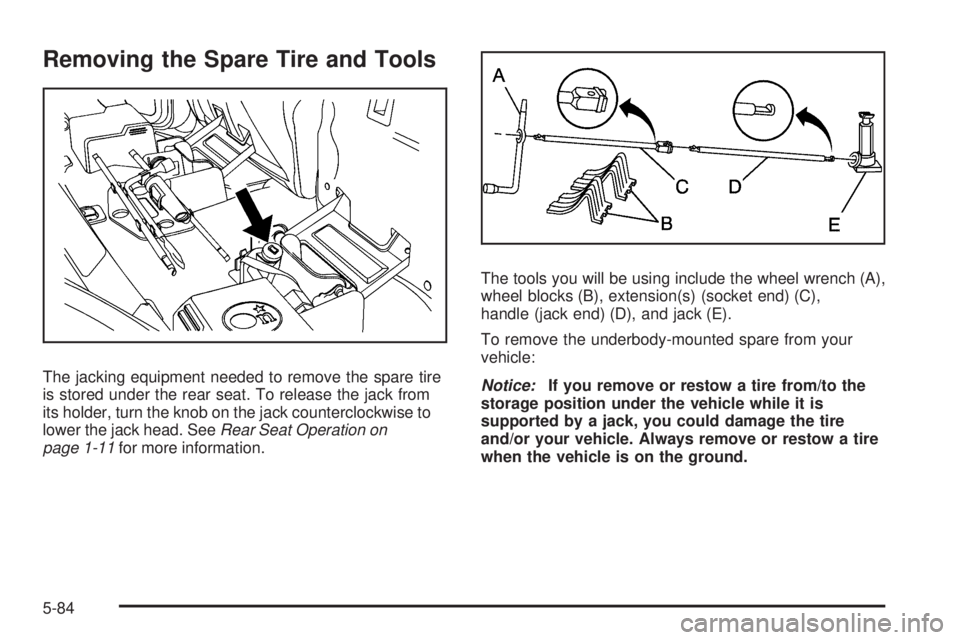
The jacking equipment needed to remove the spare tire
is stored under the rear seat. To release the jack from
its holder, turn the knob on the jack counterclockwise to
lower the jack head. SeeRear Seat Operation on
page 1-11for more information.The tools you will be using include the wheel wrench (A),
wheel blocks (B), extension(s) (socket end) (C),
handle (jack end) (D), and jack (E).
To remove the underbody-mounted spare from your
vehicle:
Notice:If you remove or restow a tire from/to the
storage position under the vehicle while it is
supported by a jack, you could damage the tire
and/or your vehicle. Always remove or restow a tire
when the vehicle is on the ground.
5-84
Page 379 of 468
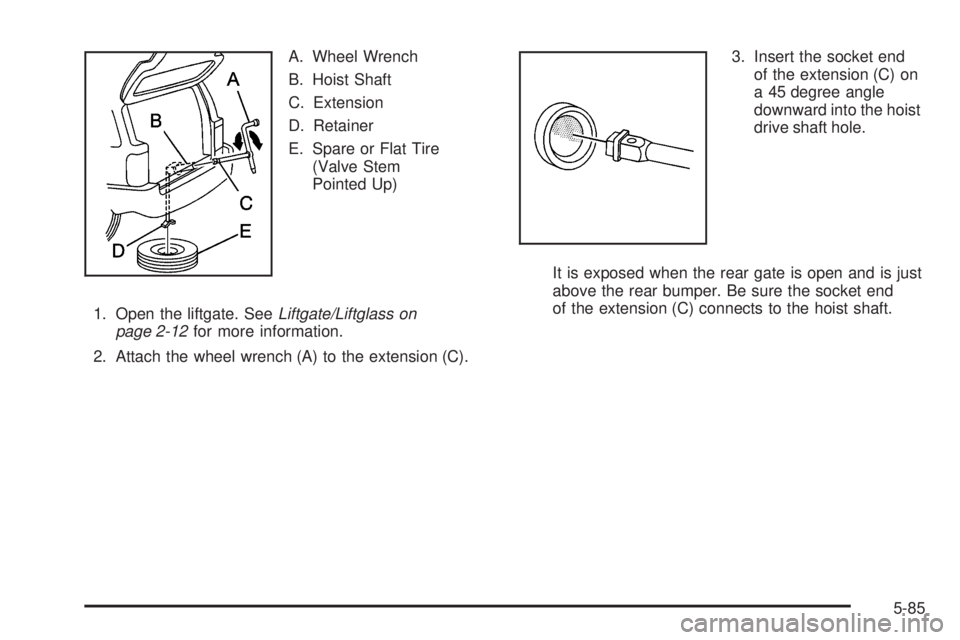
A. Wheel Wrench
B. Hoist Shaft
C. Extension
D. Retainer
E. Spare or Flat Tire
(Valve Stem
Pointed Up)
1. Open the liftgate. SeeLiftgate/Liftglass on
page 2-12for more information.
2. Attach the wheel wrench (A) to the extension (C).3. Insert the socket end
of the extension (C) on
a 45 degree angle
downward into the hoist
drive shaft hole.
It is exposed when the rear gate is open and is just
above the rear bumper. Be sure the socket end
of the extension (C) connects to the hoist shaft.
5-85
Page 380 of 468
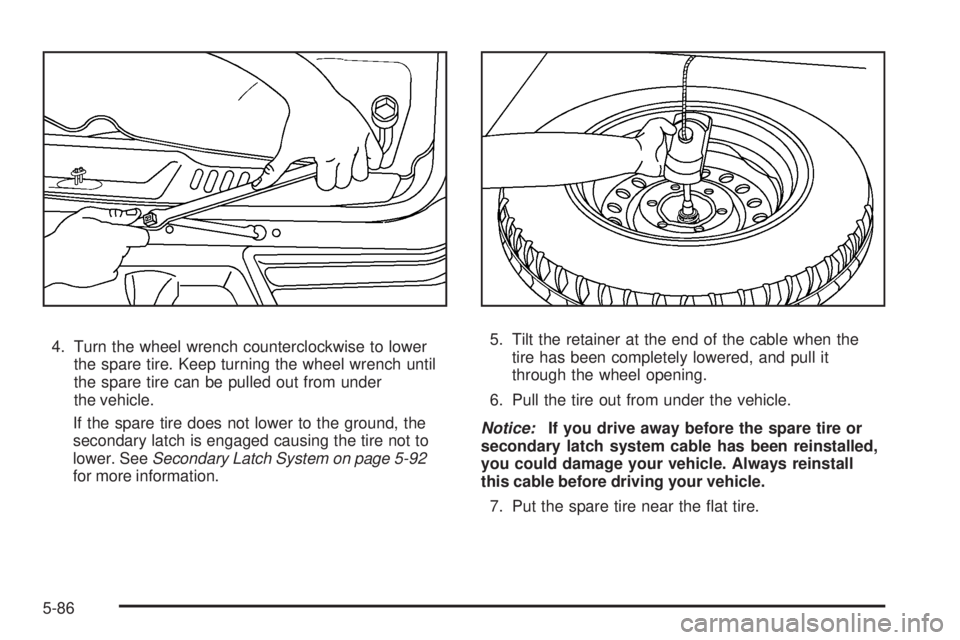
4. Turn the wheel wrench counterclockwise to lower
the spare tire. Keep turning the wheel wrench until
the spare tire can be pulled out from under
the vehicle.
If the spare tire does not lower to the ground, the
secondary latch is engaged causing the tire not to
lower. SeeSecondary Latch System on page 5-92
for more information.5. Tilt the retainer at the end of the cable when the
tire has been completely lowered, and pull it
through the wheel opening.
6. Pull the tire out from under the vehicle.
Notice:If you drive away before the spare tire or
secondary latch system cable has been reinstalled,
you could damage your vehicle. Always reinstall
this cable before driving your vehicle.
7. Put the spare tire near the at tire.
5-86
Page 381 of 468
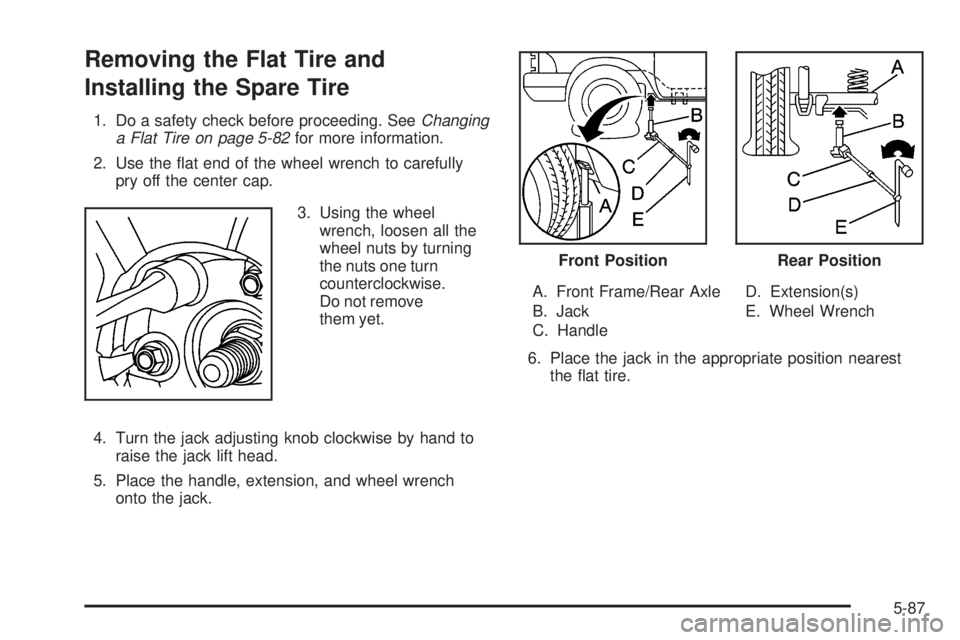
Removing the Flat Tire and
Installing the Spare Tire
1. Do a safety check before proceeding. SeeChanging
a Flat Tire on page 5-82for more information.
2. Use the at end of the wheel wrench to carefully
pry off the center cap.
3. Using the wheel
wrench, loosen all the
wheel nuts by turning
the nuts one turn
counterclockwise.
Do not remove
them yet.
4. Turn the jack adjusting knob clockwise by hand to
raise the jack lift head.
5. Place the handle, extension, and wheel wrench
onto the jack.A. Front Frame/Rear Axle
B. Jack
C. HandleD. Extension(s)
E. Wheel Wrench
6. Place the jack in the appropriate position nearest
the at tire.
Front PositionRear Position
5-87