ECU GMC ENVOY 2008 Owner's Guide
[x] Cancel search | Manufacturer: GMC, Model Year: 2008, Model line: ENVOY, Model: GMC ENVOY 2008Pages: 468, PDF Size: 2.64 MB
Page 66 of 468
The passenger sensing system will turn off the right
front passenger’s frontal airbag under certain conditions.
The driver’s airbags are not part of the passenger
sensing system.
The passenger sensing system works with sensors
that are part of the right front passenger’s seat.
The sensors are designed to detect the presence
of a properly-seated occupant and determine if the
right front passenger’s frontal airbag should be enabled
(may inate) or not.
Accident statistics show that children are safer if they
are restrained in the rear rather than the front seat.
We recommend that children be secured in a rear seat,
including: an infant or a child riding in a rear-facing
child restraint; a child riding in a forward-facing child
seat; an older child riding in a booster seat; and children,
who are large enough, using safety belts.
A label on your sun visor says, “Never put a rear-facing
child seat in the front.” This is because the risk to the
rear-facing child is so great, if the airbag deploys.
{CAUTION:
A child in a rear-facing child restraint can be
seriously injured or killed if the right front
passenger’s airbag inates. This is because
the back of the rear-facing child restraint
would be very close to the inating airbag.
Even though the passenger sensing system is
designed to turn off the right front passenger’s
frontal airbag if the system detects a
rear-facing child restraint, no system is
fail-safe, and no one can guarantee that an
airbag will not deploy under some unusual
circumstance, even though it is turned off. We
recommend that rear-facing child restraints be
secured in a rear seat, even if the airbag is off.
If you secure a forward-facing child restraint
in the right front seat, always move the front
passenger seat as far back as it will go. It is
better to secure the child restraint in a rear seat.
1-62
Page 67 of 468
The passenger sensing system is designed to turn off
the right front passenger’s frontal airbag if:
The right front passenger seat is unoccupied.
The system determines that an infant is present in
a rear-facing infant seat.
The system determines that a small child is present
in a child restraint.
The system determines that a small child is present
in a booster seat.
A right front passenger takes his/her weight off of
the seat for a period of time.
The right front passenger seat is occupied by a
smaller person, such as a child who has outgrown
child restraints.
Or, if there is a critical problem with the airbag
system or the passenger sensing system.
When the passenger sensing system has turned off the
right front passenger’s frontal airbag, the off indicator
will light and stay lit to remind you that the airbag is off.
SeePassenger Airbag Status Indicator on page 3-34.If a child restraint has been installed and the on indicator
is lit, turn the vehicle off. Remove the child restraint from
the vehicle and reinstall the child restraint following the
child restraint manufacturer’s directions and refer to
Securing a Child Restraint in the Right Front Seat
Position on page 1-50.
If, after reinstalling the child restraint and restarting the
vehicle, the on indicator is still lit, check to make sure that
the vehicle’s seatback is not pressing the child restraint
into the seat cushion. If this happens, slightly recline
the vehicle’s seatback and adjust the seat cushion if
possible. Also make sure the child restraint is not trapped
under the vehicle head restraint. If this happens, adjust
the head restraint. SeeHead Restraints on page 1-10.
Remove any additional material from the seat such as
blankets, cushions, seat covers, seat heaters or seat
massagers before reinstalling or securing the child
restraint.
If the on indicator is still lit, secure the child in the child
restraint in a rear seat position in the vehicle, and
check with your dealer/retailer.
1-63
Page 71 of 468
Any object, such as an aftermarket seat heater or a
comfort enhancing pad or device, installed under or
on top of the seat fabric, could also interfere with
the operation of the passenger sensing system.
This could either prevent proper deployment of the
passenger airbag(s) or prevent the passenger
sensing system from properly turning off the
passenger airbag(s). SeePassenger Sensing
System on page 1-61.
If you have any questions about this, you should
contact Customer Assistance before you modify
your vehicle. The phone numbers and addresses
for Customer Assistance are in Step Two of
the Customer Satisfaction Procedure in this manual.
SeeCustomer Satisfaction Procedure on page 7-2.
If your vehicle has rollover roof-rail airbags, see
Different Size Tires and Wheels on page 5-76
for additional important information.Q:Because I have a disability, I have to get my
vehicle modied. How can I nd out whether
this will affect my airbag system?
A:If you have questions, call Customer Assistance.
The phone numbers and addresses for Customer
Assistance are in Step Two of the Customer
Satisfaction Procedure in this manual. See
Customer Satisfaction Procedure on page 7-2.
In addition, your dealer/retailer and the service manual
have information about the location of the airbag sensors,
sensing and diagnostic module and airbag wiring.
1-67
Page 75 of 468
Keys...............................................................2-3
Remote Keyless Entry (RKE) System................2-4
Remote Keyless Entry (RKE) System
Operation...................................................2-5
Doors and Locks.............................................2-7
Door Locks....................................................2-7
Power Door Locks..........................................2-8
Delayed Locking.............................................2-8
Programmable Automatic Door Locks................2-9
Rear Door Security Locks..............................2-11
Lockout Protection........................................2-11
Liftgate/Liftglass............................................2-12
Windows........................................................2-13
Power Windows............................................2-14
Sun Visors...................................................2-15
Theft-Deterrent Systems..................................2-16
Content Theft-Deterrent.................................2-16
Passlock
®(U. S. Only)..................................2-17
PASS-Key®III+............................................2-18
PASS-Key®III+ Operation (Canada Only).........2-18
Starting and Operating Your Vehicle................2-20
New Vehicle Break-In....................................2-20
Ignition Positions..........................................2-21Retained Accessory Power (RAP)...................2-22
Starting the Engine.......................................2-22
Adjustable Throttle and Brake Pedal................2-24
Engine Coolant Heater..................................2-24
Active Fuel Management™.............................2-25
Automatic Transmission Operation...................2-26
Four-Wheel Drive..........................................2-29
Parking Brake..............................................2-33
Shifting Into PARK (P)...................................2-34
Shifting Out of PARK (P)...............................2-36
Parking Over Things That Burn.......................2-37
Engine Exhaust............................................2-37
Running the Vehicle While Parked..................2-38
Mirrors...........................................................2-39
Manual Rearview Mirror.................................2-39
Manual Rearview Mirror with OnStar
®..............2-39
Automatic Dimming Rearview Mirror with
OnStar
®and Compass...............................2-39
Automatic Dimming Rearview Mirror with
OnStar
®, Compass and Temperature
Display....................................................2-41
Automatic Dimming Rearview Mirror with
Compass and Temperature Display..............2-44
Section 2 Features and Controls
2-1
Page 85 of 468
Rear Door Security Locks
Your vehicle may have this feature. You can lock the
rear doors so they cannot be opened from the inside by
passengers. To use one of these locks do the following:
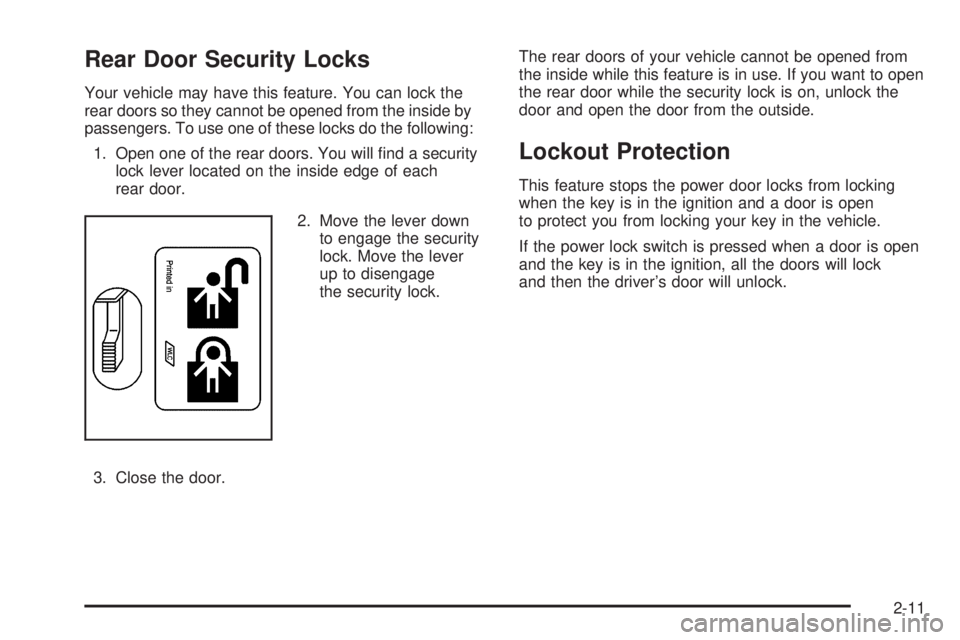
1. Open one of the rear doors. You will nd a security
lock lever located on the inside edge of each
rear door.
2. Move the lever down
to engage the security
lock. Move the lever
up to disengage
the security lock.
3. Close the door.The rear doors of your vehicle cannot be opened from
the inside while this feature is in use. If you want to open
the rear door while the security lock is on, unlock the
door and open the door from the outside.
Lockout Protection
This feature stops the power door locks from locking
when the key is in the ignition and a door is open
to protect you from locking your key in the vehicle.
If the power lock switch is pressed when a door is open
and the key is in the ignition, all the doors will lock
and then the driver’s door will unlock.
2-11
Page 90 of 468
Theft-Deterrent Systems
Vehicle theft is big business, especially in some cities.
Although your vehicle has a number of theft-deterrent
features, we know that nothing we put on it can make it
impossible to steal.
Content Theft-Deterrent
Your vehicle may have a content theft-deterrent alarm
system.
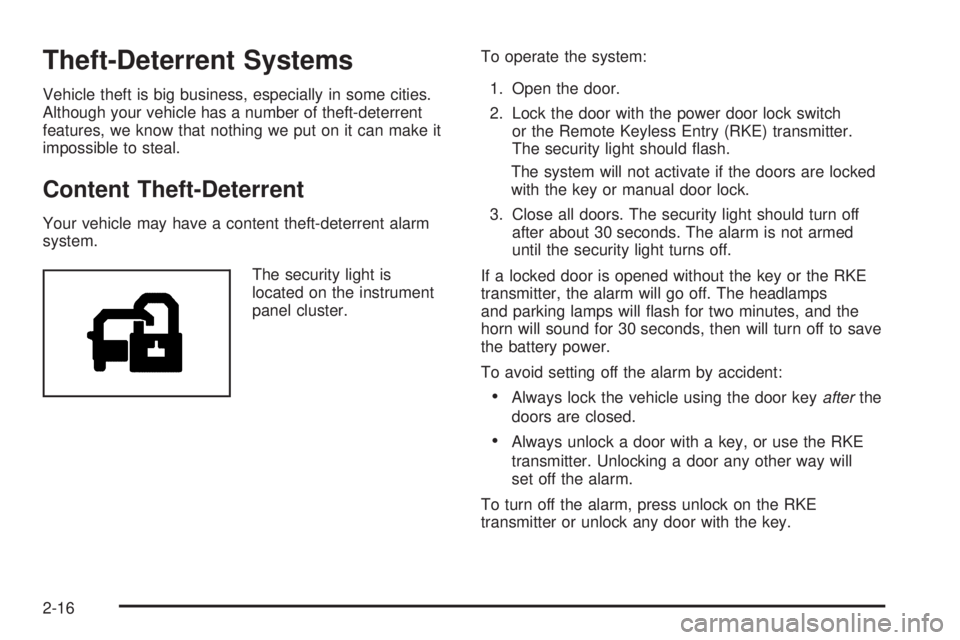
The security light is
located on the instrument
panel cluster.To operate the system:
1. Open the door.
2. Lock the door with the power door lock switch
or the Remote Keyless Entry (RKE) transmitter.
The security light should ash.
The system will not activate if the doors are locked
with the key or manual door lock.
3. Close all doors. The security light should turn off
after about 30 seconds. The alarm is not armed
until the security light turns off.
If a locked door is opened without the key or the RKE
transmitter, the alarm will go off. The headlamps
and parking lamps will ash for two minutes, and the
horn will sound for 30 seconds, then will turn off to save
the battery power.
To avoid setting off the alarm by accident:
Always lock the vehicle using the door keyafterthe
doors are closed.
Always unlock a door with a key, or use the RKE
transmitter. Unlocking a door any other way will
set off the alarm.
To turn off the alarm, press unlock on the RKE
transmitter or unlock any door with the key.
2-16
Page 91 of 468
Testing the Alarm
To test the alarm:
1. From inside the vehicle, lower the driver’s window
and open the driver’s door.
2. Activate the system by locking the doors with the
power door lock switch while the door is open, or
with the RKE transmitter.
3. Get out of the vehicle, close the door and wait for
the security light to go out.
4. Then reach in through the window, unlock the door
with the manual door lock and open the door.
This should set off the alarm.
When the alarm is set the power door unlock switch will
not work.
If the alarm does not sound when it should but the
headlamps ash, check to see if the horn works.
The horn fuse may be blown. To replace the fuse,
seeFuses and Circuit Breakers on page 5-110.
If the alarm does not sound or the headlamps do
not ash, the vehicle should be serviced by your
dealer/retailer.
Passlock®(U. S. Only)
Your vehicle has the Passlock®theft-deterrent system.
Passlock®is a passive theft-deterrent system that
enables fuel if the ignition lock cylinder is turned with a
valid key. If a correct key is not used or the ignition lock
cylinder has been tampered with, the fuel system is
disabled and the vehicle will not start.
During normal operation, the security light will turn off
about ve seconds after the key is turned to ON/RUN.
If the engine stalls and the security light ashes,
wait about 10 minutes until the light stops ashing before
trying to restart the engine. Remember to release the
key from START as soon as the engine starts.
If the engine does not start after three tries, the vehicle
needs service.
If the engine is running and the security light comes on,
you will be able to restart the engine if you turn the engine
off. However, your Passlock
®system is not working
properly and must be serviced by your dealer/retailer.
Your vehicle is not protected by Passlock
®at this time.
You may also want to check the fuse. SeeFuses and
Circuit Breakers on page 5-110. See your dealer/retailer
for service.
In an emergency, call the Roadside Assistance Center.
SeeRoadside Assistance Program on page 7-8.
Do not leave the key or device that disarms or
deactivates the theft deterrent system in the vehicle.
2-17
Page 92 of 468
PASS-Key®III+
The PASS-Key®III+ system operates on a radio
frequency subject to Federal Communications
Commission (FCC) Rules and with Industry Canada.
This device complies with Part 15 of the FCC Rules.
Operation is subject to the following two conditions:
1. This device may not cause harmful interference.
2. This device must accept any interference received,
including interference that may cause undesired
operation.
This device complies with RSS-210 of Industry Canada.
Operation is subject to the following two conditions:
1. This device may not cause interference.
2. This device must accept any interference received,
including interference that may cause undesired
operation of the device.
Changes or modications to this system by other than
an authorized service facility could void authorization to
use this equipment.
PASS-Key
®III+ uses a radio frequency transponder in
the key that matches a decoder in your vehicle.
PASS-Key®III+ Operation
(Canada Only)
Your vehicle has a passive theft-deterrent system.
The system is automatically armed when the key
is removed from the ignition.
The system is automatically disarmed when the key is
turned to ON/RUN.
You do not have to manually arm or disarm the system.
The security light will come on if there is a problem
with arming or disarming the theft-deterrent system.
The key uses a transponder that matches an immobilizer
control unit in your vehicle. Only the correct key will
start the vehicle. If the key is ever damaged, you may
not be able to start your vehicle.
2-18
Page 93 of 468
When trying to start the vehicle, if the engine does not
start and the security light comes on, there may be
a problem with your theft-deterrent system. Turn
the ignition off and try again.
If the engine still does not start, and the key appears to
be undamaged, try another ignition key. At this time,
you may also want to check the fuse. SeeFuses
and Circuit Breakers on page 5-110. If the engine still
does not start with the other key, your vehicle needs
service. If your vehicle does start, the rst key may be
faulty. See your dealer/retailer who can service the
theft-deterrent system and have a new key made.
It is possible for the theft-deterrent system decoder to
learn the transponder value of a new or replacement
key. Up to 10 keys may be programmed for the vehicle.
The following procedure is for programming additional
keys only.Canadian Owners:If you lose or damage your keys,
only a dealer/retailer can service the theft-deterrent
system to have new keys made. To program additional
keys you will require two current driver’s keys.
To program a new key do the following:
1. Verify that the new key has PK3+ stamped on it.
2. Insert the current driver’s key in the ignition
and start the engine. If the engine will not start
see your dealer/retailer for service.
3. After the engine has started, turn the key to
LOCK/OFF, and remove the key.
4. Insert the second current driver’s key in the ignition
and start the engine within ten seconds of removing
the previous key. If the engine will not start see
your dealer/retailer for service.
2-19
Page 94 of 468
5. After the engine has started, turn the key to
LOCK/OFF, and remove the key. Insert the key
to be programmed and turn it to ON within
ten seconds of removing the previous key.
The security light will turn off once the key has
been programmed.
6. Repeat the Steps 1 through 5 if additional keys are
to be programmed.
If the security light comes on and stays on while driving,
you will be able to restart the engine if you turn it off.
The theft-deterrent system, however, is not working
properly and must be serviced by your dealer/retailer.
Your vehicle is not protected by the theft-deterrent
system at this time.
In an emergency, contact Roadside Assistance.
SeeRoadside Assistance Program on page 7-8.
Do not leave the key or device that disarms or
deactivates the theft deterrent system in the vehicle.Starting and Operating Your
Vehicle
New Vehicle Break-In
Notice:Your vehicle does not need an elaborate
break-in. But it will perform better in the long run if
you follow these guidelines:
Keep your speed at 55 mph (88 km/h) or less for
the rst 500 miles (805 km).
Do not drive at any one constant speed, fast or
slow, for the rst 500 miles (805 km). Do not
make full-throttle starts. Avoid downshifting
to brake or slow the vehicle.
Avoid making hard stops for the rst 200 miles
(322 km) or so. During this time the new brake
linings are not yet broken in. Hard stops with new
linings can mean premature wear and earlier
replacement. Follow this breaking-in guideline
every time you get new brake linings.
Do not tow a trailer during break-in. SeeTowing
a Trailer on page 4-45for the trailer towing
capabilities of your vehicle and more
information.
Following break-in, engine speed and load can be
gradually increased.
2-20