brake light GMC ENVOY 2009 Owner's Guide
[x] Cancel search | Manufacturer: GMC, Model Year: 2009, Model line: ENVOY, Model: GMC ENVOY 2009Pages: 474, PDF Size: 2.56 MB
Page 265 of 474
Driving Downhill
When off-roading takes you downhill, consider:
How steep is the downhill? Will I be able to maintain
vehicle control?
What is the surface like? Smooth? Rough?
Slippery? Hard-packed dirt? Gravel?
Are there hidden surface obstacles? Ruts? Logs?
Boulders?
What is at the bottom of the hill? Is there a hidden
creek bank or even a river bottom with large rocks?
If you decide you can go down a hill safely, try to keep
the vehicle headed straight down. Use a low gear
so engine drag can help the brakes so they do not have
to do all the work. Descend slowly, keeping the
vehicle under control at all times.
{CAUTION:
Heavy braking when going down a hill can cause
your brakes to overheat and fade. This could cause
loss of control and a serious accident. Apply the
brakes lightly when descending a hill and use a low
gear to keep vehicle speed under control.Things not to do when driving down a hill:
When driving downhill, avoid turns that take you
across the incline of the hill. A hill that is not too
steep to drive down might be too steep to drive
across. The vehicle could roll over.
Never go downhill with the transmission in
N (Neutral), called free-wheeling. The brakes
will have to do all the work and could overheat
and fade.
Vehicles are much more likely to stall when going uphill,
but if it happens when going downhill:
1. Stop the vehicle by applying the regular brakes and
apply the parking brake.
2. Shift to P (Park) and, while still braking, restart the
engine.
3. Shift back to a low gear, release the parking brake,
and drive straight down.
4. If the engine will not start, get out and get help.
4-21
Page 269 of 474
Driving at Night
Night driving is more dangerous than day driving because
some drivers are likely to be impaired — by alcohol or
drugs, with night vision problems, or by fatigue.
Night driving tips include:
Drive defensively.
Do not drink and drive.
Reduce headlamp glare by adjusting the inside
rearview mirror.
Slow down and keep more space between you and
other vehicles because headlamps can only light up
so much road ahead.
Watch for animals.
When tired, pull off the road.
Do not wear sunglasses.
Avoid staring directly into approaching headlamps.
Keep the windshield and all glass on your vehicle
clean — inside and out.
Keep your eyes moving, especially during turns or
curves.
No one can see as well at night as in the daytime.
But, as we get older, these differences increase.
A 50-year-old driver might need at least twice as much
light to see the same thing at night as a 20-year-old.
Driving in Rain and on Wet Roads
Rain and wet roads can reduce vehicle traction
and affect your ability to stop and accelerate. Always
drive slower in these types of driving conditions
and avoid driving through large puddles and
deep-standing or owing water.
{CAUTION:
Wet brakes can cause crashes. They might not
work as well in a quick stop and could cause pulling
to one side. You could lose control of the vehicle.
After driving through a large puddle of water or a
car/vehicle wash, lightly apply the brake pedal until
the brakes work normally.
Flowing or rushing water creates strong forces.
Driving through owing water could cause your
vehicle to be carried away. If this happens, you and
other vehicle occupants could drown. Do not ignore
police warnings and be very cautious about trying to
drive through owing water.
4-25
Page 301 of 474
The seven-wire harness contains the following trailer
circuits:
Yellow: Left Stop/Turn Signal
Dark Green: Right Stop/Turn Signal
Brown: Running Lamps
White: Ground
Light Green: Back-up Lamps
Red: Battery Feed
Dark Blue: Electric BrakesIf towing a light-duty trailer with a standard four-way
round pin connector, an adapter connector is available
from your dealer/retailer.
If charging a remote (non-vehicle) battery, turn on the
headlamps to boost the vehicle system voltage and
properly charge the battery.
The vehicle is also equipped with wiring for an
electric trailer brake controller. These wires are
located inside the vehicle on the driver side under the
instrument panel. These wires should be connected
to an electric trailer brake controller by your
dealer/retailer or a qualied service center.
4-57
Page 339 of 474

Brake Wear
This vehicle has disc brakes. Disc brake pads have
built-in wear indicators that make a high-pitched warning
sound when the brake pads are worn and new pads
are needed. The sound can come and go or be heard all
the time the vehicle is moving, except when applying
the brake pedal rmly.
{CAUTION:
The brake wear warning sound means that soon
the brakes will not work well. That could lead to an
accident. When the brake wear warning sound is
heard, have the vehicle serviced.
Notice:Continuing to drive with worn-out brake
pads could result in costly brake repair.Some driving conditions or climates can cause a brake
squeal when the brakes are rst applied or lightly applied.
This does not mean something is wrong with the brakes.
Properly torqued wheel nuts are necessary to help
prevent brake pulsation. When tires are rotated, inspect
brake pads for wear and evenly tighten wheel nuts in
the proper sequence to torque specications in
Capacities and Specifications on page 5-120.
Brake linings should always be replaced as complete
axle sets.Brake Pedal Travel
See your dealer/retailer if the brake pedal does not
return to normal height, or if there is a rapid increase in
pedal travel. This could be a sign that brake service
might be required.
Brake Adjustment
Every brake stop, the disc brakes adjust for wear.
5-37
Page 369 of 474
The TPMS sensors can also be matched to each
tire/wheel position by increasing or decreasing the tire’s
air pressure. If increasing the tire’s air pressure, do
not exceed the maximum ination pressure indicated
on the tire’s sidewall.
To decrease air-pressure out of a tire you can use the
pointed end of the valve cap, a pencil-style air pressure
gage, or a key.
You have two minutes to match the rst tire/wheel
position, and ve minutes overall to match all four
tire/wheel positions. If it takes longer than two minutes,
to match the rst tire and wheel, or more than ve
minutes to match all four tire and wheel positions the
matching process stops and you need to start over.
The TPMS sensor matching process is outlined below:
1. Set the parking brake.
2. Turn the ignition switch to ON/RUN with the
engine off.
3. Turn the headlamp control from off to parking lamps
four times within three seconds. A double horn
chirp will sound and the TPMS low tire warning
light will begin to ash. The double horn chirp and
ashing TPMS warning light indicate that the
TPMS matching process has started. The TPMS
warning light should continue ashing throughout
the matching procedure.
4. Start with the driver side front tire.5. Remove the valve cap from the valve cap stem.
Activate the TPMS sensor by increasing or
decreasing the tire’s air pressure for 10 seconds,
then stop and listen for a single horn chirp.
The single horn chirp should sound within
15 seconds, conrming that the sensor identication
code has been matched to this tire and wheel
position. If you do not hear the conrming single
horn chirp, you will need to start over with step
number one.
6. Proceed to the passenger side front tire, and repeat
the procedure in Step 5.
7. Proceed to the passenger side rear tire, and repeat
the procedure in Step 5.
8. Proceed to the driver side rear tire, and repeat the
procedure in Step 5.
9. After hearing the conrming horn chirp for the
driver’s side rear tire, check to see if the TPMS
warning light is still ashing. If yes, turn the ignition
switch to LOCK/OFF to exit the sensor matching
process. If the TPMS warning light is not ashing,
the ve minute time limit has passed and you
will need to start the process over beginning with
Step 1.
10. Set all four tires to the recommended air pressure
level as indicated on the Tire and Loading
Information label.
11. Put the valve caps back on the valve stems.
5-67
Page 374 of 474
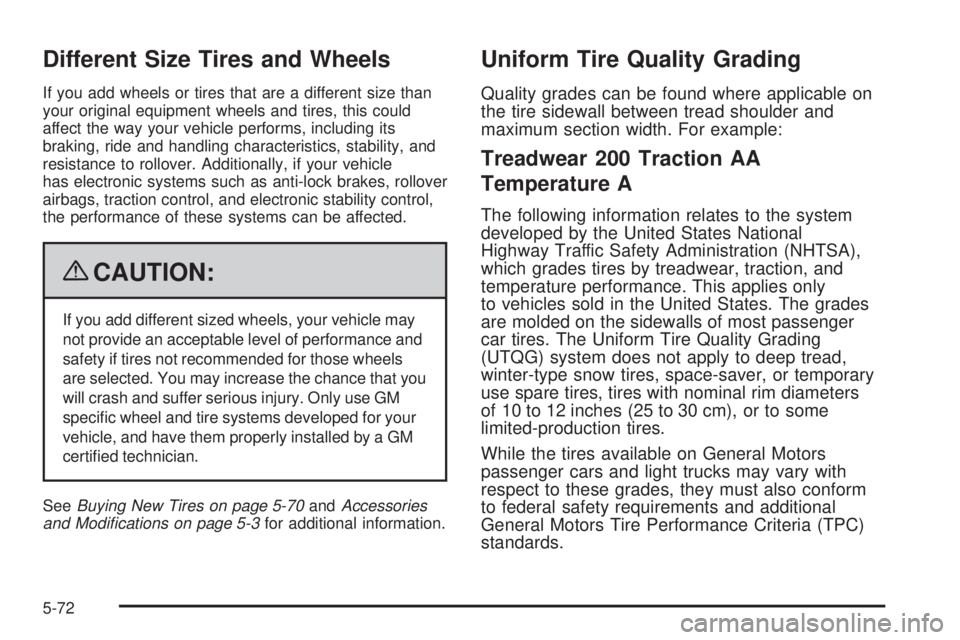
Different Size Tires and Wheels
If you add wheels or tires that are a different size than
your original equipment wheels and tires, this could
affect the way your vehicle performs, including its
braking, ride and handling characteristics, stability, and
resistance to rollover. Additionally, if your vehicle
has electronic systems such as anti-lock brakes, rollover
airbags, traction control, and electronic stability control,
the performance of these systems can be affected.
{CAUTION:
If you add different sized wheels, your vehicle may
not provide an acceptable level of performance and
safety if tires not recommended for those wheels
are selected. You may increase the chance that you
will crash and suffer serious injury. Only use GM
specic wheel and tire systems developed for your
vehicle, and have them properly installed by a GM
certied technician.
SeeBuying New Tires on page 5-70andAccessories
and Modifications on page 5-3for additional information.
Uniform Tire Quality Grading
Quality grades can be found where applicable on
the tire sidewall between tread shoulder and
maximum section width. For example:
Treadwear 200 Traction AA
Temperature A
The following information relates to the system
developed by the United States National
Highway Traffic Safety Administration (NHTSA),
which grades tires by treadwear, traction, and
temperature performance. This applies only
to vehicles sold in the United States. The grades
are molded on the sidewalls of most passenger
car tires. The Uniform Tire Quality Grading
(UTQG) system does not apply to deep tread,
winter-type snow tires, space-saver, or temporary
use spare tires, tires with nominal rim diameters
of 10 to 12 inches (25 to 30 cm), or to some
limited-production tires.
While the tires available on General Motors
passenger cars and light trucks may vary with
respect to these grades, they must also conform
to federal safety requirements and additional
General Motors Tire Performance Criteria (TPC)
standards.
5-72
Page 417 of 474
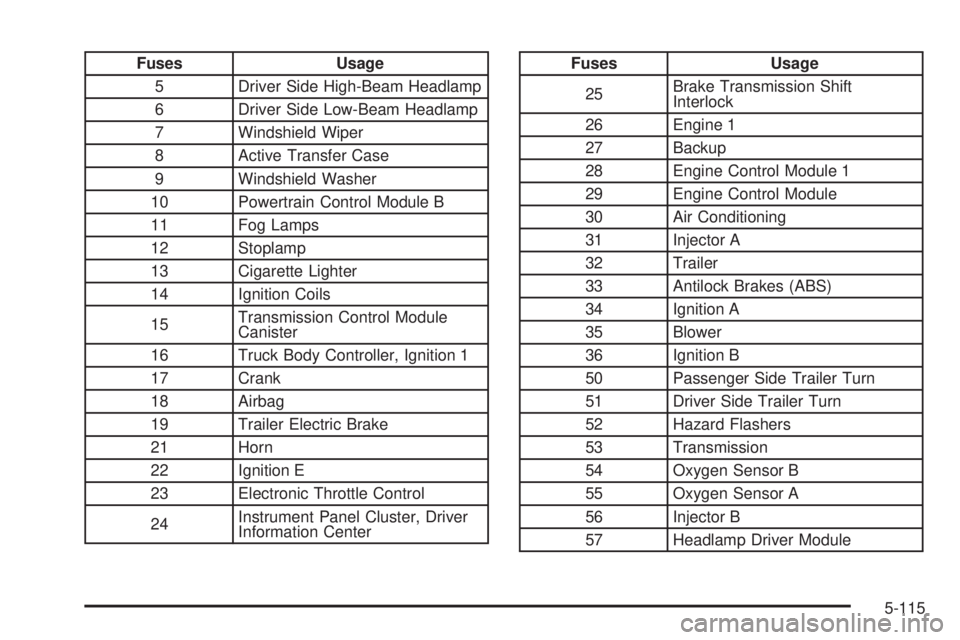
Fuses Usage
5 Driver Side High-Beam Headlamp
6 Driver Side Low-Beam Headlamp
7 Windshield Wiper
8 Active Transfer Case
9 Windshield Washer
10 Powertrain Control Module B
11 Fog Lamps
12 Stoplamp
13 Cigarette Lighter
14 Ignition Coils
15Transmission Control Module
Canister
16 Truck Body Controller, Ignition 1
17 Crank
18 Airbag
19 Trailer Electric Brake
21 Horn
22 Ignition E
23 Electronic Throttle Control
24Instrument Panel Cluster, Driver
Information CenterFuses Usage
25Brake Transmission Shift
Interlock
26 Engine 1
27 Backup
28 Engine Control Module 1
29 Engine Control Module
30 Air Conditioning
31 Injector A
32 Trailer
33 Antilock Brakes (ABS)
34 Ignition A
35 Blower
36 Ignition B
50 Passenger Side Trailer Turn
51 Driver Side Trailer Turn
52 Hazard Flashers
53 Transmission
54 Oxygen Sensor B
55 Oxygen Sensor A
56 Injector B
57 Headlamp Driver Module
5-115
Page 461 of 474

A
Accessories and Modications............................ 5-3
Accessory Power Outlets.................................3-18
Adding a Snow Plow or Similar Equipment.........4-38
Adding Equipment to Your Airbag-Equipped
Vehicle.......................................................1-69
Additives, Fuel................................................. 5-6
Add-On Electrical Equipment...........................5-112
Adjustable Throttle and Brake Pedal..................2-23
Air Cleaner/Filter, Engine.................................5-20
Air Conditioning......................................3-19, 3-22
Airbag
Passenger Status Indicator...........................3-32
Readiness Light..........................................3-31
Airbag System................................................1-55
Adding Equipment to Your Airbag-Equipped
Vehicle...................................................1-69
How Does an Airbag Restrain?......................1-62
Passenger Sensing System...........................1-64
Servicing Your Airbag-Equipped Vehicle..........1-68
What Makes an Airbag Inate?......................1-61
What Will You See After an Airbag Inates?........1-62
When Should an Airbag Inate?....................1-60
Where Are the Airbags?...............................1-58
Antenna, Fixed Mast......................................3-112
Antenna, XM™ Satellite Radio Antenna
System.....................................................3-112
Antilock Brake System (ABS)............................. 4-5Antilock Brake, System Warning Light................3-36
Appearance Care
Aluminum Wheels......................................5-109
Care of Safety Belts...................................5-106
Chemical Paint Spotting..............................5-110
Cleaning Exterior Lamps/Lenses..................5-107
Fabric/Carpet............................................5-104
Finish Care...............................................5-108
Finish Damage..........................................5-110
Instrument Panel, Vinyl, and Other
Plastic Surfaces.....................................5-106
Interior Cleaning........................................
5-103
Leather....................................................5-105
Sheet Metal Damage..................................5-109
Tires........................................................5-109
Underbody Maintenance.............................5-110
Washing Your Vehicle.................................5-107
Weatherstrips............................................5-106
Windshield, Backglass, and Wiper Blades......5-108
Appointments, Scheduling Service.....................7-10
Ashtray.........................................................3-19
Audio System.................................................3-62
Audio Steering Wheel Controls....................3-110
Chime Level Adjustment.............................3-112
Fixed Mast Antenna...................................3-112
Navigation/Radio System,
see Navigation Manual..............................3-86
Radio Reception........................................3-111
Rear Seat Audio (RSA)...............................3-109
1
Page 462 of 474

Audio System (cont.)
Setting the Clock.........................................3-63
Theft-Deterrent Feature...............................3-110
XM™ Satellite Radio Antenna System...........3-112
Audio System(s).............................................3-64
Automatic Headlamp System............................3-14
Automatic Transmission
Fluid..........................................................5-21
Operation...................................................2-25
B
Battery..........................................................5-38
Electric Power Management..........................3-17
Run-Down Protection...................................3-18
Bluetooth
®.....................................................3-86
Brake
Emergencies................................................ 4-6
Brake Fluid....................................................5-35
Brakes..........................................................5-35
System Warning Light..................................3-35
Braking........................................................... 4-4
Braking in Emergencies..................................... 4-6
Break-In, New Vehicle.....................................2-20
Bulb Replacement...........................................5-46
Back-Up Lamps...........................................5-48
Front Turn Signal, Sidemarker and
Parking Lamps.........................................5-47
Halogen Bulbs............................................5-46Bulb Replacement (cont.)
Headlamp Aiming........................................5-45
Headlamps.................................................5-46
License Plate Lamps....................................5-49
Replacement Bulbs......................................5-49
Taillamps, Turn Signal, and Stoplamps............5-47
Buying New Tires...........................................5-70
C
Calibration.....................................................2-40
California Fuel.................................................. 5-6
California Perchlorate Materials Requirements....... 5-4
California Proposition 65 Warning....................... 5-4
Canadian Owners................................................ ii
Capacities and Specications..........................5-120
Carbon Monoxide...........................2-12, 2-37, 4-28
Care of
Safety Belts..............................................5-106
Cargo Cover..................................................2-54
Cargo Tie Downs............................................2-55
CD, MP3 .......................................................3-80
Center Console Storage Area...........................2-52
Chains, Tire...................................................5-76
Charging System Light....................................3-33
Check
Engine Lamp..............................................3-38
Gages Warning Light...................................3-45
Check Gas Cap Light......................................3-47
2
Page 467 of 474

I
Ignition Positions.............................................2-21
Infants and Young Children, Restraints...............1-35
Ination - Tire Pressure...................................5-60
Inator Kit, Tire...............................................5-77
Instrument Panel
Brightness..................................................3-16
Cluster.......................................................3-28
Overview..................................................... 3-4
J
Jump Starting.................................................5-39
K
Keyless Entry System....................................... 2-4
Keys............................................................... 2-3
L
Labeling, Tire Sidewall.....................................5-54
Lamp
Malfunction Indicator....................................3-38Lamps
Dome ........................................................3-16
Dome Lamp Override...................................3-16
Reading.....................................................3-17
Lap-Shoulder Belt...........................................1-27
LATCH System for Child Restraints...................1-43
License Plate Lamps.......................................5-49
Liftgate/Liftglass..............................................2-12
Liftglass/Liftgate..............................................2-12
Light
Airbag Readiness........................................3-31
Antilock Brake System (ABS) Warning............3-36
Brake System Warning.................................3-35
Change Engine Oil......................................3-43
Charging System.........................................3-33
Check Gages Warning.................................3-45
Check Gas Cap..........................................3-47
Cruise Control.............................................3-43
Gate Ajar...................................................3-45
Highbeam On.............................................3-44
Low Fuel Warning.......................................3-47
Passenger Airbag Status Indicator..................3-32
Reduced Engine Power................................3-44
Safety Belt Reminders..................................3-30
Security.....................................................3-43
Service Four-Wheel-Drive Warning Light.........3-44
StabiliTrak Service.......................................3-36
StabiliTrak
®Indicator....................................3-37
Tire Pressure..............................................3-38
7