steering wheel GMC ENVOY DENALI 2005 Owner's Guide
[x] Cancel search | Manufacturer: GMC, Model Year: 2005, Model line: ENVOY DENALI, Model: GMC ENVOY DENALI 2005Pages: 502, PDF Size: 2.66 MB
Page 315 of 502
If you do not have a traction system, accelerate gently.
Try not to break the fragile traction. If you accelerate
too fast, the drive wheels will spin and polish the surface
under the tires even more.
Your anti-lock brakes improve your vehicle’s stability
when you make a hard stop on a slippery road.
Even though you have an anti-lock braking system, you
will want to begin stopping sooner than you would on
dry pavement. SeeAnti-Lock Brake System (ABS)
on page 4-7.
Allow greater following distance on any
slippery road.
Watch for slippery spots. The road might be ne
until you hit a spot that is covered with ice. On
an otherwise clear road, ice patches may appear in
shaded areas where the sun cannot reach, such
as around clumps of trees, behind buildings,
or under bridges. Sometimes the surface of a curve
or an overpass may remain icy when the
surrounding roads are clear. If you see a patch of
ice ahead of you, brake before you are on it. Try not
to brake while you are actually on the ice, and
avoid sudden steering maneuvers.
If You Are Caught in a Blizzard
If you are stopped by heavy snow, you could be in a
serious situation. You should probably stay with
your vehicle unless you know for sure that you are near
help and you can hike through the snow. Here are
some things to do to summon help and keep yourself
and your passengers safe:
Turn on your hazard ashers.
Tie a red cloth to your vehicle to alert police that
you have been stopped by the snow.
Put on extra clothing or wrap a blanket around you.
If you do not have blankets or extra clothing, make
body insulators from newspapers, burlap bags,
rags, oor mats — anything you can wrap around
yourself or tuck under your clothing to keep warm.
4-41
Page 318 of 502
Rocking Your Vehicle to Get It Out
First, turn your steering wheel left and right. That
will clear the area around your front wheels. If you have
a four- wheel-drive vehicle, shift into 4HI. Then shift
back and forth between REVERSE (R) and a forward
gear, spinning the wheels as little as possible. Release
the accelerator pedal while you shift, and press lightly
on the accelerator pedal when the transmission is
in gear. By slowly spinning your wheels in the forward
and reverse directions, you will cause a rocking
motion that may free your vehicle. If that does not get
you out after a few tries, you may need to be towed out.
If you do need to be towed out, seeTowing Your
Vehicle on page 4-51.
Loading Your Vehicle
It is very important to know how much weight your
vehicle can carry. This weight is called the vehicle
capacity weight and includes the weight of all occupants,
cargo and all nonfactory-installed options. Two labels
on your vehicle show how much weight it was designed
to carry, the Tire and Loading Information label and
the Certication/Tire label.
{CAUTION:
Do not load your vehicle any heavier than the
Gross Vehicle Weight Rating (GVWR), or either
the maximum front or rear Gross Axle Weight
Rating (GAWR). If you do, parts on your
vehicle can break, and it can change the way
your vehicle handles. These could cause you
to lose control and crash. Also, overloading
can shorten the life of your vehicle.
4-44
Page 338 of 502
Before you start, check all trailer hitch parts and
attachments, safety chains, electrical connection, lamps,
tires and mirror adjustment. If the trailer has electric
brakes, start your vehicle and trailer moving and then
apply the trailer brake controller by hand to be sure
the brakes are working. This lets you check your
electrical connection at the same time.
During your trip, check occasionally to be sure that the
load is secure, and that the lamps and any trailer
brakes are still working.
Following Distance
Stay at least twice as far behind the vehicle ahead as
you would when driving your vehicle without a trailer.
This can help you avoid situations that require
heavy braking and sudden turns.
Passing
You’ll need more passing distance up ahead when
you’re towing a trailer. And, because you’re a good deal
longer, you’ll need to go much farther beyond the
passed vehicle before you can return to your lane.
Backing Up
Hold the bottom of the steering wheel with one hand.
Then, to move the trailer to the left, just move that hand
to the left. To move the trailer to the right, move your
hand to the right. Always back up slowly and, if possible,
have someone guide you.
Making Turns
Notice:Making very sharp turns while trailering
could cause the trailer to come in contact with the
vehicle. Your vehicle could be damaged. Avoid
making very sharp turns while trailering.
When you’re turning with a trailer, make wider turns than
normal. Do this so your trailer won’t strike soft shoulders,
curbs, road signs, trees or other objects. Avoid jerky or
sudden maneuvers. Signal well in advance.
4-64
Page 343 of 502
Service............................................................5-3
Doing Your Own Service Work.........................5-4
Adding Equipment to the Outside
of Your Vehicle...........................................5-5
Fuel................................................................5-5
Gasoline Octane............................................5-5
Gasoline Specications....................................5-5
California Fuel...............................................5-5
Additives.......................................................5-6
Fuels in Foreign Countries...............................5-6
Filling Your Tank............................................5-7
Filling a Portable Fuel Container.......................5-9
Checking Things Under the Hood....................5-10
Hood Release..............................................5-10
Engine Compartment Overview.......................5-12
Engine Oil...................................................5-16
Engine Oil Life System..................................5-19
Engine Air Cleaner/Filter................................5-20
Automatic Transmission Fluid.........................5-22
Engine Coolant.............................................5-25
Radiator Pressure Cap..................................5-28
Engine Overheating.......................................5-28
Cooling System............................................5-30Engine Fan Noise.........................................5-35
Power Steering Fluid.....................................5-36
Windshield Washer Fluid................................5-36
Brakes........................................................5-37
Battery........................................................5-41
Jump Starting...............................................5-42
Rear Axle.......................................................5-47
Four-Wheel Drive............................................5-48
Front Axle......................................................5-48
Bulb Replacement..........................................5-49
Halogen Bulbs..............................................5-49
Headlamps, Front Turn Signal, Sidemarker,
and Parking Lamps....................................5-50
Taillamps, Turn Signal, and Stoplamps............5-50
Back-Up Lamps............................................5-51
Replacement Bulbs.......................................5-51
Windshield Wiper Blade Replacement..............5-52
Tires..............................................................5-54
Tire Sidewall Labelling...................................5-55
Tire Terminology and Denitions.....................5-58
Ination - Tire Pressure.................................5-61
Tire Inspection and Rotation...........................5-62
When It Is Time for New Tires.......................5-64
Section 5 Service and Appearance Care
5-1
Page 400 of 502
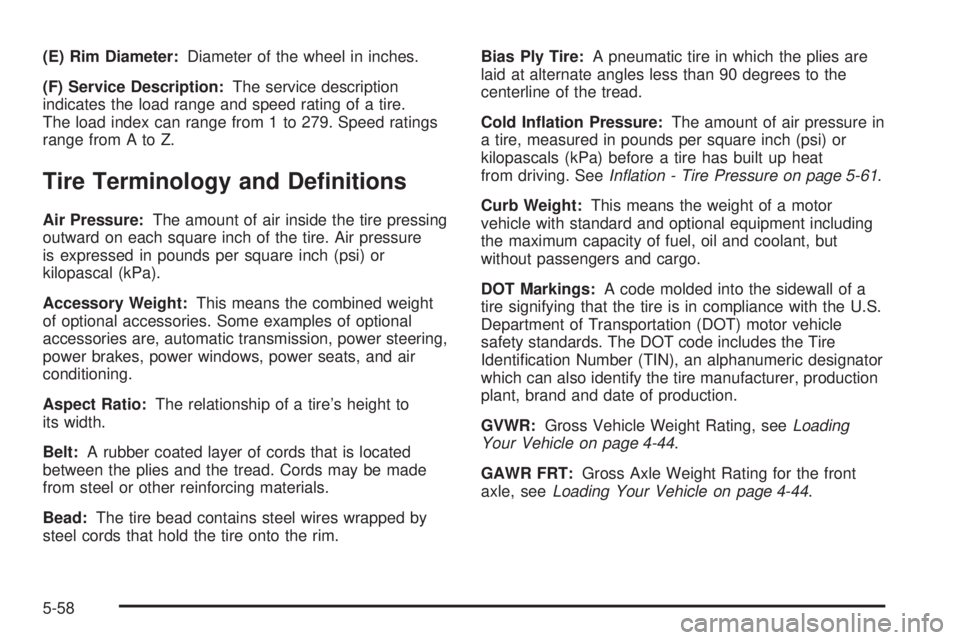
(E) Rim Diameter:Diameter of the wheel in inches.
(F) Service Description:The service description
indicates the load range and speed rating of a tire.
The load index can range from 1 to 279. Speed ratings
range from A to Z.
Tire Terminology and Denitions
Air Pressure:The amount of air inside the tire pressing
outward on each square inch of the tire. Air pressure
is expressed in pounds per square inch (psi) or
kilopascal (kPa).
Accessory Weight:This means the combined weight
of optional accessories. Some examples of optional
accessories are, automatic transmission, power steering,
power brakes, power windows, power seats, and air
conditioning.
Aspect Ratio:The relationship of a tire’s height to
its width.
Belt:A rubber coated layer of cords that is located
between the plies and the tread. Cords may be made
from steel or other reinforcing materials.
Bead:The tire bead contains steel wires wrapped by
steel cords that hold the tire onto the rim.Bias Ply Tire:A pneumatic tire in which the plies are
laid at alternate angles less than 90 degrees to the
centerline of the tread.
Cold Ination Pressure:The amount of air pressure in
a tire, measured in pounds per square inch (psi) or
kilopascals (kPa) before a tire has built up heat
from driving. SeeInation - Tire Pressure on page 5-61.
Curb Weight:This means the weight of a motor
vehicle with standard and optional equipment including
the maximum capacity of fuel, oil and coolant, but
without passengers and cargo.
DOT Markings:A code molded into the sidewall of a
tire signifying that the tire is in compliance with the U.S.
Department of Transportation (DOT) motor vehicle
safety standards. The DOT code includes the Tire
Identication Number (TIN), an alphanumeric designator
which can also identify the tire manufacturer, production
plant, brand and date of production.
GVWR:Gross Vehicle Weight Rating, seeLoading
Your Vehicle on page 4-44.
GAWR FRT:Gross Axle Weight Rating for the front
axle, seeLoading Your Vehicle on page 4-44.
5-58
Page 412 of 502
To reinstall the cover, line up the tabs at the back of the
cover, put it in place and latch the tabs.
A continuous ashing indicator light may also indicate a
malfunction in the air suspension system. See
“Electronically Controlled Air Suspension System” under
Loading Your Vehicle on page 4-44for more information.
{CAUTION:
Inating something too much can make it
explode, and you or others could be injured.
Be sure to read the inator instructions, and
inate any object only to its recommended
pressure.
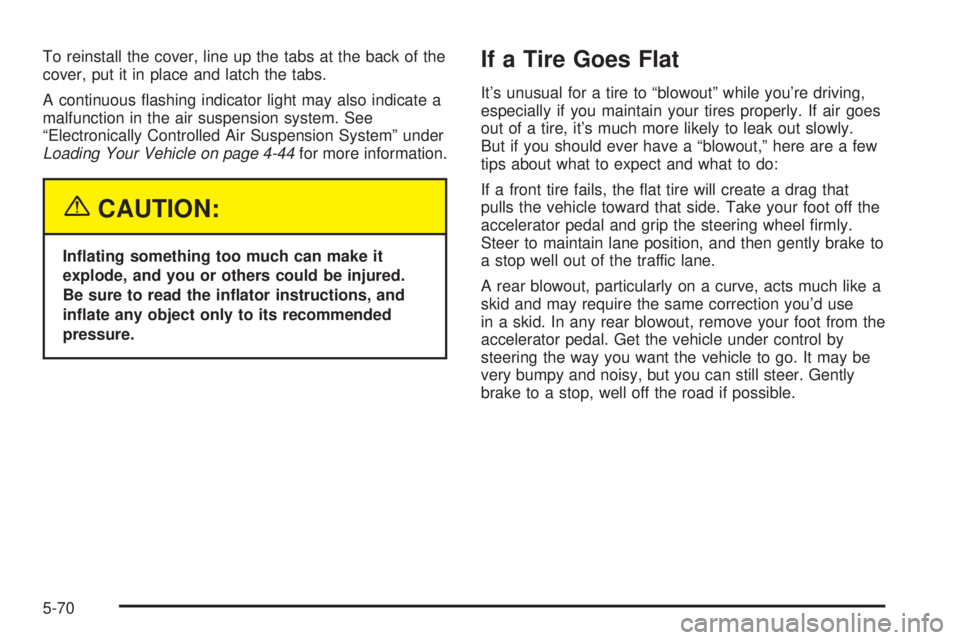
If a Tire Goes Flat
It’s unusual for a tire to “blowout” while you’re driving,
especially if you maintain your tires properly. If air goes
out of a tire, it’s much more likely to leak out slowly.
But if you should ever have a “blowout,” here are a few
tips about what to expect and what to do:
If a front tire fails, the at tire will create a drag that
pulls the vehicle toward that side. Take your foot off the
accelerator pedal and grip the steering wheel rmly.
Steer to maintain lane position, and then gently brake to
a stop well out of the traffic lane.
A rear blowout, particularly on a curve, acts much like a
skid and may require the same correction you’d use
in a skid. In any rear blowout, remove your foot from the
accelerator pedal. Get the vehicle under control by
steering the way you want the vehicle to go. It may be
very bumpy and noisy, but you can still steer. Gently
brake to a stop, well off the road if possible.
5-70
Page 489 of 502
A
Accessory Inator...........................................5-69
Accessory Power Outlets.................................3-19
Adding Equipment to Your Airbag-Equipped
Vehicle.......................................................1-63
Additives, Fuel................................................. 5-6
Add-On Electrical Equipment............................5-96
Adjustable Throttle and Brake Pedal..................2-21
Air Cleaner/Filter, Engine.................................5-20
Air Conditioning......................................3-21, 3-23
Airbag
Passenger Status Indicator...........................3-37
Readiness Light..........................................3-36
Airbag Sensing and Diagnostic Module (SDM)....7-10
Airbag System................................................1-48
Adding Equipment to Your Airbag-Equipped
Vehicle...................................................1-63
How Does an Airbag Restrain?......................1-55
Passenger Sensing System...........................1-58
Servicing Your Airbag-Equipped Vehicle..........1-62
What Makes an Airbag Inate?......................1-55
What Will You See After an Airbag Inates?....1-56
When Should an Airbag Inate?....................1-53
Where Are the Airbags?...............................1-50
Antenna, Fixed Mast......................................3-139
Antenna, XM™ Satellite Radio Antenna System . . . 3-139
Anti-Lock Brake System (ABS)........................... 4-7Anti-Lock Brake, System Warning Light..............3-41
Appearance Care............................................5-86
Aluminum Wheels........................................5-91
Care of Safety Belts....................................5-89
Chemical Paint Spotting...............................5-93
Cleaning Exterior Lamps/Lenses....................5-90
Fabric/Carpet..............................................5-86
Finish Care.................................................5-90
Finish Damage............................................5-93
Glass Surfaces............................................5-88
Instrument Panel.........................................5-88
Interior Plastic Components...........................5-88
Leather......................................................5-88
Sheet Metal Damage...................................5-92
Tires..........................................................5-92
Underbody Maintenance...............................5-93
Vehicle Care/Appearance Materials................5-94
Vinyl..........................................................5-88
Washing Your Vehicle...................................5-89
Weatherstrips..............................................5-89
Windshield, Backglass, and Wiper Blades.......5-91
Ashtrays........................................................3-20
Assist Handles...............................................2-55
Audio System(s).............................................3-65
Audio Steering Wheel Controls....................3-136
Care of Your Cassette Tape Player...............3-137
Care of Your CD and DVD Player................3-139
1
Page 493 of 502
E
Electrical System
Add-On Equipment......................................5-96
Engine Compartment Fuse Block...................5-97
Fuses and Circuit Breakers...........................5-97
Headlamps.................................................5-96
Power Windows and Other Power Options......5-96
Rear Underseat Fuse Block.........................5-106
Windshield Wiper Fuses...............................5-96
Engine
Air Cleaner/Filter.........................................5-20
Battery.......................................................5-41
Change Engine Oil Light...............................3-46
Check and Service Engine Soon Light............3-42
Coolant......................................................5-25
Coolant Heater............................................2-21
Coolant Temperature Gage...........................3-41
Engine Compartment Overview......................5-12
Exhaust.....................................................2-34
Fan Noise..................................................5-35
Oil .............................................................5-16
Overheating................................................5-28
Reduced Power Light...................................3-47
Starting......................................................2-20
Entry Lighting.................................................3-19
Event Data Recorders (EDR)............................7-10
Exit Lighting...................................................3-19
Extender, Safety Belt.......................................1-26
F
Filter
Engine Air Cleaner......................................5-20
Finish Damage...............................................5-93
Fixed Mast Antenna.......................................3-139
Flash-to-Pass................................................... 3-8
Flat Tire........................................................5-70
Flat Tire, Changing.........................................5-71
Flat Tire, Storing.............................................5-82
Fluid
Automatic Transmission................................5-22
Power Steering...........................................5-36
Windshield Washer......................................5-36
Fog Lamps....................................................3-17
Four-Wheel Drive....................................2-26, 5-48
Front Axle......................................................5-48
Fuel............................................................... 5-5
Additives...................................................... 5-6
California Fuel.............................................. 5-5
Check Gas Cap Light...................................3-51
Filling a Portable Fuel Container..................... 5-9
Filling Your Tank........................................... 5-7
Fuels in Foreign Countries.............................. 5-6
Gage.........................................................3-50
Gasoline Octane........................................... 5-5
Gasoline Specications.................................. 5-5
Low Warning Light.......................................3-51
5
Page 497 of 502
N
Navigation/Radio System................................3-134
New Vehicle Break-In......................................2-18
Normal Maintenance Replacement Parts............6-14
O
Odometer......................................................3-34
Odometer, Trip...............................................3-34
Off-Road Recovery..........................................4-13
Oil
Change Engine Oil Light...............................3-46
Engine.......................................................5-16
Pressure Gage............................................3-45
Older Children, Restraints................................1-26
Online Owner Center........................................ 7-4
OnStar
®System.............................................2-47
Operating Your All-Wheel-Drive Vehicle Off
Paved Roads..............................................4-16
Other Warning Devices...................................... 3-6
Outlet Adjustment............................................3-28
Outside
Convex Mirror.............................................2-47
Curb View Assist Mirror................................2-46
Heated Mirrors............................................2-47
Manual Mirrors............................................2-45
Power Mirrors.............................................2-46
Overhead Console..........................................2-54Owner Checks and Services.............................. 6-9
Owners, Canadian............................................... ii
P
Park (P)
Shifting Into................................................2-31
Shifting Out of............................................2-33
Parking
Brake........................................................2-30
Over Things That Burn.................................2-33
Passenger Airbag Status Indicator.....................3-37
Passenger Sensing System..............................1-58
Passing.........................................................4-14
Passlock
®......................................................2-18
Personalization, Climate Controls......................3-31
Power
Accessory Outlets........................................3-19
Electrical System.........................................5-96
Lumbar Controls........................................... 1-2
Rear Quarter Windows.................................2-16
Reduced Engine Light..................................3-47
Retained Accessory (RAP)............................2-19
Seat............................................................ 1-2
Steering Fluid.............................................5-36
Windows....................................................2-15
Pretensioners, Safety Belt................................1-26
Programmable Automatic Door Locks.................. 2-9
Programming the HomeLink
®Transmitter...........2-50
9
Page 500 of 502
Servicing Your Airbag-Equipped Vehicle..............1-62
Setting the Time.............................................3-65
Sheet Metal Damage.......................................5-92
Shifting Into Park (P).......................................2-31
Shifting Out of Park (P)...................................2-33
Signals, Turn and Lane-Change.......................... 3-7
Spare Tire.....................................................5-85
Installing....................................................5-75
Removing...................................................5-72
Storing.......................................................5-82
Specications, Capacities...............................5-113
Speedometer..................................................3-34
Starting Your Engine.......................................2-20
Steering........................................................4-11
Steering Wheel Controls, Audio.......................3-136
Steering Wheel, Tilt Wheel................................. 3-6
Storage Areas
Center Console Storage Area........................2-54
Convenience Net.........................................2-58
Glove Box..................................................2-54
Luggage Carrier..........................................2-55
Overhead Console.......................................2-54
Rear Compartment Storage Panel/Cover.........2-56
Rear Floor Storage Lid.................................2-58
Stuck in Sand, Mud, Ice or Snow......................4-43
Sun Visors.....................................................2-16
Sunroof.........................................................2-60T
Tachometer....................................................3-34
Taillamps
Turn Signal, and Stoplamps..........................5-50
Theft-Deterrent, Radio....................................3-135
Theft-Deterrent Systems...................................2-16
Content Theft-Deterrent................................2-16
Passlock
®...................................................2-18
Throttle, Adjustable..........................................2-21
Tilt Wheel........................................................ 3-6
Tires.............................................................5-54
Aluminum Wheels, Cleaning..........................5-91
Buying New Tires........................................5-64
Chains.......................................................5-68
Changing a Flat Tire....................................5-71
Cleaning....................................................5-92
If a Tire Goes Flat.......................................5-70
Ination -- Tire Pressure...............................5-61
Inspection and Rotation................................5-62
Installing the Spare Tire................................5-75
Removing the Flat Tire.................................5-75
Removing the Spare Tire and Tools...............5-72
Secondary Latch System..............................5-80
Spare Tire..................................................5-85
Storing a Flat or Spare Tire and Tools............5-82
Tire Sidewall Labelling..................................5-55
12