mirror GMC ENVOY DENALI 2007 Owner's Guide
[x] Cancel search | Manufacturer: GMC, Model Year: 2007, Model line: ENVOY DENALI, Model: GMC ENVOY DENALI 2007Pages: 562, PDF Size: 2.87 MB
Page 234 of 562
Choose one of the available options and press the
customization button while it is displayed on the
DIC to select it and move on to the next feature.
For more information on the memory seat feature,
seeMemory Seat, Mirrors, and Pedals on page 12.
Curb View
Press the customization button until CURB VIEW:
OFF appears in the display. To select your
preference for curb view, press the select button
while CURB VIEW: OFF is displayed on the
DIC. Pressing the select button will scroll through
the following choices:
CURB VIEW: OFF (default):The passenger’s
outside mirror will not be tilted down when
the vehicle is shifted into REVERSE (R).
CURB VIEW: PASSENGER:The passenger’s
outside mirror will be tilted down when the vehicle
is shifted into REVERSE (R).
When the vehicle is placed in PARK (P) or in any
forward gear, the mirror will return to the normal
driving position, following a short delay.Choose one of the available options and press the
customization button while it is displayed on the
DIC to select it and move on to the next feature.
For more information on tilt mirror in reverse,
seeOutside Curb View Assist Mirror on page 144.
Alarm Warning
Press the customization button until ALARM
WARNING: BOTH appears in the display. To
select your preference for alarm warning, press the
select button while ALARM WARNING: BOTH is
displayed on the DIC. Pressing the select
button will scroll through the following choices:
ALARM WARNING: BOTH (default):The
headlamps will ash and the horn will chirp when
the alarm is active.
ALARM WARNING: HORN:The horn will chirp
when the alarm is active.
ALARM WARNING: LAMPS:The headlamps will
ash when the alarm is active.
234
Page 317 of 562
Watch for traffic signs, pavement markings, and
lines. If you can see a sign up ahead that might
indicate a turn or an intersection, delay your
pass. A broken center line usually indicates it is
all right to pass, providing the road ahead is
clear. Never cross a solid line on your side of
the lane or a double solid line, even if the road
seems empty of approaching traffic.
Do not get too close to the vehicle you want to
pass while you are awaiting an opportunity. For
one thing, following too closely reduces your
area of vision, especially if you are following a
larger vehicle. Also, you will not have adequate
space if the vehicle ahead suddenly slows or
stops. Keep back a reasonable distance.
When it looks like a chance to pass is coming
up, start to accelerate but stay in the right lane
and do not get too close. Time your move so
you will be increasing speed as the time comes
to move into the other lane. If the way is clear to
pass, you will have a running start that more
than makes up for the distance you would lose
by dropping back. And if something happens to
cause you to cancel your pass, you need only
slow down and drop back again and wait for
another opportunity.
If other vehicles are lined up to pass a slow
vehicle, wait your turn. But take care that
someone is not trying to pass you as you pull
out to pass the slow vehicle. Remember to
glance over your shoulder and check the
blind spot.
Check your vehicle’s mirrors, glance over your
shoulder, and start your left lane change signal
before moving out of the right lane to pass.
When you are far enough ahead of the passed
vehicle to see its front in your vehicle’s inside
mirror, activate the right lane change signal and
move back into the right lane. Remember that
your vehicle’s passenger side outside mirror is
convex. The vehicle you just passed may seem
to be farther away from you than it really is.
Try not to pass more than one vehicle at a time
on two-lane roads. Reconsider before passing
the next vehicle.
Do not overtake a slowly moving vehicle too
rapidly. Even though the brake lamps are not
ashing, it may be slowing down or starting
to turn.
If you are being passed, make it easy for the
following driver to get ahead of you. Perhaps
you can ease a little to the right.
317
Page 318 of 562
Loss of Control
Let us review what driving experts say about what
happens when the three control systems — brakes,
steering, and acceleration — do not have enough
friction where the tires meet the road to do what the
driver has asked.
In any emergency, do not give up. Keep trying to
steer and constantly seek an escape route or
area of less danger.
Skidding
In a skid, a driver can lose control of the vehicle.
Defensive drivers avoid most skids by taking
reasonable care suited to existing conditions, and
by not overdriving those conditions. But skids
are always possible.
The three types of skids correspond to your
vehicle’s three control systems. In the braking skid,
your wheels are not rolling. In the steering or
cornering skid, too much speed or steering in a
curve causes tires to slip and lose cornering force.
And in the acceleration skid, too much throttle
causes the driving wheels to spin.
A cornering skid is best handled by easing your
foot off the accelerator pedal.If your vehicle starts to slide, ease your foot off
the accelerator pedal and quickly steer the
way you want the vehicle to go. If you start
steering quickly enough, your vehicle may
straighten out. Always be ready for a second skid
if it occurs.
Of course, traction is reduced when water, snow,
ice, gravel, or other material is on the road.
For safety, you will want to slow down and adjust
your driving to these conditions. It is important
to slow down on slippery surfaces because
stopping distance will be longer and vehicle control
more limited.
While driving on a surface with reduced traction, try
your best to avoid sudden steering, acceleration, or
braking, including reducing vehicle speed by
shifting to a lower gear. Any sudden changes could
cause the tires to slide. You may not realize the
surface is slippery until your vehicle is skidding.
Learn to recognize warning clues — such as
enough water, ice, or packed snow on the road to
make a mirrored surface — and slow down when
you have any doubt.
Remember: Any Anti-Lock Brake System (ABS)
helps avoid only the braking skid.
318
Page 334 of 562
Driving at Night
Night driving is more dangerous than day driving.
One reason is that some drivers are likely to
be impaired — by alcohol or drugs, with night
vision problems, or by fatigue.
Here are some tips on night driving.
Drive defensively.
Do not drink and drive.
Adjust the inside rearview mirror to reduce the
glare from headlamps behind you.
Since you cannot see as well, you may need
to slow down and keep more space between
you and other vehicles.
Slow down, especially on higher speed roads.
Your vehicle’s headlamps can light up only so
much road ahead.
In remote areas, watch for animals.
If you are tired, pull off the road in a safe
place and rest.No one can see as well at night as in the daytime.
But as we get older these differences increase.
A 50-year-old driver may require at least twice as
much light to see the same thing at night as a
20-year-old.
What you do in the daytime can also affect your
night vision. For example, if you spend the day in
bright sunshine you are wise to wear sunglasses.
Your eyes will have less trouble adjusting to night.
But if you are driving, do not wear sunglasses at
night. They may cut down on glare from headlamps,
but they also make a lot of things invisible.
You can be temporarily blinded by approaching
headlamps. It can take a second or two, or even
several seconds, for your eyes to re-adjust to the
dark. When you are faced with severe glare, as
from a driver who does not lower the high beams, or
a vehicle with misaimed headlamps, slow down a
little. Avoid staring directly into the approaching
headlamps.
334
Page 339 of 562
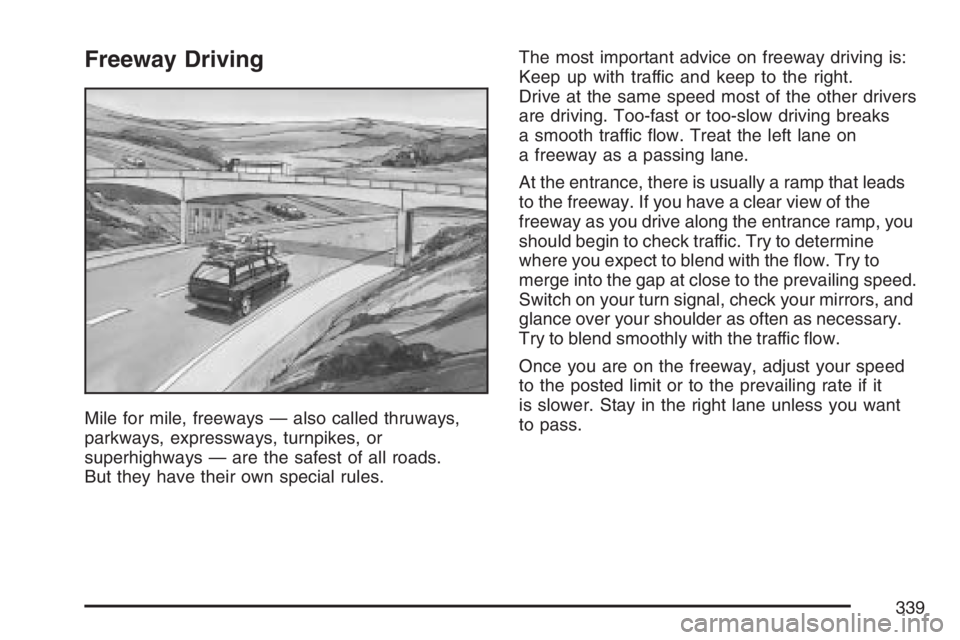
Freeway Driving
Mile for mile, freeways — also called thruways,
parkways, expressways, turnpikes, or
superhighways — are the safest of all roads.
But they have their own special rules.The most important advice on freeway driving is:
Keep up with traffic and keep to the right.
Drive at the same speed most of the other drivers
are driving. Too-fast or too-slow driving breaks
a smooth traffic ow. Treat the left lane on
a freeway as a passing lane.
At the entrance, there is usually a ramp that leads
to the freeway. If you have a clear view of the
freeway as you drive along the entrance ramp, you
should begin to check traffic. Try to determine
where you expect to blend with the ow. Try to
merge into the gap at close to the prevailing speed.
Switch on your turn signal, check your mirrors, and
glance over your shoulder as often as necessary.
Try to blend smoothly with the traffic ow.
Once you are on the freeway, adjust your speed
to the posted limit or to the prevailing rate if it
is slower. Stay in the right lane unless you want
to pass.
339
Page 340 of 562
Before changing lanes, check your mirrors.
Then use your turn signal.
Just before you leave the lane, glance quickly
over your shoulder to make sure there is not
another vehicle in your blind spot.
Once you are moving on the freeway, make
certain you allow a reasonable following distance.
Expect to move slightly slower at night.
When you want to leave the freeway, move to the
proper lane well in advance. If you miss your
exit, do not, under any circumstances, stop and
back up. Drive on to the next exit.
The exit ramp can be curved, sometimes quite
sharply. The exit speed is usually posted.
Reduce your speed according to your
speedometer, not to your sense of motion.
After driving for any distance at higher speeds,
you may tend to think you are going slower than
you actually are.Before Leaving on a Long Trip
Make sure you are ready. Try to be well rested.
If you must start when you are not fresh — such as
after a day’s work — do not plan to make too
many miles that rst part of the journey. Wear
comfortable clothing and shoes you can easily
drive in.
Is your vehicle ready for a long trip? If you keep it
serviced and maintained, it is ready to go. If it
needs service, have it done before starting out.
Of course, you will nd experienced and able
service experts in GM dealerships all across
North America. They will be ready and willing to
help if you need it.
340
Page 341 of 562
Here are some things you can check before a trip:
Windshield Washer Fluid:Is the reservoir
full? Are all windows clean inside and outside?
Wiper Blades:Are they in good shape?
Fuel, Engine Oil, Other Fluids:Have you
checked all levels?
Lamps:Are they all working? Are the lenses
clean?
Tires:They are vitally important to a safe,
trouble-free trip. Is the tread good enough
for long-distance driving? Are the tires
all inated to the recommended pressure?
Weather Forecasts:What is the weather
outlook along your route? Should you
delay your trip a short time to avoid a major
storm system?
Maps:Do you have up-to-date maps?
Highway Hypnosis
Is there actually such a condition as highway
hypnosis? Or is it just plain falling asleep at the
wheel? Call it highway hypnosis, lack of
awareness, or whatever.
There is something about an easy stretch of road
with the same scenery, along with the hum of the
tires on the road, the drone of the engine, and the
rush of the wind against the vehicle that can make
you sleepy. Do not let it happen to you! If it does,
your vehicle can leave the road in less than a
second, and you could crash and be injured.
What can you do about highway hypnosis?
First, be aware that it can happen.
Then here are some tips:
Make sure your vehicle is well ventilated, with
a comfortably cool interior.
Keep your eyes moving. Scan the road ahead
and to the sides. Check your mirrors and your
instruments frequently.
If you get sleepy, pull off the road into a rest,
service, or parking area and take a nap, get
some exercise, or both. For safety, treat
drowsiness on the highway as an emergency.
341
Page 370 of 562
Driving with a Trailer
{CAUTION:
If you have a rear-most window open and
you pull a trailer with your vehicle, carbon
monoxide (CO) could come into your
vehicle. You can not see or smell CO. It can
cause unconsciousness or death. See
Engine Exhaust on page 131. To maximize
your safety when towing a trailer:
Have your exhaust system inspected
for leaks, and make necessary repairs
before starting on your trip.
Keep the rear-most windows closed.
If exhaust does come into your vehicle
through a window in the rear or another
opening, drive with your front, main
heating or cooling system on and with
the fan on any speed. This will bring
fresh, outside air into your vehicle.
CAUTION: (Continued)
CAUTION: (Continued)
Do not use the climate control setting for
maximum air because it only recirculates
the air inside your vehicle. SeeDual
Climate Control System on page 186.
Towing a trailer requires a certain amount of
experience. Before setting out for the open road,
you’ll want to get to know your rig. Acquaint
yourself with the feel of handling and braking with
the added weight of the trailer. And always
keep in mind that the vehicle you are driving is
now a good deal longer and not nearly as
responsive as your vehicle is by itself.
Before you start, check all trailer hitch parts and
attachments, safety chains, electrical connection,
lamps, tires and mirror adjustment. If the trailer
has electric brakes, start your vehicle and
trailer moving and then apply the trailer brake
controller by hand to be sure the brakes are
working. This lets you check your electrical
connection at the same time.
370
Page 555 of 562
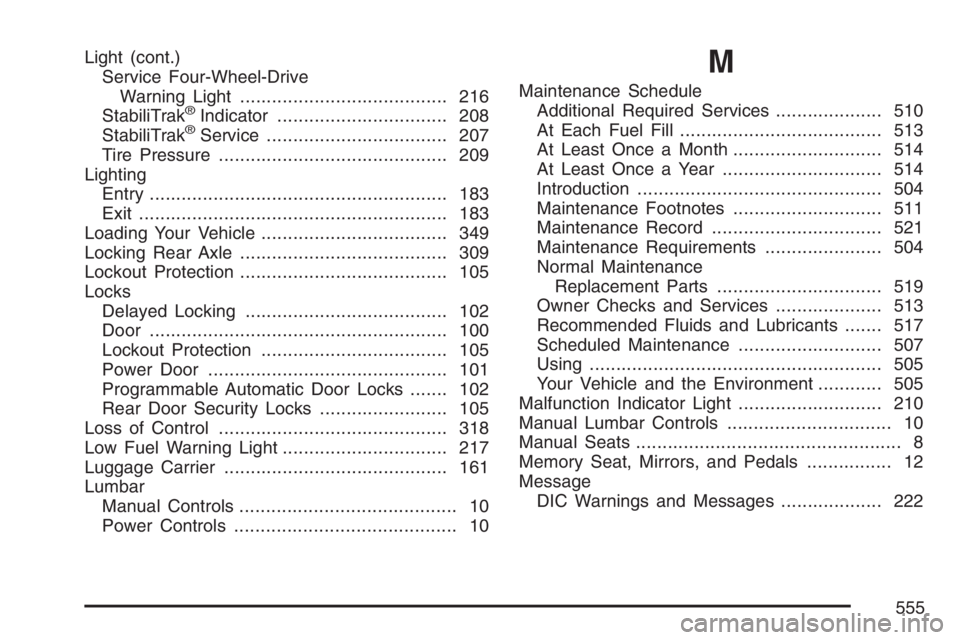
Light (cont.)
Service Four-Wheel-Drive
Warning Light....................................... 216
StabiliTrak
®Indicator................................ 208
StabiliTrak®Service.................................. 207
Tire Pressure........................................... 209
Lighting
Entry........................................................ 183
Exit.......................................................... 183
Loading Your Vehicle................................... 349
Locking Rear Axle....................................... 309
Lockout Protection....................................... 105
Locks
Delayed Locking...................................... 102
Door........................................................ 100
Lockout Protection................................... 105
Power Door............................................. 101
Programmable Automatic Door Locks....... 102
Rear Door Security Locks........................ 105
Loss of Control........................................... 318
Low Fuel Warning Light............................... 217
Luggage Carrier.......................................... 161
Lumbar
Manual Controls......................................... 10
Power Controls.......................................... 10
M
Maintenance Schedule
Additional Required Services.................... 510
At Each Fuel Fill...................................... 513
At Least Once a Month............................ 514
At Least Once a Year .............................. 514
Introduction.............................................. 504
Maintenance Footnotes............................ 511
Maintenance Record................................ 521
Maintenance Requirements...................... 504
Normal Maintenance
Replacement Parts............................... 519
Owner Checks and Services.................... 513
Recommended Fluids and Lubricants....... 517
Scheduled Maintenance........................... 507
Using....................................................... 505
Your Vehicle and the Environment............ 505
Malfunction Indicator Light........................... 210
Manual Lumbar Controls............................... 10
Manual Seats.................................................. 8
Memory Seat, Mirrors, and Pedals................ 12
Message
DIC Warnings and Messages................... 222
555
Page 556 of 562
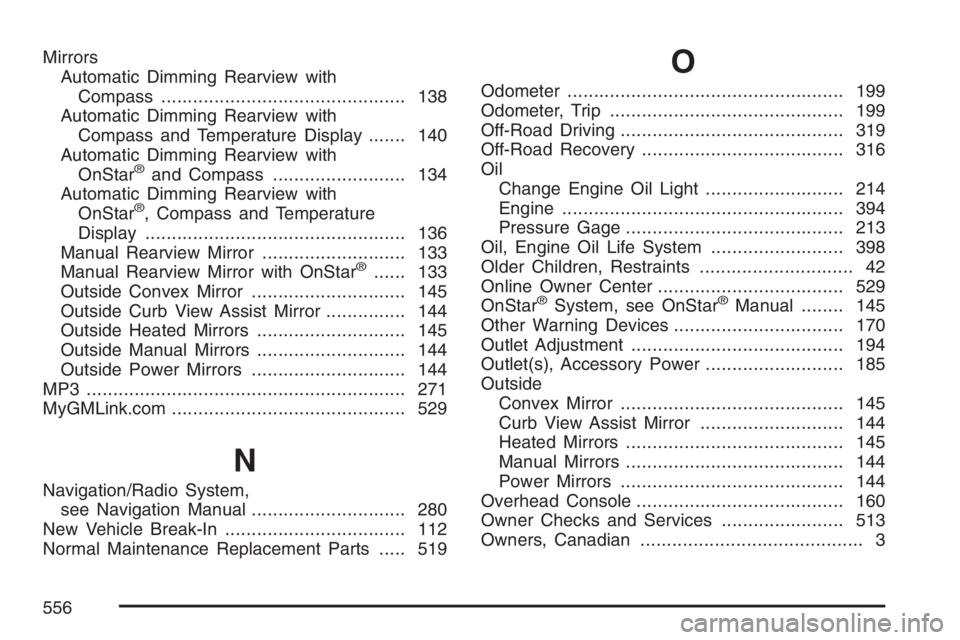
Mirrors
Automatic Dimming Rearview with
Compass.............................................. 138
Automatic Dimming Rearview with
Compass and Temperature Display....... 140
Automatic Dimming Rearview with
OnStar
®and Compass......................... 134
Automatic Dimming Rearview with
OnStar
®, Compass and Temperature
Display................................................. 136
Manual Rearview Mirror........................... 133
Manual Rearview Mirror with OnStar
®...... 133
Outside Convex Mirror............................. 145
Outside Curb View Assist Mirror............... 144
Outside Heated Mirrors............................ 145
Outside Manual Mirrors............................ 144
Outside Power Mirrors............................. 144
MP3 ............................................................ 271
MyGMLink.com............................................ 529
N
Navigation/Radio System,
see Navigation Manual............................. 280
New Vehicle Break-In.................................. 112
Normal Maintenance Replacement Parts..... 519
O
Odometer.................................................... 199
Odometer, Trip............................................ 199
Off-Road Driving.......................................... 319
Off-Road Recovery...................................... 316
Oil
Change Engine Oil Light.......................... 214
Engine..................................................... 394
Pressure Gage......................................... 213
Oil, Engine Oil Life System ......................... 398
Older Children, Restraints............................. 42
Online Owner Center................................... 529
OnStar
®System, see OnStar®Manual........ 145
Other Warning Devices................................ 170
Outlet Adjustment........................................ 194
Outlet(s), Accessory Power.......................... 185
Outside
Convex Mirror.......................................... 145
Curb View Assist Mirror........................... 144
Heated Mirrors......................................... 145
Manual Mirrors......................................... 144
Power Mirrors.......................................... 144
Overhead Console....................................... 160
Owner Checks and Services....................... 513
Owners, Canadian.......................................... 3
556