traction GMC ENVOY DENALI 2007 Owners Manual
[x] Cancel search | Manufacturer: GMC, Model Year: 2007, Model line: ENVOY DENALI, Model: GMC ENVOY DENALI 2007Pages: 562, PDF Size: 2.87 MB
Page 122 of 562

Four-Wheel Drive
If your vehicle has four-wheel drive, the engine’s
driving power can be sent to all four wheels
for extra traction. To get the most satisfaction out
of four-wheel drive, you must be familiar with
its operation. Read the part that follows before
using four-wheel drive. You should use Two-Wheel
High for most normal driving conditions.
Notice:Driving on clean, dry pavement in
Four-Wheel-Drive High or Four-Wheel-Drive
Low for an extended period of time may cause
premature wear on your vehicle’s powertrain.
Do not drive on clean, dry pavement in
Four-Wheel-Drive High or Four-Wheel-Drive
Low for extended periods of time.
Automatic Transfer Case
If your vehicle has four-wheel drive, the transfer
case knob is located to the right of the steering
wheel on the instrument panel.Use this knob to shift
into and out of
four-wheel drive
2
m(Two-Wheel High):This setting is for
driving in most street and highway situations.
Your front axle is not engaged in two-wheel drive.
It also provides the best fuel economy.
AUTO (Automatic Four-Wheel Drive):This
setting is ideal for use when road conditions are
variable. When driving your vehicle in automatic
four-wheel drive, the front axle is engaged, but the
vehicle’s power is sent to the rear wheels.
When the vehicle senses a loss of traction, the
system will automatically engage four-wheel drive.
Driving in this mode results in slightly lower fuel
economy than Two-Wheel High.
122
Page 123 of 562

4m(Four-Wheel High):This setting should be
used when you need extra traction, such as
on snowy or icy roads or in most off-road
situations. This setting also engages your front
axle to help drive your vehicle.
4
n(Four-Wheel Low):This setting also
engages your front axle and delivers extra torque.
It sends maximum power to all four wheels.
You might choose this setting if you are driving
off-road in deep sand, deep mud, and climbing or
descending steep hills.
{CAUTION:
Shifting the transfer case to NEUTRAL
can cause your vehicle to roll even if the
transmission is in PARK (P). You or
someone else could be seriously injured.
Be sure to set the parking brake before
placing the transfer case in NEUTRAL.
SeeParking Brake on page 126.NEUTRAL:Shift the vehicle’s transfer case to
NEUTRAL only when towing your vehicle.
SeeRecreational Vehicle Towing on page 355for
more information.
An indicator light in the knob will show you which
position the transfer case is in. The indicator
lights will come on briey when you turn on the
ignition and one will stay on. If the lights do
not come on, you should take your vehicle to your
dealer for service. An indicator light will ash
while shifting the transfer case. It will stay on when
the shift is complete. If for some reason the
transfer case cannot make a requested shift, it will
return to the last chosen setting.
If the service Four-Wheel Drive Warning Light on
the instrument panel cluster stays on, you
should take your vehicle to your dealer for service.
SeeService Four-Wheel Drive Warning Light on
page 216for further information.
123
Page 176 of 562

Cruise Control
Your vehicle has cruise
control. The controls are
located on the end of
the turn signal/
multifunction lever.
R(On):Move the switch to this position to turn
the cruise control system on.
S(Resume/Accelerate):Move the switch to this
position to resume a set speed or to accelerate.
T(Set):Press this button, located at the end of
the lever, to set a speed.
9(Off):Move the switch to this position to turn
the cruise control system off and cancel memory
of a set speed.With cruise control, you can maintain a speed of
about 25 mph (40 km/h) or more without
keeping your foot on the accelerator. This can
really help on long trips. Cruise control does not
work at speeds below about 25 mph (40 km/h).
If you apply the brakes, the cruise control shuts off.
{CAUTION:
Cruise control can be dangerous where
you cannot drive safely at a steady speed.
So, do not use your cruise control on
winding roads or in heavy traffic.
Cruise control can be dangerous on
slippery roads. On such roads, fast
changes in tire traction can cause
excessive wheel slip, and you could lose
control. Do not use cruise control on
slippery roads.
176
Page 208 of 562

StabiliTrak®Indicator Light
This warning light
should come on briey
when the engine is
started.
During most driving conditions, this light will not
come on. If the StabiliTrak
®System is actively
controlling the stability and/or traction of the
vehicle, this light will ash. This is normal.
This light will come on if any portion of the system
has been manually turned off or a problem is
detected in the system.
If your vehicle has a Driver Information Center, a
message will appear also, seeDIC Warnings
and Messages on page 222andStabiliTrak
®
System on page 309for more information.
Engine Coolant Temperature Gage
This gage shows the engine coolant temperature.
If the gage pointer moves into the red area, it
means that the engine coolant has overheated.
If you have been operating your vehicle under
normal driving conditions, you should pull off the
road, stop your vehicle and turn off the engine
as soon as possible.
SeeEngine Overheating on page 408for more
information.
United StatesCanada
208
Page 227 of 562
SERVICE TIRE MONITOR
This message displays if a part on the Tire
Pressure Monitor (TPM) system is not working
properly. If you drive your vehicle while any of the
four sensors are missing or inoperable, the
warning comes on in about 20 minutes. A sensor
would be missing, for example, if you put
different wheels on your vehicle without
transferring the sensors. If the warning comes on
and stays on, there may be a problem with the
TPM. See your dealer.
STABILITRAK ACTIVE
This message displays anytime the StabiliTrak®
system activates to maintain vehicle stability.
Any combination of engine speed management,
brake traction control, and stability control displays
this message.
STABILITRAK NOT READY
This message may display if driving conditions
delay StabiliTrak®system initialization. This
is normal. Once the system initializes, this
message will no longer be displayed on the DIC.
STABILITRAK OFF
This message displays when you press the
StabiliTrak®button for more than ve seconds or
when stability control has been automatically
disabled. The StabiliTrak
®button is located on the
transmission shift handle. To limit wheel spin and
realize the full benets of the stability enhancement
system, you should normally leave StabiliTrak
®on.
However, you should turn StabiliTrak®off if your
vehicle gets stuck in sand, mud, ice, or snow and
you want to rock your vehicle to attempt to free it, or
if you are driving in extreme off-road conditions and
require more wheel spin. SeeIf Your Vehicle is
Stuck in Sand, Mud, Ice, or Snow on page 348.
To turn the StabiliTrak
®system back on, press the
StabiliTrak®button again.
227
Page 228 of 562

There are several conditions that can cause this
message to appear.
The message may display if the brake system
warning light is on. SeeBrake System
Warning Light on page 206.
The message displays if the vehicle is shifted
into 4LO.
The message turns off as soon as the conditions
that caused the message to be displayed are
no longer present.
TIGHTEN FUEL CAP
This message may display and a chime may sound
if the vehicle’s fuel cap is not tightened properly.
Fully reinstall the fuel cap. SeeFilling the Tank on
page 385. The diagnostic system can determine if
the fuel cap has been left off or improperly installed.
A loose or missing fuel cap allows fuel to evaporate
into the atmosphere. This message remains on until
it is acknowledged and cleared from the DIC display
by pressing any of the DIC buttons or the trip stem.
The DIC message is also cancelled if the ignition is
turned off.The DIC message and the Service Engine Soon
light may come on again during a second trip if the
fuel cap is still not tightened properly. See
Malfunction Indicator Lamp on page 210for
more information.
TRACTION CONTROL OFF
This message displays when you momentarily
press the StabiliTrak®button located on the
transmission shift handle. In this mode, stability
control and the brake-traction control are
functional. Engine speed management will be
modied and the driven wheels can spin more
freely. For more details on this mode, see
StabiliTrak
®System on page 309.
TURN SIGNAL ON
This message displays and a chime sounds if a
turn signal is left on for 3/4 of a mile (1.2 km).
Move the turn signal/multifunction lever to the off
position. Press any of the DIC buttons, or the
trip stem, to acknowledge this message and clear
it from the DIC display.
228
Page 236 of 562
Units
Press the customization button until UNITS: U.S.
(ENGLISH) appears in the display. To select
English or metric, press the select button while
UNITS: U.S. (ENGLISH) is displayed on the DIC.
Pressing the select button will scroll through
the following choices:
UNITS: U.S. (ENGLISH) (default)
UNITS: METRIC (km/L)
UNITS: METRIC (L/100 km)
If U.S. (ENGLISH) is chosen, all information will
be displayed in English units. For example,
distance will be displayed in miles (mi) and fuel
economy in miles per gallon (MPG). If METRIC
(km/L) is chosen, all information will be displayed
in metric units. For example, distance will be
displayed in kilometers (km) and fuel economy in
kilometers per liter (km/L). If METRIC (L/100 km)
is chosen, all information will be displayed in metric
units. For example, distance will be displayed in
kilometers (km) and fuel economy in liters per
100 kilometers (L/100 km).
Choose one of the available options and press the
customization button while it is displayed on the
DIC to select it and exit out of the customizable
options.
Audio System(s)
Determine which radio your vehicle has and then
read the pages following to familiarize yourself
with its features.
Driving without distraction is a necessity for a
safer driving experience. SeeDefensive Driving on
page 302. By taking a few moments to read this
manual and get familiar with your vehicle’s
audio system, you can use it with less effort, as
well as take advantage of its features. While your
vehicle is parked, set up your audio system by
presetting your favorite radio stations, setting the
tone, and adjusting the speakers. Then, when
driving conditions permit, you can tune to
your favorite stations using the presets and
steering wheel controls if the vehicle has them.
236
Page 237 of 562
{CAUTION:
This system provides you with a far greater
access to audio stations and song listings.
Giving extended attention to entertainment
tasks while driving can cause a crash and
you or others can be injured or killed.
Always keep your eyes on the road and
your mind on the drive — avoid engaging
in extended searching while driving.
Keeping your mind on the drive is important for
safe driving. Here are some ways in which you can
help avoid distraction while driving.
While your vehicle is parked:
Familiarize yourself with all of its controls.
Familiarize yourself with its operation.
Set up your audio system by presetting your
favorite radio stations, setting the tone, and
adjusting the speakers. Then, when driving
conditions permit, you can tune to your favorite
radio stations using the presets and steering
wheel controls if the vehicle has them.Notice:Before adding any sound equipment to
your vehicle, such as an audio system, CD
player, CB radio, mobile telephone, or two-way
radio, make sure that it can be added by
checking with your dealer. Also, check federal
rules covering mobile radio and telephone
units. If sound equipment can be added, it is
very important to do it properly. Added sound
equipment may interfere with the operation of
your vehicle’s engine, radio, or other systems,
and even damage them. Your vehicle’s systems
may interfere with the operation of sound
equipment that has been added.
Notice:The chime signals related to safety
belts, parking brake, and other functions of
your vehicle operate through the radio/
entertainment system. If that equipment is
replaced or additional equipment is added to
your vehicle, the chimes may not work. Make
sure that replacement or additional equipment
is compatible with your vehicle before installing
it. SeeAccessories and Modifications on
page 380.
237
Page 280 of 562
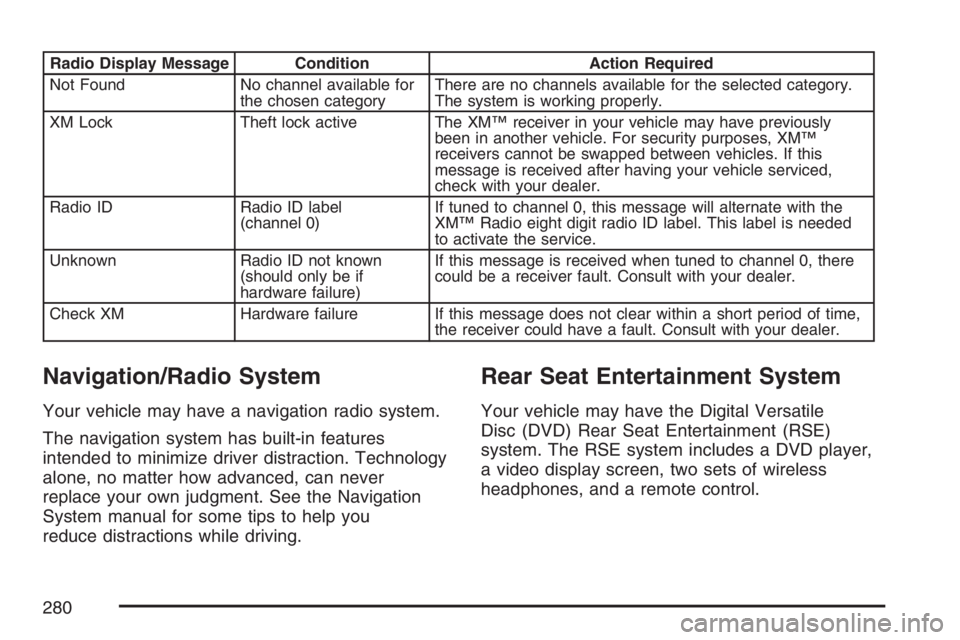
Radio Display Message Condition Action Required
Not Found No channel available for
the chosen categoryThere are no channels available for the selected category.
The system is working properly.
XM Lock Theft lock active The XM™ receiver in your vehicle may have previously
been in another vehicle. For security purposes, XM™
receivers cannot be swapped between vehicles. If this
message is received after having your vehicle serviced,
check with your dealer.
Radio ID Radio ID label
(channel 0)If tuned to channel 0, this message will alternate with the
XM™ Radio eight digit radio ID label. This label is needed
to activate the service.
Unknown Radio ID not known
(should only be if
hardware failure)If this message is received when tuned to channel 0, there
could be a receiver fault. Consult with your dealer.
Check XM Hardware failure If this message does not clear within a short period of time,
the receiver could have a fault. Consult with your dealer.
Navigation/Radio System
Your vehicle may have a navigation radio system.
The navigation system has built-in features
intended to minimize driver distraction. Technology
alone, no matter how advanced, can never
replace your own judgment. See the Navigation
System manual for some tips to help you
reduce distractions while driving.
Rear Seat Entertainment System
Your vehicle may have the Digital Versatile
Disc (DVD) Rear Seat Entertainment (RSE)
system. The RSE system includes a DVD player,
a video display screen, two sets of wireless
headphones, and a remote control.
280
Page 309 of 562
Remember: ABS does not change the time you
need to get your foot up to the brake pedal or
always decrease stopping distance. If you get too
close to the vehicle in front of you, you will not have
time to apply your brakes if that vehicle suddenly
slows or stops. Always leave enough room up
ahead to stop, even though you have ABS.
Using ABS
Do not pump the brakes. Just hold the brake
pedal down rmly and let anti-lock work for you.
You may feel the brakes vibrate, or you may notice
some noise, but this is normal.
Braking in Emergencies
With ABS, you can steer and brake at the same
time. In many emergencies, steering can help you
more than even the very best braking.
Locking Rear Axle
If your vehicle has this feature, your locking rear
axle can give you additional traction on snow, mud,
ice, sand or gravel. It works like a standard axle
most of the time, but when one of the rear wheels
has no traction and the other does, this feature will
allow the wheel with traction to move the vehicle.
StabiliTrak®System
Your vehicle is equipped with StabiliTrak®,
Electronic Stability Control (ESC) which combines
antilock brake, traction and stability control systems
and helps the driver maintain directional control of
the vehicle in most driving conditions.
Traction control activates when the controller
senses wheel spin. StabiliTrak
®will selectively
apply the brakes and reduce engine torque to help
regain traction.
Stability control activates when the controller
senses a discrepancy between your intended path
and the direction the vehicle is travelling.
StabiliTrak
®selectively applies braking pressure at
any one of the vehicle’s brakes to help guide the
vehicle in the direction which you are steering.
When you rst start your vehicle and begin to drive
away, the system performs several diagnostic
checks to insure there are no problems. You may
hear or feel the system working. This is normal and
does not mean there is a problem with your vehicle.
If driving conditions delay system initialization, the
STABILITRAK NOT READY message may be
displayed. If this is the case, your vehicle does not
need servicing.
309