belt GMC JIMMY 1997 User Guide
[x] Cancel search | Manufacturer: GMC, Model Year: 1997, Model line: JIMMY, Model: GMC JIMMY 1997Pages: 410, PDF Size: 20.03 MB
Page 27 of 410
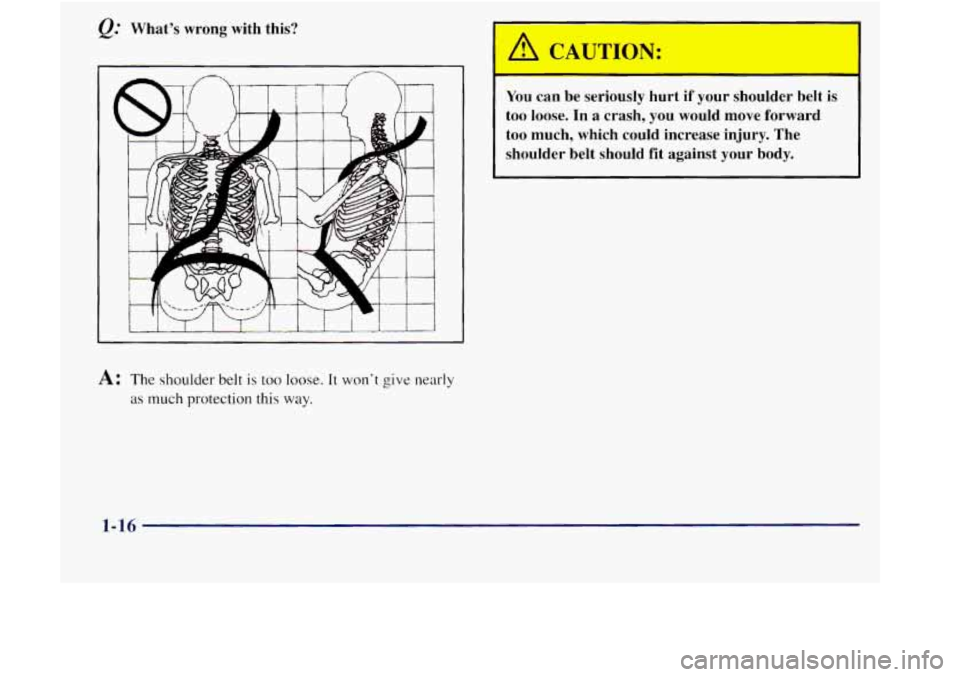
Q: What’s wrong with this?
A: The shoulder belt is too loose. It won’t give nearly
as much protection this way.
You can be seriously hurt if your shoulder belt is
too loose. In a crash, you would move forward
too much, which could increase injury. The
shoulder belt should
fit against your body.
1-16
Page 28 of 410
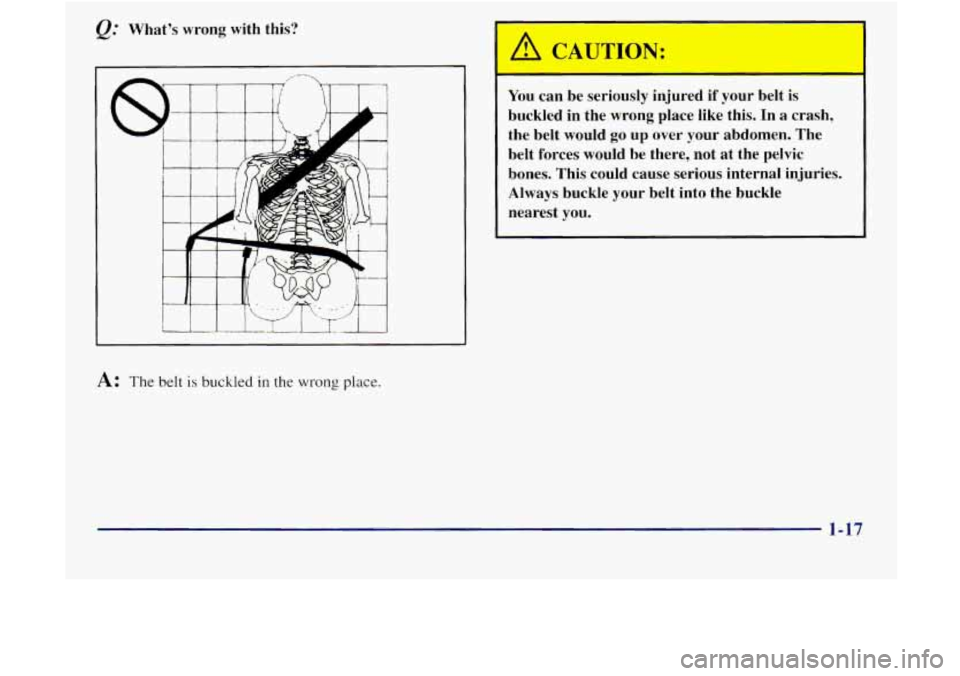
&.' What's wrong with this?
A: The belt is buckled in the wrong place.
A CA"TL3N:
You can be seriously injured if your belt is
buckled in the wrong place like this. In a crash,
the belt would
go up over your abdomen. The
belt forces would be there, not at the pelvic
bones. This could cause serious internal injuries.
Always buckle your belt into the buckle
nearest you.
1-17
Page 29 of 410
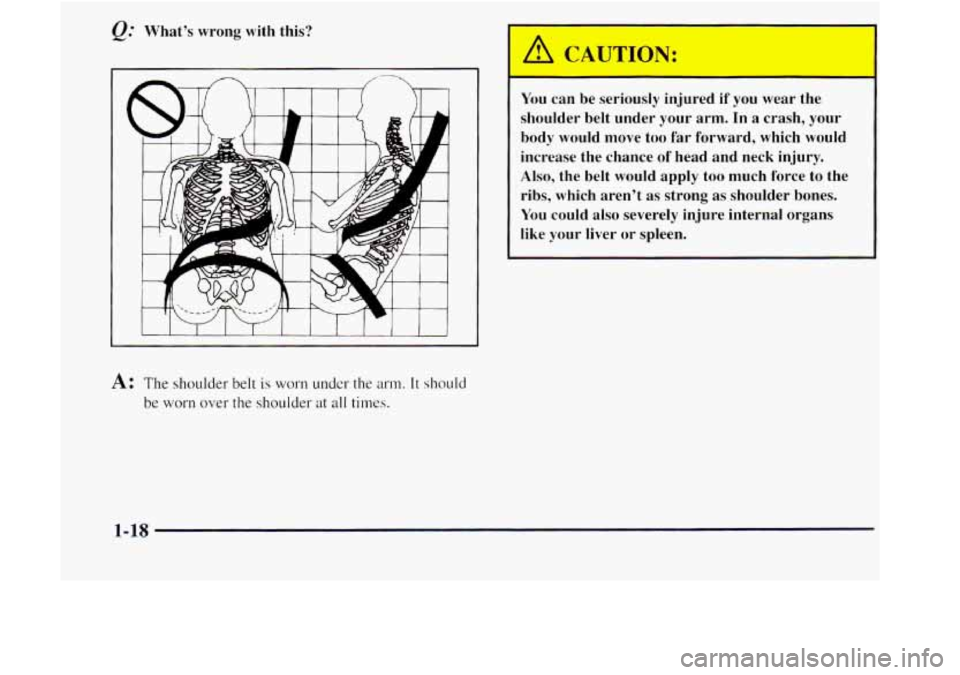
Q.’ What’s wrong with this?
A: The shoulder belt is worn under the ann. It should
be worn over the shoulder at all times.
You can be seriously injured if you wear the
shoulder belt under
your arm. In a crash, your
body would move too far forward, which would
increase the chance
of head and neck injury.
Also, the belt would apply too much force to the
ribs, which aren’t as strong
as shoulder bones.
You could also severely injure internal organs
like your liver or spleen.
1-1s
Page 30 of 410
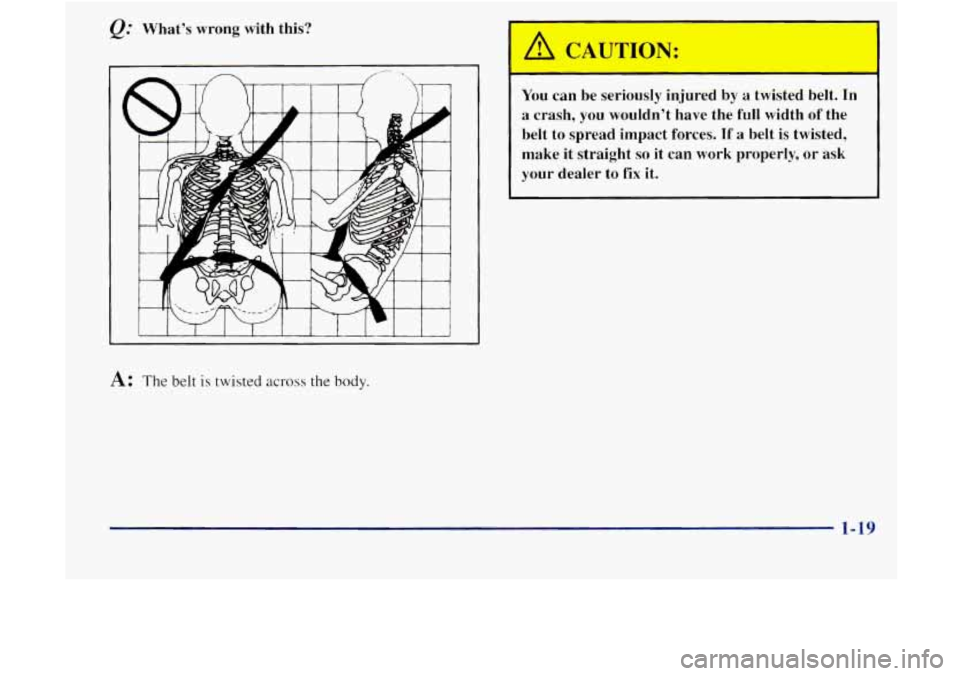
Q: What’s wrong with this?
A: The belt is twisted across the body.
You can be seriously injured by a twisted belt. In
a crash, you wouldn’t have the full width of the
belt to spread impact forces.
If a belt is twisted,
make it straight
so it can work properly, or ask
your dealer to fix it.
1-19
Page 31 of 410
Supplemental Inflatable Restraint
(SIR) System
This part explains the Supplemental Inflatable Restraint
(SIR) system or air bag system.
Your vehicle has
an air bag for the driver.
Here are the most important things to
know about the
air bag system:
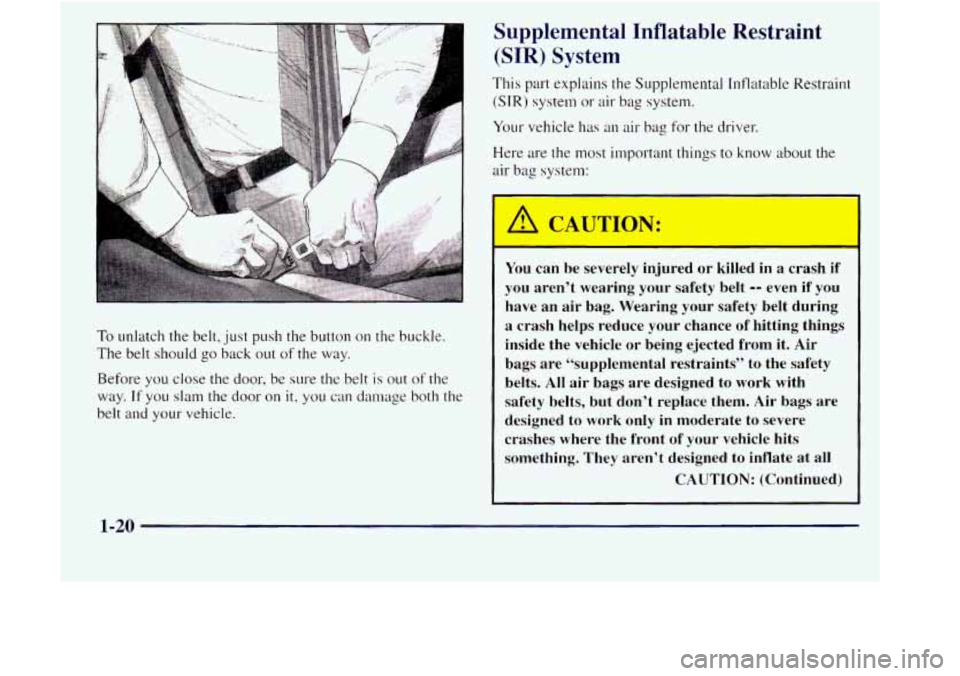
To unlatch the belt, just push the button on the buckle.
The belt should
go back out of the way.
Before you close the door, be sure the belt is
out of the
way. If you slam the door on it, you can damage both the
belt and your vehicle.
’ You can be severely injured or killed in a crash if
you aren’t wearing your safety belt
-- even if you
have an
air bag. Wearing your safety belt during
a crash helps reduce your chance of hitting things
inside the vehicle or being ejected from it. Air
bags are “supplemental restraints” to the safety belts.
All air bags are designed to work with
safety belts, but don’t replace them. Air bags are
designed to
work only in moderate to severe
crashes where the front of your vehicle hits
something. They aren’t designed to inflate at all
I
CAUTION: (Continued)
1-20
Page 32 of 410
in rollover, rear, side or low-speed frontal crashes.
Everyone in your vehicle should wear a safety belt
properly
-- whether or not there’s an air bag for
that person.
I
/! CAUTION:
Air bags inflate with great force, faster than the
blink
of an eye. If you’re too close to an inflating
air bag, it could seriously injure you. Safety belts
help keep you
in position before and during a
crash. Always wear your safety belt, even with an
air bag, and sit as far back as you can while still
maintaining control of your vehicle.
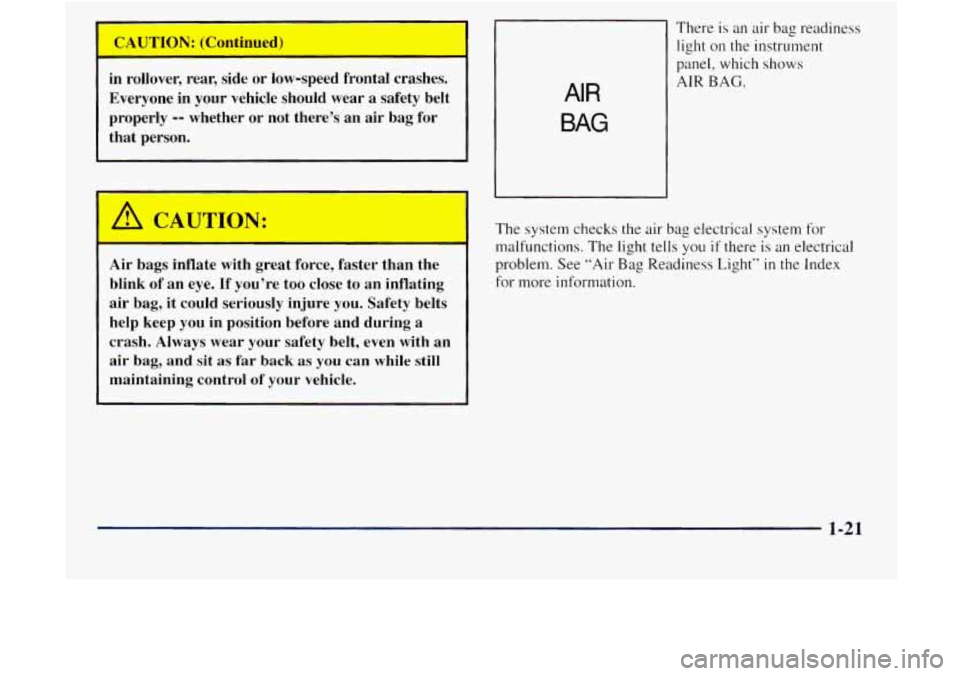
I There is an air bag readiness
AIR
BAG
light on the instrument
panel, which shows
AIR BAG.
The system checks the air bag electrical system for
malfunctions. The light tells you
if there is an electrical
problem. See ”Air Bag Readiness Light”
in the Index
for more information.
- 1-21
Page 34 of 410
When should an air bag inflate?
An air bag is designed to inflate in a moderate to severe
frontal or near-frontal crash. The air bag will inflate
only
if the impact speed is above the system's designed
"threshold level."
If your vehicle goes straight into a
wall that doesn't move or deform. the threshold level is
about
14 to 18 mph (23 to 29 km/h). The threshold level
can vary, however,
with specific vehicle design. so that
it can be somewhat above or below this range. If your
vehicle strikes something
that will move or deform, such
as a parked car. the threshold level will be higher. The
air
bag is not designed to inflate in rollovers, side
impacts or rear impacts. because inflation would not
help the occupant.
In any particular crash, no one can say whether an air
bag should have inflated simply because of the damage
to a vehicle or because of what the repair costs were.
Inflation is determined
by the angle of the impact and
how quickly the vehicle slows down in frontal and
near-frontal impacts.
The air bag system
is designed to work properly under a
wide range of conditions, including off-road usage.
Observe safe driving speeds. especially
on rough terrain.
As always. wear your safety belt. See "Off-Road
Driving"
in the Index for Inore tips on off-road driving.
What makes an air bag inflate?
In an impact of sufficient severity, the air bag sensing
system detects that the vehicle is
in a crash. The sensing
system triggers a release of gas from
the inflator. which
inflates
the air bag. The inflator, air bag and related
hardware
are all part of the air bag module inside the
steering wheel.
How does an air bag restrain?
In tnoderate to severe frontal or near-frontal collisions.
even belted occupants can contact the steering wheel.
The air bag supplements the protection provided by
safety belts. Air bags distribute the force
of the impact
more evenly over
the occupant's upper body. stopping
the occupant more gradually.
But air bags would not
help you in many types of collisions, including
rollovers. rear impacts and side impacts. primarily
because an occupant's motion is
not toward the air bag.
Air bags should never be regarded as anything more
than a supplement
to safety belts. and then only in
moderate to severe frontal or near-frontal collisions.
1-23
Page 35 of 410
What will you see after an air bag inflates?
After an air bag inflates, it quickly deflates,
so quickly
that some people may not even realize the air bag
inflated. Some components of the
air bag module in the
steering wheel hub
will be hot for a short time. The parts
of the bag that come into contact with you may be
warm, but not
too hot to touch. There will be some
smoke and dust coming from vents
in the deflated air
bag. Air bag inflation doesn’t prevent the driver from
seeing or from being
able to steer the vehicle, nor does it
stop people from leaving the vehicle.
When an
air bag inflates, there is dust in the air.
This dust could cause breathing problems for
people with
a history of asthma or other
breathing trouble.
To avoid this, everyone in the
vehicle should get out
as soon as it is safe to do so.
If you have breathing problems but can’t get out
of the vehicle after an air bag inflates, then get
fresh air by opening a window
or door.
e
e
e
The air bag is designed to inflate only once. After it
inflates? you‘ll need some new parts for your air bag
system.
If you don’t get them, the air bag system
won’t be there to help protect you
in another crash.
A new system will include the air bag module and
possibly other parts. The service manual for
your
vehicle covers the need to replace other parts.
Your vehicle is equipped
with a diagnostic module,
which records information about the air bag system.
The module records information about the readiness
of the system, when the sensors are activated and
driver’s safety belt usage at deployment.
Let only qualified technicians work on your air bag system. Improper service can mean that your air bag
system won’t work properly. See your dealer
for service.
NOTICE:
If you damage the cover for the driver’s air bag,
the bag may not work properly. You may have to
replace the air bag module.
Do not open or break
the air bag cover.
1-24
Page 37 of 410
Safety Belt Use During Pregnancy
Safety belts work for everyone, including presnant
women. Like all occupants, they are
more likely to be
seriously injured
if they don't wear safety belts.
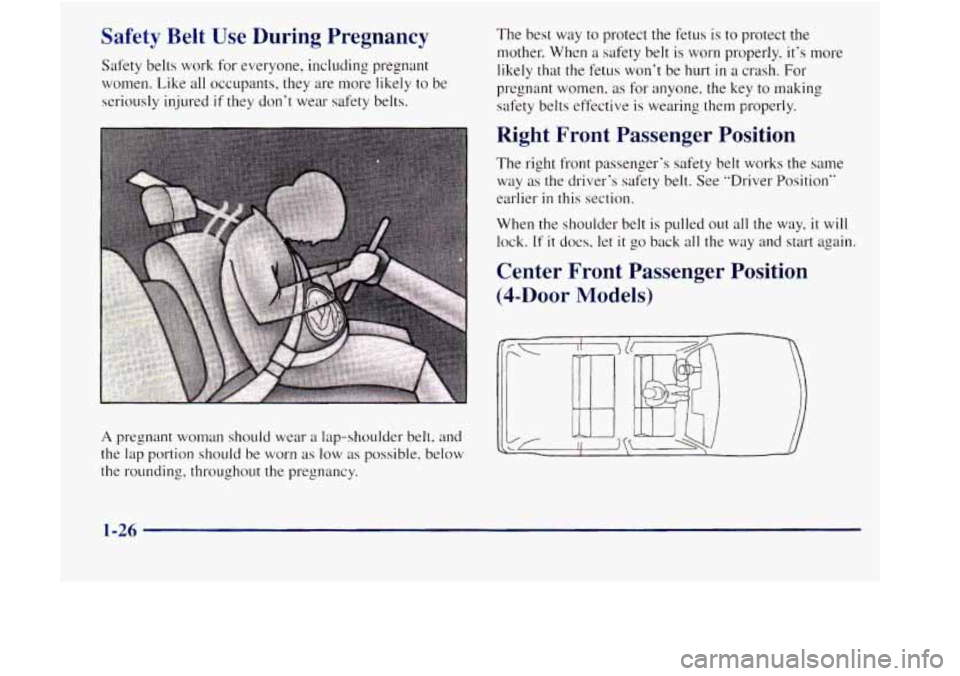
A pregnant woman should wear a lap-shoulder belt. and
the lap portion should be worn
as low as possible. below
the rounding, throughout the pregnancy. The
best way
to protect the fetus is to protect the
mother. When a safety belt is worn properly, it's more
likely that the fetus won't be hurt in a crash. For
pregnant women, as for anyone. the key to making
safety belts effective is wearing then1 properly.
Right Front Passenger Position
The right front passenger's safety belt works the same
way
as the driver's safety belt. See "Driver Position"
earlier
in this section.
When the shoulder belt
is pulled out all the way. it will
lock.
If it does, let it go back all the way and start again.
Center Front Passenger Position
(4-I)oor Models)
1-26
Page 38 of 410
Lap Belt
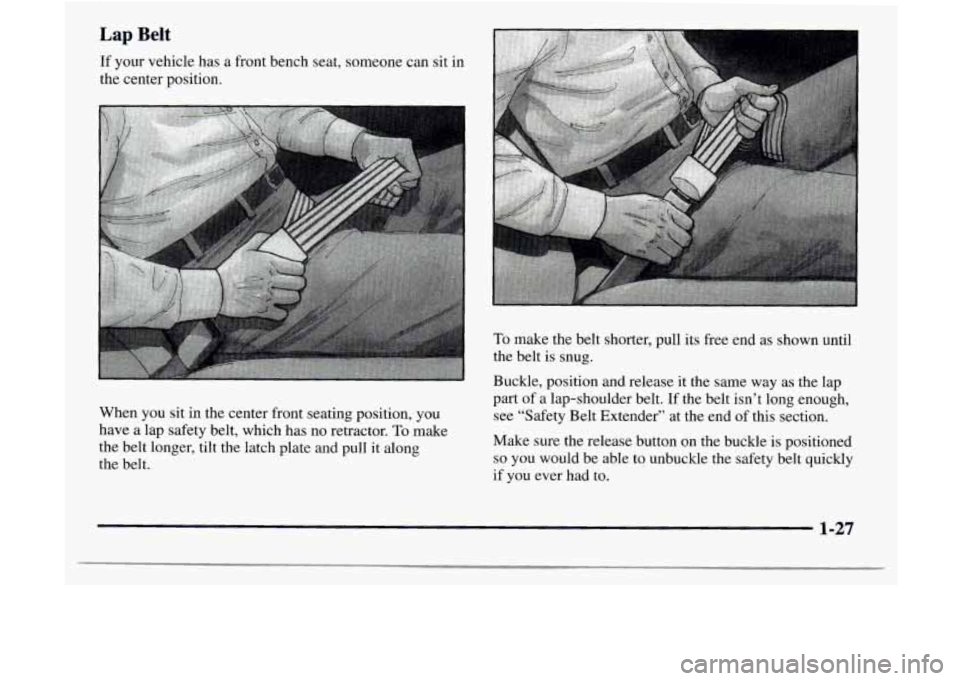
If your vehicle has a front bench seat, someone can sit in
the center position.
When you sit in the center front seating position, you
have a lap safety belt, which has no retractor.
To make
the belt longer, tilt the latch plate and pull it along
the belt.
To make the belt shorter, pull its free end as shown until
the belt
is snug.
Buckle, position and release it the same way as the lap
part of a lap-shoulder belt. If the belt isn’t long enough,
see “Safety Belt Extender” at the end of this section.
Make sure the release button on the buckle is positioned
so you would be able to unbuckle the safety belt quickly
if you ever had to.
1-27