steering GMC JIMMY 1997 Owner's Guide
[x] Cancel search | Manufacturer: GMC, Model Year: 1997, Model line: JIMMY, Model: GMC JIMMY 1997Pages: 410, PDF Size: 20.03 MB
Page 203 of 410

What's the worst time for this'? "Wet ice." Very cold
snow
or ice can be slick and hard to drive on. But wet
ice can be
even more trouble because it may offer the
least traction
of all. You can get wet ice when it's about
freezing
(32°F; 0°C) and freezing rain begins to fill.
Try to avoid driving on wet ice until salt and sand crews
can get there. Whatever
me condition
-- smooth ice, packed, blowing.
or loose snow -- drive with caution.
Accelerate gently. Try not to break the fragile traction. If
you accelerate
too fist, the drive wheels will spin and
polish the surface under the tires even more.
Your anti-lock brakes improve your vehicle's stability
when
you make a hard stop on a slippery road. Even
though
you have an anti-lock braking system, you'll
want to begin stopping sooner than you would on dry
pavement. See "Anti-Lock"
in the Index.
Allow greater following distance on any
slippery road.
Watch for slippery spots. The road might be fine
until you hit a spot that's covered with ice. On an
otherwise clear road, ice patches may appear
in
shaded areas where the sun can't reach: around
clumps
of trees, behind buildings or under bridges.
Sometimes the surface of
a curve or an overpass may
remain icy when the surrounding roads are clear.
If
you see a patch of ice ahead of you, brake before you
are on it. Try not to brake while you're actually on
the ice, and avoid sudden steering maneuvers.
4-3s
Page 206 of 410

Recreational Vehicle Towing (Four-wheel Drive With
7
Shift Transfer Case Only)
1.
2.
3.
3.
Set the par' * lg brake firmly.
Place an automatic transmission
in PARK (P) or a
manual transmission in FIRST ( I ).
Firmly attach the vehicle being towed to the tow
vehicle.
Do not tow the vehicle by the rear bumper
bar. Refer
to the hitch manufacturer's instructions.
Place the manual shift transfer case shift lever
in
NEUTRAL (N).
A CAUTION:
Shifting the transfer case into NEUTRAL (N) can
cause your vehicle to roll even if the transmission
is
in PARK (P), for an automatic transmission, or
if your vehicle is in gear, for a manual
transmission. You
or others could be injured.
Make sure the parking brake
is firmly set before
you shift the transfer case into
NEUTRAL (N).
5. Release the parking brake only after the vehicle
being towed is firmly attached
to the tow vehicle.
6. Insert the ignition key into the ignition switch and
turn
it one notch forward of the LOCK position. This
places the key
in the OFF position, which unlocks
the steering column while preventing battery drain.
Unlocking the steering column will allow
for proper
movement
of the front wheelshires during towing.
4-41
Page 230 of 410

When your vehicle is being towed. have the ignition key
turned to the OFF position. The steering wheel should
be cla111ped
in a straight-alwad position with a clamping
device designed for towing service. Do not use the
vehicle's steering column lock for this. The transmission
should be
in NEUTRAL (N) and the transfer case, if you
have one. should be in 2HI. The parking brake should
be released.
If your vehicle 11as a floor mounted shifter and no
electrical power, the electrical solenoid lock must be
overridden to shift from PARK (P) to NEUTRAL (N).
Follow these steps:
1. Push the base of the shift lever boot forward \%7ith
your tlwmb.
2. Lift the boot and find the white solenoid lever.
3.
4.
5.
Move the solenoid lever toward the driver's side to
unlock
it.
While holding the solenoid lever in the ~~nlock
position. press the shift lever button and shift into
NEUTRAL (N).
5-9
Page 243 of 410

Engine Fan Noise If a Tire Goes Flat
This vehicle has a clutched engine cooling fan. When
the clutch is engaged,
the fan spins faster to provide
more air to cool the engine.
In most everyday driving
conditions, the clutch
is not engaged. This improves
fuel economy and reduces
fan noise. Under heavy
vehicle loading, trailer towing and/or high outside
temperatures, the
fan speed increases when the clutch
engages.
So you may hear an increase in fan noise. This
is normal and should not be mistaken as the
transmission slipping
or making extra shifts. It is merely
the cooling system functioning properly. The fan will
slow down when additional cooling is not required and
the clutch disengages.
You
may also hear this fan noise when you start he
engine.
It will go away as the fan clutch disengages. It's
unusual
for a tire to "blow out" while you're driving,
especially
if you maintain your tires properly. If air goes
out of
a tire, it's muc11 more likely to leak out slowly.
But if you should ever have a "blowout." here are a few
tips about what
to expect and what to do:
If a front tire fails, the flat tire will create a drag that
pulls the vehicle toward that side. Take your foot off the
accelerator pedal and grip the steering wheel firmly.
Steer to ~naintain lane position, and then gently brake to
a stop well out of the traffic lane.
A rear blowout. particularly on a curve, acts much like a
skid and may require the same correction you'd use in a
skid. In any rear blowout, remove yo~~r foot from the
accelerator pedal. Get the c.ehicle under control
by
steering the way ~OLI want the vehicle to go. It may be
very bumpy
and noisy. but you can still steer. Gently
brake to
a stop -- well off the road if possible.
5-22
Page 267 of 410
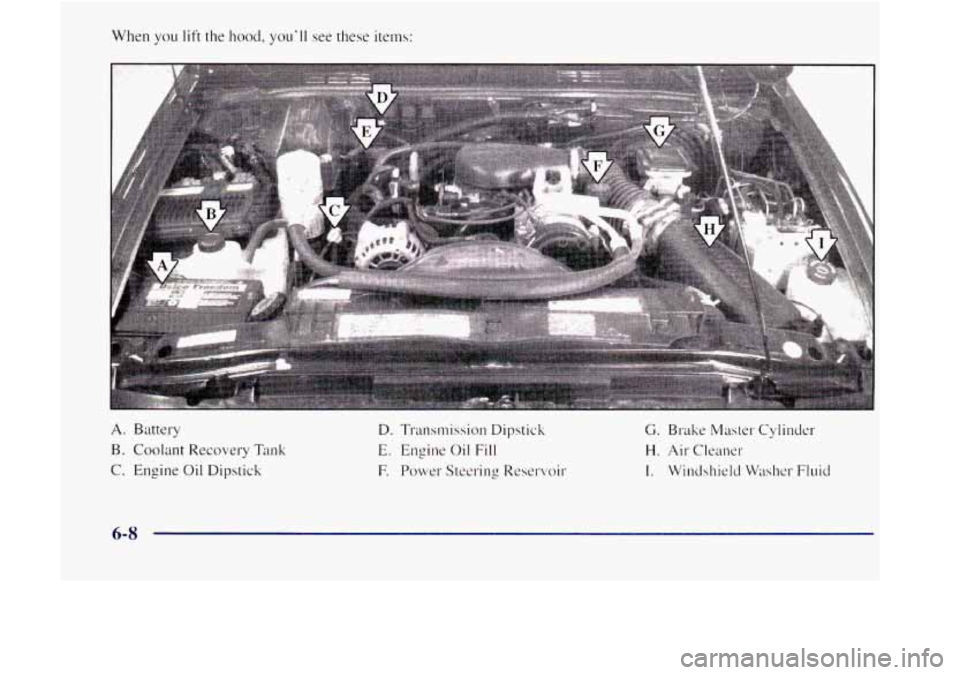
When you lift the I~ood, you'll see these items:
A. Battery
B. Coolant Re,covery
Tank
C. Engine Oil Dipstick
D. Transmission Dipstick C. Brake Master Cylinder
E. Engine Oil Fill H. Air Cleaner
E Power Steering Reservoir I. Windshield Washer Fluid
6-8
Page 271 of 410
Engine Oil Additives
Don't add anything to your oil. YOLK GM dealer is ready
to advise
if you think something should be added.
When to Change Engine Oil
If any one of these is true for you. LIS~ the short trip/city
. maintenxm schedule:
Most trips are less than 5 to 10 miles (8 to 16 km).
This is particularly important when outside
temperatures are below freezing.
Most trips include extensive idling (such as frequent
driving
in stop-and-go traffic).
0 You operate your vehicle in dusty areas or
off-road frequently.
YOLI frequently tow a trailer or use a carrier on top of
your vehicle.
The vehicle is used for delivery service, police, taxi
or other commercial application. Driving under
these conditions causes engine oil to
break
down sooner. If any one of these is true for your
vehicle. then you need to change your
oil and filter
every
3.000 miles (5 000 km) or 3 months -- whichever
occurs first.
Remote Oil Filter (Four-wheel Drive)
The ;1ccess door for the remote oil filter is in the steering
linkage shicld
assembly located under the radiator
support. Twist the
screw to unlock or lock the door.
Make sure
if you open the door, it is securely closed
when you are finished.
6-12
Page 286 of 410

When to Check Power Steering Fluid
It is not necessary to regularly check power steering
fluid ~rnless
you suspect there is a leak in the system or
you hear an unusual noise. A fluid loss in this system
could indicate
a problem. Have the system inspected
and repaired.
How To Check Power Steering Fluid
When the engine compartment is cool, wipe the cap and
the top of the reservoir clean, then unscrew the cap and
wipe
the dipstick with a clean rag. Replace the cap and
completely tighten
it. Then remove the cap again and
look at the fluid level on the dipstick.
The level should be between the
ADD and FULL marks.
If necessary, add only enough fluid to bring the level up
to the proper range.
What to Use
Windshield Washer Fluid
What to Use
When you need windshield washer fluid. be sure to read
the manuf‘~cturer’s instructions before ~rse.
If you will be
operating your
\:chicle in an area where the temperature
may fall below freezing,
LIS~ a fluid that has sufficient
protection against freezing.
Adding Washer Fluid
To determine what kind of fluid to use, see
“Recommended Fluids and Lubricants”
in the Index.
Always use the proper fluid. Failure to use the proper
fluid can cause leaks and damage hoses and seals.
Open
the cap labeled WASHER FLUID ONLY with the
washer symbol 011 it. Add washer tluid until the tank is full.
6-27
Page 330 of 410
Short Trip/City Maintenance Schedule
The services shown in this schedule LIP to 100.000 miles
( I66 000 km) should be performed after 100,000 miles
( 166 000 km) at the same intervals. The services shown
at 150.000 miles (240
000 km) should be performed at
the
same interval after 150.000 miles (240 000 km).
See "Owner Checks and Services" and "Periodic
Maintenance Inspections" following.
Footnotes
-f The U.S. Environmental Protection Agency or the
California Air Resources Board has determined that the
failure to perform this maintenance item will not
nullify
the emission warranty or limit recall liability prior to the
completion
of the vehicle's useful life. We. however,
urge that
all recommended maintenance services be
performed at the indicated intervals and
the maintenance
be recorded.
## Lubricate the front suspension. ball joints. steering
linkage and transfer case shift linkage. parking brake
cable guides, propshaft splines. Lulivel-sal joints and
brake
pedal springs.
+ A good time to check your brakes is during tire
rotation. See "Brake System Inspection" under "Periodic
Maintenance Inspection"
in Part C of this schedule.
'i::k Drive axle service (see "Recommended Fluids and
Lubricants"
in the Index for proper lubricant to use):
0
0
0
Locking Differential -- Drain fluid and refill at first
engine oil change. At subsequent oil changes, check
fluid level and add fluid as needed.
If driving in
dusty areas or towing a trailer, drain tluid and refil
every 15,000 miles
(25 000 km).
Standard Differential
-- Check fluid level and add
tluid
as needed at every oil change. If driving in
dusty areas or towing a trailer, drain fluid and refil
every
15,000 miles (25 000 km).
More frequent lubrication may be required
for
heavy-duty or off-road use.
1
1
7-7
Page 353 of 410
I Long Trip/Highway Maintenance Schedule
The services shown in this schedule up to 100,000 miles
( I66 000 km) should be performed after 100,000 miles
( 166 000 km) at the same intervals. The services shown
at
150,000 miles (240 000 km) should be performed at
the same interval after
150,000 miles (240 000 km).
See "Owner Checks and Services" and "Periodic
Maintenance Inspections'' following.
Footnotes
3' The U.S. Environmental Protection Agency 01- the
California Air Resources Board has determined that the
failure to perform this maintenance item
will not nullify
the emission warranty or limit recall liability prior to the
completion
of the vehicle's useful life. We, however,
urge that
all recommended maintenance services be
performed at the indicated intervals and the maintenance
be recorded.
# Lubricate Ihe front suspension, ball joints, steering
linkage and transfer case
shift linkage, parking brake
cable guides, propshaft splines, universal
joints and
brake pedal springs.
+ A good time to check your brakes is during tire
rotation. See "Brake System Inspection'' under "Periodic
Maintenance Inspections"
in Part C of this schedule.
Drive axle service (see "Recommended Fluids and
Lubricants"
in the Index for proper lubricant to use):
0 Locking Differential -- Drain fluid and refill at first
engine oil change.
At subsequent oil changes, check
fluid level and
add fluid as needed.
0 Standard Differential -- Check fluid level and add
fluid as needed at every engine
oil change.
More frequent lubrication may be required for
heavy-duty or off-road use.
7-30
Page 373 of 410
Part C: Periodic Maintenance
Inspections
Listed below are inspections and services which should
be performed at least twice
a year (for instance. each
spring and fall). You should let
your GM dealer's
service department or other qualified service center
do
these jobs. Make sure any necessary repairs are
completed
at once.
Proper procedures to perform these services may be
found
in a GM service nnanual. See "Service and Owner
Publications"
in the Index.
Steering, Suspension and Front Drive Axle
Boot
and Seal Inspection
Inspect the front and rear suspension and steering
system for damaged. loose or missing parts, signs
of
wear or lack of lubrication. Inspect the power steering
lines
and hoses for proper hook-up, binding, leaks,
cracks, chafing, etc. Clean and then inspect the drive
axle boot seals for damage, tears or leakage. Replace
seals
if necessary.
Exhaust System Inspection
Inspect the complete exhaust system. Inspect the body
near the exhaust system. Look for broken, damaged,
missing or out-of-position parts
as well as open seams,
holes. loose connections
or other conditions which could
cause
a heat build-up in the floor pan or could let
exhaust fumes into the vehicle. See "Engine Exhaust"
in
the Index.
Radiator and Heater Hose Inspection
Inspect the hoses and have them replaced if they are
cracked. swollen or deteriorated. Inspect
all pipes,
fittings
and clamps; replace as needed.
Throttle Linkage Inspection
Inspect the throttle linkage for interference or binding,
and for damage or missing parts. Replace parts
as
needed. Replace any cables that have high effort or
excessi\.e wear.
Do not lubricate accelerator and cruise
control cables.
7-50