oil additives GMC JIMMY 2005 Owner's Manual
[x] Cancel search | Manufacturer: GMC, Model Year: 2005, Model line: JIMMY, Model: GMC JIMMY 2005Pages: 432, PDF Size: 2.65 MB
Page 273 of 432
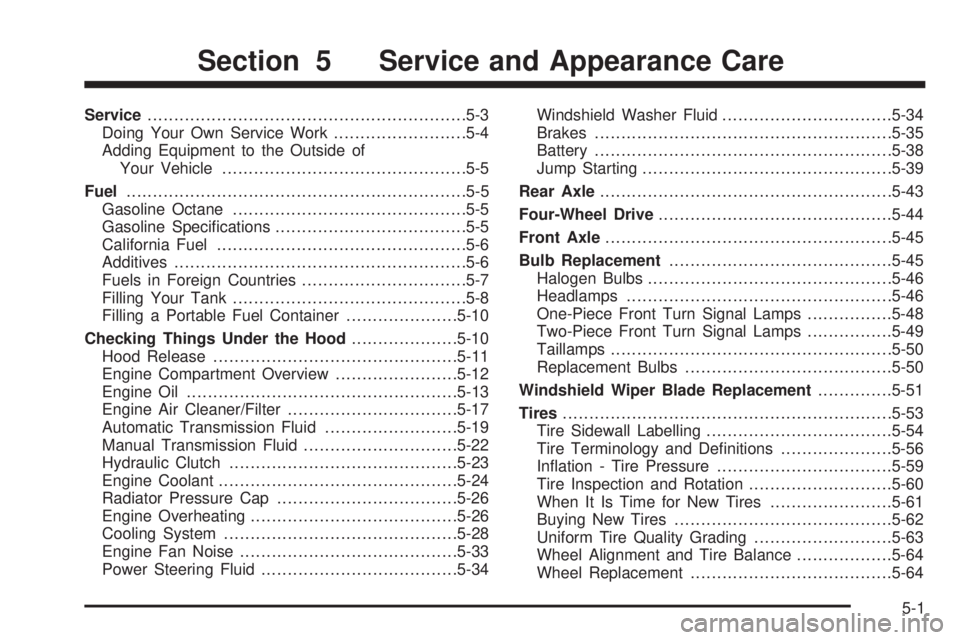
Service............................................................5-3
Doing Your Own Service Work.........................5-4
Adding Equipment to the Outside of
Your Vehicle..............................................5-5
Fuel................................................................5-5
Gasoline Octane............................................5-5
Gasoline Specications....................................5-5
California Fuel...............................................5-6
Additives.......................................................5-6
Fuels in Foreign Countries...............................5-7
Filling Your Tank............................................5-8
Filling a Portable Fuel Container.....................5-10
Checking Things Under the Hood....................5-10
Hood Release..............................................5-11
Engine Compartment Overview.......................5-12
Engine Oil...................................................5-13
Engine Air Cleaner/Filter................................5-17
Automatic Transmission Fluid.........................5-19
Manual Transmission Fluid.............................5-22
Hydraulic Clutch...........................................5-23
Engine Coolant.............................................5-24
Radiator Pressure Cap..................................5-26
Engine Overheating.......................................5-26
Cooling System............................................5-28
Engine Fan Noise.........................................5-33
Power Steering Fluid.....................................5-34Windshield Washer Fluid................................5-34
Brakes........................................................5-35
Battery........................................................5-38
Jump Starting...............................................5-39
Rear Axle.......................................................5-43
Four-Wheel Drive............................................5-44
Front Axle......................................................5-45
Bulb Replacement..........................................5-45
Halogen Bulbs..............................................5-46
Headlamps..................................................5-46
One-Piece Front Turn Signal Lamps................5-48
Two-Piece Front Turn Signal Lamps................5-49
Taillamps.....................................................5-50
Replacement Bulbs.......................................5-50
Windshield Wiper Blade Replacement..............5-51
Tires..............................................................5-53
Tire Sidewall Labelling...................................5-54
Tire Terminology and Denitions.....................5-56
Ination - Tire Pressure.................................5-59
Tire Inspection and Rotation...........................5-60
When It Is Time for New Tires.......................5-61
Buying New Tires.........................................5-62
Uniform Tire Quality Grading..........................5-63
Wheel Alignment and Tire Balance..................5-64
Wheel Replacement......................................5-64
Section 5 Service and Appearance Care
5-1
Page 288 of 432

GM Goodwrench®oil meets all the requirements for
your vehicle.
If you are in an area of extreme cold, where the
temperature falls below−20°F (−29°C), it is
recommended that you use either an SAE 5W-30
synthetic oil or an SAE 0W-30 oil. Both will provide
easier cold starting and better protection for your engine
at extremely low temperatures.
Engine Oil Additives
Do not add anything to your oil. The recommended oils
with the starburst symbol that meet GM Standard
GM6094M are all you will need for good performance
and engine protection.
When to Change Engine Oil
If any one of these is true for you, use the short trip/city
maintenance schedule:
Most trips are less than 5 miles (8 km). This is
particularly important when outside temperatures
are below freezing.
Most trips include extensive idling, such as frequent
driving in stop-and-go traffic.
You frequently tow a trailer or use a carrier on top
of your vehicle.
The vehicle is used for delivery service, police, taxi,
or other commercial application.Driving under these conditions causes engine oil to
break down sooner. If any one of these is true for your
vehicle, then you need to change your oil and lter
every 3,000 miles (5 000 km) or 3 months — whichever
occurs rst.
If none of them is true, use the long trip/highway
maintenance schedule. Change the oil and lter every
7,500 miles (12 500 km) or 12 months — whichever
occurs rst. Driving a vehicle with a fully warmed engine
under highway conditions will cause engine oil to
break down slower.
Remote Oil Filter (Four-Wheel Drive)
The access door for the
remote oil lter is in the
steering linkage shield
assembly located under
the radiator support.
Turn the screw to unlock
or lock the door. If you
open the door, make sure
it is securely closed
when you are nished.
5-16
Page 297 of 432

{CAUTION:
Adding only plain water to your cooling
system can be dangerous. Plain water, or
some other liquid such as alcohol, can boil
before the proper coolant mixture will. Your
vehicle’s coolant warning system is set for the
proper coolant mixture. With plain water or the
wrong mixture, your engine could get too hot
but you would not get the overheat warning.
Your engine could catch re and you or others
could be burned. Use a 50/50 mixture of clean,
drinkable water and the proper coolant.
Notice:If you use an improper coolant mixture, your
engine could overheat and be badly damaged. The
repair cost would not be covered by your warranty.
Too much water in the mixture can freeze and crack
the engine, radiator, heater core and other parts.
If you have to add coolant more than four times a year,
have your dealer check your cooling system.
Notice:If you use the proper coolant, you do not
have to add extra inhibitors or additives which claim
to improve the system. These can be harmful.
Checking Coolant
The coolant recovery tank is located in the engine
compartment on the passenger’s side of the vehicle.
SeeEngine Compartment Overview on page 5-12
for more information on location.
The vehicle must be on a level surface. When your
engine is cold, the coolant level should be at ADD, or a
little higher. When your engine is warm, the level
should be up to FULL HOT, or a little higher.
5-25
Page 423 of 432
F
Filter
Engine Air Cleaner......................................5-17
Finish Damage...............................................5-87
Fixed Mast Antenna........................................3-79
Flash-to-Pass................................................... 3-9
Flat Tire........................................................5-66
Flat Tire, Changing.........................................5-67
Flat Tire, Storing.............................................5-76
Fluid
Automatic Transmission................................5-19
Manual Transmission....................................5-22
Power Steering...........................................5-34
Windshield Washer......................................5-34
Fog Lamps....................................................3-17
Four-Wheel Drive....................................2-30, 5-44
Front Axle......................................................5-45
Front Reading Lamps......................................3-19
Front Storage Area.........................................2-52
Fuel............................................................... 5-5
Additives...................................................... 5-6
California Fuel.............................................. 5-6
Filling a Portable Fuel Container....................5-10
Filling Your Tank........................................... 5-8
Fuels in Foreign Countries.............................. 5-7
Gage.........................................................3-38
Gasoline Octane........................................... 5-5Fuel (cont.)
Gasoline Specications.................................. 5-5
Low Warning Light.......................................3-38
System Inspection.......................................6-31
Fuses
Engine Compartment Fuse Block...................5-92
Fuses and Circuit Breakers...........................5-90
Instrument Panel Fuse Block.........................5-91
Windshield Wiper.........................................5-90
G
Gage
Check Gages Warning Light..........................3-37
Engine Coolant Temperature.........................3-31
Fuel..........................................................3-38
Oil Pressure...............................................3-34
Speedometer..............................................3-26
Tachometer.................................................3-26
Voltmeter Gage...........................................3-28
Garage Door Opener.......................................2-45
Gasoline
Octane........................................................ 5-5
Specications............................................... 5-5
Gate Ajar Light...............................................3-37
Glove Box.....................................................2-49
GM Mobility Reimbursement Program.................. 7-5
5