check oil GMC SAFARI 2003 User Guide
[x] Cancel search | Manufacturer: GMC, Model Year: 2003, Model line: SAFARI, Model: GMC SAFARI 2003Pages: 376, PDF Size: 2.25 MB
Page 226 of 376
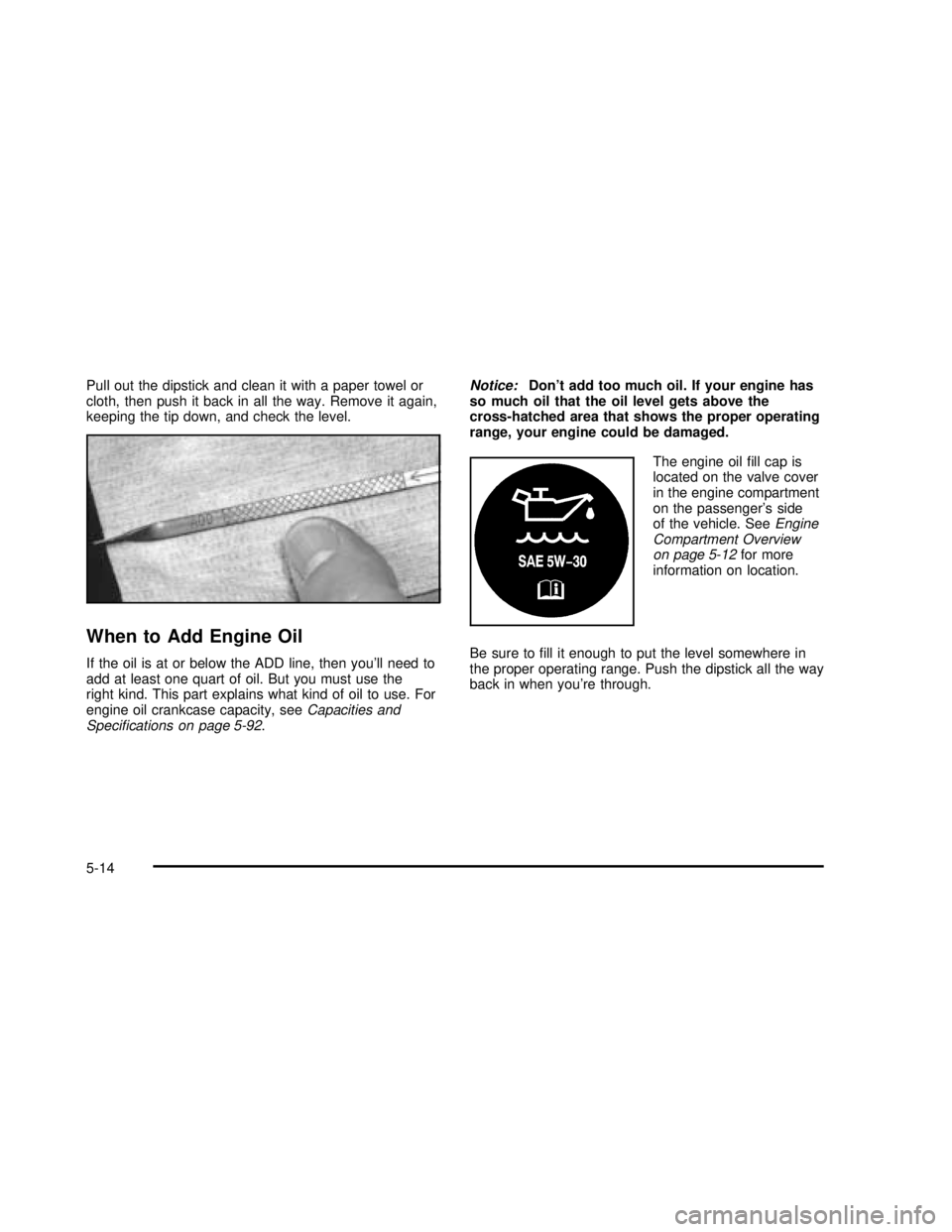
Pull out the dipstick and clean it with a paper towel or
cloth, then push it back in all the way. Remove it again,
keeping the tip down, and check the level.
When to Add Engine Oil
If the oil is at or below the ADD line, then you’ll need to
add at least one quart of oil. But you must use the
right kind. This part explains what kind of oil to use. For
engine oil crankcase capacity, seeCapacities and
Specifications on page 5-92.Notice:Don’t add too much oil. If your engine has
so much oil that the oil level gets above the
cross-hatched area that shows the proper operating
range, your engine could be damaged.
The engine oilfill cap is
located on the valve cover
in the engine compartment
on the passenger’s side
of the vehicle. SeeEngine
Compartment Overview
on page 5-12for more
information on location.
Be sure tofill it enough to put the level somewhere in
the proper operating range. Push the dipstick all the way
back in when you’re through.
5-14
2003 - Safari OM
Page 234 of 376

How to Inspect the Engine Air
Cleaner/Filter
To inspect the engine air cleaner/filter remove thefilter
from the vehicle and lightly shakefilter to release
loose dust and dirt. If thefilter remains caked with dirt, a
newfilter is required.
To inspect or replace thefilter, do the following:
1. Unsnap both clips on the cover.
2. Remove the cover.
3. Change thefilter.
4. Snap both clips to secure the engine air
cleaner/filter cover.
{CAUTION:
Operating the engine with the air cleaner/lter
off can cause you or others to be burned. The
air cleaner not only cleans the air, it helps to
stopame if the engine backres. If it isn’t there
and the engine backres, you could be burned.
Don’t drive with it off, and be careful working on
the engine with the air cleaner/lter off.Notice:If the air cleaner/lter is off, a backre can
cause a damaging enginere. And, dirt can
easily get into your engine, which will damage it.
Always have the air cleaner/lter in place when
you’re driving.
Automatic Transmission Fluid
When to Check and Change
A good time to check your automatic transmissionfluid
level is when the engine oil is changed.
Change both thefluid andfilter every 15,000 miles
(25 000 km) if the vehicle is mainly driven under one or
more of these conditions:
•In heavy city traffic where the outside temperature
regularly reaches 90°F (32°C) or higher.
•In hilly or mountainous terrain.
•When doing frequent trailer towing.
•Uses such as found in taxi, police or delivery
service.
If you do not use your vehicle under any of these
conditions, change thefluid andfilter every 50,000 miles
(83 000 km).
SeePart A: Scheduled Maintenance Services on
page 6-4.
5-22
2003 - Safari OM
Page 237 of 376

How to Add Fluid
Refer to the Maintenance Schedule to determine what
kind of transmissionfluid to use. SeePart D:
Recommended Fluids and Lubricants on page 6-34.
Addfluid only after checking the transmissionfluid while
it is hot. (A cold check is used only as a reference.) If
thefluid level is low, add only enough of the properfluid
to bring the level up to the HOT area for a hot check.
It doesn’t take muchfluid, generally less than one pint
(0.5 L).Don’t overfill.
Notice:We recommend you use onlyuid labeled
DEXRON
®-III, becauseuid with that label is
made especially for your automatic transmission.
Damage caused byuid other than DEXRON
®-III is
not covered by your new vehicle warranty.
•After addingfluid, recheck thefluid level as
described under“How to Check.”
•When the correctfluid level is obtained, push the
dipstick back in all the way; thenflip the handle
down to lock the dipstick in place.
Engine Coolant
The cooling system in your vehicle isfilled with
DEX-COOL®engine coolant. This coolant is designed
to remain in your vehicle for 5 years or 150,000 miles
(240 000 km), whichever occursfirst, if you add
only DEX-COOL
®extended life coolant.The following explains your cooling system and how to
add coolant when it is low. If you have a problem
with engine overheating, seeEngine Overheating on
page 5-28.
A 50/50 mixture of clean, drinkable water and
DEX-COOL
®coolant will:
•Give freezing protection down to−34°F(−37°C).
•Give boiling protection up to 265°F (129°C).
•Protect against rust and corrosion.
•Help keep the proper engine temperature.
•Let the warning lights and gages work as they
should.
Notice:When adding coolant, it is important that
you use only DEX-COOL
®(silicate-free) coolant.
If coolant other than DEX-COOL®is added to
the system, premature engine, heater core or
radiator corrosion may result. In addition, the engine
coolant will require change sooner -- at 30,000 miles
(50,000 km) or 24 months, whichever occursrst.
Damage caused by the use of coolant other
than DEX-COOL
®is not covered by your new vehicle
warranty.
5-25
2003 - Safari OM
Page 238 of 376
What to Use
Use a mixture of one-halfclean, drinkable waterand
one-half DEX-COOL®coolant which won’t damage
aluminum parts. If you use this coolant mixture,
you don’t need to add anything else.
{CAUTION:
Adding only plain water to your cooling
system can be dangerous. Plain water, or
some other liquid such as alcohol, can boil
before the proper coolant mixture will. Your
vehicle’s coolant warning system is set for the
proper coolant mixture. With plain water or the
wrong mixture, your engine could get too hot
but you wouldn’t get the overheat warning.
Your engine could catchre and you or others
could be burned. Use a 50/50 mixture of clean,
drinkable water and the proper coolant.
Notice:If you use an improper coolant mixture,
your engine could overheat and be badly damaged.
The repair cost wouldn’t be covered by your
warranty. Too much water in the mixture can freeze
and crack the engine, radiator, heater core and
other parts.If you have to add coolant more than four times a year,
have your dealer check your cooling system.
Notice:If you use the proper coolant, you don’t
have to add extra inhibitors or additives which claim
to improve the system. These can be harmful.
Checking Coolant
The engine coolant tank is
located in the engine
compartment on the
passenger’s side at the
front. SeeEngine
Compartment Overview on
page 5-12for more
information on location.
The vehicle must be on a level surface. When your
engine is cold, the coolant level should be at ADD, or a
little higher. When your engine is warm, the level
should be up to FULL HOT, or a little higher.
Adding Coolant
If you need more coolant, add the proper DEX-COOL®
coolant mixtureat the coolant recovery tank.
5-26
2003 - Safari OM
Page 305 of 376

Capacities and Specifications
ApplicationCapacities
English Metric
Cooling Capacities
Quantity without Rear Heater
Quantity with Rear Heater13.5 quarts
16.5 quarts12.8 L
15.6 L
Engine Oil with Filter 4.5 quarts 4.3 L
Fuel Tank 27.0 gallons 101.8 L
Transmission Fluid (Drain and Refill) 5.0 quarts 4.7 L
Differential Fluid
Front Axle
Rear Axle2.6 pints
3.5 pints1.2 L
1.7 L
Refrigerant Type 134a
Front A/C
Front and Rear A/C2.25 lbs.
3.0 lbs.1.02 kg
1.36 kg
All capacities are approximate. When adding, be sure to fill to the appropriate level, as recommended in this
manual. recheck the fluid level after filling. SeePart D: Recommended Fluids and Lubricants on page 6-34for
more information.
5-93
2003 - Safari OM
Page 308 of 376

Maintenance Schedule
Introduction
Important: Keep engine oil at the proper level and
change as recommended.
Have you purchased the GM Protection Plan? The Plan
supplements your new vehicle warranties. See your
Warranty and Owner Assistance booklet or your dealer
for details.
Your Vehicle and the Environment
Proper vehicle maintenance not only helps to keep your
vehicle in good working condition, but also helps the
environment. Improper vehicle maintenance can
even affect the quality of the air we breathe. Improper
fluid levels or the wrong tire inflation can increase
the level of emissions from your vehicle. To help protect
our environment, and to keep your vehicle in good
condition, be sure to maintain your vehicle properly.
Maintenance Requirements
Maintenance intervals, checks, inspections and
recommended fluids and lubricants as prescribed in this
manual are necessary to keep your vehicle in good
working condition. Any damage caused by failure to
follow scheduled maintenance may not be covered by
warranty.
6-2
2003 - Safari OM
Page 311 of 376

Selecting the Right Schedule
First you’ll need to decide which of the two schedules is
right for your vehicle. Here’s how to decide which
schedule to follow:
Short Trip/City Definition
Follow the Short Trip/City Scheduled Maintenance if any
one of these conditions is true for your vehicle:
•Most trips are less than 5 miles (8 km). This is
particularly important when outside temperatures
are below freezing.
•Most trips include extensive idling (such as frequent
driving in stop-and-go traffic).
•You frequently tow a trailer or use a carrier on top
of your vehicle.
•If the vehicle is used for delivery service, police,
taxi or other commercial application.
One of the reasons you should follow this schedule if
you operate your vehicle under any of these conditions
is that these conditions cause engine oil to break
down sooner.
Short Trip/City Intervals
Every 3,000 Miles (5 000 km):Engine Oil and Filter
Change (or 3 months, whichever occursfirst). Chassis
Lubrication (or 3 months, whichever occursfirst).
Drive Axle Fluid Check.
Every 6,000 Miles (10 000 km):Tire Rotation.
Every 15,000 Miles (25 000 km):Engine Air Cleaner
Filter Inspection. Front Wheel Bearing Repack
(two–wheel drive only) (or at each brake relining,
whichever occursfirst). Automatic Transmission Service
(severe conditions only).
Every 30,000 Miles (50 000 km):Engine Air Cleaner
Filter Replacement. Fuel Filter Replacement.
Every 50,000 Miles (83 000 km):Automatic
Transmission Service (normal conditions). Transfer
Case Fluid Change.
Every 100,000 Miles (166 000 km):Spark Plug Wire
Inspection. Spark Plug Replacement. Positive
Crankcase Ventilation (PCV) Valve Inspection.
Every 150 000 Miles (240 000 km):Cooling System
Service (or every 60 months, whichever occurs
first). Engine Accessory Drive Belt Inspection.
These intervals only summarize maintenance services.
Be sure to follow the complete scheduled maintenance
on the following pages.
6-5
2003 - Safari OM
Page 312 of 376

Long Trip/Highway Definition
Follow this scheduled maintenanceonlyif none of the
conditions from the Short Trip/City Scheduled
Maintenance are true. Do not use this schedule if the
vehicle is used for trailer towing, driven in a dusty area
or used off paved roads. Use the Short Trip/City
schedule for these conditions
Driving a vehicle with a fully warmed engine under
highway conditions will cause engine oil to break down
slower.
Long Trip/Highway Intervals
Every 7,500 Miles (12 500 km):Engine Oil and Filter
Change (or every 12 months, whichever occurs
first). Chassis Lubrication (or 12 months, whichever
occursfirst). Drive Axle Fluid Check. Tire Rotation.
Every 15,000 Miles (25 000 km):Engine Air Cleaner
Filter Inspection. Automatic Transmission Service
(severe conditions only).Every 30,000 Miles (50 000 km):Fuel Filter
Replacement. Engine Air Cleaner Filter Replacement.
Front Wheel Bearing Repack (two–wheel drive only) (or
at each brake relining, whichever occursfirst).
Every 50,000 Miles (83 000 km):Automatic
Transmission Service (normal conditions). Transfer
Case Fluid Change.
Every 100,000 Miles (166 000 km):Spark Plug Wire
Inspection. Spark Plug Replacement. Positive
Crankcase Ventilation (PCV) Valve Inspection.
Every 150,000 Miles (240 000 km):Cooling System
Service (or every 60 months, whichever occurs
first). Engine Accessory Drive Belt Inspection.
These intervals only summarize maintenance services.
Be sure to follow the complete scheduled maintenance
on the following pages.
6-6
2003 - Safari OM
Page 313 of 376

Short Trip/City Scheduled
Maintenance
The services shown in this schedule up to
100,000 miles (166 000 km) should be repeated after
100,000 miles (166 000 km) at the same intervals for the
life of this vehicle. The services shown at 150,000 miles
(240 000 km) should be repeated at the same interval
after 150,000 miles (240 000 km) for the life of this
vehicle.
SeePart B: Owner Checks and Services on page 6-27
andPart C: Periodic Maintenance Inspections on
page 6-32.
Footnotes
†The U.S. Environmental Protection Agency or the
California Air Resources Board has determined that the
failure to perform this maintenance item will not nullify
the emission warranty or limit recall liability prior to
the completion of the vehicle’s useful life. We, however,
urge that all recommended maintenance services be
performed at the indicated intervals and the
maintenance be recorded.
#Lubricate the front suspension, ball joints and kingpin
bushings, steering linkage, parking brake cable
guides and brake pedal springs.
+A good time to check your brakes is during tire
rotation. See Brake System Inspection on page 6-33.
3,000 Miles (5 000 km)
❑Change engine oil andfilter (or every 3 months,
whichever occursfirst).An Emission Control Service.
❑Lubricate chassis components (or every 3 months,
whichever occursfirst).(See footnote #.)
❑Check rear/front axlefluid level and addfluid as
needed. Check constant velocity joints and axle seals
for leaking.
6,000 Miles (10 000 km)
❑Change engine oil andfilter (or every 3 months,
whichever occursfirst).An Emission Control Service.
❑Lubricate chassis components (or every 3 months,
whichever occursfirst).(See footnote #.)
❑Check rear/front axlefluid level and addfluid as
needed. Check constant velocity joints and axle seals
for leaking.
❑Rotate tires. SeeTire Inspection and Rotation on
page 5-58for proper rotation pattern and additional
information.(See footnote +.)
9,000 Miles (15 000 km)
❑Change engine oil andfilter (or every 3 months,
whichever occursfirst).An Emission Control Service.
❑Lubricate chassis components (or every 3 months,
whichever occursfirst).(See footnote #.)
❑Check rear/front axlefluid level and addfluid as
needed. Check constant velocity joints and axle seals
for leaking.
6-7
2003 - Safari OM
Page 314 of 376

12,000 Miles (20 000 km)
❑Change engine oil andfilter (or every 3 months,
whichever occursfirst).An Emission Control Service.
❑Lubricate chassis components (or every 3 months,
whichever occursfirst).(See footnote #.)
❑Check rear/front axlefluid level and addfluid as
needed. Check constant velocity joints and axle seals
for leaking.
❑Rotate tires. SeeTire Inspection and Rotation on
page 5-58for proper rotation pattern and additional
information.(See footnote +.)
15,000 Miles (25 000 km)
❑Change engine oil andfilter (or every 3 months,
whichever occursfirst).An Emission Control Service.
❑Lubricate chassis components (or every 3 months,
whichever occursfirst).(See footnote #.)
❑Inspect engine air cleanerfilter. If necessary, replace
thefilter. If vehicle is driven in dusty/dirty conditions,
inspectfilter at every engine oil change. See
Engine Air Cleaner/Filter on page 5-21for more
information.An Emission Control Service. (See
footnote†.)❑Check rear/front axlefluid level and addfluid as
needed. Check constant velocity joints and axle seals
for leaking.
❑For Two-Wheel-Drive vehicles only: Clean and
repack the front wheel bearings (or at each
brake relining, whichever occursfirst).
❑Change automatic transmissionfluid andfilter if the
vehicle is mainly driven under one or more of these
conditions:
In heavy city traffic where the outside
temperature regularly reaches 90°F (32°C) or
higher.
In hilly or mountainous terrain.
When doing frequent trailer towing.
Uses such as found in taxi, police or delivery
service.
If you do not use your vehicle under any of these
conditions, change the fluid and filter every
50,000 miles (83 000 km).
6-8
2003 - Safari OM