transmission GMC SAFARI 2003 Owner's Guide
[x] Cancel search | Manufacturer: GMC, Model Year: 2003, Model line: SAFARI, Model: GMC SAFARI 2003Pages: 376, PDF Size: 2.25 MB
Page 212 of 376

Maintenance When Trailer Towing
Your vehicle will need service more often when you’re
pulling a trailer. See the Maintenance Schedule for more
on this. Things that are especially important in trailer
operation are automatic transmissionuid (don’t overll),
engine oil, axle lubricant, belt, cooling system and
brake system. Each of these is covered in this manual,
and the Index will help yound them quickly. If
you’re trailering, it’s a good idea to review these sections
before you start your trip.
Check periodically to see that all hitch nuts and bolts
are tight.
Trailer Wiring Harness
If you have the optional trailering package, your vehicle
will have an eight-wire harness, including the center
high-mounted stoplamp battery feed wire. The harness
is stored on the passenger’s side of the vehicle near
the rear wheel well. This harness has a 30 amp battery
feed wire and no connector, and should be wired by
a qualied electrical technician. After choosing an
aftermarket trailer mating connector pair, have the
technician attach one connector to the eight-wire trailer
harness and the other connector to the wiring harness
on the trailer. Be sure the wiring harness on the trailer is
taped or strapped to the trailer’s frame rail and leave
it loose enough so the wiring doesn’t bend or break, but
not so loose that it drags on the ground. The eight-wire
harness must be routed out of your vehicle betweenthe rear door and theoor, with enough of the harness
left on both sides so that the trailer or the body won’t
pull it. If you do not have the optional trailering package,
your vehicle will still have a trailering harness. The
harness is located near the passenger’s side rear wheel
well. It consists of six wires that may be used by
after-market trailer hitch installers.
The technician can use the following color code chart
when connecting the wiring harness to your trailer.
Brown: Rear lamps.
Yellow: Left stoplamp and turn signal.
Dark Green: Right stoplamp and turn signal.
White (Heavy Gage): Ground.
Light Green: Back-up lamps.
White (Light Gage): Center High-Mounted Stoplamp.
Blue: Auxiliary circuit (eight-wire harness only).
Orange: Fused auxiliary (eight-wire harness only).
Store the harness in its original place. Wrap the
harness together and tie it neatly so it won’t
be damaged.
4-40
2003 - Safari OM
Page 213 of 376

Service............................................................5-3
Doing Your Own Service Work.........................5-3
Adding Equipment to the Outside of Your
Vehicle......................................................5-4
Fuel................................................................5-4
Gasoline Octane............................................5-4
Gasoline Specifications....................................5-5
California Fuel...............................................5-5
Additives.......................................................5-6
Fuels in Foreign Countries...............................5-6
Filling Your Tank............................................5-6
Filling a Portable Fuel Container.......................5-9
Checking Things Under the Hood.....................5-9
Hood Release..............................................5-10
Engine Compartment Overview.......................5-12
Engine Oil...................................................5-13
Engine Cover...............................................5-17
Engine Air Cleaner/Filter................................5-21
Automatic Transmission Fluid.........................5-22
Engine Coolant.............................................5-25
Radiator Pressure Cap..................................5-27
Engine Overheating.......................................5-28
Cooling System............................................5-30
Engine Fan Noise.........................................5-36
Power Steering Fluid.....................................5-36
Windshield Washer Fluid
................................5-37Brakes........................................................5-39
Battery........................................................5-42
Jump Starting...............................................5-43
All-Wheel Drive..............................................5-48
Rear Axle.......................................................5-49
Front Axle......................................................5-49
Bulb Replacement..........................................5-50
Halogen Bulbs..............................................5-50
Headlamps..................................................5-51
Front Turn Signal Lamps...............................5-54
Taillamps.....................................................5-54
Replacement Bulbs.......................................5-56
Windshield Wiper Blade Replacement..............5-56
Tires..............................................................5-57
Inflation -- Tire Pressure................................5-58
Tire Inspection and Rotation...........................5-58
When It Is Time for New Tires.......................5-60
Buying New Tires.........................................5-60
Uniform Tire Quality Grading..........................5-61
Wheel Alignment and Tire Balance..................5-63
Wheel Replacement......................................5-63
Tire Chains..................................................5-64
If a Tire Goes Flat........................................5-64
Changing a Flat Tire.....................................5-65
Compact Spare Tire......................................5-75
Section 5 Service and Appearance Care
5-1
2003 - Safari OM
Page 225 of 376
A. Windshield Washer Fluid
B. Engine Coolant
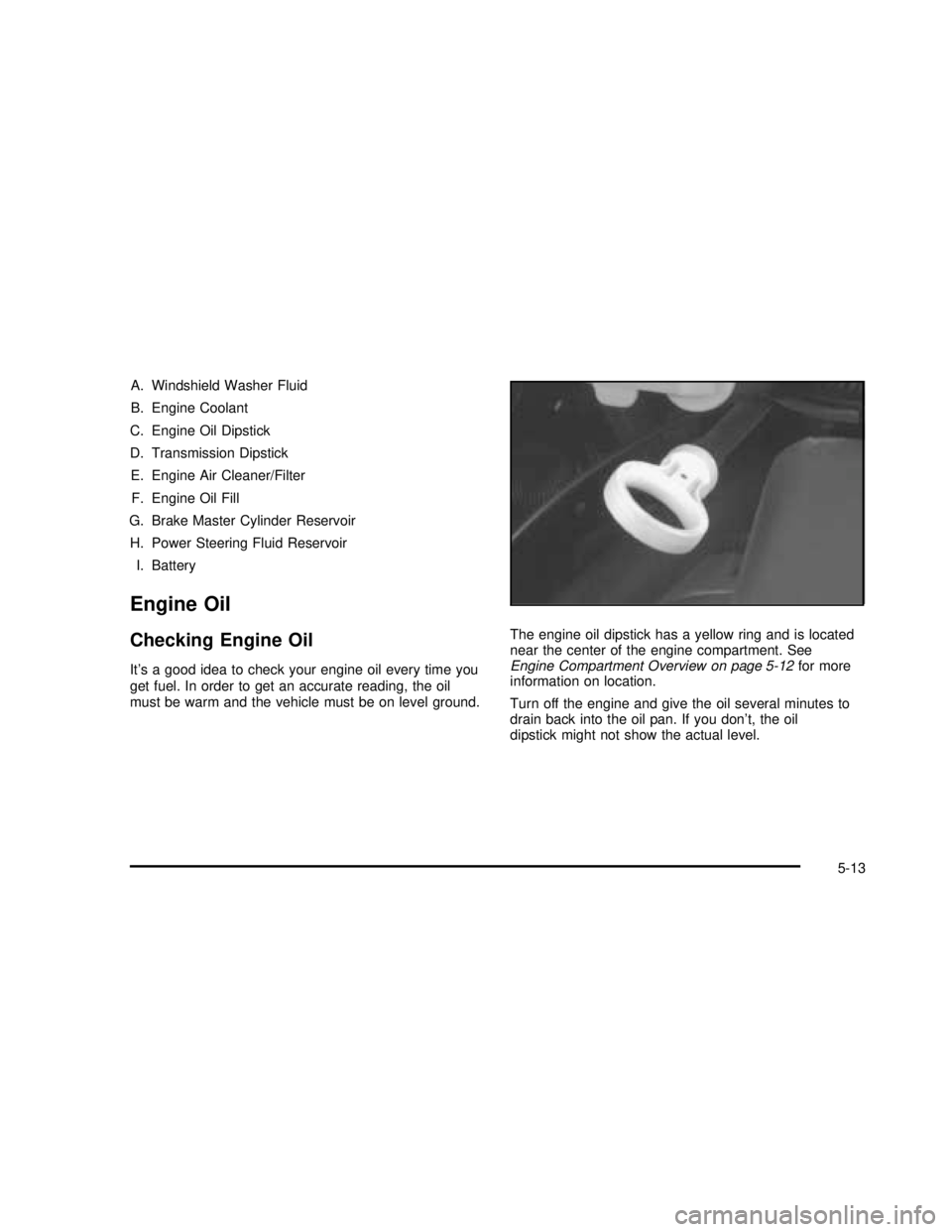
C. Engine Oil Dipstick
D. Transmission Dipstick
E. Engine Air Cleaner/Filter
F. Engine Oil Fill
G. Brake Master Cylinder Reservoir
H. Power Steering Fluid Reservoir
I. Battery
Engine Oil
Checking Engine Oil
It’s a good idea to check your engine oil every time you
get fuel. In order to get an accurate reading, the oil
must be warm and the vehicle must be on level ground.The engine oil dipstick has a yellow ring and is located
near the center of the engine compartment. See
Engine Compartment Overview on page 5-12for more
information on location.
Turn off the engine and give the oil several minutes to
drain back into the oil pan. If you don’t, the oil
dipstick might not show the actual level.
5-13
2003 - Safari OM
Page 234 of 376

How to Inspect the Engine Air
Cleaner/Filter
To inspect the engine air cleaner/filter remove thefilter
from the vehicle and lightly shakefilter to release
loose dust and dirt. If thefilter remains caked with dirt, a
newfilter is required.
To inspect or replace thefilter, do the following:
1. Unsnap both clips on the cover.
2. Remove the cover.
3. Change thefilter.
4. Snap both clips to secure the engine air
cleaner/filter cover.
{CAUTION:
Operating the engine with the air cleaner/lter
off can cause you or others to be burned. The
air cleaner not only cleans the air, it helps to
stopame if the engine backres. If it isn’t there
and the engine backres, you could be burned.
Don’t drive with it off, and be careful working on
the engine with the air cleaner/lter off.Notice:If the air cleaner/lter is off, a backre can
cause a damaging enginere. And, dirt can
easily get into your engine, which will damage it.
Always have the air cleaner/lter in place when
you’re driving.
Automatic Transmission Fluid
When to Check and Change
A good time to check your automatic transmissionfluid
level is when the engine oil is changed.
Change both thefluid andfilter every 15,000 miles
(25 000 km) if the vehicle is mainly driven under one or
more of these conditions:
•In heavy city traffic where the outside temperature
regularly reaches 90°F (32°C) or higher.
•In hilly or mountainous terrain.
•When doing frequent trailer towing.
•Uses such as found in taxi, police or delivery
service.
If you do not use your vehicle under any of these
conditions, change thefluid andfilter every 50,000 miles
(83 000 km).
SeePart A: Scheduled Maintenance Services on
page 6-4.
5-22
2003 - Safari OM
Page 235 of 376

How to Check
Because this operation can be a little difficult, you may
choose to have this done at the dealership service
department.
If you do it yourself, be sure to follow all the instructions
here, or you could get a false reading on the dipstick.
Notice:Too much or too littleuid can damage
your transmission. Too much can mean that some
of theuid could come out and fall on hot engine
part or exhaust system parts, starting are.
Too littleuid could cause the transmission to
overheat. Be sure to get an accurate reading if you
check your transmissionuid.
Wait at least 30 minutes before checking the
transmissionfluid level if you have been driving:
•When outside temperatures are above 90°F (32°C).
•At high speed for quite a while.
•In heavy traffic—especially in hot weather.
•While pulling a trailer.
To get the right reading, thefluid should be at normal
operating temperature, which is 180°Fto200°F
(82°Cto93°C).Get the vehicle warmed up by driving about 15 miles
(24 km) when outside temperatures are above 50°F
(10°C).Ifit’s colder than 50°F (10°C), drive the vehicle
in THIRD (3) until the engine temperature gage
moves and then remains steady for 10 minutes.
A coldfluid check can be made after the vehicle has
been sitting for eight hours or more with the engine off,
but this is used only as a reference. Let the engine
run at idle forfive minutes if outside temperatures are
50°F (10°C) or more.
If it’s colder than 50°F (10°C), you may have to idle the
engine longer. Should thefluid level be low during
this cold check, youmustcheck thefluid hot before
addingfluid. Checking thefluid hot will give you a more
accurate reading of thefluid level.
Checking the Fluid Level
Prepare your vehicle as follows:
•Park your vehicle on a level place. Keep the engine
running.
•With the parking brake applied, place the shift lever
in PARK (P).
•With your foot on the brake pedal, move the shift
lever through each gear range, pausing for about
three seconds in each range. Then, position the shift
lever in PARK (P).
•Let the engine run at idle for three minutes or more.
5-23
2003 - Safari OM
Page 236 of 376
Then, without shutting off the engine, follow these steps:
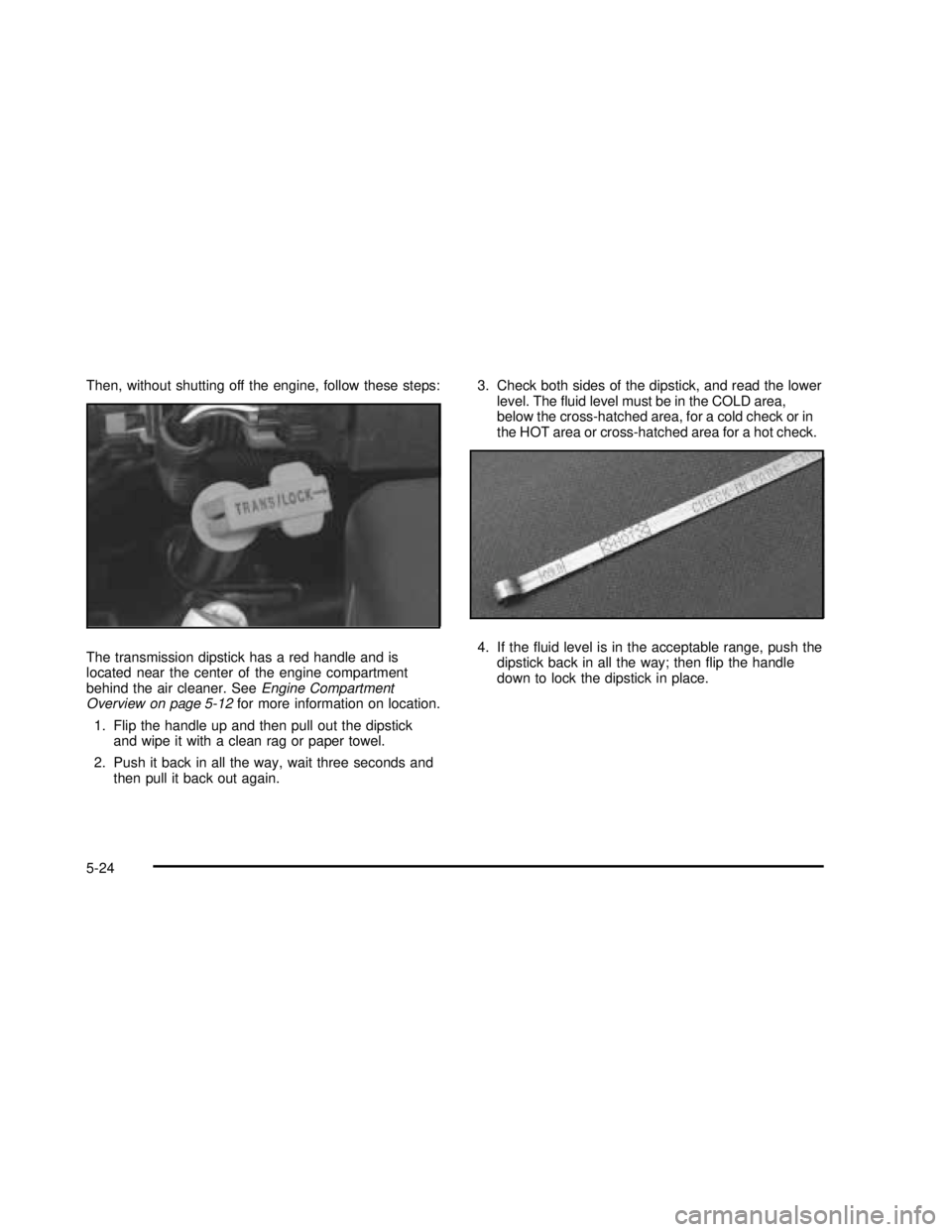
The transmission dipstick has a red handle and is
located near the center of the engine compartment
behind the air cleaner. SeeEngine Compartment
Overview on page 5-12for more information on location.
1. Flip the handle up and then pull out the dipstick
and wipe it with a clean rag or paper towel.
2. Push it back in all the way, wait three seconds and
then pull it back out again.3. Check both sides of the dipstick, and read the lower
level. Thefluid level must be in the COLD area,
below the cross-hatched area, for a cold check or in
the HOT area or cross-hatched area for a hot check.
4. If thefluid level is in the acceptable range, push the
dipstick back in all the way; thenflip the handle
down to lock the dipstick in place.
5-24
2003 - Safari OM
Page 237 of 376

How to Add Fluid
Refer to the Maintenance Schedule to determine what
kind of transmissionfluid to use. SeePart D:
Recommended Fluids and Lubricants on page 6-34.
Addfluid only after checking the transmissionfluid while
it is hot. (A cold check is used only as a reference.) If
thefluid level is low, add only enough of the properfluid
to bring the level up to the HOT area for a hot check.
It doesn’t take muchfluid, generally less than one pint
(0.5 L).Don’t overfill.
Notice:We recommend you use onlyuid labeled
DEXRON
®-III, becauseuid with that label is
made especially for your automatic transmission.
Damage caused byuid other than DEXRON
®-III is
not covered by your new vehicle warranty.
•After addingfluid, recheck thefluid level as
described under“How to Check.”
•When the correctfluid level is obtained, push the
dipstick back in all the way; thenflip the handle
down to lock the dipstick in place.
Engine Coolant
The cooling system in your vehicle isfilled with
DEX-COOL®engine coolant. This coolant is designed
to remain in your vehicle for 5 years or 150,000 miles
(240 000 km), whichever occursfirst, if you add
only DEX-COOL
®extended life coolant.The following explains your cooling system and how to
add coolant when it is low. If you have a problem
with engine overheating, seeEngine Overheating on
page 5-28.
A 50/50 mixture of clean, drinkable water and
DEX-COOL
®coolant will:
•Give freezing protection down to−34°F(−37°C).
•Give boiling protection up to 265°F (129°C).
•Protect against rust and corrosion.
•Help keep the proper engine temperature.
•Let the warning lights and gages work as they
should.
Notice:When adding coolant, it is important that
you use only DEX-COOL
®(silicate-free) coolant.
If coolant other than DEX-COOL®is added to
the system, premature engine, heater core or
radiator corrosion may result. In addition, the engine
coolant will require change sooner -- at 30,000 miles
(50,000 km) or 24 months, whichever occursrst.
Damage caused by the use of coolant other
than DEX-COOL
®is not covered by your new vehicle
warranty.
5-25
2003 - Safari OM
Page 248 of 376

Engine Fan Noise
This vehicle has a clutched engine cooling fan. When
the clutch is engaged, the fan spins faster to provide
more air to cool the engine. In most everyday driving
conditions, the clutch is not fully engaged. This improves
fuel economy and reduces fan noise. Under heavy
vehicle loading, trailer towing and/or high outside
temperatures, the fan speed increases when the clutch
engages. So you may hear an increase in fan noise.
This is normal and should not be mistaken as the
transmission slipping or making extra shifts. It is merely
the cooling system functioning properly. The fan will
slow down when additional cooling is not required and
the clutch disengages.
You may also hear this fan noise when you start the
engine. It will go away as the fan clutch disengages.
Power Steering Fluid
5-36
2003 - Safari OM
Page 256 of 376
2. Get the vehicles close enough so the jumper cables
can reach, but be sure the vehicles aren’t touching
each other. If they are, it could cause a ground
connection you don’t want. You wouldn’t be able to
start your vehicle, and the bad grounding could
damage the electrical systems.
To avoid the possibility of the vehicles rolling, set
the parking brakefirmly on both vehicles involved in
the jump start procedure. Put an automatic
transmission in PARK (P) and a manual
transmission in NEUTRAL.
3. Turn off the ignition on both vehicles. Unplug
unnecessary accessories plugged into the cigarette
lighter or accessory power outlets. Turn off all
lamps that aren’t needed as well as radios. This will
avoid sparks and help save both batteries. In
addition, it could save your radio!
Notice:If you leave your radio on, it could be badly
damaged. The repairs wouldn’t be covered by
your warranty.
4. Open the hoods and locate the batteries. Find the
positive (+) and negative (−) terminals on each
battery.
{CAUTION:
Using a match near a battery can cause battery
gas to explode. People have been hurt doing
this, and some have been blinded. Use a
ashlight if you need more light.
Be sure the battery has enough water. You
don’t need to add water to the ACDelco
®
battery installed in your new vehicle. But if a
battery hasller caps, be sure the right
amount ofuid is there. If it is low, add water
to take care of thatrst. If you don’t, explosive
gas could be present.
Batteryuid contains acid that can burn you.
Don’t get it on you. If you accidentally get it in
your eyes or on your skin,ush the place with
water and get medical help immediately.
5-44
2003 - Safari OM
Page 300 of 376

Fuse/Circuit
BreakerUsage
12 L, M1, M2 Blower Motor, Rear Air
Conditioning Relay Coil, Front Cont.
Temp. Door Motor, HI Blower Relay,
Defogger Timer Coil
13 Cigarette Lighter, Door Lock
Switches, Dutch Door Release
Module
14 Cluster Illum, Climate Controls,
Chime Module, Radio Illumination,
Rear Heat Switch Illumination, Rear
Wiper/Washer Switch Illumination,
Rear Liftgate Switch Illumination,
Remote Cassette Illumination,
Overhead Console, Truck Body
Control Illumination
15 Truck Body Module, Headlamp
Relay
16 Front Turn Signals, Rear Turn
Signals, Trailer Turn Signals,
Back-Up Lamps, Brake
Transmission Shift Interlock SolenoidFuse/Circuit
BreakerUsage
17 Front Wipers, Front Washer Pump
18 VCM-Ign 3, VCM-Brake, Cruise
Stepper Motor Signal, ATC Module
19 Instrument Panel Radio: ATC (Main
Feed), 2000 Series (Standby)
20 PRNDL/Odometer, TCC Enable and
PWM Solenoid, Shift A and Shift B
Solenoids, 3–2 Downshift Solenoid,
Instrument Panel Cluster, VCM
Module
21 Powr Adjust Mirrors
22 Not Used
23 Rear Wiper, Rear Washer Pump
24 Not Used
A (Circuit Breaker) Power Door Lock
Relay, 6–Way Power Seats
B (Circuit Breaker) Power Windows
5-88
2003 - Safari OM