fuel GMC SAVANA 1996 User Guide
[x] Cancel search | Manufacturer: GMC, Model Year: 1996, Model line: SAVANA, Model: GMC SAVANA 1996Pages: 372, PDF Size: 18.81 MB
Page 174 of 372
Run your engine only as long as you must. This saves
fuel. When you run the engine, make
it go a little fdster
than just idle. That
is, push the accelerator slightly.
This uses
less fuel for the heat that you get and it
keeps the battery (or batteries) charged. You will need
a well-charged battery (or batteries) to restart the
vehicle, and possibly for signaling later on with your
headlamps. Let the heater
run for awhile.
If you have a diesel engine, you may have to run it at a
higher speed to get enough heat. Then, shut the engine
off and close the window almost all the way to preserve
the heat. Start the engine again and repeat this only
when you feel really uncomfortable from the cold.
But
do it as little as possible. Preserve the fuel as long as you
can. To help keep warm, you can get out of the vehicle
and
do some fairly vigorous exercises every half hour or
so until help comes.
Loading Your T hicle
on
GAWR FRT
RIM COLD TIRE PRI
EE ~ENERS MANUAL FOR ADDITIONAL INFORMATION. -1
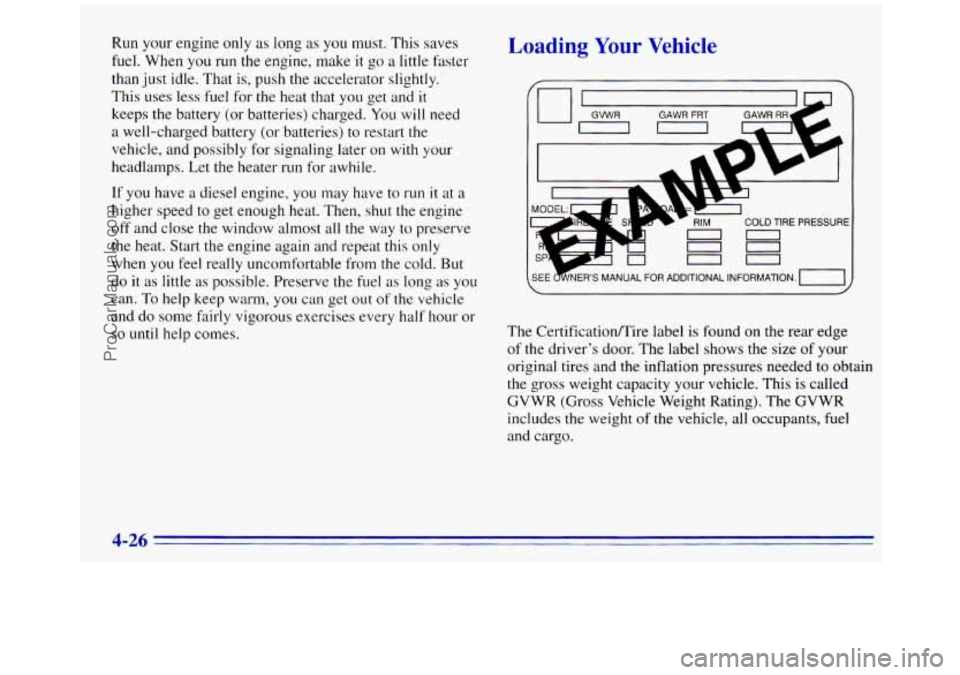
The CertificationRire label is found on the rear edge
of the driver’s door. The label shows the size
of your
original tires and the inflation pressures needed to obtain the gross weight capacity your vehicle. This is called
GVWR (Gross Vehicle Weight Rating). The GVWR
includes the weight of the vehicle, all occupants, fuel
and cargo.
4-26
ProCarManuals.com
Page 176 of 372
Towin; a Traile
A CAUTION:
If you don’t use the correct equipment and drive
properly, you can lose control when you pull
a
trailer. For example, if the trailer is too heavy, the
brakes may not work
well -- or even at all. You
and your passengers could be seriously injured.
Pull
a trailer only if you have followed all the
steps in this section.
Ask your GM dealer for
advice and information about towing
a trailer
with your vehicle.
NOTICE:
Pulling a trailer improperly can damage your
vehicle and result in costly repairs not covered by
your warranty.
To pull a trailer correctly, follow
the advice in this part, and see your
GM dealer
for important information about towing a trailer
with your vehicle.
Your vehicle can tow
a trailer. To identify what the
vehicle trailering capacity is for your vehicle, you
should read
the information in “Weight of the Trailer”
that appears later
in this section. But trailering is
different than just driving your vehicle by itself.
Trailering means changes
in handling, durability and
fuel economy. Successful, safe trailering takes correct
equipment, and
it has to be used properly.
That’s the reason for this section.
In it are many
time-tested, important trailering tips and safety rules.
Many of these are important for your safety and that of
your passengers. So please read this section carefully
before you pull
a trailer.
4-28
ProCarManuals.com
Page 225 of 372
Section 6 Service and Appearance Care
Here you will find information about the care of your
vehicle. This section begins
with service and fuel
information, and then
it shows how to check important
fluid and lubricant levels. There is also technical
information about your vehicle, and
a part devoted to its
appearance care.
Service
Your GM dealer knows your vehicle best and wants you
to be happy
with it. We hope you'll go to your dealer for
all your service needs. You'll get genuine
GM parts and
GM-trained and supported service people. We
hope
you'll want to keep your GM vehicle all GM.
Genuine
GM parts have one of these marks:
Doing Your Own Service Work
If you want to do some of your own service work, you'll
want to get the proper GM Service Manual.
It tells you
much more about how to service your vehicle than this
manual can.
To order the proper service manual, see
"Service and Owner Publications"
in the Index.
6- 1
ProCarManuals.com
Page 226 of 372
Your vehicle may have an air bag system. If it does, see
1 “Servicing Your Air Bag-Equipped Vehicle” in the
I Index before attempting to do your own service work.
You should keep a record with all parts receipts and list
the mileage and the date of any service work
you
perform. See “Maintenance Record” in the Index.
You can be injured and your vehicle could be
damaged if you try to do service work on a
vehicle without knowing enough about
it.
Be sure you have suffkient knowledge,
experience, and the proper replacement
parts and tools before you attempt any
vehicle maintenance task.
0 Be sure to use the proper nuts, bolts and
other fasteners. “English” and “metric”
fasteners can be easily confused.
If you use
the wrong fasteners, parts can later break
or fall
off. You could be hurt.
Fuel (Gasoline Engine)
If your vehicle has a diesel engine, see “Diesel Fuel
Requirements and Fuel System” in the Diesel Engine
Supplement. For vehicles with gasoline engines, please
read this.
L
Use regular unleaded gasoline rated at 87 octane,or
higher. At a minimum, it should meet specifications
ASTM D4814 in the United States and
CGSB 3.5-M93
in Canada. Improved gasoline specifications have been
developed by the American Automobile Manufacturers
Association (AAMA) for better vehicle performance
and engine protection. Gasolines meeting the AAMA
specification could provide improved driveability and
emission control system protection compared to
other gasolines.
Be sure the posted octane
is at least 87. If the octane is
less than 87, you may get a heavy knocking noise when
you drive. If it’s bad enough, it can damage your engine.
If
you’re using fuel rated at 87 octane or higher and you
still hear heavy knocking, your engine needs service.
But don’t worry if you hear a little pinging noise when
you’re accelerating or driving up a hill. ,That’s normal,
and you don’t have to buy a higher octane fuel
to get rid
of pinging. It’s the heavy, constant knock that means
you have a problem.
i 6-2
I
ProCarManuals.com
Page 227 of 372
If your vehicle is certified to meet California Emission
Standards (inciicatecl on the underhood tune-up label),
it
is designed to operate on fuels that meet California
specifications.
If such fuels are not available in states
adopting California emissions standards,
your vehicle
will operate satisfactorily on fuels meeting federal
specifications. but emission control system performance
may be affected. The malfunction indicator lamp on
Y~LII' instrument panel may turn on and/or your vehicle
may fail a smog-check test.
If this OCCLII-S, return to YOLK
authorized GM dealer for diagnosis to determine the
cause of failure.
In the event it is cletermined that the
ca~~se
of the condition is the type of fuels used, repairs
may not be covered
by your warranty.
In Canada, some gasolines contain an octane-enhancing
additive crdled MMT.
IF you LIS~ such f~~els. your
emission control system performance may deteriorate
and the malfunction indicator lamp on your instrument
panel may turn on.
If this happens, return to YOLII'
authorized GM dealer for service.
To provide cleaner air, all gasolines are now required to
contain additives that
will help prevent deposits from
forming
in your engine and fuel system. allowing your
emission control system to function properly. Therefore,
you should not have
to add anything to the fuel. In
addition, gasolines containing oxygenates. such as ethers
and ethanol, and reforn~~lated gasolines may
be
available in your area to help clean the air. General
Motors recmnlnends that you use these gasolines ilthey
comply
with the specifications described earlier.
NOTICE:
Your vehicle was not designed for fuel that
contains methanol. Don't
use it. It can corrode
metal parts in your fuel system and
also damage
plastic and rubber parts. That damage wouldn't
be covered under your warranty.
6-3
ProCarManuals.com
Page 228 of 372
Fuels in Foreign Countries
-- Gasoline Engines
If you plan on driving in another country outside the
United States or Canada, the proper fuel may be hard to
find. Never use leaded gasoline or any other fuel not
recommended in the previous text on fuel. Costly repairs
caused by use
of improper fuel wouldn’t be covered by
your warranty.
To check on fuel availability, ask an auto club, or
contact a major
oil company that does business in the
country where you’ll be driving.
You can also write
us at the following address for
advice.
Just tell us where you’re going and give your
Vehicle Identification Number (VIN).
General Motors Overseas Distribution Corporation,
North American Export Sales (NAES)
1908 Colonel Sam Drive
Oshawa, Ontario
L 1 H 8P7
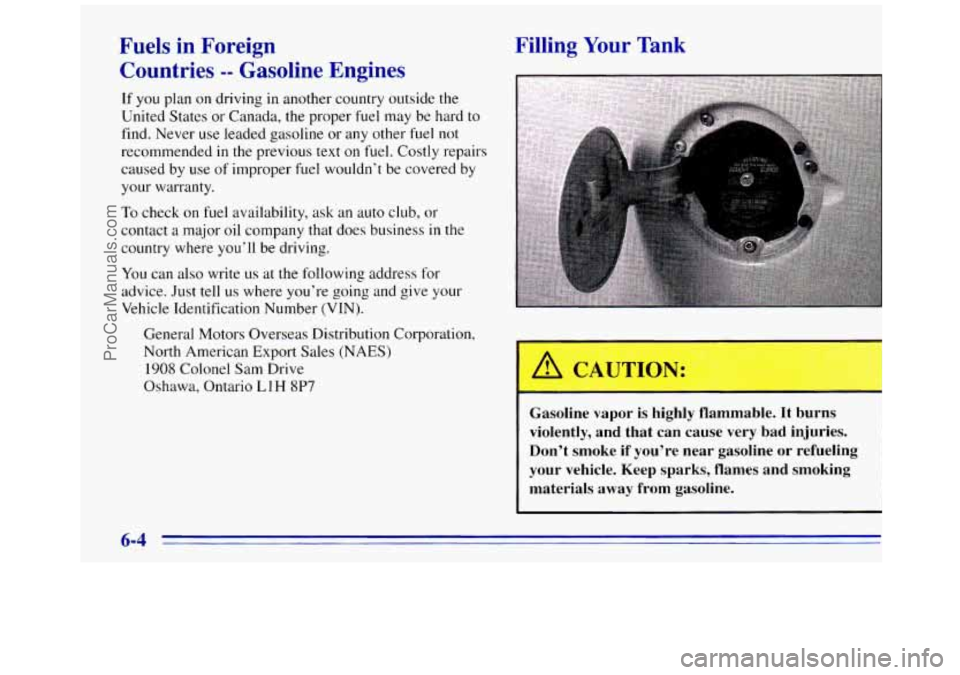
Filling Your Tank
Gasoline vapor is highly flammable. It burns
violently, and that can cause very bad injuries.
Don’t smoke if you’re near gasoline or refueling
your vehicle. Keep sparks, flames and smoking
materials away from gasoline.
6-4
ProCarManuals.com
Page 229 of 372
L
If you get gasoline on yourself and then
something ignites it, you could be badly burned.
Gasoline can spray out
on you if you open the
fuel filler cap too quickly.
This spray can happen
if your tank
is nearly full, and is more likely in
hot weather. Open the fuel filler cap slowly and
wait for any “hiss” noise to stop. Then unscrew
the cap all the way.
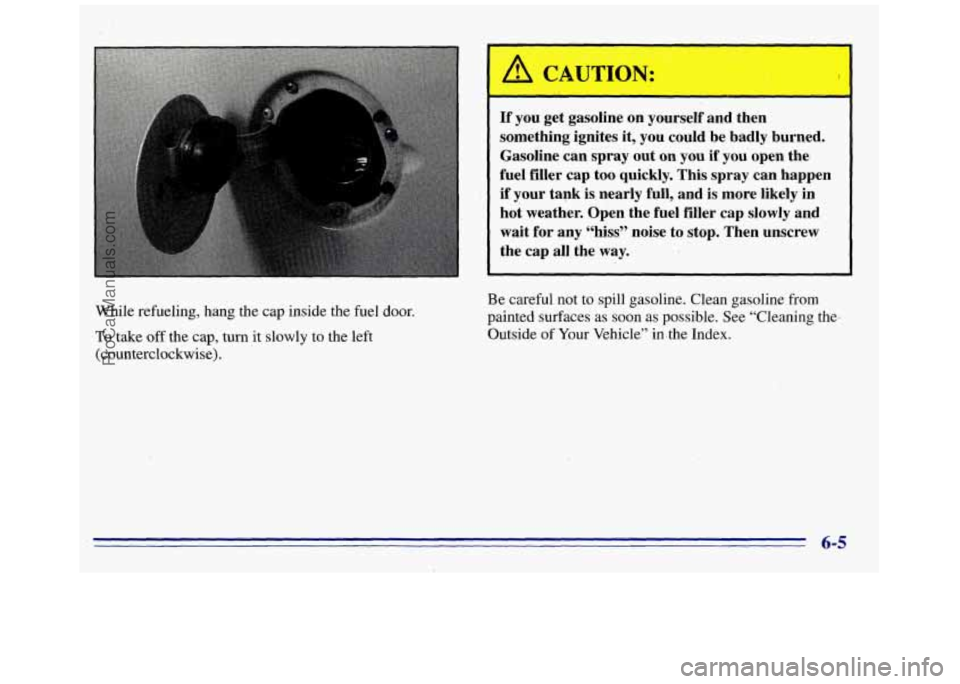
While refueling, hang the cap inside the fuel door.
To take off the cap, turn it slowly to the left
(counterclockwise). Be
careful not
to spill gasoline. Clean gasoline from
painted surfaces
as soon as possible. See “Cleaning the-
Outside of Your Vehicle” in.the Index.
6-5
f
ProCarManuals.com
Page 230 of 372
When you put the cap back on, turn it to the right until
you hear at least three clicks. Make sure you fully install
the cap. The diagnostic system can determine if the fuel
cap has been left off
or improperly installed. This would
allow fuel to evaporate int.0 the atmosphere. See
“Malfunction Indicator Lamp”
in the Index.
I NOTICE:
If you need a new cap, be sure to get the right
type. Your dealer can get one for you.
If you get
the wrong type, it
may not fit or have proper
venting, and your fuel tank and emissions system
might be damaged.
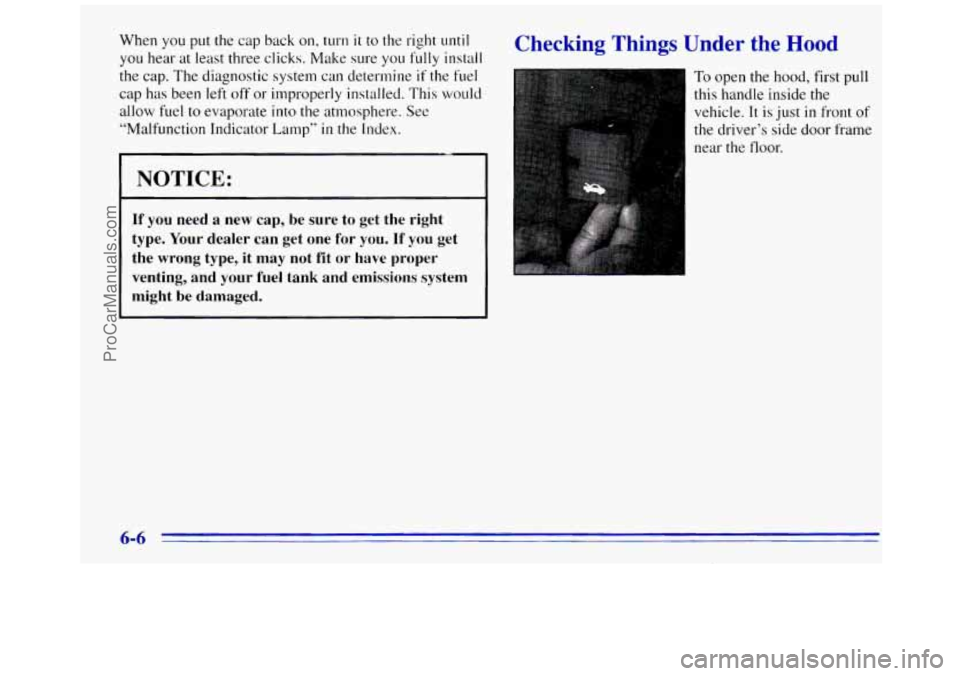
Checking Things Under the Hood
To open the hood, first pull
this handle inside the
vehicle. It is just
in front of
the driver’s side door frame
near
the floor.
6-6
ProCarManuals.com
Page 235 of 372
Engine Oil (Gasoline Engine)
If your vehicle has a diesel engine, see “Engine Oil
(Diesel Engine)” in the Diesel Engine Supplement.
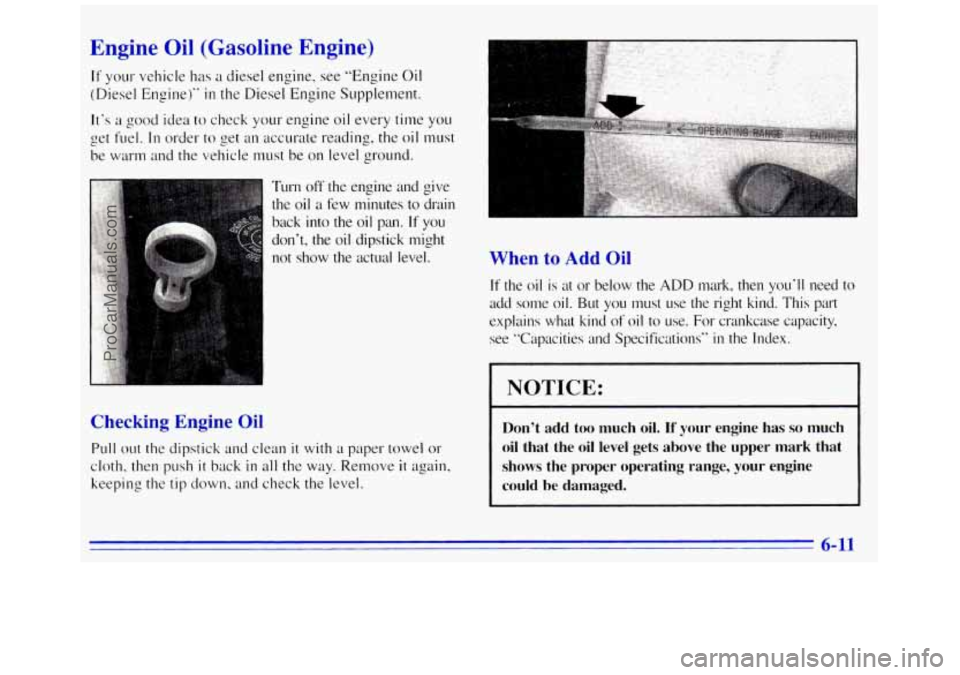
It‘s
a good idea to check your engine oil every time you
be warm and the vehicle must be on level ground.
c‘ Get fuel. In order to get an accurate reading, the oil must
Turn
off the engine and give
the oil
a few minutes to drain
back into the
oil pan. If you
don’t, the oil dipstick might
not show the actual level.
Checking Engine Oil
Pull out the dipstick and clean it with a paper towel or
cloth, then push
it back in all the way. Remove it again,
keeping the tip down, and check the level.
When to Add Oil
If the oil is at or below the ADD mark, then ~011’11 need to
add some oil. But you must use the right kind. This part
explains what kind
of oil to use. For crankcase capacity,
see “Capacities and Specifications”
in the Index.
NOTICE:
Don’t add too much oil. If your engine has so much
oil that the oil level gets above the upper mark that
shows the proper operating range, your engine could be damaged.
ProCarManuals.com
Page 237 of 372
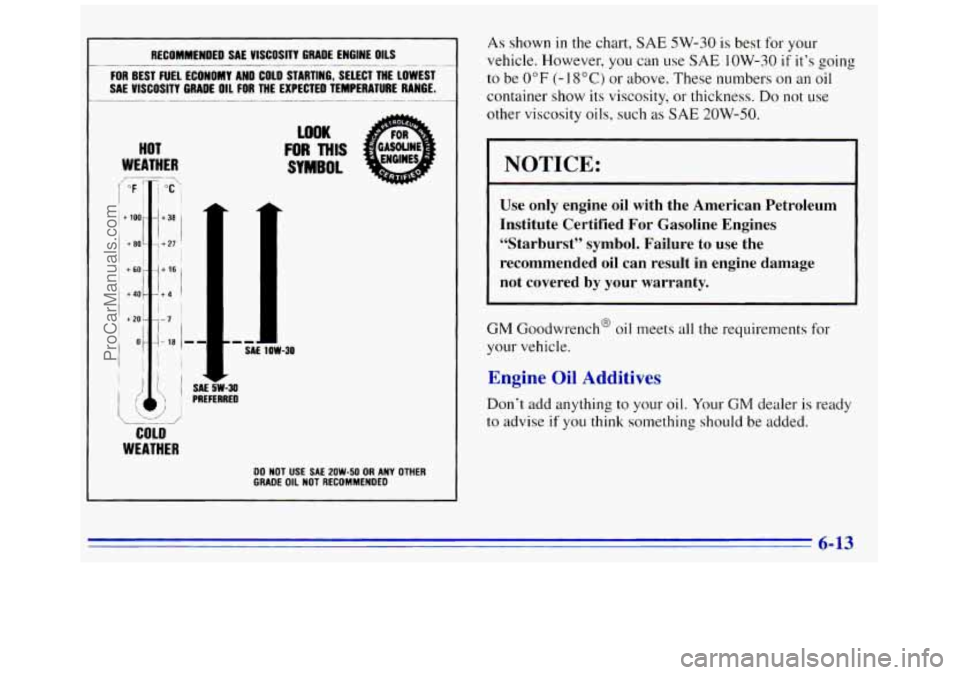
RECOMMENDED SAE VISCOSITY GRADE ENGINE OILS
FOR BEST FUEL ECONOMY AND COLD STARTING, SELECT THE LOWEST
SAE VISCOSITY GRADE
OIL FOR THE EXPECTED TEMPERATURE RANGE.
HOT
WEATHER
i +38
1 +27
LOOK
FOR THIS
SYMBOL
COLD
WEATHER
DO NOT USE SAE 2OW-50 OR ANY OTHER GRADE OIL NOT RECOMMENDED
As shown in the chart, SAE 5W-30 is best for your
vehicle. However, you can use
SAE ]OW-30 if it’s going
to be
0°F (- 18°C) or above. These numbers on an oil
container
show its viscosity, or thickness. Do not use
other viscosity oils, such as
SAE 20W-50.
NOTICE:
Use only engine oil with the American Petroleum
Institute Certified For Gasoline Engines
LcStarbur~t” symbol. Failure to use the
recommended oil can result in engine damage
not covered by your warranty.
GM Goodwrench@ oil meets all the requirements for
your vehicle.
Engine Oil Additives
Don‘t add anything to your oil. Your GM dealer is ready
to advise
if you think something should be added.
6-13
ProCarManuals.com