turn signal GMC SAVANA 1996 User Guide
[x] Cancel search | Manufacturer: GMC, Model Year: 1996, Model line: SAVANA, Model: GMC SAVANA 1996Pages: 372, PDF Size: 18.81 MB
Page 163 of 372
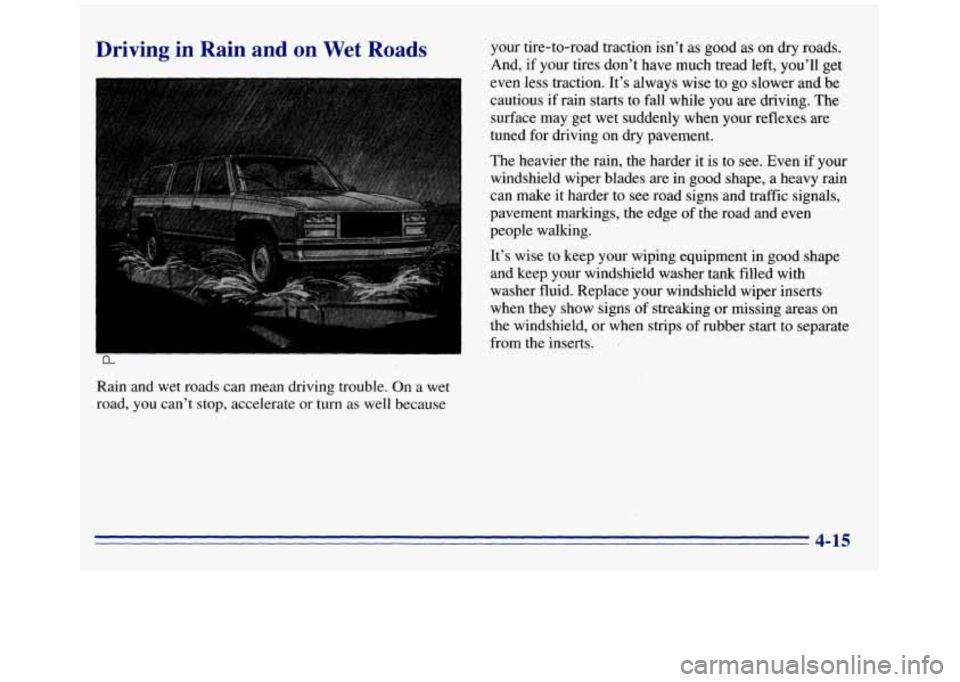
Driving in Rain and on Wet Roads
Rain and wet roads can mean driving trouble. On a wet
road, you can’t stop, accelerate or turn as well because your tire-to-road traction isn’t as good as
on dry roads.
And,
if your tires don’t have much tread left, you’ll get
even less traction. It’s always wise to
go slower and be
cautious if rain starts to fall while you
are driving. The
surface may get wet suddenly when your reflexes
are
tuned for driving on dry pavement.
The heavier the rain, the harder it is to see. Even if your
windshield wiper blades
are in good shape, a heavy rain
can make
it harder to see road signs and traffic signals,
pavement markings, the edge
of the road and even
people walking.
It’s wise to keep your wiping equipment in good shape
and keep your windshield washer tank filled with
washer fluid. Replace your windshield wiper inserts
when they show signs of streaking or missing areas on
the windshield, or when strips of rubber start to separate
from the inserts.
4-15
ProCarManuals.com
Page 166 of 372
City Driving
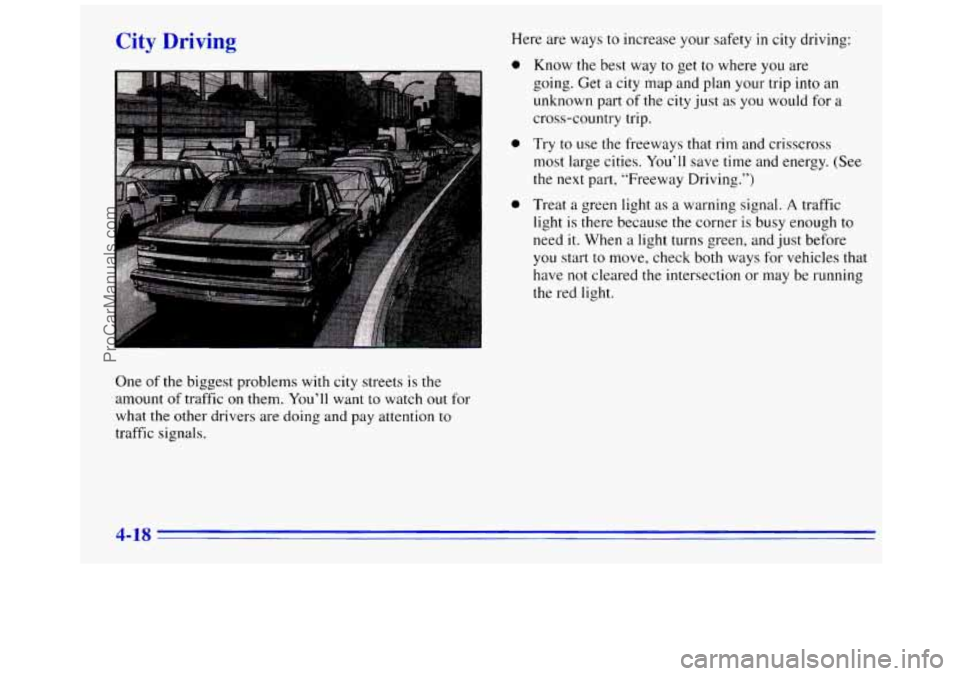
One of the biggest problems with city streets is the
amount of traffic on them. You’ll want to watch out for
what the other drivers are doing and pay attention
to
traffic signals. Here
are ways
to increase your safety in city driving:
0 Know the best way to get to where you are
going. Get a city map and plan your trip into an
unknown part of the city just as you would for a
cross-country trip.
0 Try to use the freeways that rim and crisscross
most large cities.
You’ll save time and energy. (See
the next part, “Freeway Driving.”)
0 Treat a green light as a warning signal. A traffic
light
is there because the corner is busy enough to
need
it. When a light turns green, and just before
you start to move, check both ways for vehicles that
have not cleared the intersection or may be running
the red light.
4-18
ProCarManuals.com
Page 167 of 372
Freeway Driving The most important advice on freeway driving is: Keep
up
with traffic and keep to the right. Drive at the same
speed most of the other drivers are driving. Too-fast or
too-slow driving breaks a smooth traffic flow. Treat the
left lane on a freeway as a passing lane.
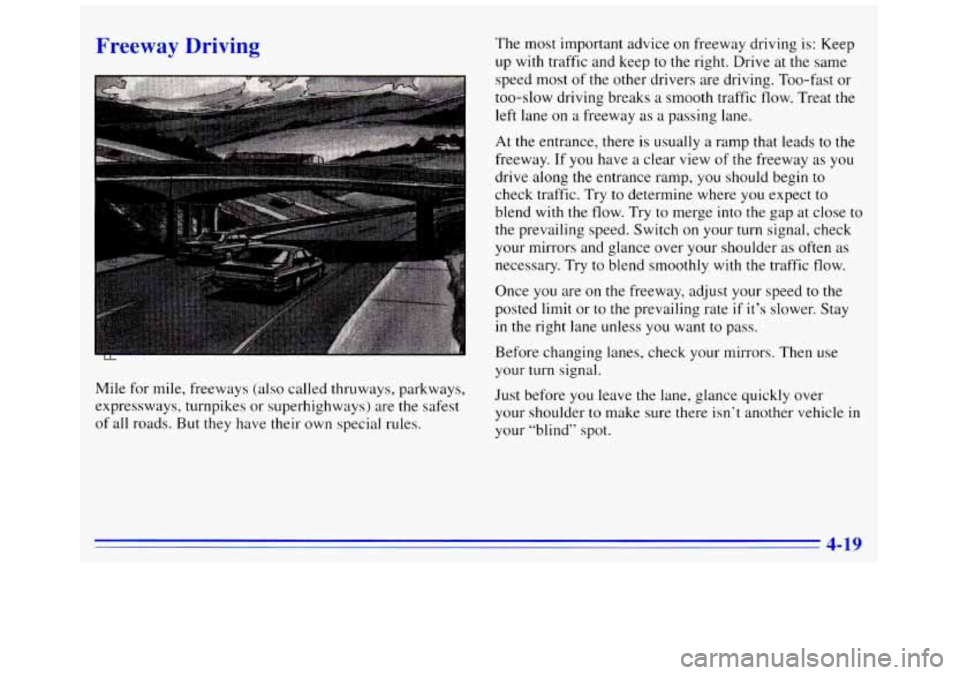
At the entrance, there is usually a ramp that leads to the
freeway.
If you have a clear view of the freeway as you
drive along the entrance ramp, you should begin to
check traffic. Try to determine where you expect to
blend with the flow. Try to merge into the
gap at close to
the prevailing speed. Switch on your
turn signal, check
your mirrors and glance over your shoulder
as often as
necessary. Try to blend smoothly with the traffic flow.
Once you are
on the freeway, adjust your speed to the
posted limit or to the prevailing rate
if it’s slower. Stay
in the right lane unless you want to
pass.
Before changing lanes, check your mirrors. Then use
your
turn signal.
Mile for mile, freeways (also called thruways, parkways,
Just before you leave the lane, glance quickly over
expressways, turnpikes or superhighways) are the safest your shoulder to make Sure there isn’t another vehicle in
of all roads. But they have their own special rules. your “blind” spot.
4-1 9
ProCarManuals.com
Page 183 of 372
Passing
You’ll need more passing distance up ahead when
you’re towing
a trailer. And, because you’re a good deal
longer, you’ll need to go much farther beyond the
passed vehicle before
you can return to your lane.
Backing Up
Hold the bottom of the steering wheel with one hand.
Then, to move the trailer
to the left, just move that hand
to the left.
To move the trailer to the right, move your
hand to the right. Always back
up slowly and, if
possible, have someone guide you.
Making Turns
NOTICE:
Making very sharp turns while trailering could
cause the trailer to come in contact with the
vehicle. Your vehicle could be damaged. Avoid
making very sharp turns while trailering.
When you’re turning with a trailer, make wider
turns than normal.
Do this so your trailer won’t
strike
soft shoulders, curbs, road signs, trees or other
objects. Avoid jerky
or sudden maneuvers. Signal well
in advance.
Thrn Signals When Towing a Trailer
When you tow a trailer, your vehicle has to have extra
wiring and
a heavy-duty turn signal flasher (included in
the optional trailering package).
The green arrows on your instrument panel will flash
whenever you signal
a turn or lane change. Properly
hooked up,
the trailer lamps will also flash, telling other
drivers you’re about to turn, change lanes or stop.
When towing
a trailer, the green arrows on your
instrument panel will flash for turns even
if the bulbs on
the trailer are burned out. Thus, you may think drivers
behind
you are seeing your signal when they are not. It’s
important to check occasionally to be sure
the trailer
bulbs are still working.
4-35
ProCarManuals.com
Page 189 of 372
Section 5 Problems on the Road
Here you’ll find what to do about some problems that
can occur on the road.
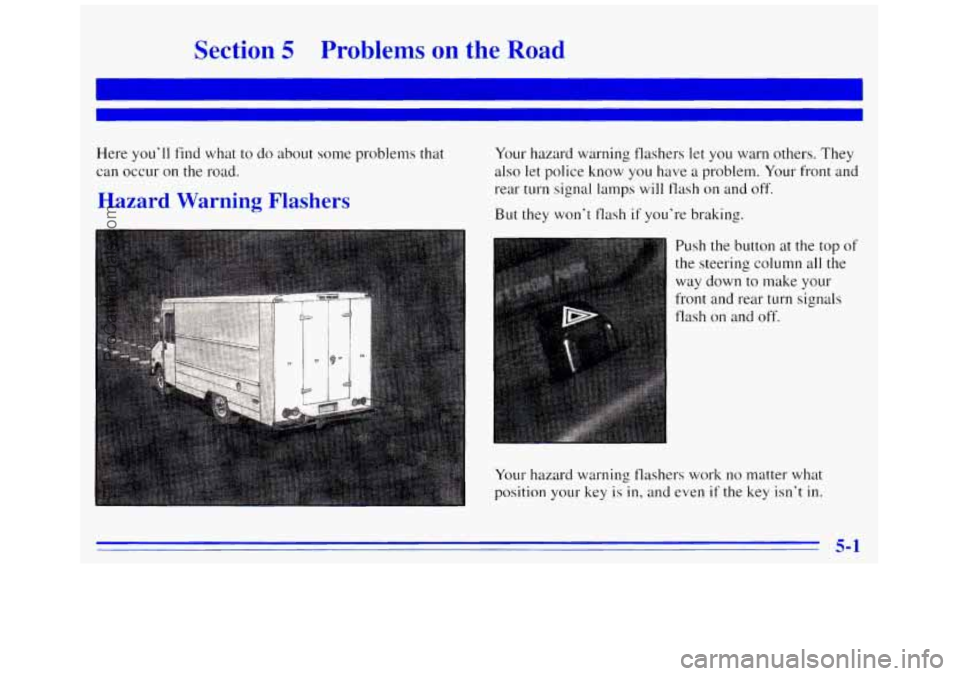
Hazard Warning Flashers
Your hazard warning flashers let you warn others. They
also let police know you have a problem. Your front and
rear turn signal lamps will flash on and
off.
But they won’t flash if you’re braking.
Push the button at the top
of
the steering column all the
way down to make your
front and rear turn signals
flash on and
off.
Your hazard warning flashers work no matter what
position your key
is in, and even if the key isn’t in.
5-1
ProCarManuals.com
Page 190 of 372
To turn off the flashers, push the button until the first
‘click and release.
When the hazard warning flashers are on, your turn
signals- won’t work.
1 ’ Other Warning Devices
U? you carry reflective triangles, you can use them to
warn others. Set one up at the side of the road about
300 feet (100 m) behind your vehicle.
Jump Starting
If your battery has run down, you may want to use another
vehicle and some jumper cables to
start your vehicle. But
please use the following steps listed to
do it safely.
Batteries can hurt you. They can be
dangerous because:
0 They contain acid that can burn you.
0 They contain gas that can explode or ignite.
0 They contain enough electricity to burn you.
If you don’t follow these steps exa’ctly, some or all
of these things can hurt you.
i
NOTICE:
1. Check the other vehicle. It must have a 12-volt
battery with a negative ground system.
Ignoring these steps could result in costly damage
to your vehicle that wouldn’t be covered by
your warranty.
Trying to start your vehicle by pushing or pulling
it won’t work, and it could damage your vehicle.
NOTICE:
I
I
If’the other system isn’t a 12-volt system with a
negative ground, both vehicles can be damaged.
I
If you have a diesel engine vehicle with two batteries
(or more) you should know before you begin that,
,especially in cold weather, you may not be able
to
get enough power from a single battery in another
vehicle to start your diesel engine.
-r
ProCarManuals.com
Page 258 of 372
Trent Parkinglnrn Signal Lamps
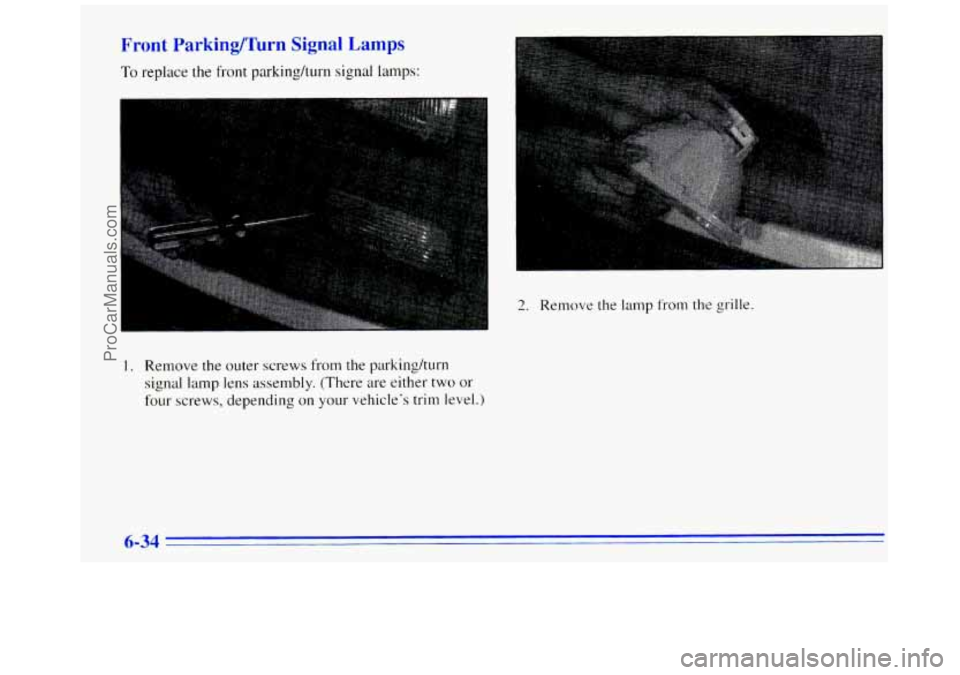
To replace the front parking/turn signal lamps:
2. Remove the lamp from the grille.
1. Remove the outer screws from the parking/turn
signal
lamp lens assembly. (There are either two or
four screws, depending on your vehicle’s trim level.)
6-34
ProCarManuals.com
Page 294 of 372
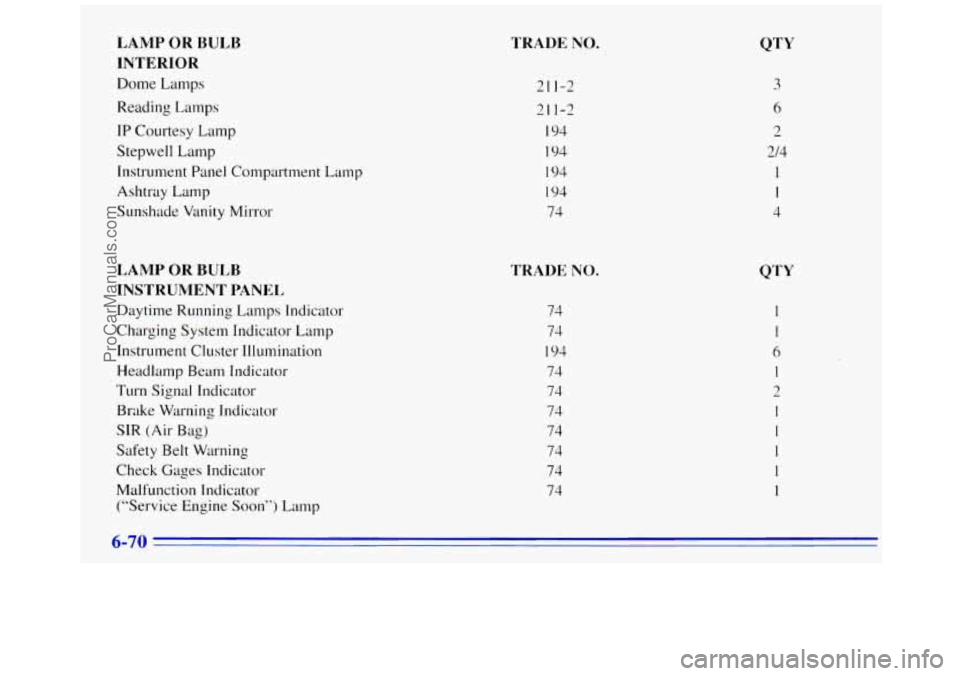
LAMP OR BULB
INTERIOR
Dome Lamps
Reading Lamps
IP Courtesy Lamp
Stepwell Lamp Instrument Panel Compartment Lamp
Ashtray Lamp
Sunshade Vanity Mirror
LAMP OR BULB
INSTRUMENT PANEL
Daytime Running Lamps Indicator
Charging System Indicator Lamp
Instrument Cluster Illumination
Headlamp Beam Indicator
Turn Signal Indicator Brake Warning Indicator
SIR (Air Bag)
Safety Belt Warning
Check Gages Indicator
Malfunction Indicator
("Service Engine Soon") Lamp
TRADE NO.
21 1-2
21 1-2
194
194
194
194 74
TRADE NO.
74
74
194 74
74
74
74
74
74
74
3
6
2
214
1
I
4
1
1
6
1
2
I
I
1
1
1
6-70
ProCarManuals.com
Page 368 of 372
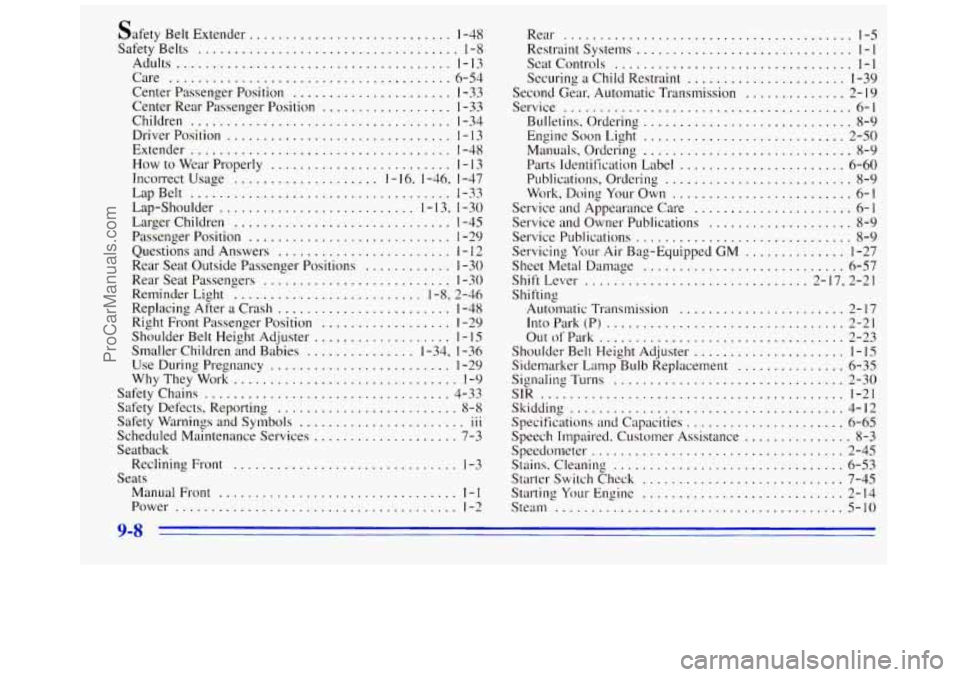
Safety Belt Extender ............................ 1-48
Safety Belts
.................................... 1-8
Adults ....................................... 1-13
Care ....................................... 6-54
Center Passenger Position ...................... 1-33
Center Rear Passenger Position .................. 1-33
Children
.................................... 1-34
Driver Position ............................... 1 - I3
Extender
.................................... 1-48
How to Wear Properly ......................... 1 - I3
Incorrect Usage .................... 1 - I6 . 1-46. 1-47
Lap-Shoulder ........................... 1 - 13, 1-30
Larger Children .............................. 1-45
Passenger Position ............................ 1-29
Questions and Answers
........................ 1 - 12
Rear Seat Outside Passenger Positions ............ 1-30
Rear Seat Passengers
.......................... 1-30
Reminder LiFht .......................... 1-8, 2-46
Replacing Atter a Crash ........................ 1-48
Right Front Passenger Position .................. 1-29
Shoulder Belt Height Adjuster
................... 1 - IS
Smaller Children and Babies ............... 1-34 . 1-36
Use During Pregnancy
......................... 1-29
WhyThey Work
............................... 1-9
Safety Chains .................................. 4-33
Safety Defects, Reporting
......................... 8-8
Safety Warnings and Symbols ....................... 111
Scheduled Maintenance Services .................... 7-3
Seatback
Seats LapBelt
.................................... 1-33
...
Reclining
Front ............................... 1-3
ManualFront
................................. 1-1
Power ....................................... 1-2
Rear ........................................ 1-5
Restraint Systems ..............................
Second Gear. Automatic Transmission .............. 2-19
Service ........................................Fi -1
Bulletins. Ordering ............................. 8-9
Engine Soon Light
............................ 2-50
Manuals, Orderlng ............................. 8-9
Parts Identification Label ....................... 6-60
Publications. Ordering .......................... 8-9
Work. Doing Your Own ......................... 6-1
Service and Appearance Care ...................... 6-1
Service and Owner Publications .................... 8-9
Service Publications
.............................. 8-9
Servicing Your Air Bag-Equipped GM .............. 1-27
Sheet Metal Darnage ............................ 6-57
Shift Lever ............................... 2- 17, 2-21
Shifting
Automatic Transmission
....................... 2-17
Into Park (P) ................................. 2-21
Out of Park
.................................. 2-23
Shoulder Belt Height Adjuster ..................... 1-15
Sidemarker Lamp Bulb Repl'acement ............... 6-35
Signaling Turns
................................ 2-30
Specifications and Capacities ...................... 6-65
Speech Impaired, Customer Assistance ............... 8-3
Speedometer
................................... 2-45
Stains
. Cleaning ................................ 6-53
Starter Switch Check ............................ 7-45
Starting Your Engine
............................ 2-14
Steam ........................................ 5-10
SIR .......................................... 1-21
Skidding ...................................... 4-12
9-8
..
ProCarManuals.com
Page 370 of 372
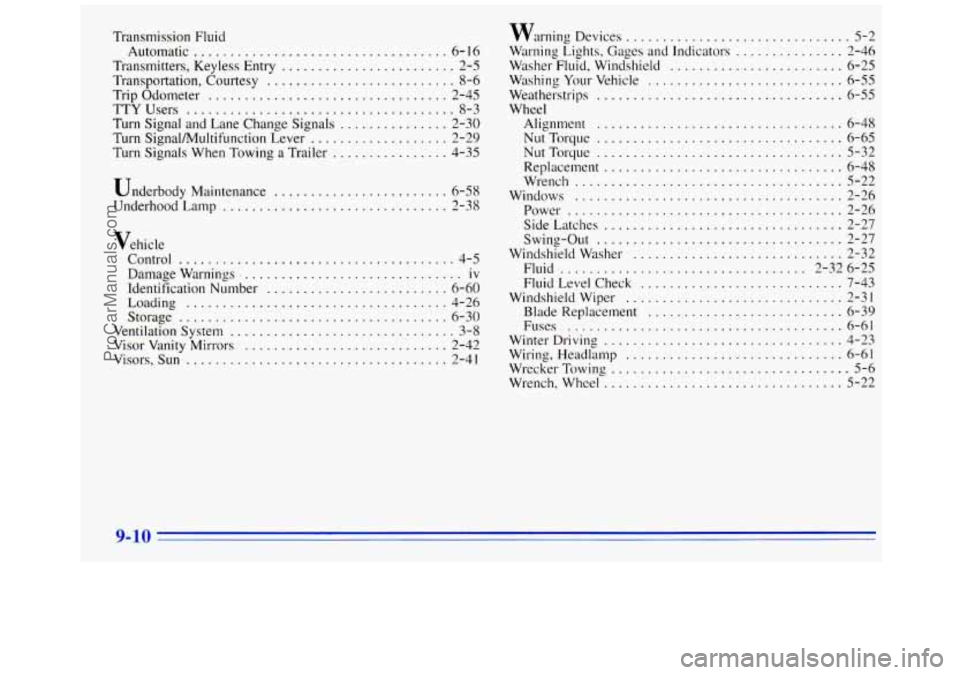
Transmission Fluid
Automatic
................................... 6- 16
Transmitters. Keyless Entry ........................ 2-5
Transportation. Courtesy
.......................... 8-6
Trip Odometer ................................. 2-45
TTYUsers
..................................... 8-3
Turn Signal and Lane Change Signals
............... 2-30
Turn Signalhlultifunction Lever
................... 2-29
Turn Signals When Towing a Trailer ................ 4-35
Underbody Maintenance
........................ 6-58
Underhood Lamp
........ , ...................... 2-38
Vehicle Control
...................................... 4-5
Identification Number ......................... 6-60
Storage
..................................... 6-30
Ventilation System
............................... 3-8
Visor Vanity Mirrors
............................ 2-42
Visors. Sun
.................................... 2-41
Damage
Warnings
............................... iv
Loading .................................... 4-26 warning
Devices
............................... 5-2
Warning Lights. Gages and Indicators ............... 2-46
Washer Fluid. Windshield
........................ 6-25
Washing Your Vehicle
........................... 6-55
Weatherstrips
.................................. 6-55
Wheel Alignment
.................................. 6-48
NutToryue
.................................. 6-65
Nut Torque .................................. 5-32
Replacement
................................. 6-48
Wrench
..................................... 5-22
Windows
..................................... 2-26
Power
....................................... 2-26
SideLatches
................................. 2-27
Swing-Out
.................................. 2-27
Windshleld Washer
............................. 2-32
Fluid
.................................. 2-326-25
Fluid Level Check ............................ 7-43
Windshield Wiper
.............................. 2-31
Blade Replacement
........................... 6-39
Fuses ...................................... 6-61
Winter Driving
................................. 4-23
Wiring. Headlamp
.............................. 6-61
WreckerTowin
f; ................................. 5-6
Wrench, Wheel
................................. 5-22
9-10
ProCarManuals.com