engine GMC SAVANA 1996 Owner's Manual
[x] Cancel search | Manufacturer: GMC, Model Year: 1996, Model line: SAVANA, Model: GMC SAVANA 1996Pages: 372, PDF Size: 18.81 MB
Page 109 of 372
If the Light Is Flashing Are you low on fuel‘?
The following may prevent more serious damage to
your vehicle:
Reduce vehicle speed.
Avoid hard accelerations.
0 Avoid steep uphill grades.
If towing a trailer, reduce the amount of cargo being
hauled as soon as
it is possible.
If the light stops flashing and remains on steady, see “If
the Light Is On Steady“ following.
If the light continues to flash, when it is safe to do so.
stop the vehicle. Put your vehicle in PARK (P). Turn the
key
off, wait at least 10 seconds and restart the engine.
If the light remains on steady, see
“If the Light Is On
Steady” following.
If the light is still flashing follow the
previous steps, and drive the vehicle to your dealer or
qualified service center for service.
If’ the Light Is On Steady
You may be able to correct the emission system
malfunction by considering the following:
Did
you just drive through a deep puddle of water?
If so, your electrical system may be wet. The condition
will usually be c0rrecte.d when the electrical system
dries out. A few driving trips should turn the light off. As
your engine starts to run
out of fuel, your engine may
not run as efficiently as designed since
s~nall amounts of
air are sucked into the fuel line causing a misfire. The
system can detect this. Adding fuel should correct this
condition. Make sure to install the fuel cap properly.
It
will take a few driving trips to turn the light off.
Have you recently changed brands of fuel‘?
If so, be sure to fuel your vehicle with quality fuel (see
“FLE~”
in the Index). Poor fuel quality will cause your
engine not to
run as efficiently as designed. You may
notice this as stalling after start-up, stalling when
you put
the vehicle into gear, misfiring, hesitation on acceleration
or stumbling on acceleration. (These conditions may go
away once the engine is warmed up.) This will be
detected by the system and cause the light to turn on.
If you experience this condition, change the fuel brand
you use. It will require at least one full tank of the
proper fuel to
turn the light off.
If none
of the above steps have made the light turn off,
have your dealer or qualified service center check the
vehicle. Your dealer has the proper test equipment and
diagnostic tools to
fix any mechanical or electrical
problems that
may have developed.
2-51
ProCarManuals.com
Page 110 of 372
Oil Pressure Gage
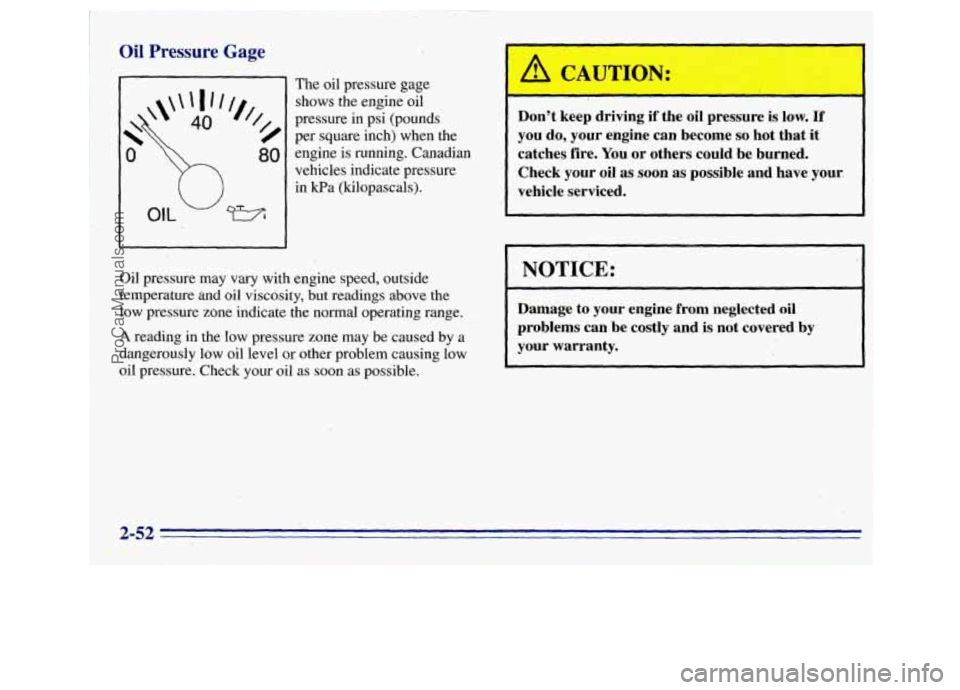
The oil pressure gage shows the engine oil
pressure in psi (pounds
per square inch) when the engine is running. Canadian
vehicles indicate pressure
Oil pressure may vary with engine speed, outside
temperature and oil viscosity,
but readings above
the
lowpressure zone indicate the normal operating range.
A reading in the low pressure zone may be caused by a
dangerously low oil level or other problem causing low
oil pressure. Check'your oil as
soon as possible.
Don't keep driving if the oil pressure is low. If
you do, your engine can become so hot that it
catches fire. You or others could be burned.
Check your oil
as soon as possible and have your.
vehicle serviced.
I
I
NOTICE: '1 ~
Damage to your engine from neglected oil
problems can be costly and
is not covered by
your warranty.
ProCarManuals.com
Page 111 of 372
Check Gages Light
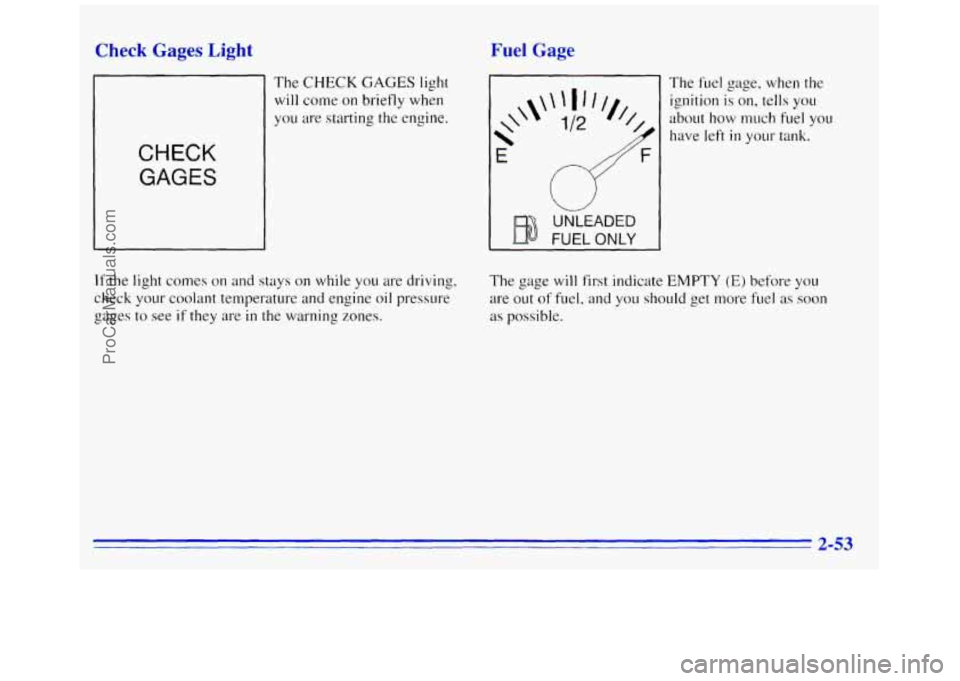
The CHECK GAGES light
will come on briefly when
you are starting
the engine.
CHECK
GAGES
Fuel Gage
*
\\'
E
FUEL ONLY
UNLEADED
The fuel gage, when the
ignition is on, tells you
about how much
fuel you
have left
in your tank.
If the light comes on and stays on while you are dri\iing,
check your coolant temperature and engine oil pressure
gages to see
if they are in the warning zones. The
gage will first indicate
EMPTY (E) before you
are out
of fuel, and you should get more fuel as soon
as
possible.
2-53
ProCarManuals.com
Page 112 of 372
Listed are four situations you may experience with your
fuel gage:
0
0
0
0
At the gas station, the fuel pump shuts off before the
gage reads
FULL (F).
It takes a little more or less fuel to fill up than the
fuel gage indicated. For example, the gage may have
indicated the tank was half
full, but it actually took a
little more or less than half the tank’s capacity to fill
the tank.
The gage moves a little when
you turn a corner or
speed
up.
The gage doesn’t go back to EMPTY (E) when you
turn off the ignition.
None
of these indicate a problem with the fuel gage.
Engine Coolant Temperature Gage
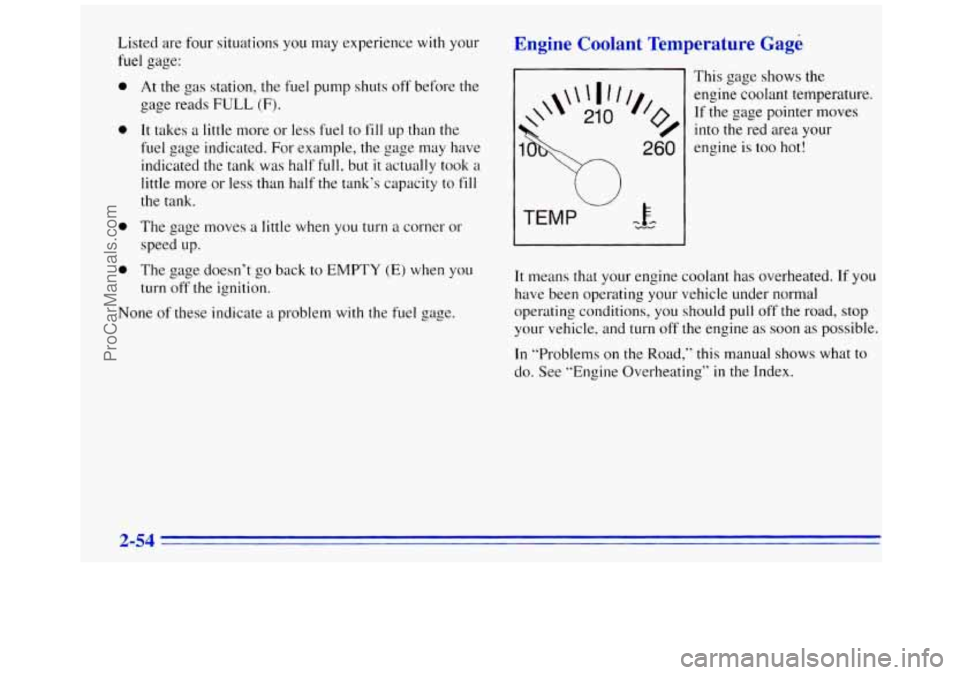
This gage shows the
If the gage pointer moves /I,
engine coolant temperature.
o/ into the red area your
260 engine is too hot!
TEMP -FA mr
It means that your engine coolant has overheated. If you
have been operating your vehicle under normal
operating conditions, you should pull off the road, stop
your vehicle, and
turn off the engine as soon as possible.
In “Problems on the Road,” this manual shows what to
do. See ”Engine Overheating”
in the Index.
2-54
ProCarManuals.com
Page 113 of 372
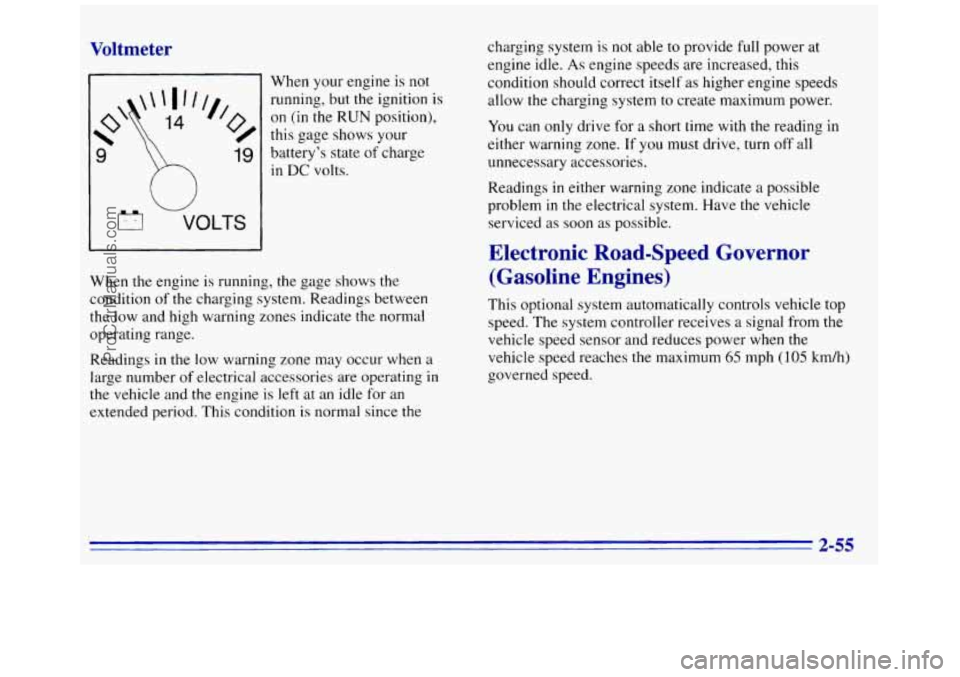
Voltmeter
When your engine is not
running, but the ignition
is
on (in the RUN position),
this gage shows your
9
h
19 battery’s state of charge
in DC volts.
u
VOLTS
When the engine is running, the gage shows the
condition of
the charging system. Readings between
the low and high warning zones indicate the normal
operating range.
Readings
in the low warning zone may occur when a
large number of electrical accessories are operating in
the vehicle and the engine is left at an idle for an
extended period. This conditi.on is normal since the charging
system
is not able to provide full power at
engine idle.
As engine speeds are increased, this
condition should correct itself as higher engine speeds
allow
the charging system to create maximum power.
You can only drive for
a short time with the reading in
either warning zone. If you must drive, turn
off all
unnecessary accessories.
Readings
in either warning zone indicate a possible
problem in the electrical system. Have the vehicle
serviced
as soon as possible.
Electronic Road-Speed Governor (Gasoline Engines)
This optional system automatically controls vehicle top
speed. The system controller receives
a signal from the
vehicle speed sensor and reduces power when the
vehicle speed reaches
the maximum 65 mph (105 km/h)
governed speed.
2-55
ProCarManuals.com
Page 123 of 372
Air Conditioning
Before using your vehicle’s air conditioning, open the
windows to clear
the vehicle of hot air. This reduces the
time it takes for your vehicle
to cool down. Then keep
your windows closed
for the air conditioner to work at
its best.
You can use MAX A/C
with the temperature knob in the
blue area, when
it’s really hot outside and you need to
cool the inside air quickly. MAX A/C lets in only a little
air from the outside.
If you first use MAX A/C, you can then use A/C with
the temperature knob
in the blue area, as soon as the
vehicle has cooled down,
so outside air will be going
through your vehicle.
If your vehicle has rear air conditioning, setting it on LO
may enhance front A/C perfor~nance by allowing
trapped refrigerant
in rear lines to circulate.
When the air conditioning,
DEFROST or BLEND is on,
you may notice a slight increase or decrease in engine
speed, due to compressor operation. This is normal
because the system is designed
to cycle the compressor
on and off to keep the desired temperature.
Heating
On cold days, use HEATER with the temperature knob
in the red area. Outside air will be brought in. through
the floor outlets. The heater works best if you keep your
windows closed while using
it.
If you use the optional engine coolant heater before
starting your engine, your heating system will produce
warmer air faster
to heat the passenger compartment in
cold weather. See ”Engine Coolant Heater”
in the Index.
3-7
ProCarManuals.com
Page 125 of 372
Audio Systems
Your Delco@ audio system has been designed to operate
easily and give years
of listening pleasure. You will get
the most enjoyment out
of it if you acquaint yourself
with it first. Find out what your Delco system can do
and how to operate
all its controls, to be sure you’re
getting
the most out of the advanced engineering that
went into it.
AM-FM Stereo
Setting the Clock for AM-FM Stereo and
AM-FM Stereo with Cassette Tape Player
Press SET. Within five seconds, press and hold the
SEEK right arrow
until the correct minute appears on
the display. Press and hold
the SEEK left arrow until the
correct hour appears on the display.
Setting the Clock for AM-FM Stereo with
Compact Disc Player
Press and hold HR until the correct hour appears on the
display. Press and hold
MIN until the correct minute
appears on the display.
To display the clock with the
ignition
off, press RECALL and the time will be displayed
for
a few seconds. There is an initial two-second delay
before the clock
goes into the time-set mode.
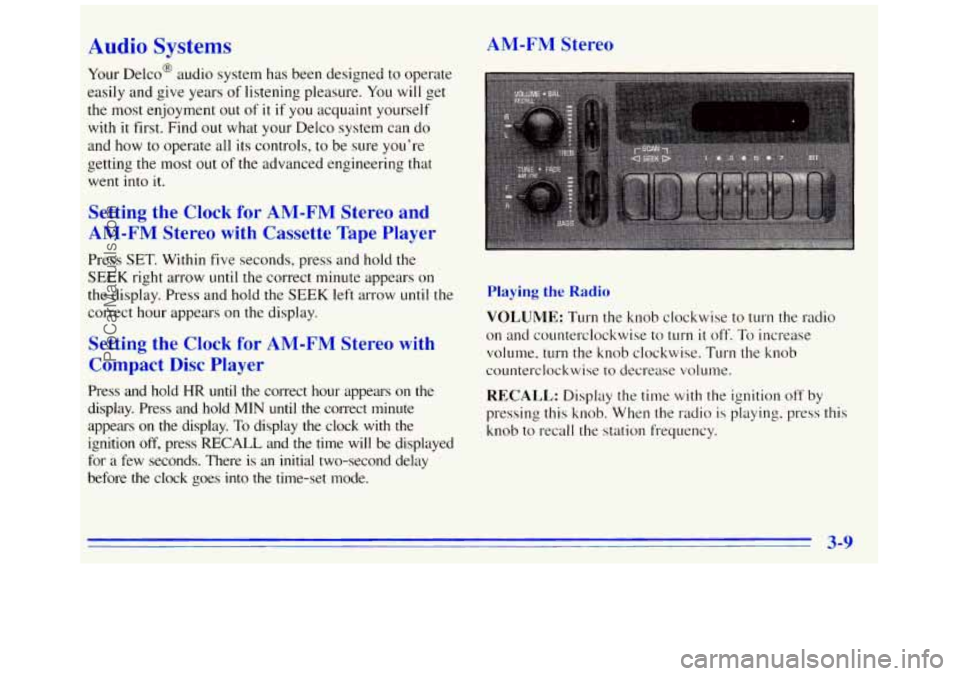
Playing the Radio
VOLUME: TLITII the knob clockwise to turn the radio
on and counterclockwise to
turn it off. To increase
volume, turn the knob clockwise. Turn the knob
counterclockwise
to decrease volume.
RECALL: Display the time with the ignition off by
pressing this
knob. When the radio is playing, press this
knob to recall
the station frequency.
3-9
ProCarManuals.com
Page 143 of 372
Tips About Your Audio System
Hearing damage from loud noise is almost undetectable
until
it is too late. Your hearing can adapt to higher
volumes
of sound. Sound that seems normal can be loud
and harmful
to your hearing. Take precautions by
adjusting the volume control
on your radio to a safe
sound level before your hearing adapts to it.
To help avoid hearing loss or damage:
Adjust the volume control to the lowest setting.
Increase volume slowly until you hear comfortably
and clearly.
NOTICE:
Before you add any sound equipment to your
vehicle
-- like a tape player, CB radio, mobile
telephone or two-way radio
-- be sure you can add
what you want. If you can, it’s very important to
do it properly. Added sound equipment may
interfere with the operation of your vehicle’s
engine, Delco radio or other systems, and even
damage them. Your vehicle’s systems may interfere
with the operation of sound equipment that has
been added improperly.
So, before adding sound equipment, check with
your dealer and be sure to check Federal rules
covering mobile radio and telephone units.
ProCarManuals.com
Page 154 of 372
Avoid needless heavy braking. Some people drive in
spurts -- heavy acceleration followed by heavy
braking
-- rather than keeping pace with traffic. This
is
a mistake. Your brakes may not have time to cool
between hard stops. Your brakes
will wear out much
faster if you
do a lot of heavy braking. If you keep pace
with the traffic and allow realistic following distances,
you
will eliminate a lot of unnecessary braking. That
means better braking and longer brake life.
If your engine ever stops while you’re driving, brake
normally but don’t pump your brakes.
If you do, the
pedal may get harder
to push down. If your engine
stops, you
will still have some power brake assist. But
you will use it when you brake. Once the power assist is
used up, it may take longer to stop and the brake pedal
will be harder to push.
Anti-Lock Brakes
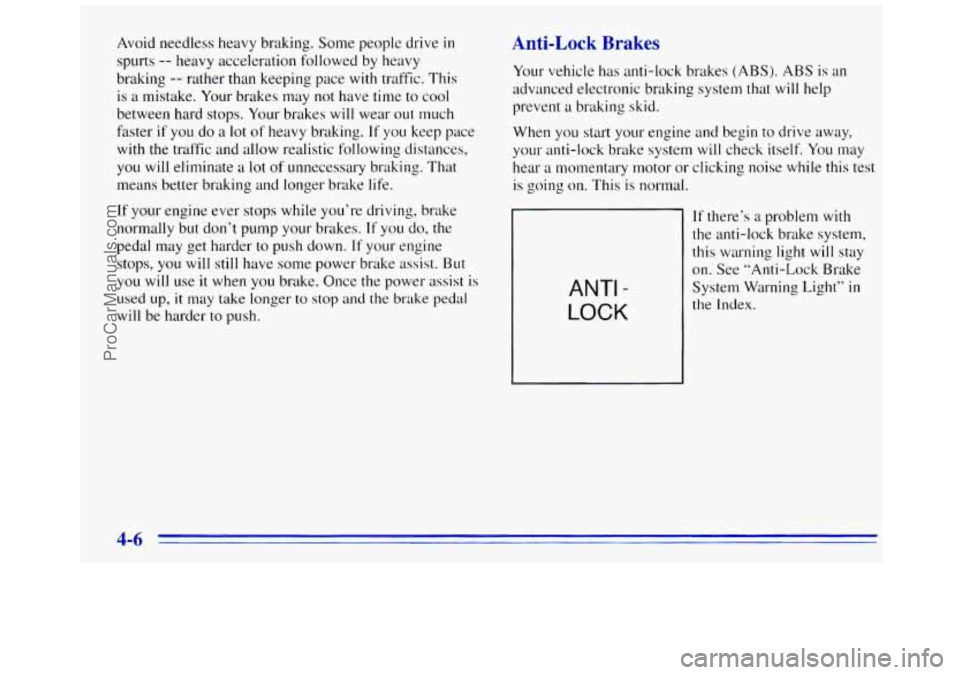
Your vehicle has anti-lock brakes (ABS). ABS is an
advanced electronic braking system that
will help
prevent
a braking skid.
When you start
your engine and begin to drive away,
your anti-lock brake system
will check itself. You may
hear
a momentary motor or clicking noise while this test
is going on. This is normal.
ANTI -
LOCK
If there’s a problem with
the anti-lock brake system,
this warning light will stay
on. See ”Anti-Lock Brake
System Warning Light’’
in
the Index.
ProCarManuals.com
Page 156 of 372
Remember: Anti-lock doesn‘t change the time you need
to get your foot
up to the brake pedal or always decrease
stopping distance.
If you get too close to the vehicle in
front of you, you won‘t have time to apply your brakes
if that vehicle suddenly slows or stops. Always leave
enough room up ahead
to stop, even though you have
anti-lock brakes.
Using Anti-Lock
Don’t pump the brakes. Just hold the brake pedal
down and let anti-lock work for you. You may feel the
brakes vibrate,
or you may notice some noise. but this
is normal.
Braking in Emergencies
Use your anti-lock braking system when you need to.
With anti-lock,
you can steer and brake at the same
time.
In many emergencies, steering can help you more
than even the very best braking.
Stc . ring
Power Steering
If you lose power steering assist because the engine
stops
or the system is not functioning, you can steer but
it will take much more effort.
Steering Tips
Driving on Curves
It’s important to take curves at a reasonable speed.
A lot of the “driver lost control” accidents mentioned on
the news happen
on curves. Here’s why:
Experienced driver or beginner, each of us is subject to
the same laws of physics when driving on curves. The
traction of the tires against the road surface makes
it
possible for the vehicle to change its path when you turn
the front wheels. If there‘s no traction, inertia will keep
the vehicle going
in the same direction. If you‘ve ever
tried to steer a vehicle on wet ice, you’ll understand this.
4-8
ProCarManuals.com