steering GMC SAVANA 1996 Owner's Manual
[x] Cancel search | Manufacturer: GMC, Model Year: 1996, Model line: SAVANA, Model: GMC SAVANA 1996Pages: 372, PDF Size: 18.81 MB
Page 195 of 372
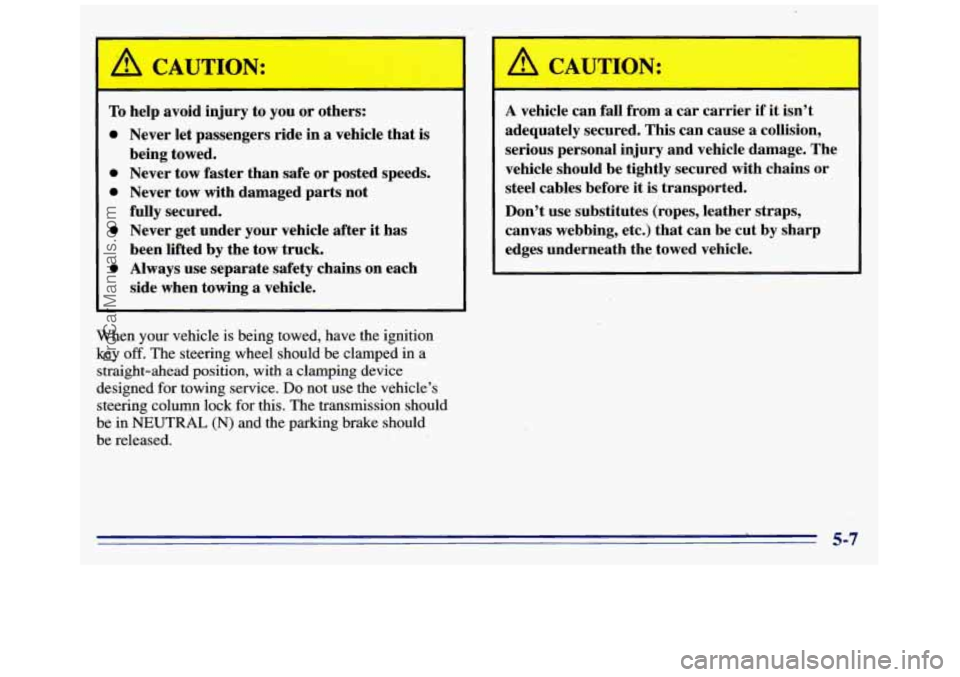
A CAUTION: A CAUTION:
To help avoid injury to you or others:
0
0
0
0
0
Never let passengers ride in a vehicle that is
being towed.
Never tow faster than safe or posted speeds.
Never tow with damaged parts not
fully secured.
Never get under your vehicle after it has
been lifted by the tow truck.
Always use separate safety chains on each
side when towing
a vehicle.
When your vehicle is being towed, have the ignition
key’off. The steering wheel should be clamped in a
straight-ahead position, with a clamping device
designed
for towing service. Do not use the vehicle’s
steering column lock for this. The transmission should
be in
NEUTRAL (N) and the parking brake should
be released.
A vehicle can fall from a car carrier if it isn’t
adequately secured. This can cause
a collision,
serious personal injury and vehicle damage. The
vehicle should be tightly secured with chains or
steel cables before it is transported.
Don’t use substitutes (ropes, leather straps,
canvas webbing, etc.) that can be cut by sharp
edges underneath the towed vehicle.
5-7
ProCarManuals.com
Page 208 of 372
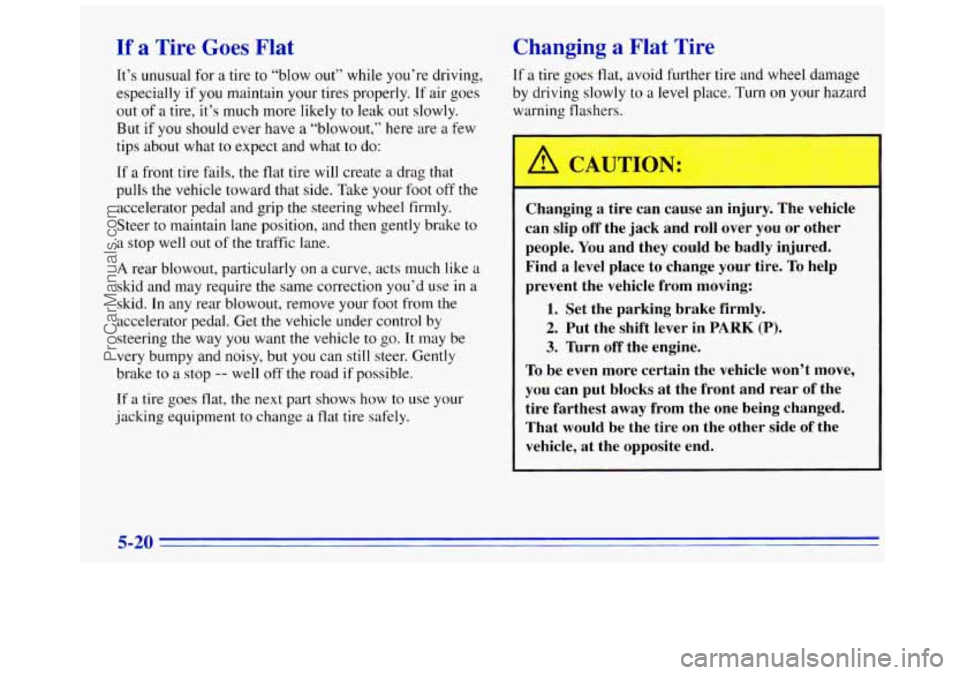
If a Tire Goes Flat
It’s unusual for a tire to “blow out” while you’re driving,
especially
if you maintain your tires properly. If air goes
out of a tire, it’s much more likely
to leak out slowly.
But
if you should ever have a “blowout,” here are a few
tips about what to expect and what to do:
If a front tire fails, the flat tire will create a drag that
pulls the vehicle toward that side. Take
your foot off the
accelerator pedal and grip the st.eering wheel firmly.
Steer to maintain lane position, and then gently brake to
a stop well out of the traffic lane.
A rear blowout, particularly on a curve, acts much like a
skid and may require the same correction you’d use in a
skid.
In any rear blowout, remove your foot from the
accelerator pedal. Get the vehicle under control
by
steering the way you want the vehicle to go. It may be
very bumpy and noisy, but you can still steer. Gently
brake to
a stop -- well off the road if possible.
If a tire goes flat, the next part shows how to use your
jacking equipment to change a
flat tire safely.
Changing a Flat Tire
If a tire goes flat, avoid further tire and wheel damage
by driving slowly to
a level place. Turn on your hazard
warning flashers.
Changing a tire can cause an injury. The vehicle
can slip off the jack and roll over you or other
people. You and they could be badly injured.
Find a level place
to change your tire. To help
prevent the vehicle from moving:
1. Set the parking brake firmly.
2. Put the shift lever in PARK (P).
3. Turn off the engine.
To be even more certain the vehicle won’t move,
you can put blocks at the front and rear of the
tire farthest away from the one being changed.
That would be the tire on the other side of the
vehicle, at the opposite end.
5-20
ProCarManuals.com
Page 224 of 372
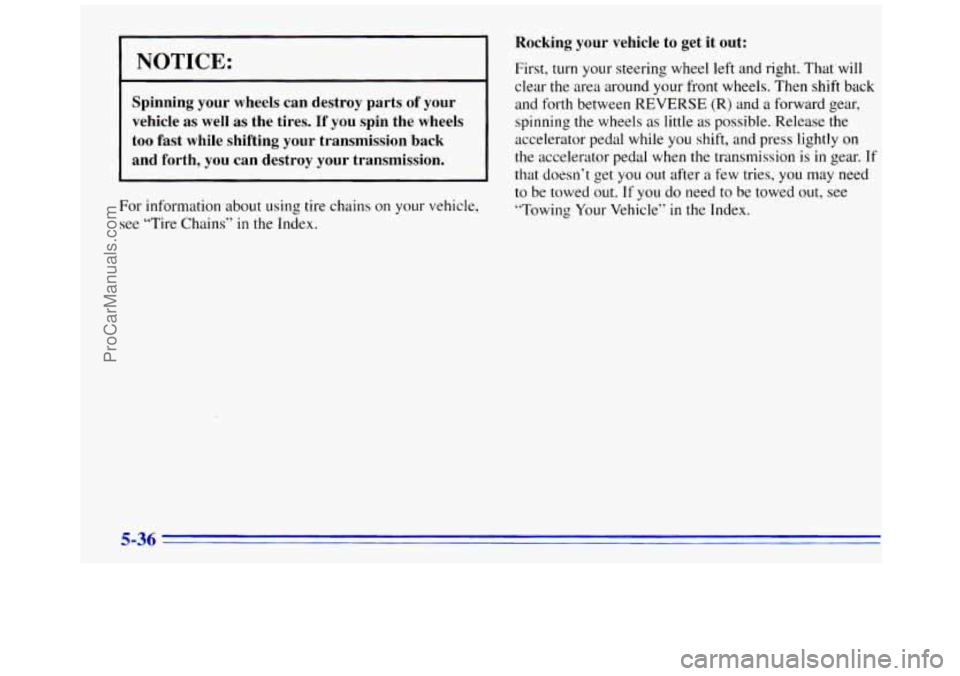
NOTICE:
Spinning your wheels can destroy parts of your
vehicle as well as the tires.
If you spin the wheels
too fast while shifting your transmission back
and forth, you can destroy your transmission.
For information about using tire chains on your vehicle,
see “Tire Chains” in the Index.
Rocking your vehicle to get it out:
First, turn your steering wheel left and right. That will
clear
the area around your front wheels. Then shift back
and forth between
REVERSE (R) and a forward gear,
spinning the wheels as little as possible. Release the
accelerator pedal while
you shift, and press lightly on
the accelerator pedal when the transmission is in gear. If
that doesn’t get
you out after a few tries, you may need
to be towed out.
If you do need to be towed out, see
”Towing Your Vehicle”
in the Index.
5-36
ProCarManuals.com
Page 232 of 372
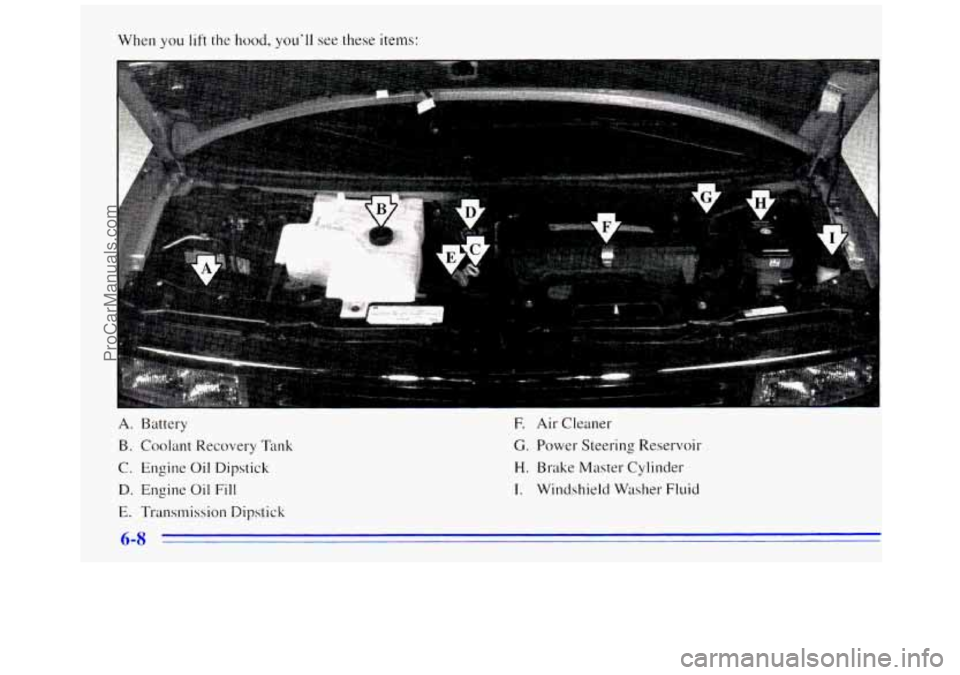
When you lift the hood, ~011’11 see these items:
A. Battery
B. Coolant Recovery Tank
C. Engine Oil Dipstick
D. Engine Oil Fill
E. Transmission Dipstick
F. Air Cleaner
G. Power Steering Reservoir
H. Brake Master Cylinder
I. Windshield Washer Fluid
ProCarManuals.com
Page 248 of 372
Thermostat
Engine coolant temperature is controlled by a thermostat
in the engine cooling system. The thermoskt stops the
tlow of coolant through the radiator until the coolant
reaches
a preset temperature.
When you replace your thermostat,
an AC@ thermostat
is recommended.
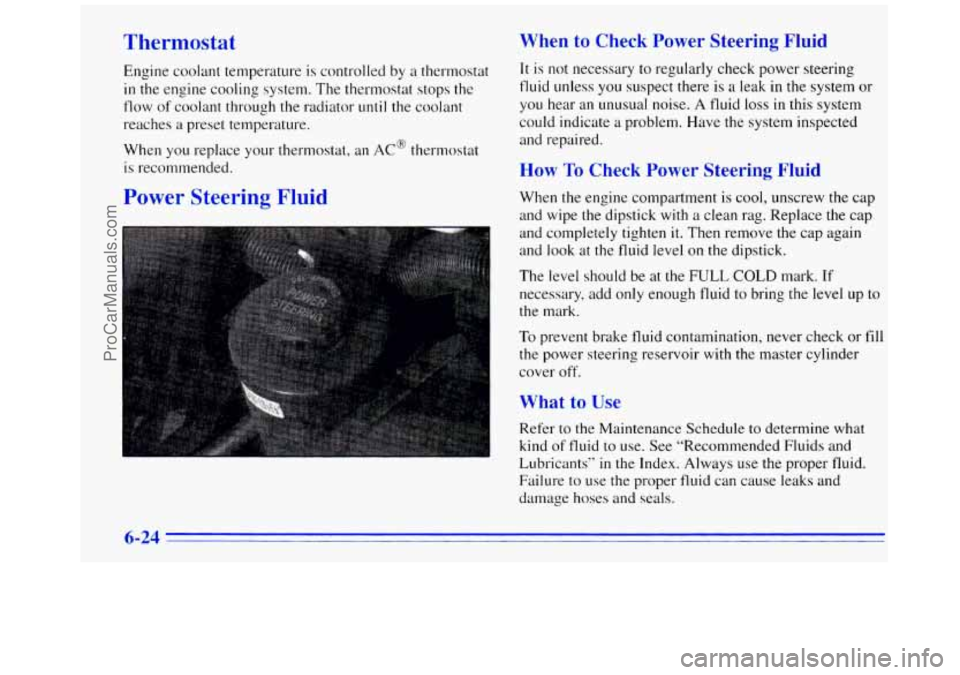
Power Steering Fluid
When to Check Power Steering Fluid
It is not necessary to regularly check power steering
tluid unless you suspect there
is a leak in the system or
you hear an unusual noise.
A fluid loss in this system
could indicate a problem. Have the system inspected
and repaired.
How To Check Power Steering Fluid
When the engine compartment is cool, unscrew the cap
and wipe the dipstick with a clean rag. Replace the cap
and completely tighten
it. Then remove the cap again
and
look at the fluid level on the dipstick.
The level should be at the FULL COLD mark. If
necessary, add only enough fluid to bring
the level up to
the mark.
To prevent brake fluid contamination, never check or
fill
the power steering reservoir with the master cylinder
cover off.
What to Use
Refer to the Maintenance Schedule to determine what
kind
of fluid to use. See “Recommended Fluids and
Lubricants”
in the Index. Always use the proper fluid.
Failure to use the proper fluid can cause leaks and
damage hoses and seals.
ProCarManuals.com
Page 303 of 372
I Short Trip/City Maintenance Schedule -= Gasoline Engines I
The services shown in this schedule up to 100,000 miles
( 166 000 km) should be performed after 100,000 miles
(166 000 km) at the same intervals.
Footnotes
f The U.S. Environmental Protection Agency or the
California Air Resources Board has determined that the
failure to perform this maintenance item will not nullify
the emission warranty or limit recall liability prior to
the
completion of the vehicle’s useful life. We, however,
urge that all recommended maintenance services be
performed at
the indicated intervals and the maintenance
be recorded.
# Lubricate the front suspenslon, kingpin bushings,
steering linkage and rear driveline center splines.
*:!: Drive axle service:
Locking Differential -- Drain fluid and refill at first
engine oil change. At subsequent
oil changes, check
fluid level and add fluid as needed. If driving
in
dusty areas or towing a trailer, drain fluid and refill
every
15,000 miles (25 000 km).
Standard Differential -- Check fluid level and add
fluid as needed at every oil change.
If driving in
dusty areas or towing a trailer, drain fluid and refill
every
15,000 miles (25 000 km).
More frequent lubrication may be required for
heavy-duty use.
7-7
ProCarManuals.com
Page 326 of 372
{bong Trip/Highway Maintenance Schedule =- Gasoline Engines
The services shown in this schedule up to 100,000 miles
(166 000 km) should be performed after 100,000 miles
(1 66 000 km) at the same intervals.
Footnotes
The U.S. Environmental Protection Agency or the
California Air Resources Board has determined that
the
failure to perform this maintenance item will not nullify
the emission warranty or limit recall liability prior to the
completion
of the vehicle’s useful life. We, however,
urge that all recommended maintenance services be
performed at
the indicated intervals and the maintenance
be recorded.
# Lubricate the front suspension, kingpin bushings,
steering linkage and rear driveline center splines.
:i: *
0
0
Drive axle service:
Locking Differential
-- Drain fluid and refill at first
engine
oil change. At subsequent oil changes, check
fluid level and add fluid as needed.
If driving in
dusty areas or towing a trailer, drain fluid and refill
every
15,000 miles (25 000 km).
Standard Differential
-- Check fluid level and add
fluid
as needed at every engine oil change. If driving
in dusty areas or towing a trailer, drain fluid and
refill every
15,000 miles (35 000 km).
More frequent lubrication may be required for
heavy-duty use.
7-30
ProCarManuals.com
Page 342 of 372
Steering Column Lock Check
While parked, and with the parking brake set, try to turn
the key
to LOCK in each shift lever position.
The key should turn to LOCK only when the shift
lever is
in PARK (P).
The key should come out only in LOCK.
Parking Brake and Automatic Transmission
PARK
(P) Mechanism Check
Park on a fairly steep hill, with the vehicle facing
downhill. Keeping your foot
on the regular brake,
set the parking brake.
To check the parking brake: With the engine running
and transmission
in NEUTRAL (N), slowly remove
foot pressure from
the regular brake pedal. Do this
until the vehicle is held by the parking brake only.
To check the PARK (P) mechanism’s holding ability:
With the engine running, shift
to PARK (P). Then
release all brakes.
When you are doing this check, your vehicle
could begin to move. You
or others could be
injured and property could be damaged. Make
sure there is room in front of your vehicle in case
it begins to roll. Be ready to apply the regular
~ brake at once should the vehicle begin to move.
~
7-46
ProCarManuals.com
Page 343 of 372
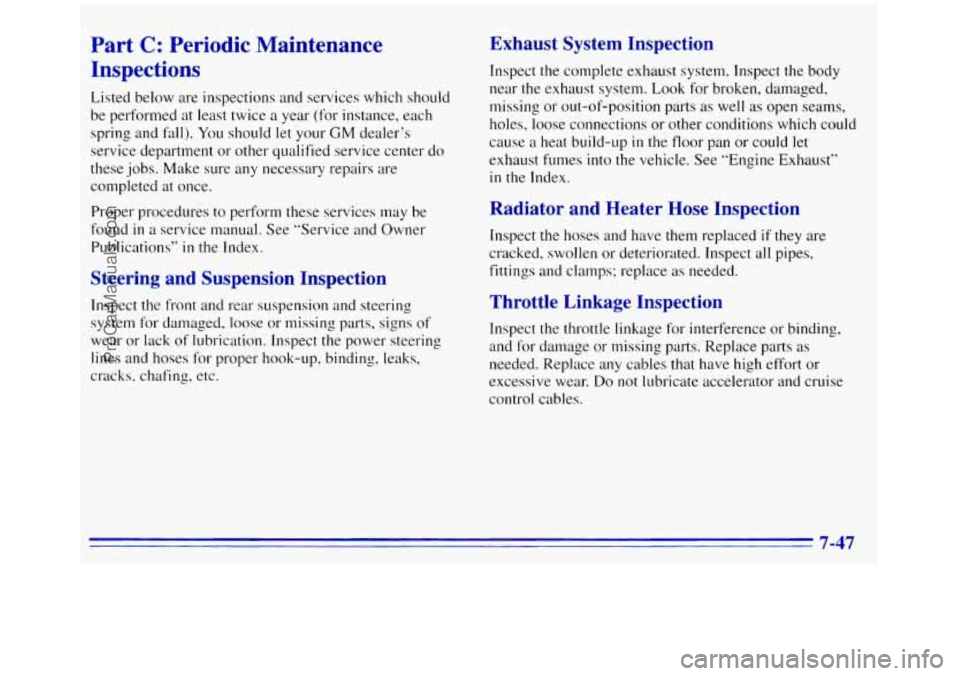
Part C: Periodic Maintenance
Inspections
Listed below are inspections and services which should
be performed at least twice a year (for instance, each
spring and fall).
You should let your GM dealer’s
service department or other qualified service center do
these
jobs. Make sure any necessary repairs are
completed at once.
Proper procedures to perform these services may be
found
in a service manual. See “Service and Owner
Publications”
in the Index.
Steering and Suspension Inspection
Inspect the front and rear suspension and steering
system for damaged,
loose or missing parts, signs of
wear or lack of lubrication. inspect the power steering
lines and hoses for proper hook-up, binding, leaks,
cracks, chafing, etc.
Exhaust System Inspection
Inspect the complete exhaust system. Inspect the body
near the exhaust system. Look for broken, damaged,
missing or out-of-position parts as well as open seams,
holes, loose connections or other conditions which could
cause
a heat build-up in the floor pan or could let
exhaust fumes into the vehicle. See “Engine Exhaust”
in the Index.
Radiator and Heater Hose Inspection
Inspect the hoses and have them replaced if they are
cracked, swollen or deteriorated. Inspect all pipes,
fittings and clamps; replace as needed.
Throttle Linkage Inspection
Inspect the throttle linkage for interference or binding,
and for damage or missing parts. Replace parts as
needed. Replace
any cables that have high effort or
excessive wear. Do not lubricate accelerator and cruise
control cables.
7-47
ProCarManuals.com
Page 345 of 372
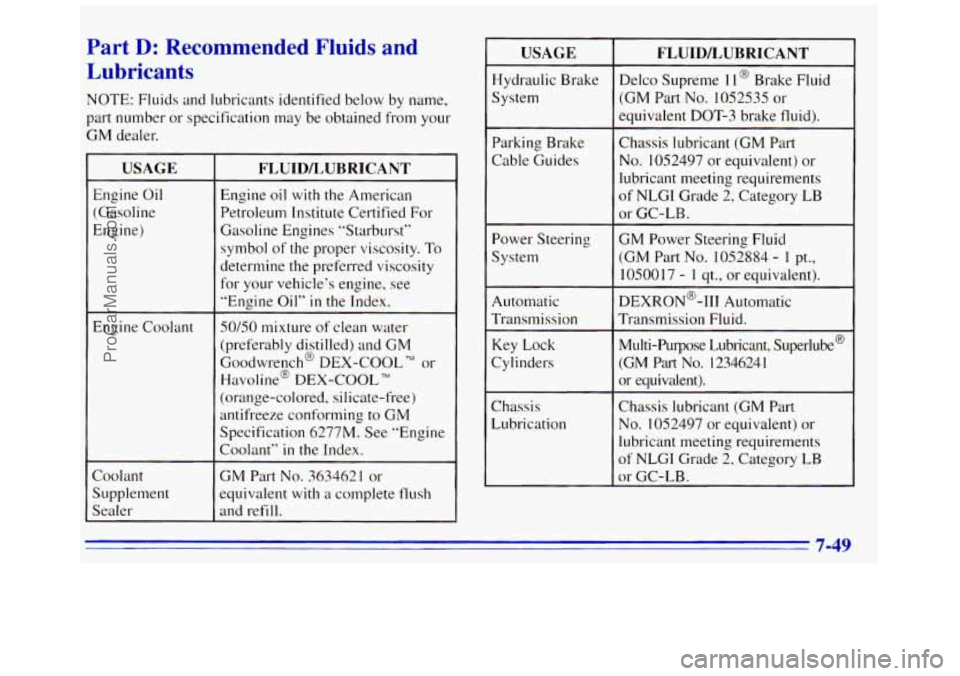
Part D: Recommended Fluids and
Lubricants
NOTE: Fluids and lubricants identified below by name,
part number or specification may be obtained from your
GM dealer.
USAGE
Engine Oil
(Gasoline
Engine)
Engine Coolant
Coolant
Supplement
Sealer
FLUID/LUBRICANT
~~ ~
~~
Engine oil with the American
Petroleum Institute Certified For
Gasoline Engines “Starburst“
symbol
of the proper viscosity. To
determine the preferred viscosity
for your vehicle’s engine, see
“Engine Oil”
in the Index.
50150 mixture of clean water
(preferably distilled) and GM
Goodwrench@ DEX-COOL
TM or
Havo line@
DEX-COOL TM
(orange-colored, silicate-free)
antifreeze conforming to GM
Specification 6277M. See “Engine
Coolant”
in the Index.
GM Part No. 3634621 or
equivalent with
a complete flush
and refill.
USAGE
Hydraulic Brake
System
Parking Brake
Cable Guides
~~
Power Steering
System
Automatic
Transmission
Key Lock
Cylinders
Chassis
Lubrication
FLUIDLUBRICANT
Delco Supreme 1 1 @ Brake Fluid
(GM Part No. 1052535 or
equivalent DOT-3 brake fluid).
Chassis lubricant (GM Part
No. 1052497 or equivalent) or
lubricant meeting requirements
of NLGI Grade 2, Category LB
or GC-LB.
GM Power Steering Fluid
(GM Part
No. 1052884 - 1 pt.,
1050017
- 1 qt., or equivalent).
DEXRON@-111 Automatic
Transmission
Fluid.
Multi-Purpose Lubricant, Superlube@
(GM
Pd-t No. 1234624 1
or equivalent).
Chassis lubricant
(GM Part
No. 1052497 or equivalent) or
lubricant meeting requirements
of NLGI Grade 2, Category
LB
or GC-LB.
7-49
ProCarManuals.com