brake GMC SAVANA 1996 Service Manual
[x] Cancel search | Manufacturer: GMC, Model Year: 1996, Model line: SAVANA, Model: GMC SAVANA 1996Pages: 372, PDF Size: 18.81 MB
Page 252 of 372
Brake Wear
NOTICE:
Using the wrong fluid can badly damage
brake system parts. For example, just a few
drops
of mineral-based oil, such as engine
oil, in your brake system can damage brake
system parts
so badly that they’ll have to be
replaced. Don’t let someone put in the
wrong kind
of fluid.
If you spill brake fluid on your vehicle’s
painted surfaces, the paint finish can be
damaged.
Be careful not to spill brake fluid
on your vehicle. If you do, wash it off
immediately. See “Appearance Care” in
the Index.
Your vehicle has front disc brakes and rear drum brakes.
Disc brake pads have built-in wear indicators that make a
high-pitched warning sound when the brake pads are worn
and new pads are needed.
The sound may come and go or
be heard all the time
your vehicle is moving (except when
you
are pushing on the brake pedal firmly).
L
The brake wear warning sound means that
sooner or later your brakes won’t work well.
That could lead to an accident. When you hear
the brake wear warning sound, have your vehicle serviced.
I NOTICE: I
Continuing to drive with worn-out brake pads
could result
in costly brake repair.
6-28
ProCarManuals.com
Page 253 of 372
Some driving conditions or climates may cause a brake
squeal when the brakes are first applied or lightly
applied. This does not mean something is wrong with
your brakes.
Free movement
of brake calipers and properly torqued
wheel
nuts are necessary to help prevent brake
pulsation. When tires are rotated, inspect brake calipers
for movement, brake pads for wear, and evenly torque
wheel
nuts in the proper sequence to GM specifications.
Your rear drum brakes don’t have wear indicators, but if
you ever hear
a rear brake rubbing noise, have the rear
brake linings inspected. Also,
the rear brake drums should
be removed and inspected each time the tires are removed
for rotation or changing. When
you have the front brakes
replaced, have
the rear brakes inspected, too.
Brake linings should always be replaced
as complete
axle sets.
:a1 ~ Pedal Travel
see your dealer if the brake pedal does not return to
normal height, or
if there is a rapid increase in pedal
travel. This could be
a sign of brake trouble.
Brake Adjustment
Every time you make a brake stop, your disc brakes
adjust for wear.
If your brake pedal goes down farther than normal, your
rear drum brakes may need adjustment. Adjust them by
backing up and firmly applying the brakes a few times.
6-29
ProCarManuals.com
Page 254 of 372
Replacing Brake System Parts
The braking system on a modern vehicle is complex. Its
many parts have to be of top quality and work well
together
if the vehicle is to have really good braking.
Vehicles we design and test have top-quality
GM brake
parts in them, as your vehicle does when
it is new. When
you replace parts
of your braking system -- for example,
when your brake linings wear down and you have to
have
new ones put in -- be sure you get new genuine
GM replacement parts. If you don’t, your brakes may
no longer work properly. For example, if someone
puts
in brake linings that are wrong for your vehicle,
the balance between your front and rear brakes can
change
-- for the worse. The braking performance
you’ve come to expect can change
in many other ways if
someone puts in the wrong replacement brake parts.
Battery
Every new vehicle has a Delco Freedom@ battery. You
never have to add water to one of these. When it’s time
for a new battery,
we recolnmend a Delco Freedom
battery. Get one that has the replacement number shown
on the original battery’s label.
Vehicle Storage
If you’re not going to drive your vehicle for 25 days
or more, take off the black, negative
(-) cable from
the battery.
This will help keep your battery from
running down.
6-30
ProCarManuals.com
Page 273 of 372
NOTICE:
The wrong wheel can also cause problems with
bearing life, brake cooling, speedometer or
odometer calibration, headlamp aim, bumper
height, vehicle ground clearance and tire or tire
chain clearance to the
body and chassis.
Whenever
a wheel, wheel bolt or wheel nut is replaced
on
a dual wheel setup, check the wheel nut torque after
100, 1,000 and 6,000 miles (160, 1 600 and 10 000 km)
of driving. For proper torque, see “Wheel Nut Torque”
in the Index.
See “Changing a Flat Tire” in the Index for
more information. Used
Replacement Wheels
Putting
a used wheel on your vehicle is
dangerous.
You can’t know how it’s been used or
how many miles it’s been driven. It could fail
suddenly and cause an accident. If
you have to
replace a wheel, use a new GM original
equipment wheel.
6-49
ProCarManuals.com
Page 288 of 372
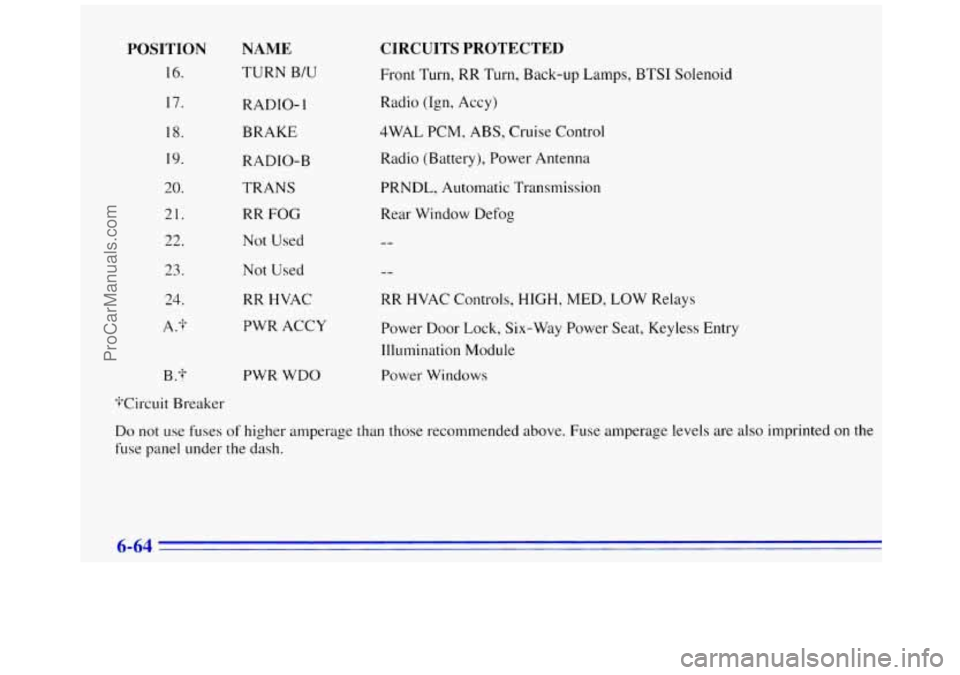
POSITION
16.
17.
18.
19.
20.
21.
22.
23.
24.
A.?
B.?
NAME
TURN B/U
RADIO-
1
BRAKE
RADIO-B
TRANS
RR FOG
Not Used
Not Used
RR HVAC
PWR ACCY
PWR WDO
CIRCUITS PROTECTED
Front Turn, RR Turn, Back-up Lamps, BTSI Solenoid
Radio
(Ign, Accy)
4WAL PCM, ABS, Cruise Control
Radio (Battery), Power Antenna
PRNDL, Automatic Transmission
Rear Window Defog
RR HVAC Controls,
HIGH, MED, LOW Relays
Power Door Lock, Six-Way Power Seat, Keyless Entry
Illumination Module
Power Windows
?Circuit Breaker Do not
use fuses of higher amperage than those recommended above. Fuse amperage levels are also imprinted on the
fuse panel under the dash.
6-64
ProCarManuals.com
Page 294 of 372
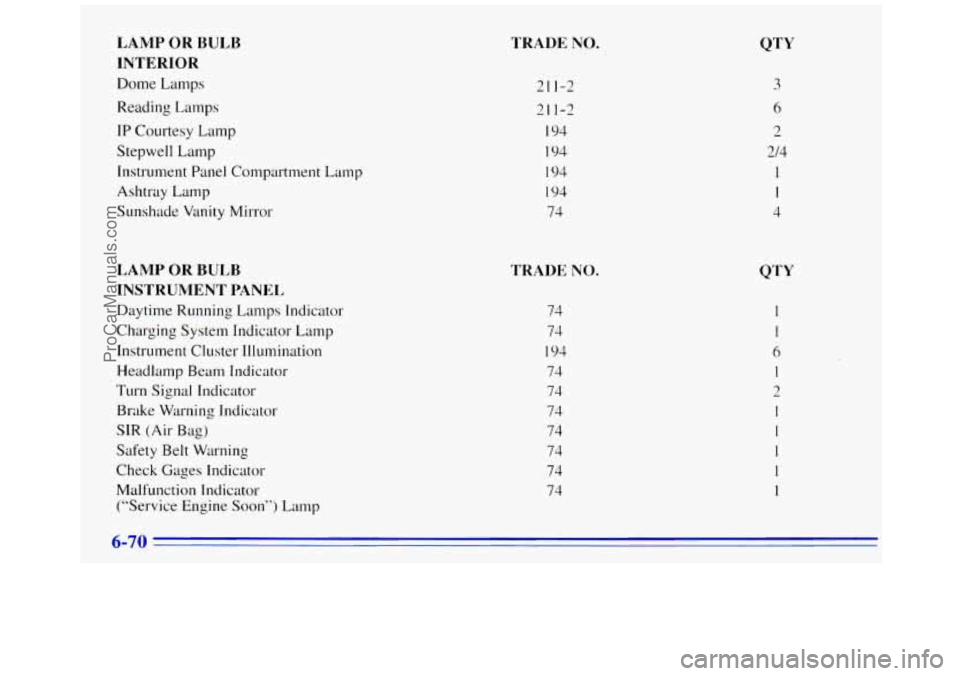
LAMP OR BULB
INTERIOR
Dome Lamps
Reading Lamps
IP Courtesy Lamp
Stepwell Lamp Instrument Panel Compartment Lamp
Ashtray Lamp
Sunshade Vanity Mirror
LAMP OR BULB
INSTRUMENT PANEL
Daytime Running Lamps Indicator
Charging System Indicator Lamp
Instrument Cluster Illumination
Headlamp Beam Indicator
Turn Signal Indicator Brake Warning Indicator
SIR (Air Bag)
Safety Belt Warning
Check Gages Indicator
Malfunction Indicator
("Service Engine Soon") Lamp
TRADE NO.
21 1-2
21 1-2
194
194
194
194 74
TRADE NO.
74
74
194 74
74
74
74
74
74
74
3
6
2
214
1
I
4
1
1
6
1
2
I
I
1
1
1
6-70
ProCarManuals.com
Page 300 of 372
Maintenance Schedule
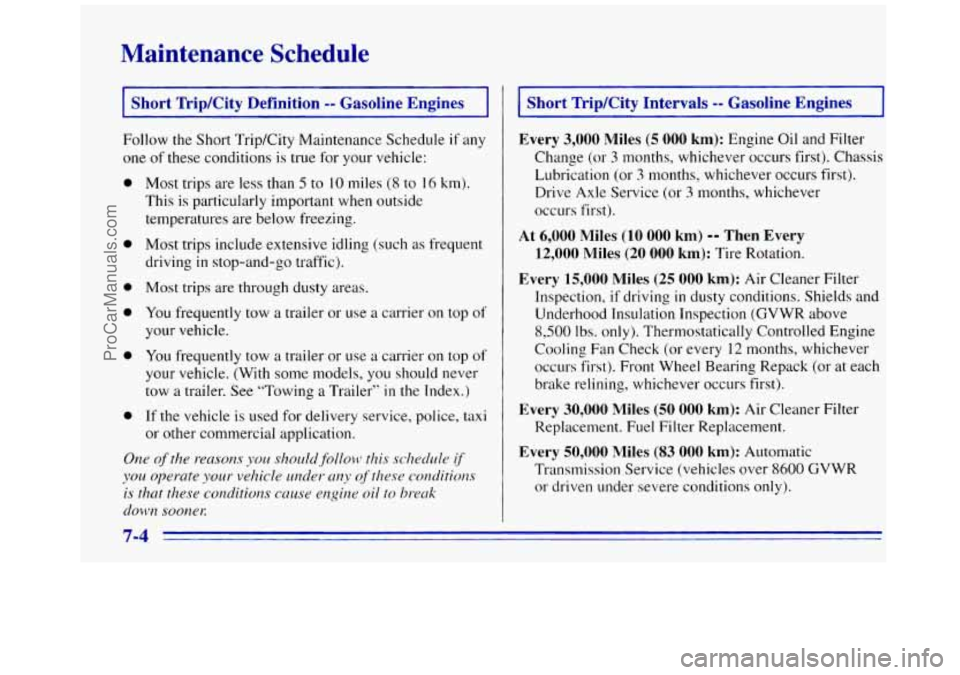
Short TripKity Definition -- Gasoline Engines i
Follow the Short Trip/City Maintenance Schedule if any
one of these conditions is true for your vehicle:
0
0
0
0
0
e
Most trips are less than 5 to 10 miles (8 to 16 km).
This is particularly important when outside
temperatures are below freezing.
Most trips include extensive idling (such as frequent
driving
in stop-and-go traffic j.
Most trips are through dusty areas.
You frequently tow
a trailer or use a carrier on top of
your vehicle.
You frequently tow
a trailer or us-e a carrier on top of
your vehicle. (With some models, you should never
tow
a trailer. See “Towing a Trailer” in the Index.)
If the vehicle is used for delivery service, police, taxi
or other commercial application.
Short Trip/City Intervals -- Gasoline Engines
Every 3,000 Miles (5 000 km): Engine Oil and Filter
Change (or
3 months, whichever occurs first). Chassis
Lubrication (or
3 months, whichever occurs first).
Drive Axle Service (or
3 months, whichever
occurs first).
At 6,000 Miles (10 000 km) -- Then Every
12,000 Miles (20
000 km): Tire Rotation.
Every 15,000 Miles (25 000 km): Air Cleaner Filter
Inspection,
if driving in dusty conditions. Shields and
Underhood Insulation Inspection (GVWR above
8,500 Ibs. only). Thermostatically Controlled Engine
Cooling Fan Check (or every
12 months, whichever
occurs first). Front Wheel Bearing Repack (or at each
brake relining, whichever occurs first).
Every 30,000 Miles (50 000 km): Air Cleaner Filter
Replacement. Fuel Filter Replacement.
Every 50,000 Miles (83 000 km): Automatic
Transmission Service (vehicles over
8600 GVWR
or driven under severe conditions only).
7-4
ProCarManuals.com
Page 302 of 372
Maintenance Schedule
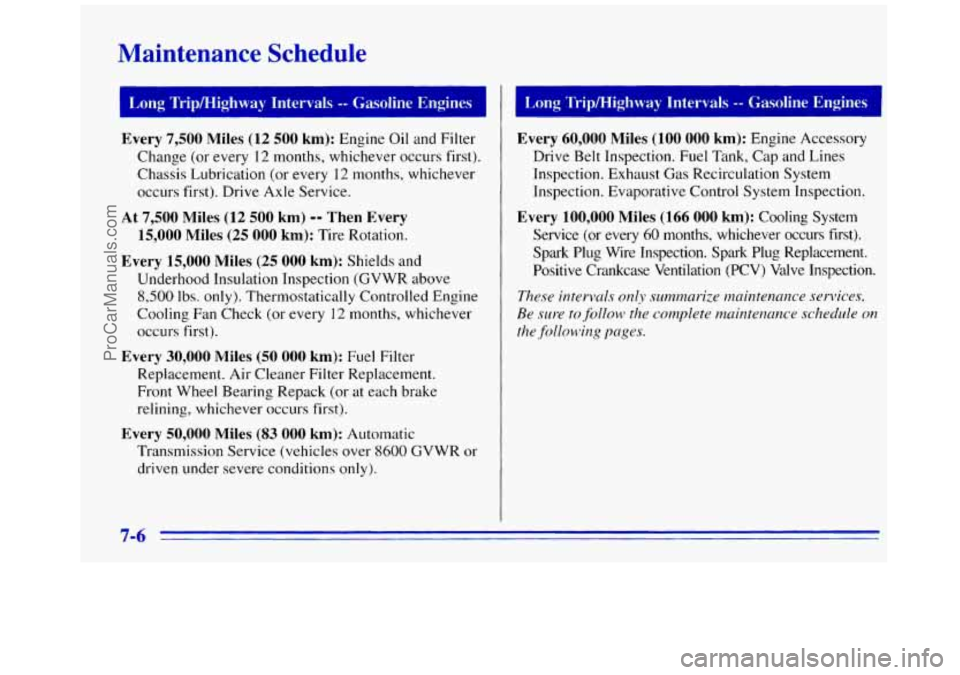
Every 7,500 Miles (12 500 km): Engine Oil and Filter
Change (or every 12 months, whichever occurs first).
Chassis Lubrication (or every 12 months, whichever
occurs first). Drive Axle Service.
At 7,500 Miles (12 500 km) -- Then Every
15,000 Miles
(25 000 km): Tire Rotation.
Every 15,000 Miles (25 000 km): Shields and
Underhood Insulation Inspection (GVWR above
8,500 lbs. only). Thermostatically Controlled Engine
Cooling Fan Check
(or every 12 months, whichever
occurs first).
Every 30,000 Miles (50 000 km): Fuel Filter
Replacement. Air Cleaner Filter Replacement.
Front Wheel Bearing Repack (or at each brake
relining, whichever occurs first).
Every 50,000 Miles (83 000 km): Automatic
Transmission Service (vehicles over
8600 GVWR or
driven under severe conditions only).
Every 60,000 Miles (100 000 km): Engine Accessory
Drive Belt Inspection. Fuel
Tank, Cap and Lines
Inspection. Exhaust Gas Recirculation System
Inspection. Evaporative Control System Inspection.
Every 100,000 Miles (166 000 km): Cooling System
Service (or every
60 months, whichever occurs fist).
Spark Plug Wire Inspection. Spark
Plug Replacement.
Positive Crankcase Ventilation (PCV) Valve Inspection.
These intervals only sumnarize maintenance services.
Be sure to follow the complete maintenance schedule on
the.following pnges.
7-6
ProCarManuals.com
Page 304 of 372
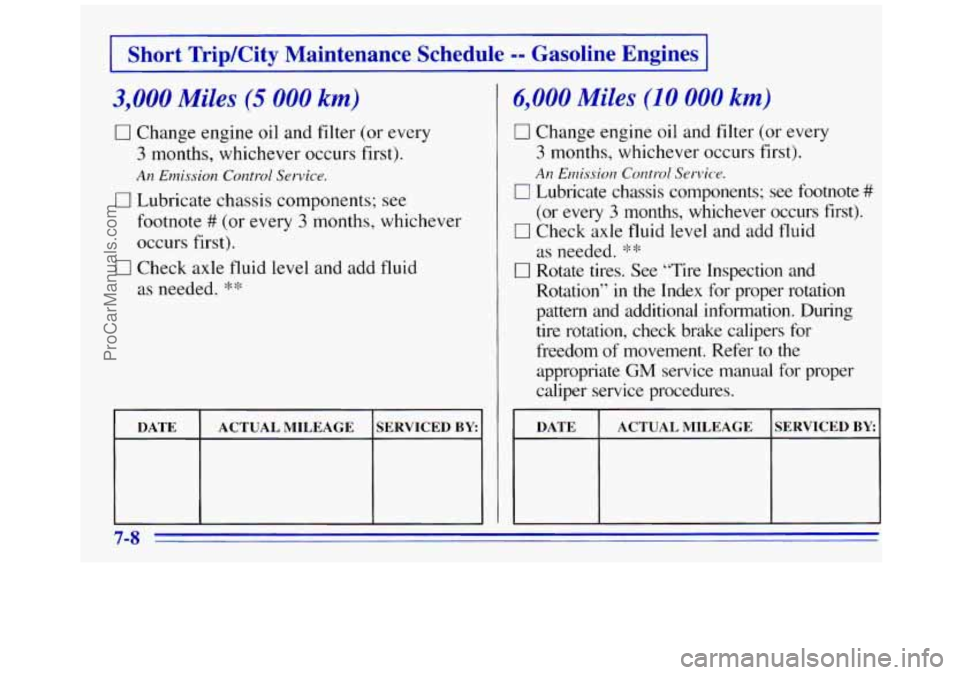
I Short TripKity Maintenance Schedule -- Gasoline Engines I
3,000 Miles (5 000 km)
0 Change engine oil and filter (or every
3 months, whichever occurs first).
0 Lubricate chassis components; see
An Emission Control Service.
footnote ## (or every 3 months, whichever
occurs first).
as needed. **
CI Check axle fluid level and add fluid
DATE ACTUAL MILEAGE SERVICED BY
6,000 Miles (10 000 km)
0 Change engine oil and filter (or every
3 months, whichever occurs first).
An Emission Control Servic-e.
0 Lubricate chassis components; see footnote ##
(or every 3 months, whichever occurs first).
0 Check axle fluid level and add fluid
as needed. **
0 Rotate tires. See “Tire Inspection and
Rotation” in the Index for proper rotation
pattern and additional information. During
tire rotation, check brake calipers for
freedom
of movement. Refer to the
appropriate
GM service manual for proper
caliper service procedures.
7-8
ProCarManuals.com
Page 306 of 372
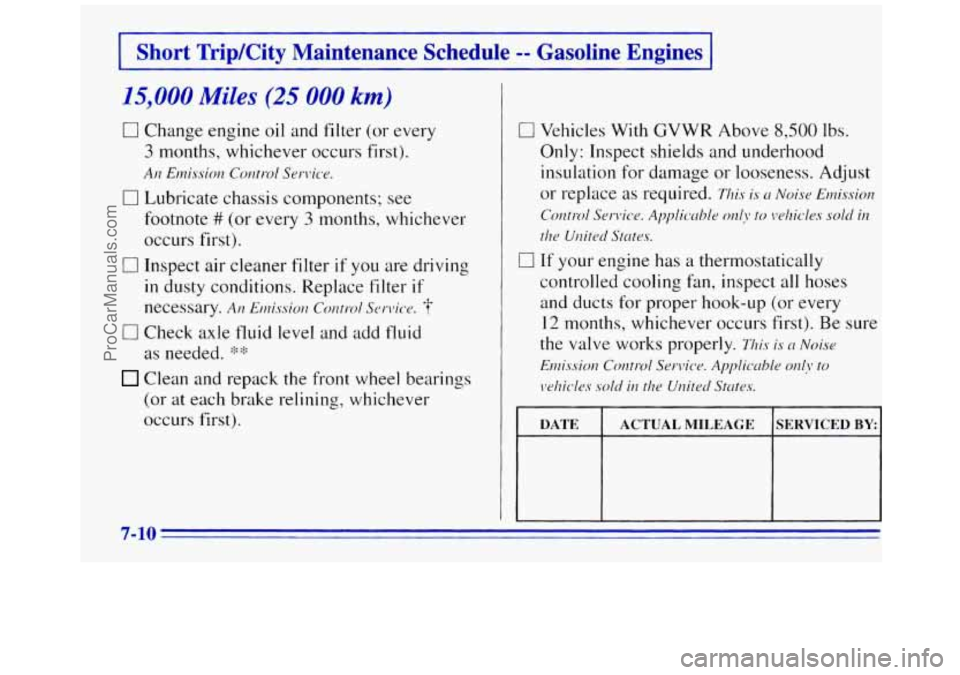
Short TripKity Maintenance Schedule -- Gasoline Engines A
15,000 Miles (25 000 km)
0 Change engine oil and filter (or every
3 months, whichever occurs first).
0 Lubricate chassis components; see
Arz Emission Cotltr-ol Senlice.
footnote ## (or every 3 months, whichever
occurs first).
El Inspect air cleaner filter if you are driving
in dusty conditions. Replace filter if
necessary. AFI Emission Contd Stjt-vic’o.
0 Check axle tluid level and add fluid
as needed.
**
Clean and repack the front wheel bearings
(or at each brake relining, whichever
occurs first).
0 Vehicles With GVWR Above 8,500 lbs.
Only: Inspect shields and underhood
insulation for damage or looseness. Adjust
or replace
as required. This is Noise Emission
Control Ser\*icc_. Applicnble only to vehicles sold irz
the United Stl1te.s.
0 If your engine has a thermostatically
controlled cooling fan, inspect all hoses
and ducts for proper hook-up (or every
12 months, whichever occurs first). Be sure
the valve works properly. 7his is CI Noise
Emission Corltrol Service. Applicddr onl~ to
\~cl~ic.lcs sold in the United Stcrtes.
DArE SERVICED BY ACTUAL MILEAGE
7-10
ProCarManuals.com