tow GMC SAVANA 1996 Service Manual
[x] Cancel search | Manufacturer: GMC, Model Year: 1996, Model line: SAVANA, Model: GMC SAVANA 1996Pages: 372, PDF Size: 18.81 MB
Page 219 of 372
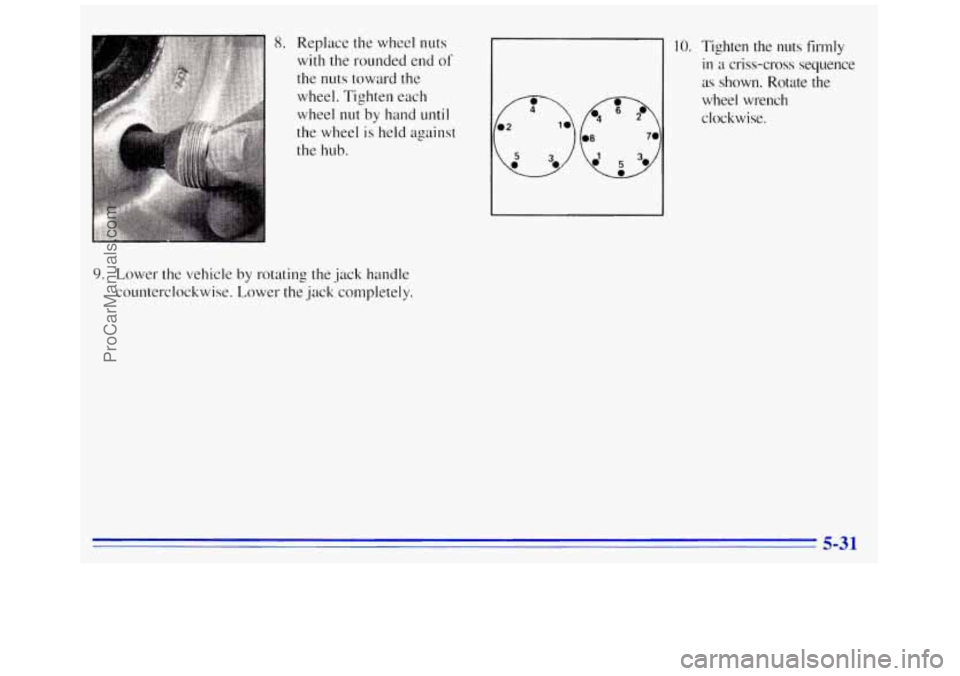
8. Replace the wheel nuts
with the rounded end of
the nuts toward the
wheel. Tighten each
wheel nut
by hand until
the wheel is held against
the hub.
9. Lower the vehicle by rotating thejack handle
counterclockwise. Lower the
jack completely.
10. Tighten the nuts firmly
in a criss-cross sequence
as shown. Rotate the
wheel wrench
clockwise.
5-31
ProCarManuals.com
Page 222 of 372
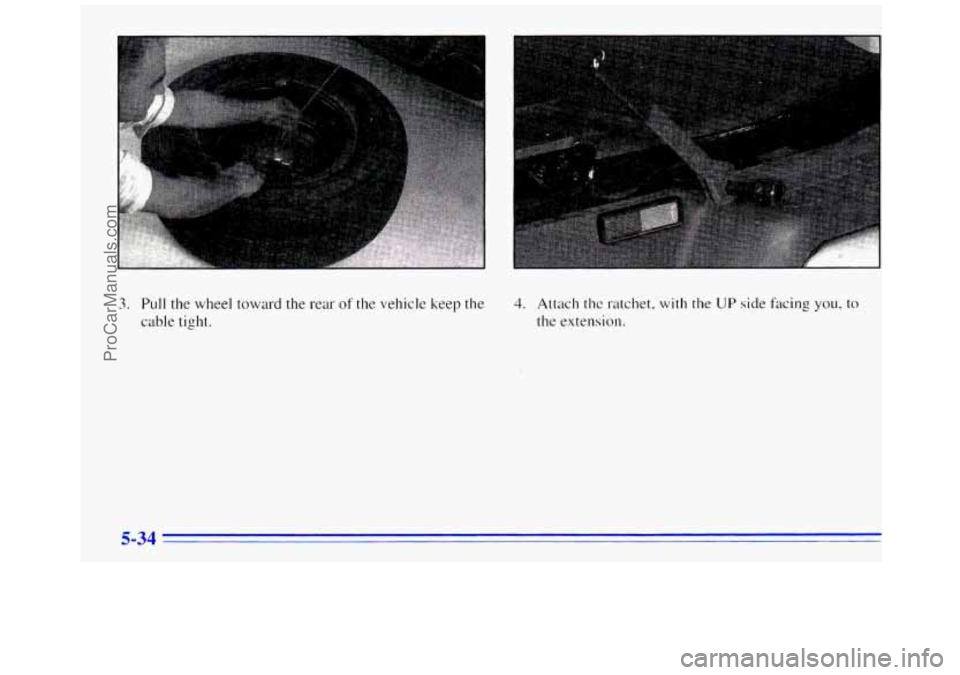
3. Pull the wheel toward the rear of the vehicle keep the
cable tight. 4. Attach the ratchet, with the UP side facing you, to
the extension.
5-34
ProCarManuals.com
Page 224 of 372
NOTICE:
Spinning your wheels can destroy parts of your
vehicle as well as the tires.
If you spin the wheels
too fast while shifting your transmission back
and forth, you can destroy your transmission.
For information about using tire chains on your vehicle,
see “Tire Chains” in the Index.
Rocking your vehicle to get it out:
First, turn your steering wheel left and right. That will
clear
the area around your front wheels. Then shift back
and forth between
REVERSE (R) and a forward gear,
spinning the wheels as little as possible. Release the
accelerator pedal while
you shift, and press lightly on
the accelerator pedal when the transmission is in gear. If
that doesn’t get
you out after a few tries, you may need
to be towed out.
If you do need to be towed out, see
”Towing Your Vehicle”
in the Index.
5-36
ProCarManuals.com
Page 235 of 372
Engine Oil (Gasoline Engine)
If your vehicle has a diesel engine, see “Engine Oil
(Diesel Engine)” in the Diesel Engine Supplement.
It‘s
a good idea to check your engine oil every time you
be warm and the vehicle must be on level ground.
c‘ Get fuel. In order to get an accurate reading, the oil must
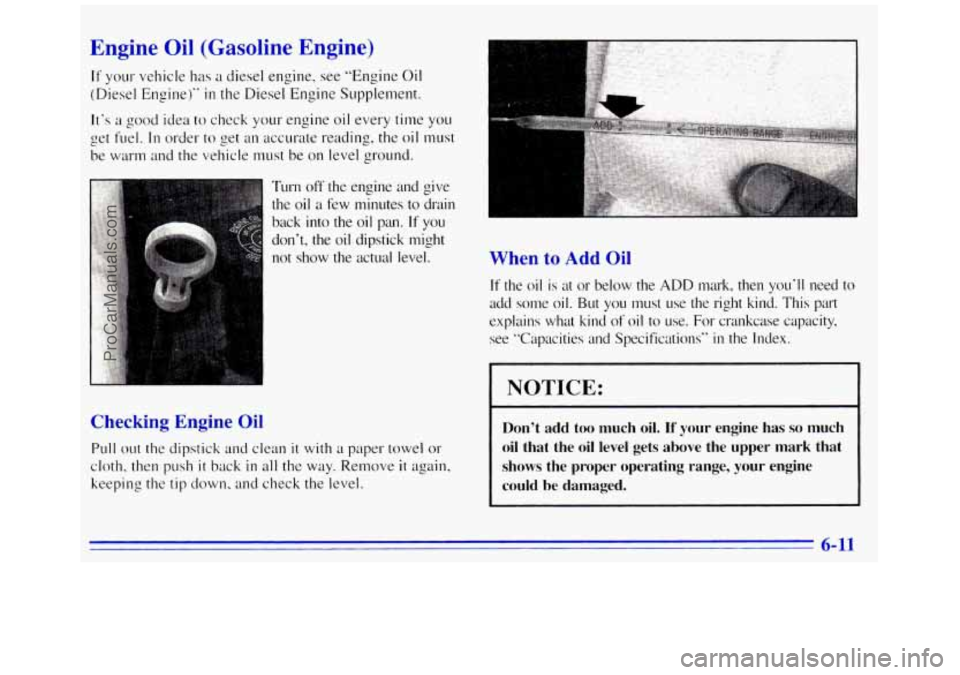
Turn
off the engine and give
the oil
a few minutes to drain
back into the
oil pan. If you
don’t, the oil dipstick might
not show the actual level.
Checking Engine Oil
Pull out the dipstick and clean it with a paper towel or
cloth, then push
it back in all the way. Remove it again,
keeping the tip down, and check the level.
When to Add Oil
If the oil is at or below the ADD mark, then ~011’11 need to
add some oil. But you must use the right kind. This part
explains what kind
of oil to use. For crankcase capacity,
see “Capacities and Specifications”
in the Index.
NOTICE:
Don’t add too much oil. If your engine has so much
oil that the oil level gets above the upper mark that
shows the proper operating range, your engine could be damaged.
ProCarManuals.com
Page 238 of 372
When to Change Engine Oil
See if any one of these is true for you:
0
0
0
0
0
Most trips are less than 5 to 10 miles (8 to 16 km).
This is particularly important when outside
temperatures are below freezing.
Most trips include extensive idling (such
as frequent
driving
in stop-and-go traffic).
Most trips are through dusty areas.
You frequently tow a trailer or use a carrier on top of
your vehicle.
The vehicle
is used for delivery service, police, taxi
or other commercial application.
Driving under these conditions causes engine oil to
break down sooner. If any one of these is true for your
vehicle, then you need to change your oil and filter
every
3,000 miles (5 000 km) or 3 months -- whichever
occurs first.
If none of them is true, change the oil and filter every
7,500 miles (1 2 SO0 km) or 12 months -- whichever
occurs first. Driving a vehicle
with a fully warnled
engine under highway conditions causes engine oil to
break down slower.
What to Do with Used Oil
Did you know that used engine oil contains certain
elements that may be unhealthy for your skin and could
even cause cancer'? Don't let used oil stay on your skin
for very long. Clean your skin and nails with soap and
water, or a
good hand cleaner. Wash or properly throw
away clothing or rags containing used engine
oil. (See
the manufacturer's warnings about the use and disposal
of oil products.)
Used oil can be a real threat to the environment. If you
change your own
oil, be sure to drain all free-flowing oil
from the filter before disposal. Don't ever dispose of oil
by putting it in the trash, pouring it on the ground, into
sewers, or into streams or bodies of water. Instead,
recycle
it by taking it to a place that collects used oil. If
you have a problem properly disposing of your used oil,
ask your dealer,
a service station or a local recycling
center for help.
6-14
ProCarManuals.com
Page 240 of 372
Automatic Transmission Fluid
7 ’ ~ n to Check and Change
A good time to check your automatic transmission fluid
level is when the engine oil is changed.
Change
both the fluid and filter every 50,000 miles
(83 000 km) if the vehicle’s GVWR is over 8,600 or
if
the vehicle is mainly driven under one or more of
these conditions:
0 In heavy city traffic where the outside temperature
0 In hilly or mountainous terrain.
0 When doing frequent trailer towing.
regularly
reaches
90°F (32°C) or higher.
0 Uses such as found in taxi, police or delivery service.
If your vehicle’s GVWR is not over 8,600 and you do
not use your vehicle under any of these conditions, the
fluid and filter do not require changing.
See “Scheduled Maintenance Services”
in the Index.
How to Check
Because this operation can be a little difficult, you
may choose to have this done at your GM dealer
Service Department.
If you do it yourself, be sure to follow all the
instructions here, or you could get
a false reading on
the dipstick.
NOTICE:
Too much or too little fluid can damage your
transmission.
Too much can mean that some of
the fluid could come out and fall on hot engine parts or exhaust system parts, starting a fire. Be
sure to get an accurate reading if you check your
transmission fluid.
ProCarManuals.com
Page 242 of 372
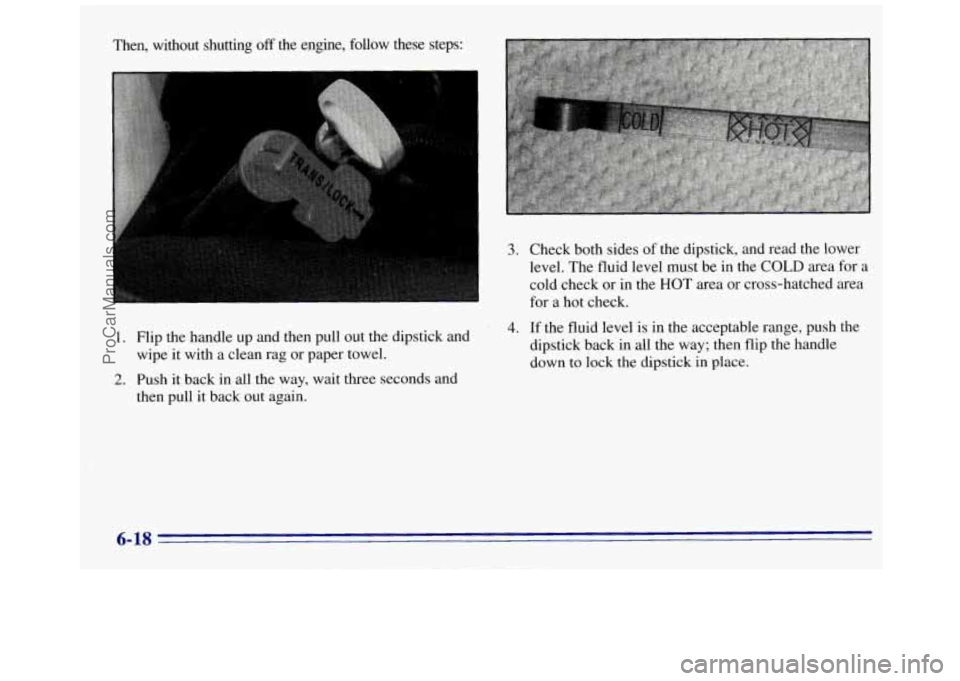
Then, without shutting off the engine, follow these steps:
1.
2.
3. Check both sides of the dipstick, and read the lower
level. The fluid level must be in the
COLD area for a
cold check
or in the HOT area or cross-hatched area
for a hot check.
Flip the handle
up and then pull out the dipstick and 4. If the fluid level is in the acceptable range, push the
wipe
it with a clean rag or paper towel. dipstick back
in all the way; then flip the handle
down to lock the dipstick in place.
Push it back
in all the way, wait three seconds and
then pull
it back out again.
6-18
ProCarManuals.com
Page 262 of 372
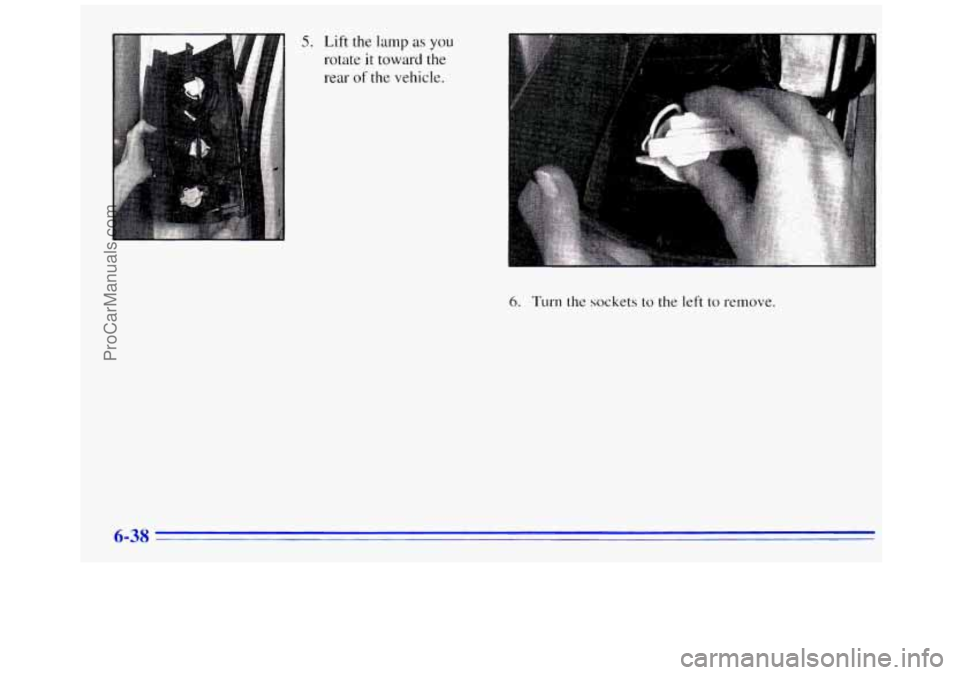
5. Lift the lamp as you
rotate it toward the
rear
of the vehicle.
6. Turn the sockets to the left to remove.
6-38
ProCarManuals.com
Page 268 of 372
A CAUTION:
Rust or dirt on a wheel, or on the parts to which
it is fastened, can make wheel nuts become loose
after
a time. The wheel could come off and cause
an accident. When you change
a wheel, remove
any rust or dirt from places where the wheel
attaches to the vehicle. In an emergency, you can
use
a cloth or a paper towel to do this; but be
sure to use
a scraper or wire brush later, if you
need
to, to get all the rust or dirt off. (See
“Changing a Flat Tire” in the Index.) When
It’s Time for New Tires
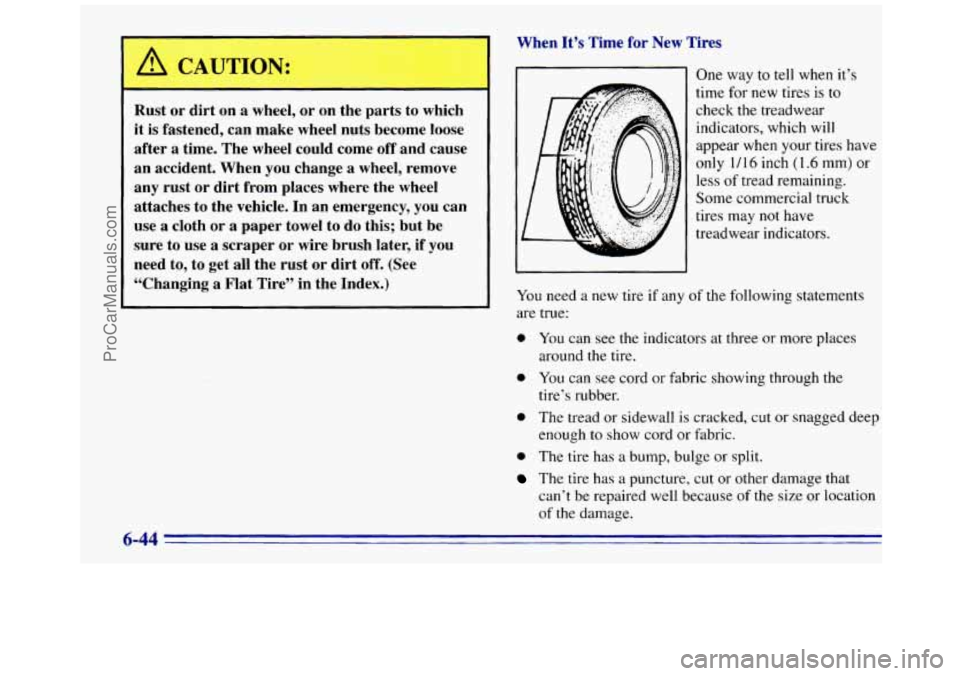
One way
to tell when it’s
time for new tires
is to
check the treadwear
indicators, which will
appear when your tires have
only 1/16 inch (1.6 mm) or
less of tread remaining.
Some commercial truck
tires may
not have
treadwear indicators.
You need a new tire if any of the following statements
are true:
0 You can see the indicators at three or more places
0 You can see cord or fabric showing through the
tire’s rubber.
0 The tread or sidewall is cracked, cut or snagged deep
enough to
show cord or fdbric.
0 The tire has a bump, bulge or split.
The tire has a puncture, cut or other damage that
around the
tire.
can’t
be repaired well because of the size or location
of the damage.
6-44
ProCarManuals.com
Page 275 of 372
Cleaning the Inside of Your Vehicle
Use a vacuum cleaner often to get rid of dust and loose
dirt. Wipe vinyl or leather
with a clean, damp cloth.
Your
CM dealer has two GM cleaners, a solvent-type
spot lifter and a foam-type powdered cleaner. They will
clean normal spots and stains very well. Do
not use
them on
vinyl or leather.
Here are some cleaning tips:
Always read the instructions on the cleaner label.
Clean up stains as soon as you can -- before they set.
Use a clean cloth or sponge, and change to a clean area
often. A soft brush may be used
if stains are stubborn.
Use solvent-type cleaners in a well-ventilated area
only.
If you use them, don’t saturate the stained area.
If a ring forms after spot cleaning, clean the entire
area immediately or
it will set.
Using Foam-Type Cleaner on Fabric
1.
2.
3.
4.
5.
6.
7.
8.
9.
10.
11.
Vacuum and brush the area to remove any
loose dirt.
Always clean a whole trim panel or section.
Mask surrounding trim along stitch
or welt lines.
Mix Multi-Purpose Powdered Cleaner following
the directions on the container label.
Use suds only and apply
with a clean sponge.
Don’t saturate the material.
Don’t rub it roughly.
As soon as you’ve cleaned the section,
use a
sponge to remove the suds.
Rinse the section with a clean, wet sponge.
Wipe off what’s left with
a slightly damp paper
towel or cloth.
Then dry
it immediately with a blow dryer.
Wipe with a clean cloth.
6-51
ProCarManuals.com