lock GMC SAVANA 1996 Repair Manual
[x] Cancel search | Manufacturer: GMC, Model Year: 1996, Model line: SAVANA, Model: GMC SAVANA 1996Pages: 372, PDF Size: 18.81 MB
Page 204 of 372
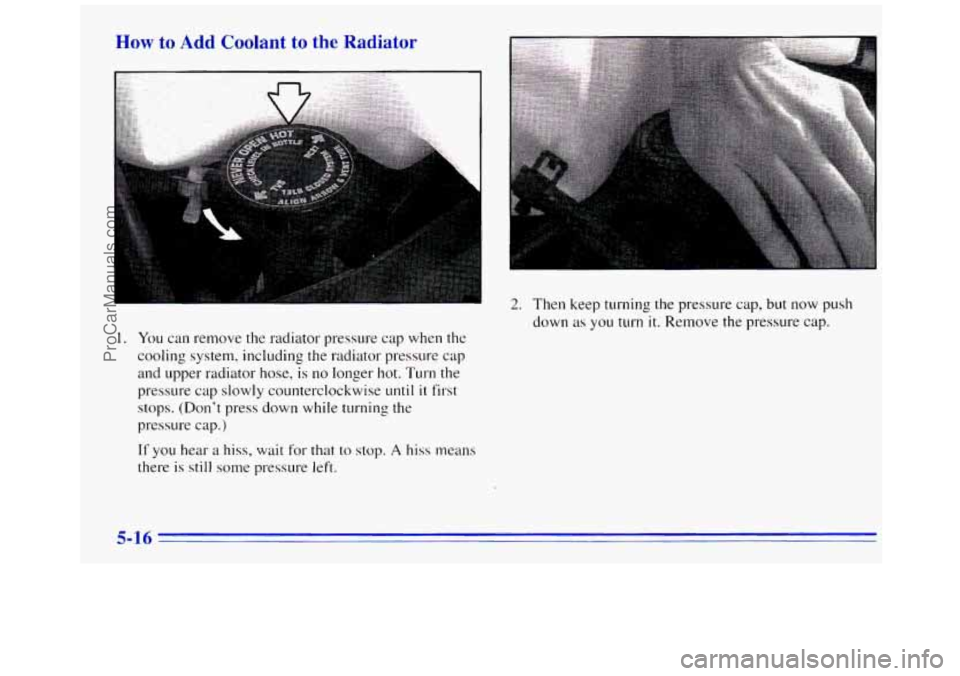
How to Add Coolant to the Radiator
I
1.
I
2. Then keep turning the pressure cap, but now push
down
as you turn it. Remove the pressure cap.
You can remove the radiator pressure cap when the
cooling system, including the radiator pressure cap
and upper radiator hose,
is no longer hot. Turn the
pressure
cap slowly counterclockwise until it first
stops. (Don’t press down while turning the
pressure cap.)
If you hear a hiss, wait for that to stop. A hiss means
there is still some pressure left.
5-16
ProCarManuals.com
Page 208 of 372
If a Tire Goes Flat
It’s unusual for a tire to “blow out” while you’re driving,
especially
if you maintain your tires properly. If air goes
out of a tire, it’s much more likely
to leak out slowly.
But
if you should ever have a “blowout,” here are a few
tips about what to expect and what to do:
If a front tire fails, the flat tire will create a drag that
pulls the vehicle toward that side. Take
your foot off the
accelerator pedal and grip the st.eering wheel firmly.
Steer to maintain lane position, and then gently brake to
a stop well out of the traffic lane.
A rear blowout, particularly on a curve, acts much like a
skid and may require the same correction you’d use in a
skid.
In any rear blowout, remove your foot from the
accelerator pedal. Get the vehicle under control
by
steering the way you want the vehicle to go. It may be
very bumpy and noisy, but you can still steer. Gently
brake to
a stop -- well off the road if possible.
If a tire goes flat, the next part shows how to use your
jacking equipment to change a
flat tire safely.
Changing a Flat Tire
If a tire goes flat, avoid further tire and wheel damage
by driving slowly to
a level place. Turn on your hazard
warning flashers.
Changing a tire can cause an injury. The vehicle
can slip off the jack and roll over you or other
people. You and they could be badly injured.
Find a level place
to change your tire. To help
prevent the vehicle from moving:
1. Set the parking brake firmly.
2. Put the shift lever in PARK (P).
3. Turn off the engine.
To be even more certain the vehicle won’t move,
you can put blocks at the front and rear of the
tire farthest away from the one being changed.
That would be the tire on the other side of the
vehicle, at the opposite end.
5-20
ProCarManuals.com
Page 212 of 372
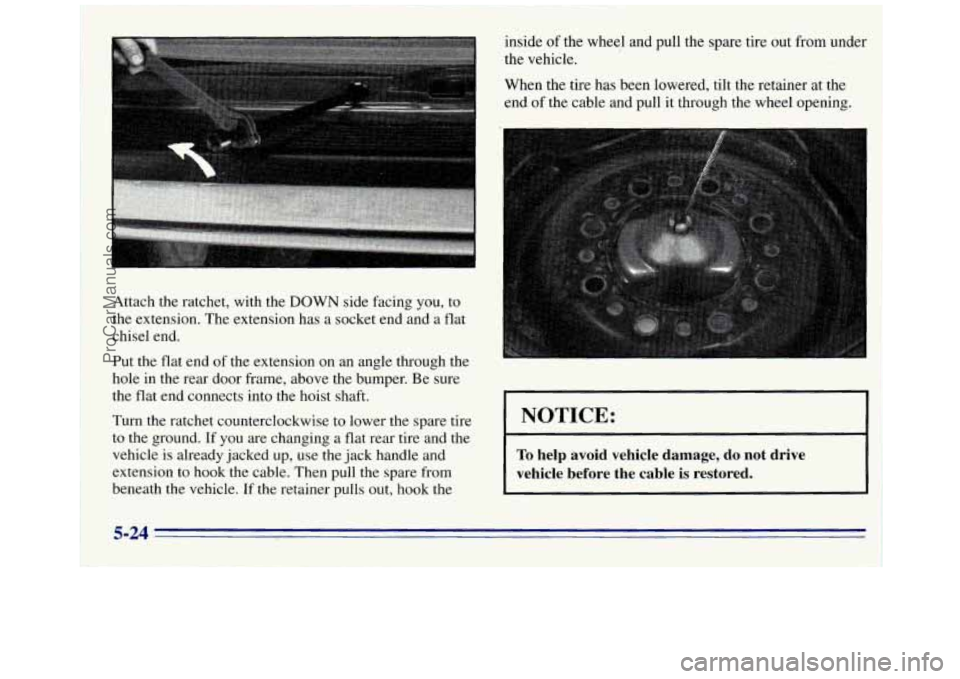
Attach the ratchet, with the DOWN side facing you, to
the extension. The extension has a socket end and a flat
chisel end.
Put the flat end of the extension on an angle through the
hole in the rear door frame, above the bumper. Be sure
the flat end connects into the hoist shaft.
Turn the ratchet counterclockwise to lower the spare tire
to the ground.
If you are changing a flat rear tire and the
vehicle is already jacked up, use the jack handle and
extension to hook the cable. Then pull the spare from
beneath the vehicle.
If the retainer pulls out, hook the inside
of the wheel and pull the
spare tire out from under
the vehicle.
When the tire has been lowered, tilt the retainer at the end
of the cable and pull it through the wheel opening.
NOTICE:
To help avoid vehicle damage, do not drive
vehicle before the cable is restored.
5-24 i
t
ProCarManuals.com
Page 214 of 372
Removing the Wheel Covers and Locking
Wheel
P
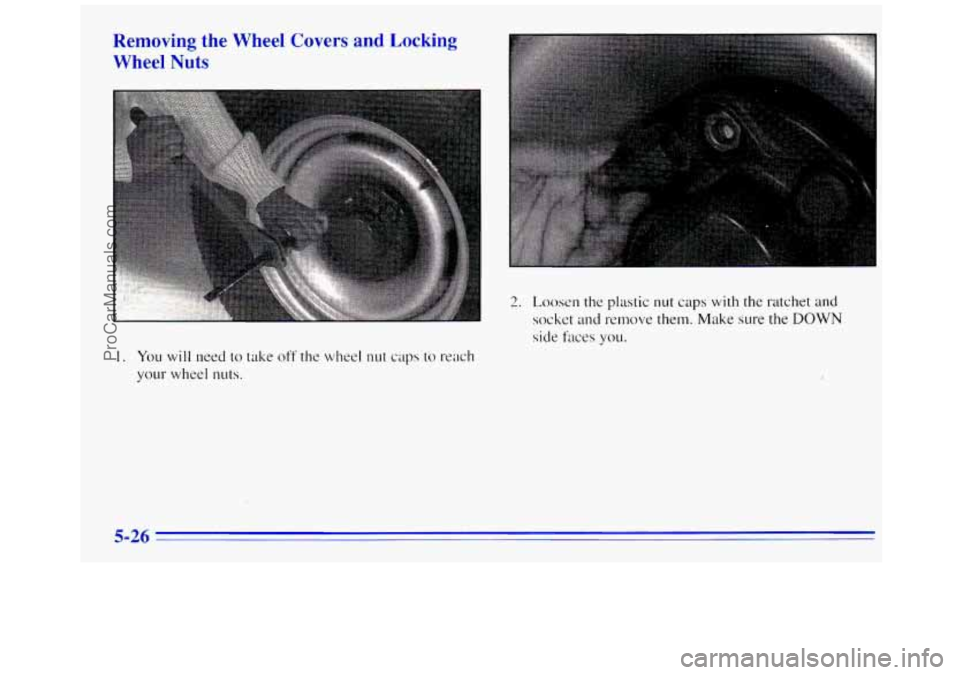
I. You will need to take oft' the wheel nut caps to reach
your wheel nuts.
2. Loosen the plastic nut caps with the ratchet and
socket and remove them. Make sure the DOWN
side faces you.
5-26
ProCarManuals.com
Page 216 of 372
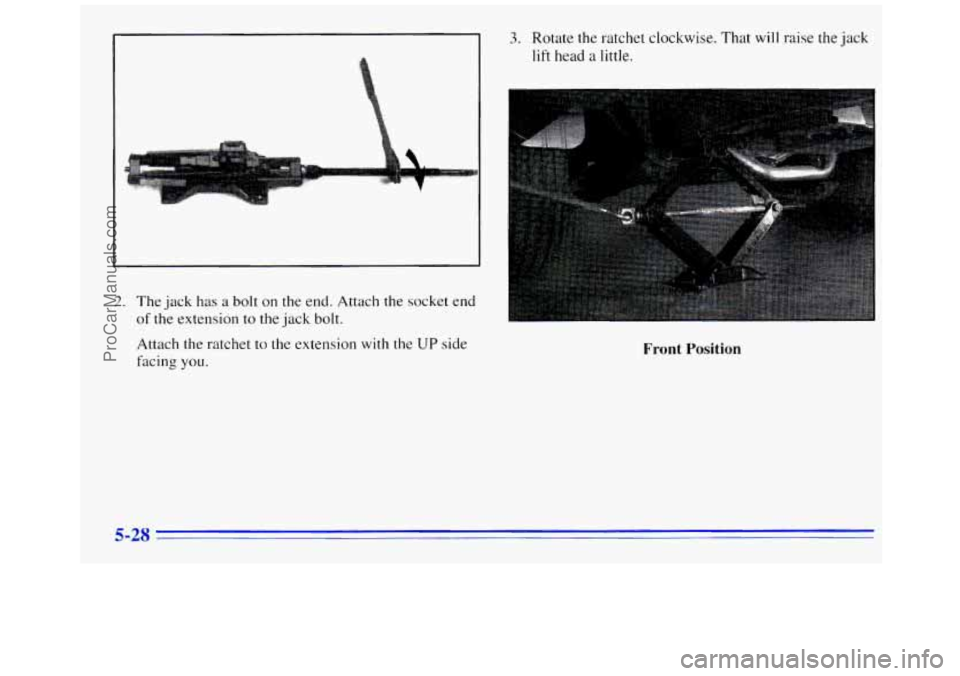
2. The jack has a bolt on the end. Attach the socket end
of the extension to the jack bolt.
Attach the ratchet to the extension
with the UP side
facing
you.
3. Rotate the ratchet clockwise. That will raise the jack
lift head a little,
Front Position
5-28
ProCarManuals.com
Page 217 of 372
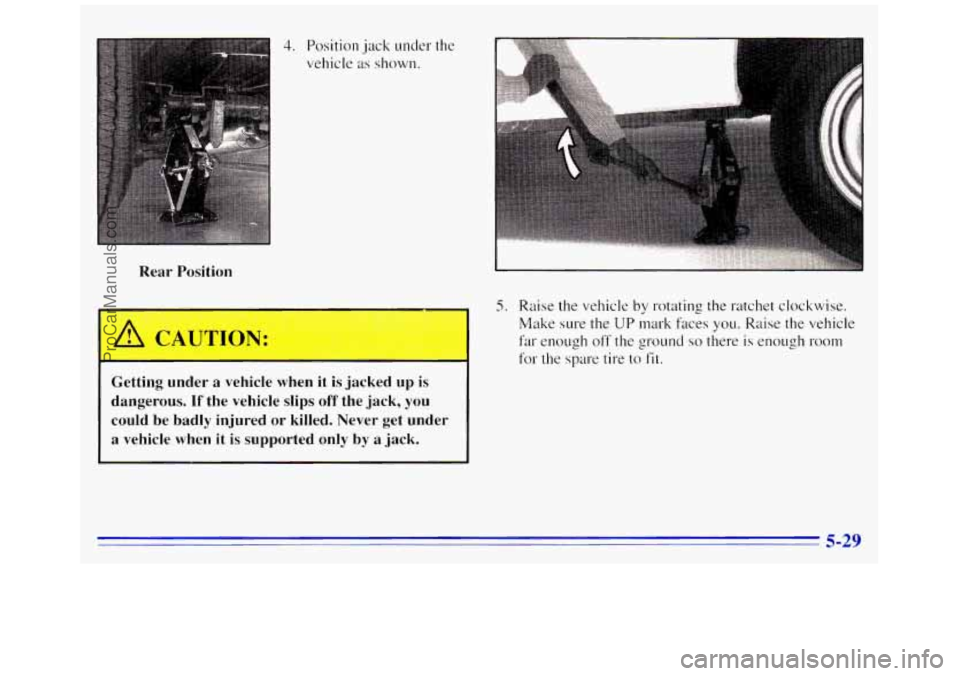
4. Position jack under the
vehicle
as shown.
Rear Positio~
Getting under a vehicle when it is jacked
up is
dangerous.
If the vehicle slips off the jack, you
could be badly injured or killed. Never get under
a vehicle when it is supported only by a jack.
5. Raise the vehicle by rotating the ratchet clockwise.
Make sure the
UP mark faces you. Raise the vehicle
far enough
off the ground so there is enough room
for the spare tire to
fit.
5-29
ProCarManuals.com
Page 219 of 372
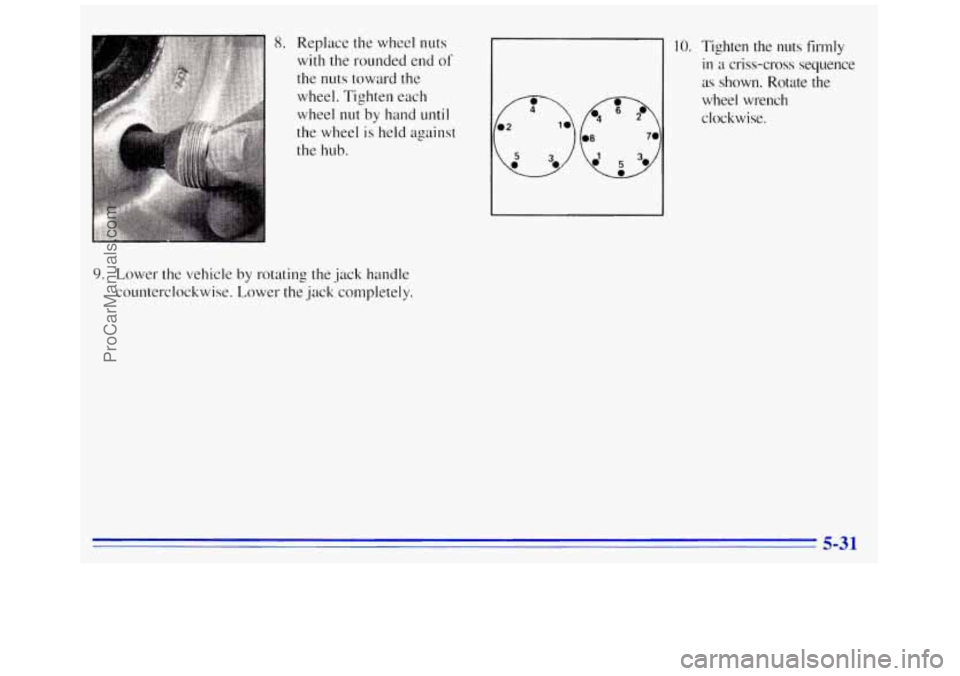
8. Replace the wheel nuts
with the rounded end of
the nuts toward the
wheel. Tighten each
wheel nut
by hand until
the wheel is held against
the hub.
9. Lower the vehicle by rotating thejack handle
counterclockwise. Lower the
jack completely.
10. Tighten the nuts firmly
in a criss-cross sequence
as shown. Rotate the
wheel wrench
clockwise.
5-31
ProCarManuals.com
Page 220 of 372
A CAUTION:
Incorrect wheel nuts or improperly tightenea
wheel nuts can cause the wheel to become loose
and even come off. This could lead to an accident.
Be sure to use the correct wheel nuts.
If you have
to replace them, be sure to get new
GM original
equipment wheel nuts.
Stop, somewhere
as soon as you can and have
the nuts tightened with a torque wrench to
122 lb-ft (165 N-m).
NOTICE:
Improperly tightened wheel nuts can lead to
brake pulsation and rotor damage.
To avoid
expensive brake repairs, evenly tighten the wheel
nuts in the proper sequence and to the proper'
torque specification.
11. Put the wheel cover back on, if you have one.
Remove any wheel blocks.'
Remember that the jack, jacking equipment and tire
must
be properly stored in their original storage
position before you begin driving again. The next
part will show you how.
5-32
ProCarManuals.com
Page 223 of 372
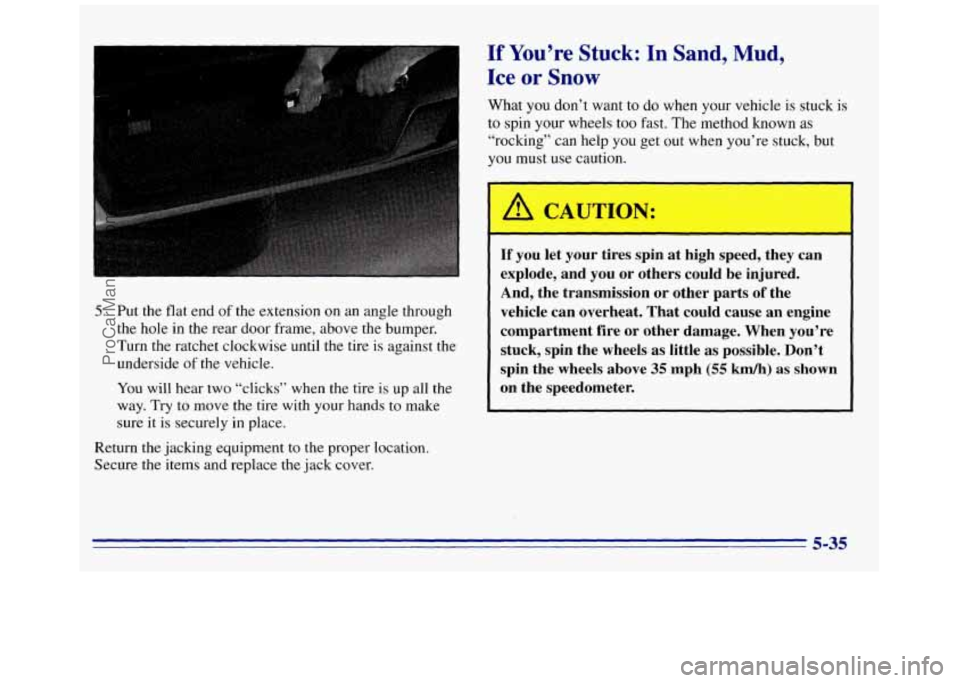
5. Put the flat end of the extension on an angle through
the hole in the rear door frame, above the bumper.
Turn the ratchet clockwise until the tire is against the
underside
of the vehicle.
You will hear two “clicks” when the tire is up all the
way. Try
to move the tire with your hands to make
sure it is securely in place.
Return the jacking equipment to the proper location.
Secure the items and replace the jack cover.
If You’re Stuck: In Sand, Mud,
Ice or Snow
What you don’t want to do when your vehicle is stuck is
to spin your wheels too fast. The method known as
”rocking” can help you get out when you’re stuck, but
you must use caution.
If you let your tires spin at high speed, they can
explode, and you or others could be injured.
And, the transmission or other parts
of the
vehicle can overheat. That
could cause an engine
compartment fire or other damage. When you’re
stuck, spin the wheels as little
as possible. Don’t
spin the wheels above
35 mph (55 kmh) as shown
on the speedometer.
5-35
ProCarManuals.com
Page 229 of 372
L
If you get gasoline on yourself and then
something ignites it, you could be badly burned.
Gasoline can spray out
on you if you open the
fuel filler cap too quickly.
This spray can happen
if your tank
is nearly full, and is more likely in
hot weather. Open the fuel filler cap slowly and
wait for any “hiss” noise to stop. Then unscrew
the cap all the way.
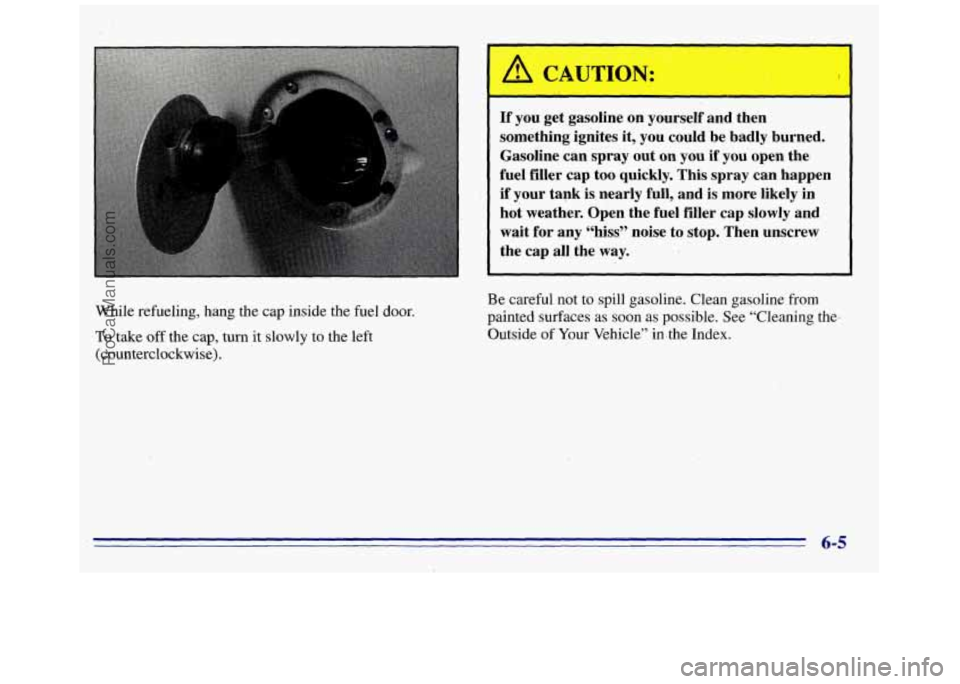
While refueling, hang the cap inside the fuel door.
To take off the cap, turn it slowly to the left
(counterclockwise). Be
careful not
to spill gasoline. Clean gasoline from
painted surfaces
as soon as possible. See “Cleaning the-
Outside of Your Vehicle” in.the Index.
6-5
f
ProCarManuals.com