automatic transmission fluid GMC SAVANA 1996 Owners Manual
[x] Cancel search | Manufacturer: GMC, Model Year: 1996, Model line: SAVANA, Model: GMC SAVANA 1996Pages: 372, PDF Size: 18.81 MB
Page 185 of 372
When You Are Ready to Leave After
Parking
on a Hill
1. Apply your regular brakes and hold the pedal down
while you:
Start your engine:
Shift into a gear: and
Release the parking brake.
2. Let up on the brake pedal.
3. Drive slowly until the trailer is clear of the chocks.
4. Stop and have someone pick up and store the chocks.
Maintenance When Trailer Towing
Your vehicle will need service more often when you’re
pulling a trailer. See the Maintenance Schedule for more
on this. Things that are especially important
in trailer
operation are automatic transmission
fluid (don’t
overfill), engine oil, axle lubricant, belt, cooling system
and brake adjustment. Each
of these is covered in this
manual, and the Index will help
you find them quickly.
If you‘re trailering, it‘s a good idea to review these
sections before you start your trip.
Check periodically to see that
all hitch nuts and bolts
are tight.
Trailer Wiring Harness
The eight-wire harness, if you have one, is stored under
your vehicle along the rear frame crossmember.
It is
wrapped and bound with a plastic strap. The harness has
a 30-anlp battery feed and no connector, and you should
have a qualified electrical service person wire your
harness for you. Attach the harness
to the trailer, then
tape or strap
it to your vehicle’s frame rail. Be sure you
leave
it loose enough so the wiring doesn’t bend or
break, but not
so loose that it drags on the ground.
Store the harness
in its original place. Wrap the harness
together and tie
it neatly so it won’t be damaged.
The five-wire harness,
if you have one, is stored inside
the vehicle at the passenger side rear corner, behind the
jack. This should be wired by a qualified electrical
service person. It must be routed out
of your vehicle
between the rear door and the floor,
with enough of the
harness left on both sides
so that the trailer or the body
won’t pull
it.
Store the harness in its original place. Wrap the harness
together and tie
it neatly so it won’t be damaged.
4-37
ProCarManuals.com
Page 191 of 372
If your vehicle has more than one battery, use the
battery that is under the hood
of the vehicle -- this
will reduce the electrical resistance.
2. Get the vehicles close enough so the jumper cables
can reach, but be sure the vehicles aren’t touching
each other.
If they are, it could cause a ground
connection
you don’t want. You wouldn’t be able to
start your vehicle, and the bad grounding could
damage the electrical systems.
Set the parking brake firmly
on each vehicle. Put an
automatic transmission in PARK
(P) or a manual
transmission in NEUTRAL
(N).
3. Turn off the ignition on both vehicles. Turn off all
lamps that aren’t needed, and radios. This will avoid
sparks and help save both batteries, and could save
your radio!
NOTICE:
If you leave your radio on, it could be badly
damaged. The repairs would not be covered by
your warranty.
4. Open the hoods and locate the batteries. Find
the positive
(+) and negative (-) terminals on
each battery.
A CA
Using a match near a battery can cause battery
gas to explode. People have been hurt doing this,
and some have been blinded. Use
a flashlight if
you need more light.
Be sure the battery (or batteries) has enough
water. You don’t need to add water to the Delco
Freedom@ battery
(or batteries) installed in
every new
GM vehicle. But if a battery has filler
caps, be sure the right amount of fluid
is there. If
it is low, add water to take care of that first. If
you don’t, explosive gas could be present.
Battery fluid contains acid that can burn you.
Don’t get it on you.
If you accidentally get it in
your eyes or on your skin, flush the place with
water and get medical help immediately.
5-3
ProCarManuals.com
Page 240 of 372
Automatic Transmission Fluid
7 ’ ~ n to Check and Change
A good time to check your automatic transmission fluid
level is when the engine oil is changed.
Change
both the fluid and filter every 50,000 miles
(83 000 km) if the vehicle’s GVWR is over 8,600 or
if
the vehicle is mainly driven under one or more of
these conditions:
0 In heavy city traffic where the outside temperature
0 In hilly or mountainous terrain.
0 When doing frequent trailer towing.
regularly
reaches
90°F (32°C) or higher.
0 Uses such as found in taxi, police or delivery service.
If your vehicle’s GVWR is not over 8,600 and you do
not use your vehicle under any of these conditions, the
fluid and filter do not require changing.
See “Scheduled Maintenance Services”
in the Index.
How to Check
Because this operation can be a little difficult, you
may choose to have this done at your GM dealer
Service Department.
If you do it yourself, be sure to follow all the
instructions here, or you could get
a false reading on
the dipstick.
NOTICE:
Too much or too little fluid can damage your
transmission.
Too much can mean that some of
the fluid could come out and fall on hot engine parts or exhaust system parts, starting a fire. Be
sure to get an accurate reading if you check your
transmission fluid.
ProCarManuals.com
Page 243 of 372
How to Add Fluid Rear Axle
Refer to the Maintenance Schedule to determine what
kind of transmission fluid to use. See “Recommended
Fluids and Lubricants”
in the Index.
Add
tluid only after checking the transmission fluid
HOT. (A COLD check is used only as a reference.) If
the fluid level is low, add only enough of the proper
fluid to bring
the level up to the HOT area for a hot
check.
It doesn’t take much fluid, generally less than a
pint (0.5 L). DOLJ ’t overfill. We recommend you use only
fluid labeled DEXRON@-111, because fluid with that
label is made especially for your automatic transmission.
Damage caused by
fluid other than DEXRON-111 is not
covered by your new vehicle warranty.
After adding fluid, recheck the fluid level as
described under ”How to Check.”
When the correct fluid level is obtained, push the
dipstick back
in all the way; then flip the handle
down to lock
the dipstick in place.
When to Check and Change Lubricant
Refer to the Maintenance Schedule to determine how
often to check the lubricant and when to change
it. See
“Scheduled Maintenance Services” in the Index.
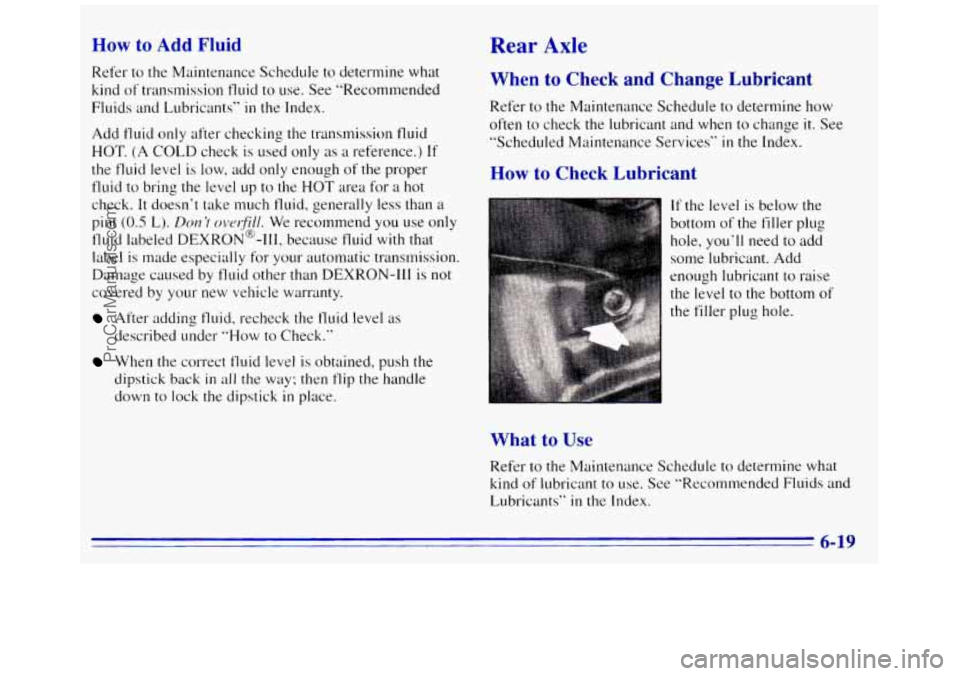
How to Check Lubricant
If the level is below the
bottom of the filler plug
hole,
you’ll need to add
some lubricant. Add
enough lubricant to raise
the level
to the bottom of
the filler plug hole.
What to Use
Refer to the Maintenance Schedule to determine what
kind
of lubricant to use. See “Recommended Fluids and
Lubricants”
in the Index.
6-19
ProCarManuals.com
Page 313 of 372
I Short TripKity Maintenance Schedule -- Gasoline Engines I
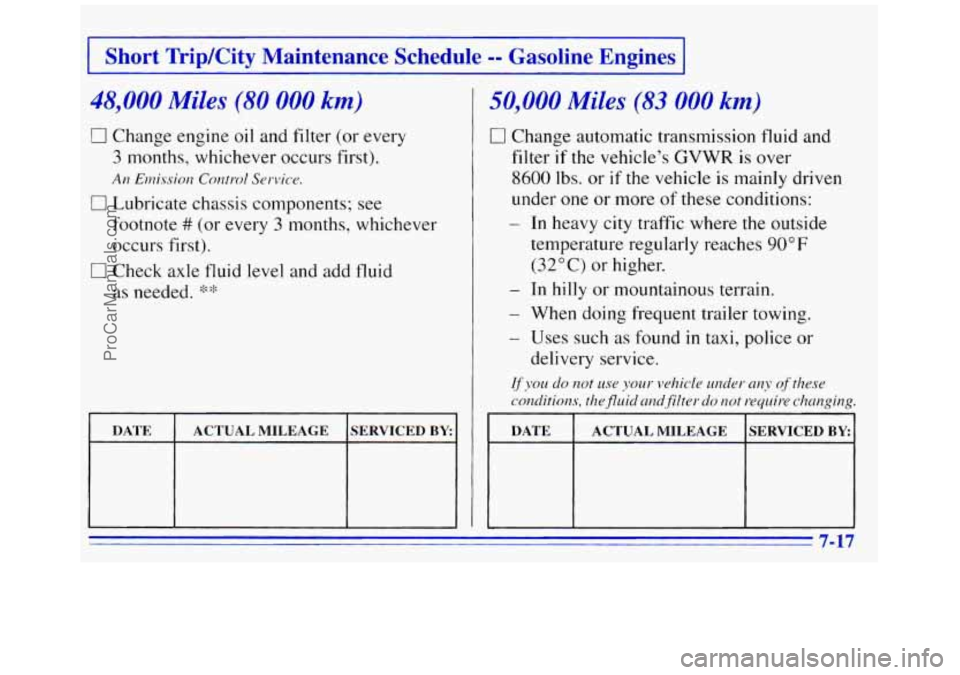
48,000 Miles (80 000 km)
0 Change engine oil and filter (or every
3 months, whichever occurs first).
0 Lubricate chassis components; see
footnote
## (or every 3 months, whichever
occurs first).
as needed. ‘W
17 Check axle fluid level and add fluid
DATE
SERVICED BY ACTUAL MILEAGE
50,000 Miles (83 000 km)
0 Change automatic transmission fluid and
filter
if the vehicle’s GVWR is over
8600 lbs. or if the vehicle is mainly driven
under one or more of these conditions:
- In heavy city traffic where the outside
temperature regularly reaches
90°F
(32 O C) or higher.
- In hilly or mountainous terrain.
- When doing frequent trailer towing.
- Uses such as found in taxi, police or
delivery service.
7-17
ProCarManuals.com
Page 325 of 372
1 Short Trip/City Maintenance Schedule -- Gasoline Engines I
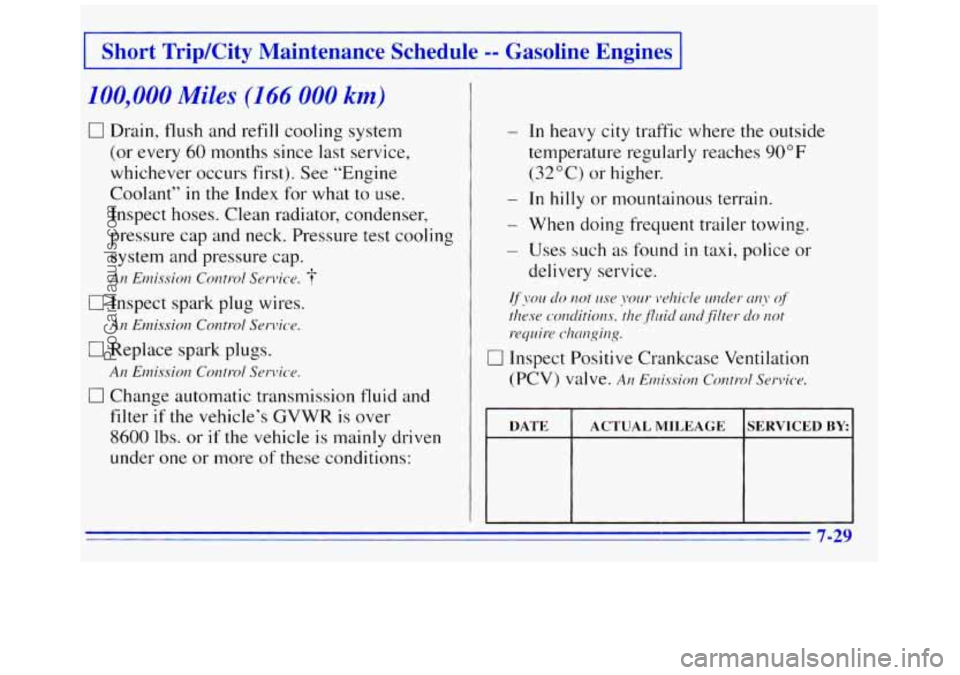
100,000 Miles (166 000 km)
0 Drain, flush and refill cooling system
(or every
60 months since last service
whichever occurs first). See “Engine
Coolant”
in the Index for what to use.
Inspect hoses. Clean radiator, condenser,
pressure cap and neck. Pressure test cooling
system and pressure cap.
AI1 Emission Control Service.
0 Inspect spark plug wires.
An Ernission Control Service.
0 Replace spark plugs.
0 Change automatic transmission fluid and
An Emission Colztrol Service.
filter if the vehicle’s GVWR is over
8600 lbs. or if the vehicle is mainly driven
under one
or more of these conditions:
- In heavy city traffic where the outside
temperature regularly reaches
90” F
(32°C) or higher.
- In hilly or mountainous terrain.
- When doing frequent trailer towing.
- Uses such as found in taxi, police or
delivery service.
If yxt do mt use yx.tr vehicle lmder- any of
thew conditio~~s, the flL.rici md,filt6>r do not
require dhnging.
0 Inspect Positive Crankcase Ventilation
(Pcv) valve. An Emission Cor~trol Service.
DATE SERVICED BY ACTUAL MILEAGE
7-29
ProCarManuals.com
Page 331 of 372
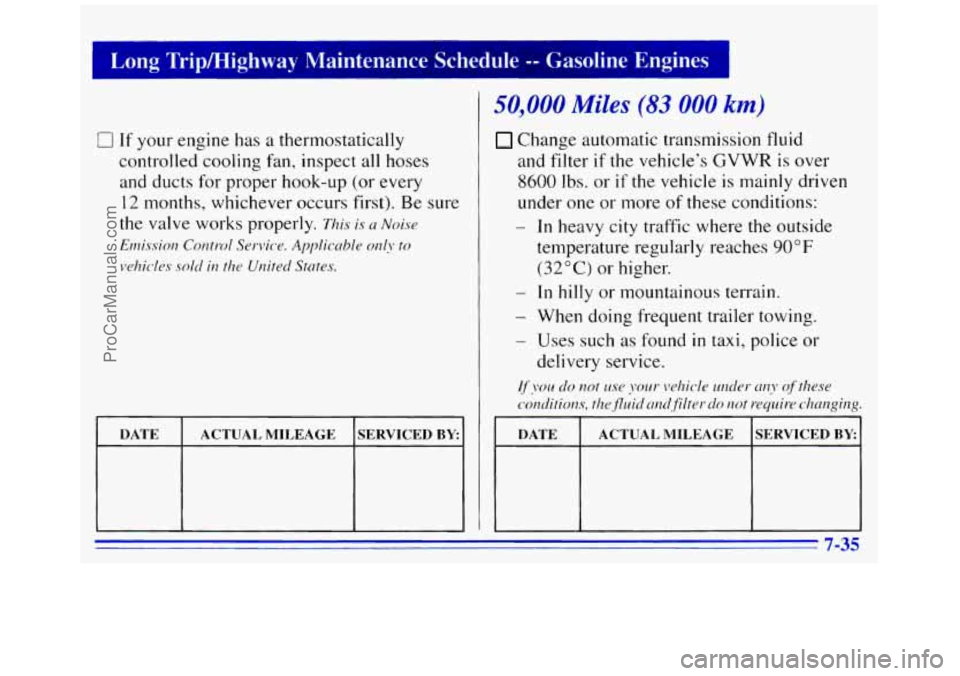
0 If your engine has a thermostatically
controlled cooling fan, inspect
all hoses
and ducts for proper hook-up (or every
12 months, whichever occurs first). Be sure
the valve works properly.
This is CI Noise
Emissim Control Service. Applicurhle OMI~ to
whicles sold ir? the United States.
DATE ACTUAL MILEAGE SERVICED BY
Change automatic transmission fluid
and filter
if the vehicle’s GVWR is over
8600 Ibs. or if the vehicle is mainly driven
under one or more
of these conditions:
- In heavy city traffic where the outside
temperature regularly reaches
90 OF
(32°C) or higher.
- In hilly or mountainous terrain.
- When doing frequent trailer towing.
- Uses such as found in taxi, police or
delivery service.
I DATE I ACTUAL MILEAGE ISERVICED BY I
7-35
ProCarManuals.com
Page 338 of 372
I Long Tripmighway Maintenance Schdule -- basolme 1
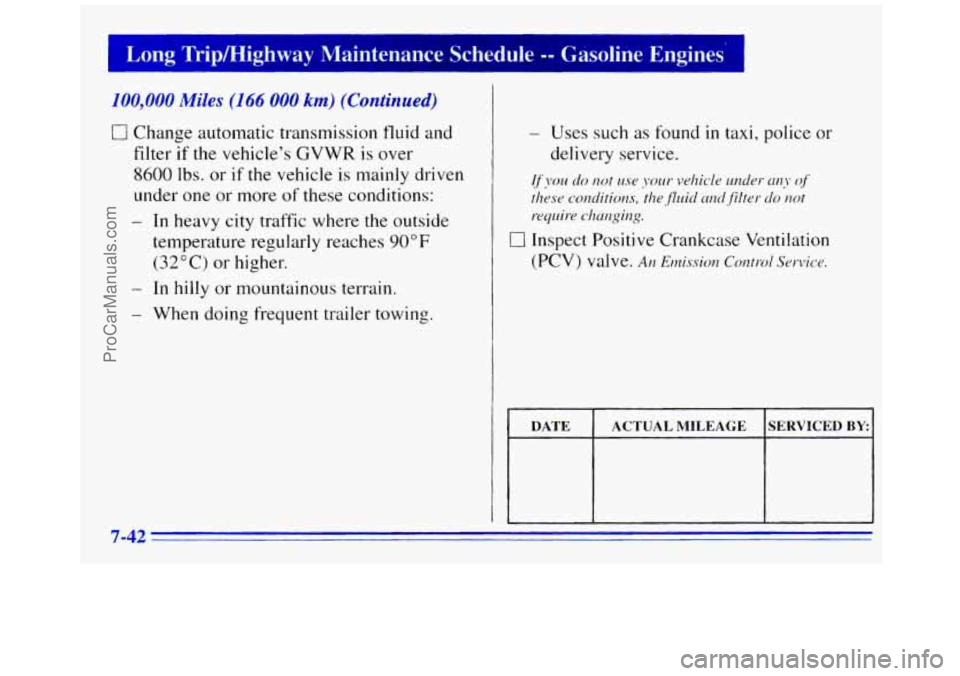
100,000 M FS (166 000 km) (Continued)
0 Change automatic transmission fluid and
filter if the vehicle's GVWR is over
8600 lbs. or if the vehicle is mainly driven
under one or more of these conditions:
- In heavy city traffic where the outside
temperature regularly reaches
90°F
(32°C) or higher.
- In hilly or mountainous terrain.
- When doing frequent trailer towing.
- Uses such as found in taxi, police or
delivery service.
[f'yc~ do not LIS~ your vehicle Llnder my oj'
these conditions, the Jluid and jilter do not
require clzmging.
17 Inspect Positive Crankcase Ventilation
(Pcv) valve.
AII Ernission Control Sewice.
I I I 3
DATE SERVICED BY ACTUAL MILEAGE
7-42
ProCarManuals.com
Page 340 of 372
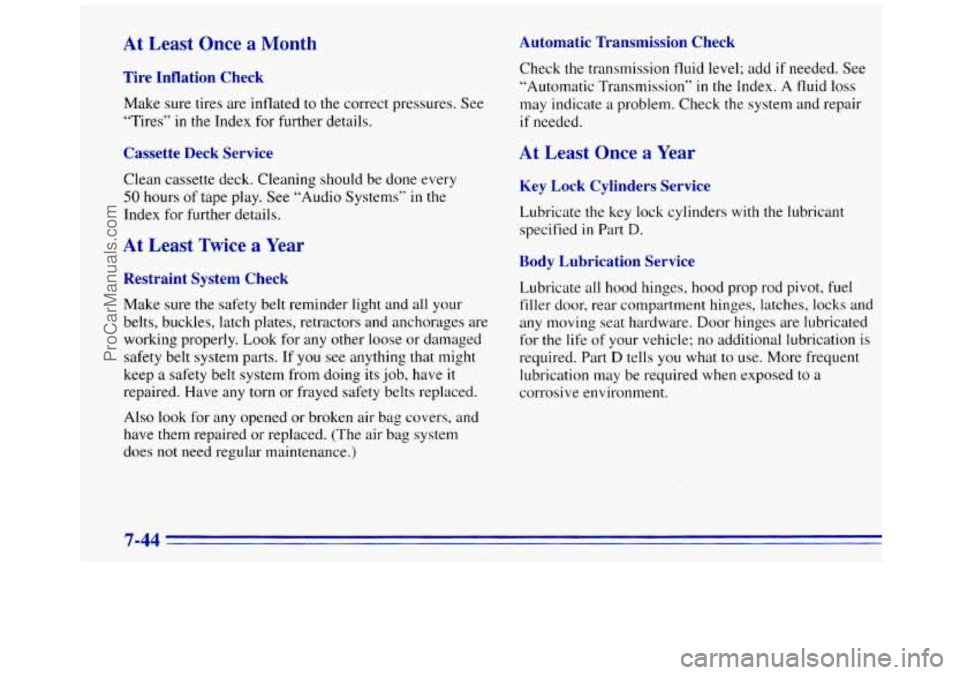
At Least Once a Month Automatic Transmission Check
Tire Inflation Check
Make sure tires are inflated to the correct pressures. See
“Tires”
in the Index for further details.
Cassettt -1eck Service
Clean cassette deck. Cleaning should be done every
50 hours of tape play. See “Audio Systems” in the
Index for further details.
At Least Twice a Year
Restraint System Check
Make sure the safety belt reminder light and all bur
belts, buckles, latch plates, retractorshnd anchoiages are
working properly.
Look for any other loose or damaged
safety belt system parts. If you see anything that might
keep
a safety belt system from doing its job, have it
repaired. Have any torn or frayed safety belts replaced.
Also look for any opened or broken air bag covers, and
have them repaired or replaced. (The air
bag system
does
not need regular maintenance.) Check
the transmission fluid level; add if needed. See
“Automatic Transmission“
in the Index. A fluid loss
may indicate a problem. Check the system and repair
if needed.
At Least Once a Year
Key Lock Cylinders Service
Lubricate the key lock cylinders with the lubricant
specified
in Part D.
Body Lubrication Service
Lubricate ail hood hinges, hood prop rod pivot, fuel
filler door, rear compartment hinges, latches,
locks and
any moving seat hardware. Door hinges are lubricated
for the
life of your vehicle; no additional lubrication is
required. Part D tells you what to use. More frequent
lubrication may be required when exposed to a
corrosive environment.
7-44
ProCarManuals.com
Page 345 of 372
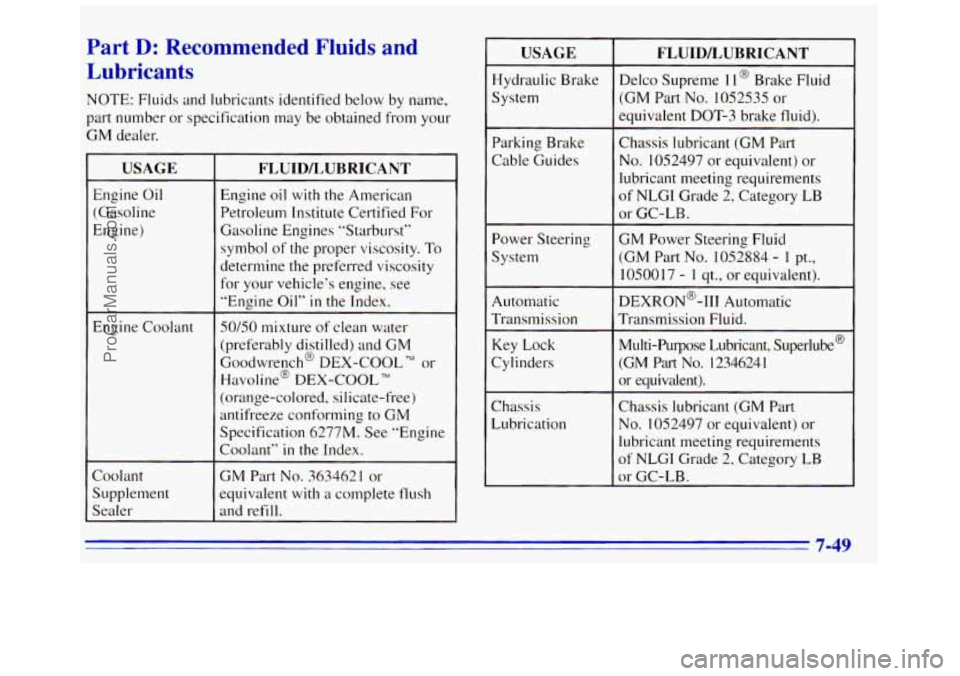
Part D: Recommended Fluids and
Lubricants
NOTE: Fluids and lubricants identified below by name,
part number or specification may be obtained from your
GM dealer.
USAGE
Engine Oil
(Gasoline
Engine)
Engine Coolant
Coolant
Supplement
Sealer
FLUID/LUBRICANT
~~ ~
~~
Engine oil with the American
Petroleum Institute Certified For
Gasoline Engines “Starburst“
symbol
of the proper viscosity. To
determine the preferred viscosity
for your vehicle’s engine, see
“Engine Oil”
in the Index.
50150 mixture of clean water
(preferably distilled) and GM
Goodwrench@ DEX-COOL
TM or
Havo line@
DEX-COOL TM
(orange-colored, silicate-free)
antifreeze conforming to GM
Specification 6277M. See “Engine
Coolant”
in the Index.
GM Part No. 3634621 or
equivalent with
a complete flush
and refill.
USAGE
Hydraulic Brake
System
Parking Brake
Cable Guides
~~
Power Steering
System
Automatic
Transmission
Key Lock
Cylinders
Chassis
Lubrication
FLUIDLUBRICANT
Delco Supreme 1 1 @ Brake Fluid
(GM Part No. 1052535 or
equivalent DOT-3 brake fluid).
Chassis lubricant (GM Part
No. 1052497 or equivalent) or
lubricant meeting requirements
of NLGI Grade 2, Category LB
or GC-LB.
GM Power Steering Fluid
(GM Part
No. 1052884 - 1 pt.,
1050017
- 1 qt., or equivalent).
DEXRON@-111 Automatic
Transmission
Fluid.
Multi-Purpose Lubricant, Superlube@
(GM
Pd-t No. 1234624 1
or equivalent).
Chassis lubricant
(GM Part
No. 1052497 or equivalent) or
lubricant meeting requirements
of NLGI Grade 2, Category
LB
or GC-LB.
7-49
ProCarManuals.com