parking brake GMC SAVANA 1996 Owners Manual
[x] Cancel search | Manufacturer: GMC, Model Year: 1996, Model line: SAVANA, Model: GMC SAVANA 1996Pages: 372, PDF Size: 18.81 MB
Page 75 of 372
Automatic Transmission Operation
There are several different positions for your shift lever.
If your vehicle is equipped with an automatic
transmission,
it now features an electronic shift position
indicator
within the instrument cluster. This display
must be powered anytime the shift lever
is capable of
being moved out of the PARK (P) position. This lneans
that
if your key is in the OFF position, but not locked,
there
will be a small current drain on your battery which
could discharge
your battery over a period of time. If
you have
a need to leave your key in the ignition in the
OFF position for an extended period for any reason, it is
recomnlended that you disconnect the battery cable from
the battery to prevent discharging yo~~r battery.
PARK (P): This locks your rear wheels. It‘s the best
position to use when you start your engine because your
vehicle can’t move easily.
A CAUTION:
It is dangerous to get out of your vehicle if the
shift lever is not fully in
PARK (P) with the
parking brake firmly set. Your vehicle can roll.
Don’t leave your vehicle when the engine is
running unless you have to.
If you have left the
engine running, the vehicle can move suddenly.
You or others could be injured. To be sure your
vehicle won’t move, even when you’re on fairly
level ground, always set your parking brake and
move the shift lever to
PARK (P).
See “Shifting Into PARK (P)” in the Index. If
you’re pulling a trailer, see “Towing a Trailer”
in the Index.
Your vehicle has
a brake-transmission shift interlock.
With the ignition in the RUN position, you must fully
apply your regular brakes before you can shift from
PARK
(P).
2-17
ProCarManuals.com
Page 78 of 372
Locking Rear Axle
If you have this feature, your rear axle can give you
additional traction
on snow, mud, ice, sand or gravel. It
works like a standard axle most of the time, but when
one
of the rear wheels has no traction and the other does,
the locking feature will allow the wheel with traction to
move the vehicle.
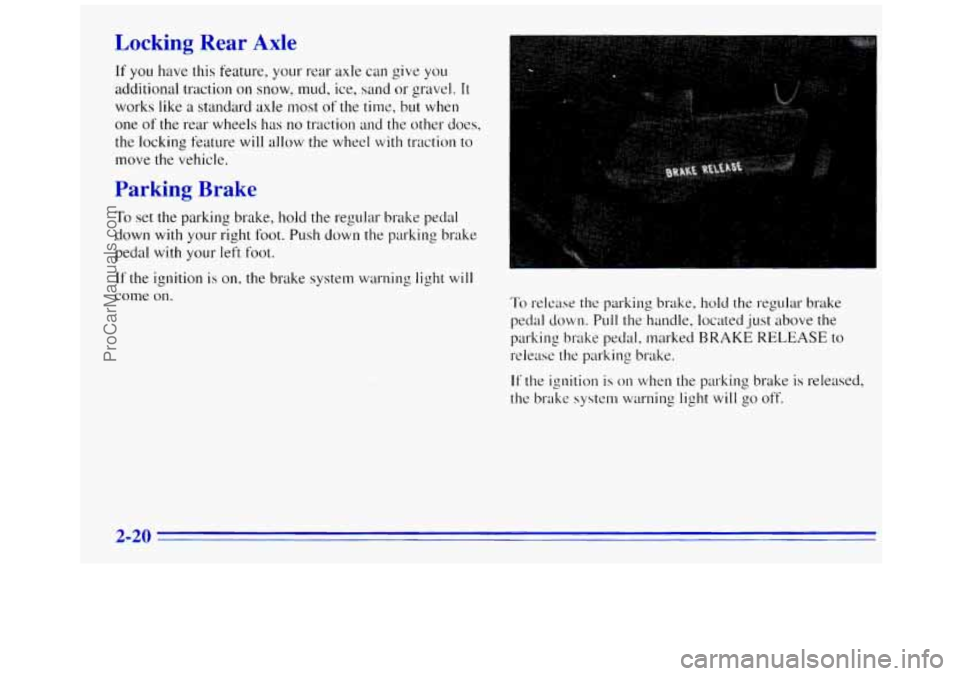
Parking Brake
To set the parking brake, hold the regular brake pedal
down with your right foot. Push down the parking brake
pedal with
your left foot.
If the ignition is on, the brake system warning light will
come on. To release the parking brake, hold the regular brake
pedal
down. Pull the handle, located just above the
parking brake pedal, marked
BRAKE RELEASE to
release the parking brake.
If the ignition is on when the parking brake is released,
the brake system warning
light will go off.
2-20
ProCarManuals.com
Page 79 of 372
NOTICE:
Driving with the parking brake on can cause
your rear brakes
to overheat. You may have to
replace them, and you could also damage other
parts of your vehicle. Always check to be sure
your parking brake
is fully released before
you drive.
If you are towing a trailer and are parking on any hill,
see biTowing a Trailer“ in the Index. That section shows
what to do first
to keep the trailer from moving.
Shifting Irto PPY (P)
It can be dangerous to get out of your vehicle if
the shift lever is not fully in
PARK (P) with the
parking brake firmly set. Your vehicle can roll.
If you have left the engine running, the vehicle
can move suddenly.
You or others could be
injured.
To be sure your vehicle won’t move,
even when you’re on fairly level ground, use the
steps that follow.
If you’re pulling a trailer, see
“Towing a Trailer” in the Index.
1. Hold the brake pedal down with your right foot and
set the parking brake.
2-21
ProCarManuals.com
Page 81 of 372
Leaving Your Vehicle With the
Enf;?e Rurr-;-y
It can be dangerous to leave your vehicle with
the engine running. Your vehicle could move
suddenly if the shift lever is not fully in PARK (P)
with the parking brake firmly set. And, if
you
leave the vehicle with the engine running, it could
overheat and even catch fire. You or others could
be injured. Don’t leave your vehicle with the
engine running unless you have to.
Torque Lock
If you are parking on a hill and you don’t shift your
transmission into PARK (P) properly,
the weight of the
vehicle may put too much force
on the parking pawl in
the transmission. You may find it difficult to pull the
shift lever out
of PARK (P). This is called “torque lock.”
To prevent torque lock, set the parking brake and then
shift into PARK (P) properly before
you leave the
driver’s seat. To find out how, see “Shifting Into
PARK
(P)” in the Index. When
you are ready
to drive, move the shift lever out of
PARK (P) before you release the parking brake.
If torque lock does occur, you may need
to have another
vehicle push yours a little uphill
to take some of the
pressure from the transmission,
so you can pull the shift
lever out of PARK
(P).
Shifting Out of PARK (P)
Your vehicle has a brake-transmission shift interlock
system.
You have to fully apply your regular brakes
before
you can shift from PARK (P). See “Automatic
Transmission” in the Index.
If
you cannot shift out of PARK (P), ease pressure on
the shift lever and push the shift lever all the way up
into PARK
(P) as you maintain brake application. Then,
move the shift lever into the gear you want.
If
you ever hold the brake pedal down but still can’t
shift out of PARK (P), try this:
1. Turn the key to OFF.
2. Apply and hold the brake until the end of Step 4.
3. Shift to NEUTRAL (N).
4. Start the vehicle and then shift to the drive gear you
5. Have the brake-transmission shift interlock system
want.
fixed
as soon
as you can.
2-23
ProCarManuals.com
Page 83 of 372
Running Your Engine While
You’re Parked
It’s better not to park with the engine running. But if you
ever have to, here are some things to know.
I
CAUTION:
Idling the engine with the air system control off
could allow dangerous exhaust into your vehicle
(see the earlier Caution under “Engine
Exhaust”).
Also, idling in a closed-in place can let deadly
carbon monoxide (CO) into your vehicle even if
the fan switch is at the highest setting. One place
tkiis can happen is a garage. Exhaust
-- with
CO
-- can come in easily. NEVER park in a
garage with the engine running.
Another closed-in place can be
a blizzard.
(See “Blizzard” in the Index.)
A CAUTION: .-
It can be dangerous to get out .of your vehicle if
the shift lever
is not fully in PARK (P) with the
parking brake
firmly set. Your vehicle can roll.
Don’t leave your vehicle when the engine is
running unless you have to.
If you’ve left the
engine running, the vehicle can move suddenly.
You or others could be injured.
To be sure your
vehicle won’t move, even when you’re on fairly
level ground, always set your parking brake and
move the shift lever to PARK
(P).
.
’Follow the proper steps td be sure your vehicle won’t
move. See “Shifting Into
PARK (P)” in the Index.
If you”re pulling a, trailer, see “Towing a Trailer” in
the Index.
2-25
ProCarManuals.com
Page 94 of 372
Rotate the switch knob clockwise again to the master
lighting symbol to turn on all the lamps listed
as well as
the headlamps.
Rotate the switch counterclockwise to
OFF to turn off
your lamps.
Rotate the thumb wheel next to the switch knob up
to
adjust instrument panel lights. Rotate the thumb wheel up
to the first notch
to return the radio display and gearshift
indicator display to
full intensity when the headlamps or
parlung lamps are on.
Rotate the thumb wheel up to the second notch to
activate the interior dome lamps.
You can switch your headlamps from high to low beam
by pulling
on the turn signal/high beam lever.
A circuit breaker protects your headlamps. If you have
an electrical overload, your headlamps will flicker on
and off. Have your headlamp wiring checked right away
if this happens.
Headlamps On Reminder
A buzzer will sound when your headlamps are turned on
and your ignition is
in OFF, LOCK or ACCESSORY,
If you need to use your headlamps when the ignition
switch is in
OFF, LOCK or ACCESSORY, the buzzer
can be turned off by turning the thumb wheel next
to the
parking lamp/headlamp switch all the way down.
Daytime Running Lamps (If Equipped)
Daytime Running Lamps (DRL) can make it easier for
others to see the front
of your vehicle during the day.
DRL can be helpful
in many different driving
conditions, but they can be especially helpful in the
short periods after dawn and before sunset.
The DRL system will make your headlamps
come on at
a reduced brightness when:
0 The ignition is on,
The headlamp switch is off and
0 The parking brake is released.
If your vehicle was first sold, when new,
in Canada,
your headlamps will come on at reduced brightness.
ProCarManuals.com
Page 95 of 372
If your vehicle was first sold, when new, in the United
States, your vehicle may be equipped with DRL.
If your
vehicle has
DRL, you will see the the DRL indicator
light
on your instrument panel and your low-beam
headlamps will come
on at reduced brightness.
When the DRL are
on, only your headlamps will be on.
The taillamps, sidemarker and other lamps won’t be on.
Your instrument panel won’t be lit up either.
When it begins to get dark, your DRL indicator light
is a reminder to turn your headlamp switch on. The
other lamps that come on with your headlamps will also
come
on.
When you turn off the headlamp switch, the regular
lamps will
go off, and your headlamps will change to
the reduced brightness of DRL.
To idle your vehicle with the engine on and the DRL off,
set the parking brake. The DRL will stay
off until you
release
the parking brake.
As with any vehicle, you should turn on the regular
headlamp system when
you need it.
)ome Lamps
The dome lamps will come on when you open the doors.
You can also turn the dome lamps on by rotating the
thumb wheel, located
next to the headlamp knob, all
the way up to the second notch. In this position, the
dome lamps will remain on whether the doors are
opened or closed.
You can use the dome
lamp button, located below the headlamp knob,
to set the dome lamps to
automatically come on
when the doors are open,
or to remain off.
To turn the lamps off, push the button once. With the
button
in this position, the dome lamps will remain off
when the doors are open. To return the lamps to
automatic operation, push the button again and return it
to the out position. With the button
in this position, the
dome lamps will come on when you open
the doors.
The delayed entry will allow
you to enter or exit your
vehicle with the lamps staying on for about
20 seconds,
after the door is closed or ignition
is cycled.
2-37
ProCarManuals.com
Page 106 of 372
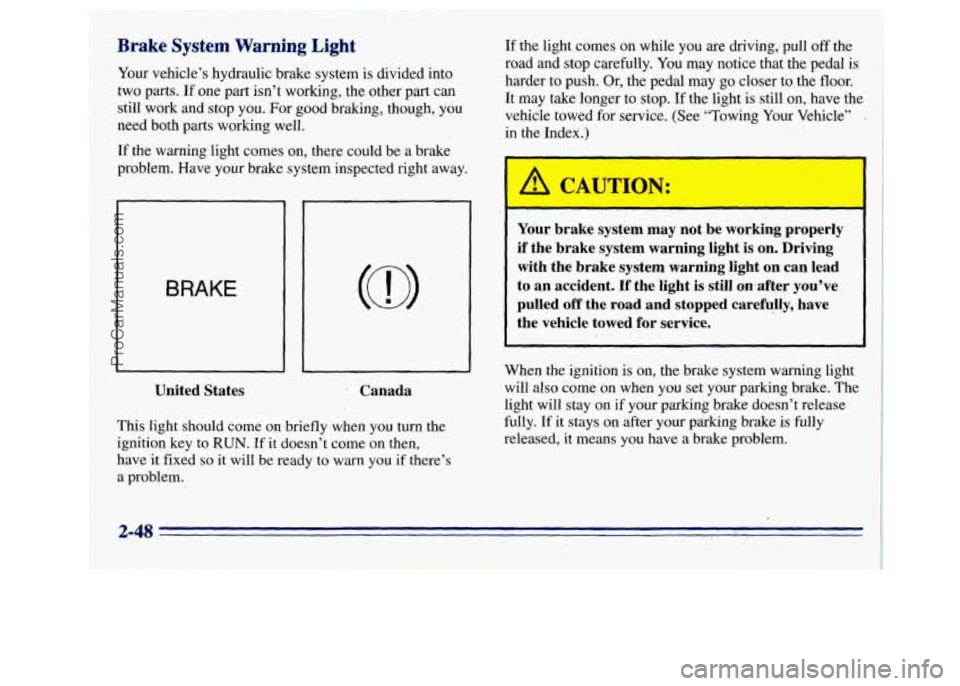
Brake System Warning Light
Your vehicle’s hydraulic brake system is divided into
two parts. If one part isn’t working, the other part can
still work and stop you. For good braking, though, you
need both parts working well.
If the warning light comes on, there could be a brake
problem. Have your brake system inspected right away.
BRAKE
United States Canada
This light should come on briefly when you turn the
ignition key
to RUN. If it doesn’t come on then,
have
it fixed so it will be ready to warn you if there’s
a problem.
If the light comes on while you are driving,, pull off the
road and stop carefully. You may notice that the pedal
is
harder to push. Or, the pedal may go closer to the floor.
It may
take longer to stop. If the light.is still on, have the
vehicle towed for service. (See “Towing Your Vehicle”
in the Index.)
Your brake system may not be working properly
if the brake system warning light is on. Driving
with the brake system warning light
on can lead
to an accident. If the light
is still 0.n-after you’ve
pulled
off the road and stopped carefully, have
the vehicle towed for service.
When the ignition is on, the brake system warning light
will also come on when you set your parking brake. The
light will stay on if your parking brake doesn’t release
fully.
If it stays on after your parking brake is fully
released, it means you have
a brake problem.
ProCarManuals.com
Page 184 of 372
Driving On Grades
Reduce speed and shift to a:lower gear before you start
down a long or steep doyngrade. If you don’t shift
down, you might have to use your brakes
so much that
they would get hot and no longer work well.
On a long uphill grade, shift down and reduce your
speed to around
45 mph (70 km/h) to reduce the
possibility
of engine and transmission overheating.
When towing at high altitude on steep uphill grades,
consider the following: Engine coolant will boil at a
lower temperature than
at normal altitudes. If you turn
your engine
off immediately after towing at high altitude
on steep uphill grades,
your vehicle may show signs
similar to engine overheating.
To avoid this, let the
engine run while parked (preferably on level ground)
with the automatic transmission in PARK
(P) for a few
minutes before turning the engine off.. If
you do get the
overheat warning, see “Engine Overheating” in the Index.
Parking on.Hills
You really should not park your vehicle, with a trailer
attached, .on a hill.
If something goes wrong, your rig
could start
to move. People can be injured, and both
your vehicle and the trailer can be damaged.
But if you ever have to park your rig on a hill, here’s
how to do it:
1. Apply your regular brakes, but don’t shift into
PARK
(P) yet. Then turn your wheels into the curb
if facing downhill or into traffic if facing ,uphill.
2. Have someone place chocks under the trailer wheels. I
3. When the wheel chocks are in place, release the
regular brakes until the chocks absorb the load.
4. Re-apply the regular brakes. Then apply your
parking brake and then shift to
PARK (P).
5. Release the regular brakes.
ProCarManuals.com
Page 185 of 372
When You Are Ready to Leave After
Parking
on a Hill
1. Apply your regular brakes and hold the pedal down
while you:
Start your engine:
Shift into a gear: and
Release the parking brake.
2. Let up on the brake pedal.
3. Drive slowly until the trailer is clear of the chocks.
4. Stop and have someone pick up and store the chocks.
Maintenance When Trailer Towing
Your vehicle will need service more often when you’re
pulling a trailer. See the Maintenance Schedule for more
on this. Things that are especially important
in trailer
operation are automatic transmission
fluid (don’t
overfill), engine oil, axle lubricant, belt, cooling system
and brake adjustment. Each
of these is covered in this
manual, and the Index will help
you find them quickly.
If you‘re trailering, it‘s a good idea to review these
sections before you start your trip.
Check periodically to see that
all hitch nuts and bolts
are tight.
Trailer Wiring Harness
The eight-wire harness, if you have one, is stored under
your vehicle along the rear frame crossmember.
It is
wrapped and bound with a plastic strap. The harness has
a 30-anlp battery feed and no connector, and you should
have a qualified electrical service person wire your
harness for you. Attach the harness
to the trailer, then
tape or strap
it to your vehicle’s frame rail. Be sure you
leave
it loose enough so the wiring doesn’t bend or
break, but not
so loose that it drags on the ground.
Store the harness
in its original place. Wrap the harness
together and tie
it neatly so it won’t be damaged.
The five-wire harness,
if you have one, is stored inside
the vehicle at the passenger side rear corner, behind the
jack. This should be wired by a qualified electrical
service person. It must be routed out
of your vehicle
between the rear door and the floor,
with enough of the
harness left on both sides
so that the trailer or the body
won’t pull
it.
Store the harness in its original place. Wrap the harness
together and tie
it neatly so it won’t be damaged.
4-37
ProCarManuals.com