spare tire GMC SAVANA 1996 Owners Manual
[x] Cancel search | Manufacturer: GMC, Model Year: 1996, Model line: SAVANA, Model: GMC SAVANA 1996Pages: 372, PDF Size: 18.81 MB
Page 209 of 372
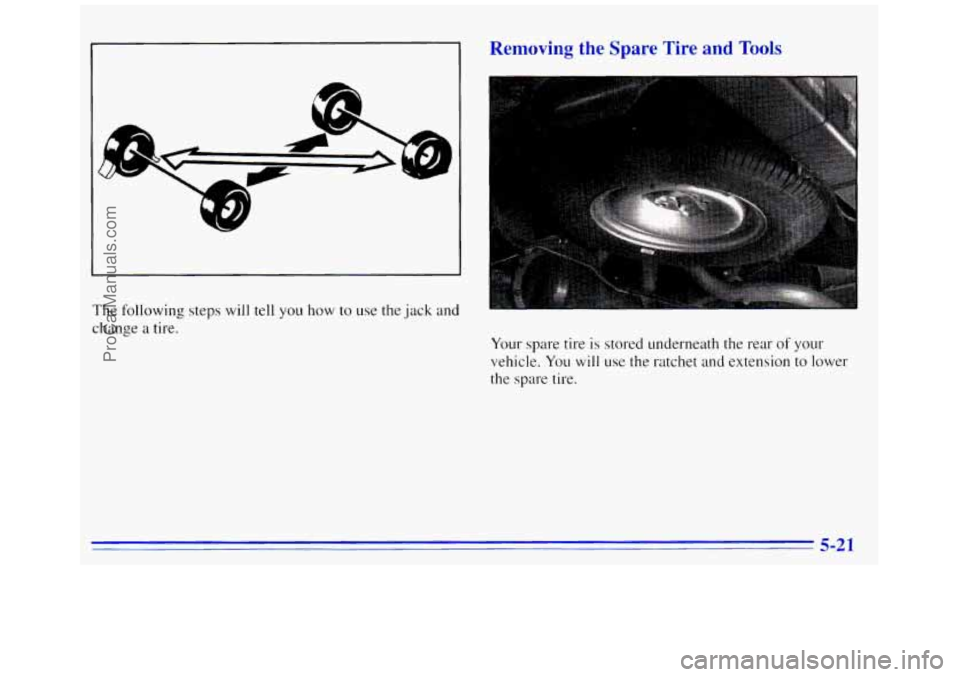
Removing the Spare Tire and Tools
The following steps will tell you how to use the jack and
change a
tire.
Your spare tire is stored underneath the rear of your
vehicle. You
will use the ratchet and extension to lower
the spare tire.
5-21
ProCarManuals.com
Page 210 of 372
NOTICE:
Never remove or restore a tire frodto a stowage
position under the vehicle while the vehicle
is
supported by a jack. Always tighten the tire
fully against the underside of the vehicle
when restowing
If you have a vehicle which was completed from a cab
.
L
A flat rear tire reduces clearance to remove the spare
tire. If there is less than 12 inches
(30.48 cm) between
the ground and
the rear bumper or any trailer hitch, jack
up the vehicle until the flat tire is off the ground.
(See “Removing the Flat Tire” and “Installing the
Spare Tire,” Steps
4 through 8, in this section.)
Unless your vehicle has a flat rear tire,
do not remove or
restore a tire from/to
a stowage position under the
vehicle while the vehicle is supported by a jack. Always
tighten the tire
fully against the underside of the vehicle
when restowing. and
chassis, refer
to the information from the body
supplier/installer.
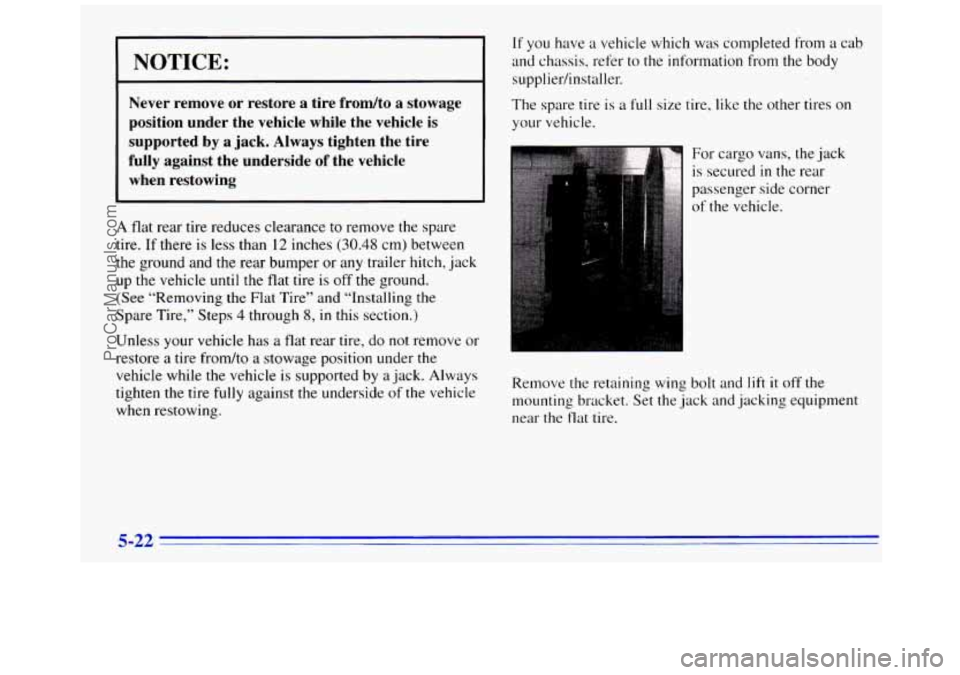
The spare tire is
a full size tire, like the other tires on
your vehicle.
For cargo vans, the jack
is secured
in the rear
passenger side corner
of the vehicle.
Remove the retaining wing bolt and
lift it off the
mounting bracket. Set the jack and jacking equipment
near the
flat tire.
5-22
ProCarManuals.com
Page 212 of 372
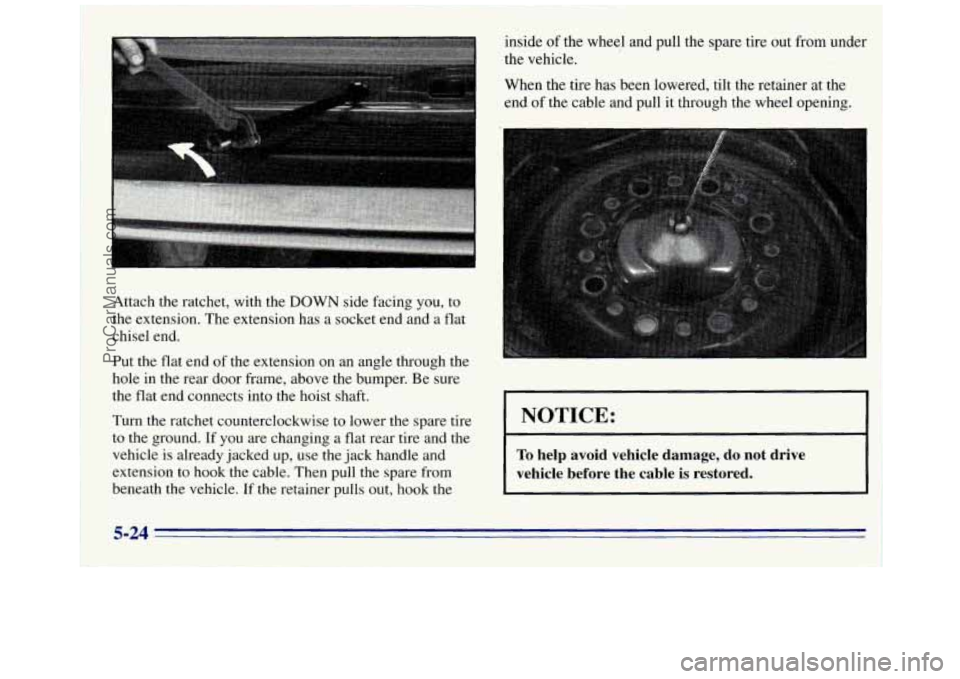
Attach the ratchet, with the DOWN side facing you, to
the extension. The extension has a socket end and a flat
chisel end.
Put the flat end of the extension on an angle through the
hole in the rear door frame, above the bumper. Be sure
the flat end connects into the hoist shaft.
Turn the ratchet counterclockwise to lower the spare tire
to the ground.
If you are changing a flat rear tire and the
vehicle is already jacked up, use the jack handle and
extension to hook the cable. Then pull the spare from
beneath the vehicle.
If the retainer pulls out, hook the inside
of the wheel and pull the
spare tire out from under
the vehicle.
When the tire has been lowered, tilt the retainer at the end
of the cable and pull it through the wheel opening.
NOTICE:
To help avoid vehicle damage, do not drive
vehicle before the cable is restored.
5-24 i
t
ProCarManuals.com
Page 217 of 372
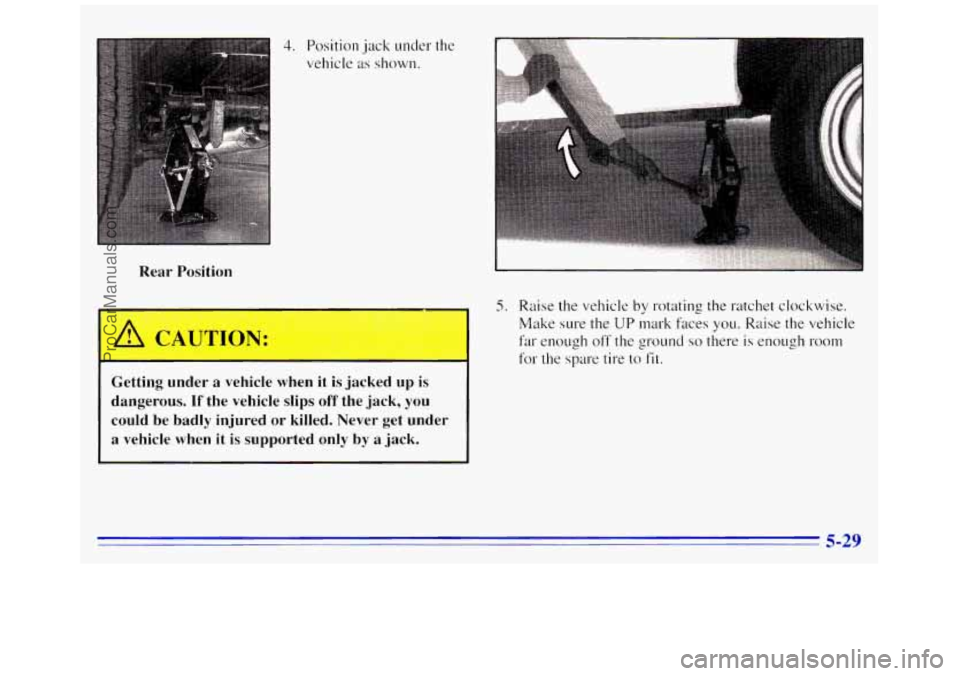
4. Position jack under the
vehicle
as shown.
Rear Positio~
Getting under a vehicle when it is jacked
up is
dangerous.
If the vehicle slips off the jack, you
could be badly injured or killed. Never get under
a vehicle when it is supported only by a jack.
5. Raise the vehicle by rotating the ratchet clockwise.
Make sure the
UP mark faces you. Raise the vehicle
far enough
off the ground so there is enough room
for the spare tire to
fit.
5-29
ProCarManuals.com
Page 218 of 372
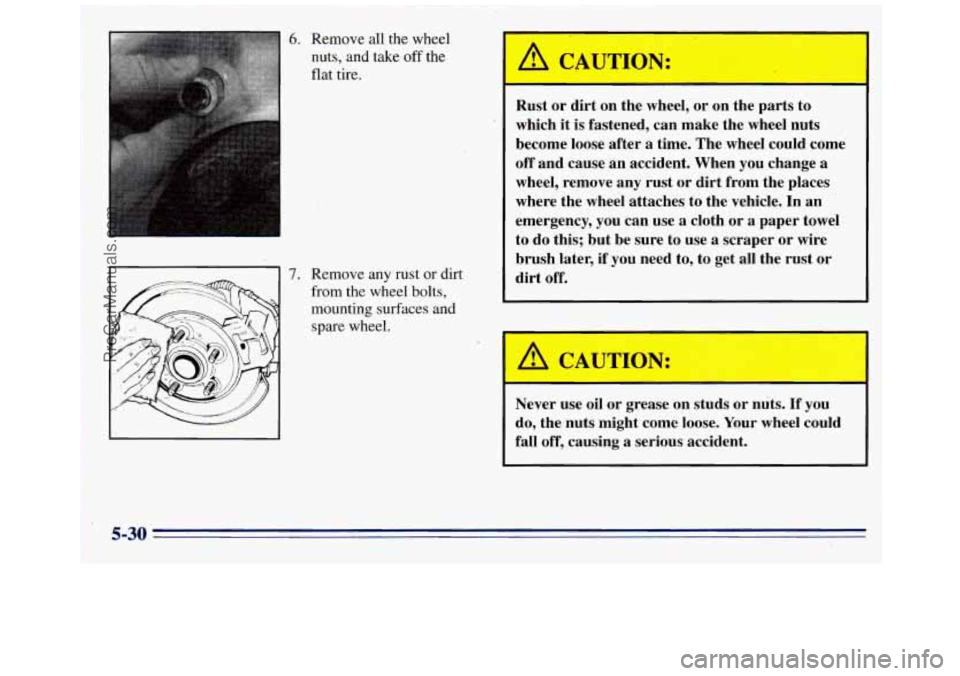
6. Remove all the wheel
nuts, and take
off the
flat tire.
7. Remove any rust or dirt
from the wheel bolts,
mounting surfaces and
spare wheel.
I
A C it 'ION:
-
Rust or dirt on the wheel, or on the parts to
which it is fastened, can make the wheel nuts
become loose after a time. The wheel could come'
off and cause an accident. When you change
a
wheel, remove any rust or dirt from the places
where the wheel attaches to the vehicle. In an
emergency, you can use
a cloth or a paper towel
to do this; but be,sure to use
a scraper or wire
brush later, if you need to, to get all the rust or
dirt off.
~~
A CAUTION:
7
Never use oil or g;,ase on studs or nuts. If you
do, the nuts might come
loose. Your wheel could
fall
off, causing a serious accident.
5-30
ProCarManuals.com
Page 221 of 372
Storing a Flat or Spare Tire and Tools
Storing a jack, a tire or other equipment in the
passenger compartment
of the vehicle could
cause injury. In a sudden stop
or collision, loose
equipment could strike someone. Store all these
in the proper place.
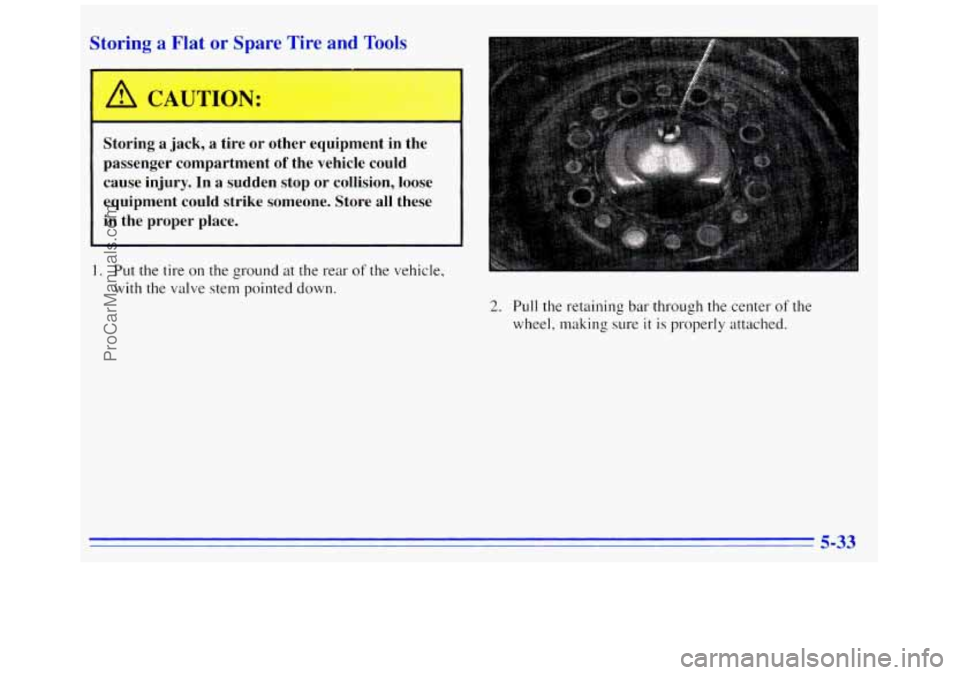
I. Put the tire on the ground at the rear of the vehicle,
with the valve stem pointed down.
2. Pull the retaining bar through the center of the
wheel, making sure
it is properly attached.
5-33
ProCarManuals.com
Page 266 of 372
Inflation -- Tire Pressure
The Certification/Til-e-~ label, which is on the rear edge of
the driver’s door, shows the correct inflation pressures
for your tires when they’re cold. “Cold” means your
vehicle
has been sitting for at least three hours or driven
no 1mre than
1 mile (1.6 ktn).
NOTICE:
Don’t let anyone tell you that underinflation or
overinflation
is all right. It’s not. If your tires
don’t have enough air (underinflation), you can
get the following:
0 Too much flexing
Too much heat
0 Tire overloading
Bad wear
0 Bad handling
Bad fuel economy.
NOTICE: (Continued)
I NOTICE: (Continued) I
If your tires have too much air (overinflation),
you can get the following:
0 Unusual wear
0 Bad handling
0 Rough ride
0 Needless damage from road hazards.
When
to Check
Check your tires once a month or more.
Also, check the
tire pressure
of the spare tire.
Haw to Check
Use a
good quality pocket-type gage to check tire
pressure.
You can’t tell if yom tires are properly inflated
simply
by looking at them. Radial tires may look
properly inflated even
when they’re underinflated.
Be sure to put the valve caps back on the valve stems.
They help prevent leaks by keeping out dirt and moisture.
6-42
ProCarManuals.com
Page 269 of 372
Dual Tire Operation
When the vehicle is new, or whenever a wheel, wheel
bolt or wheel
nut is replaced, check the wheel nut torque
after
100, 1,000 and 6,000 miles ( 160, 1 600 and
10 000 km) of driving. For proper torque, see “Wheel
Nut Torque”
in the Index.
The outer tire
on a dual wheel setup generally wears
faster than
the inner tire. Your tires will wear more
evenly and last longer if
you rotate the tires periodically.
If you’re going to be doing a lot of driving on
high-crown roads, you can reduce tire wear by adding
5 psi (35 kPa) to the tire pressure in the outer tires. Be
sure to return
to the recommended pressures when no
longer driving under those conditions. See “Changing a
Flat Tire” in the Index for more information.
A CAUTION:
If you operate your vehicle with a tire that is
badly underinflated, the tire can overheat. An
overheated tire can lose air suddenly
or catch
fire. You or others could be injured. Be sure all
tires (including the spare) are properly inflated.
Buying New Tires
To find out what kind and size of tires you need, look at
the Certification/Tire label.
The tires installed on your vehicle when
it was new had
a Tire Performance Criteria Specification (TPC Spec)
number
on each tire’s sidewall. When you get new tires,
get ones
with that same TPC Spec number. That way
your vehicle will continue to have tires that are designed
to give proper endurance, handling, speed rating,
traction, ride and other things during normal service
on
your vehicle. If your tires have an all-season tread
design, the TPC number will be followed by an
“MS”
(for mud and snow).
If you ever replace your tires with those not having a
TPC Spec number, make sure they are the same size,
load range, speed rating and construction type (bias,
bias-belted or radial) as your original tires.
ProCarManuals.com
Page 270 of 372
A CAUTION:
Mixing tires could cause you to lose control while
driving.
If you mix tires of different sizes or types
(radial and bias-belted tires), the vehicle may not
handle properly, and
you could have a crash.
Using tires of different sizes may also cause
damage to your vehicle. Be sure to use the same
size and type tires
on all wheels.
Uniform Tire Quality Grading
The following information relates to the system
developed by the United States National Highway
Traffic Safety Administration, which grades tires
by
treadwear, traction and temperature performance. (This
applies only to vehicles sold
in the United States.) The
grades are molded
on the sidewalls of most passenger
car tires. The Uniform Tire Quality Grading system does
not apply
to deep tread, winter-type snow tires,
space-saver or temporary use spare tires, tires with
nominal
rim diameters of 10 to 12 inches (25 to 30 cm),
or to some limited-production tires.
While the tires available on General Motors passenger
cars and light trucks may vary with respect
to these
grades, they must
also conform to Federal safety
requirements and additional General Motors Tire
Performance Criteria
(TYC) standards.
6-46
ProCarManuals.com
Page 354 of 372
Roadside Assistance
n
Flat Tire Cl~~lngu: Installation of spare tire will be
covered at no charge (customer is responsible for repair
or replacement of tire).
Fuel Dcli\!ery: Delivery of enough fuel for the customer
to get to the nearest service station (up to
$4.00) will
be covered.
JLIIIZ~ Smt: No-start situations which require a battery
jump start
will be covered at no charge.
Lock Out: Replacement keys or locksmith service will
be covered at no charge if you are unable to gain entry
into your vehicle. Delivery of the replacement key
will
be covered at no charge within 10 miles (16 km).
Emergc~17cy 7bkr;ing Ser-vic~: Towing to the nearest
GMC Truck dealer for warranty related disablements
will be covered.
GMC Truck’s Roadside Assistance provides stranded
owners with over-the-phone roadside repairs, location
of the nearest GMC Truck dealer or the following
special services:
8-4
ProCarManuals.com