tires GMC SAVANA 1997 User Guide
[x] Cancel search | Manufacturer: GMC, Model Year: 1997, Model line: SAVANA, Model: GMC SAVANA 1997Pages: 388, PDF Size: 20.17 MB
Page 178 of 388
Winter Driving
Here are some tips for winter driving:
Have your vehicle in good shape for winter.
You may want to put winter emergency supplies in
your vehicle.
Include an ice scraper, a small brush or broom, a supply
of windshield washer fluid, a rag, some winter outer
clothing, a small shovel, a flashlight, a red cloth and
reflective warning triangles. And, if you will be driving
under severe conditions, include a small bag
of sand, a
piece of old carpet or a couple of burlap bags to help
provide traction. Be sure
you properly secure these
:ms in your vehicle.
Driving on Snow or Ice
Most of the time, those places where your tires meet the
road probably have good traction.
However, if there is snow or ice between your tires and
the road, you can have a very slippery situation. You’ll
have a lot less traction or “grip” and will need
to be
very careful. What’s the worst time for
this? “Wet ice.” Very cold
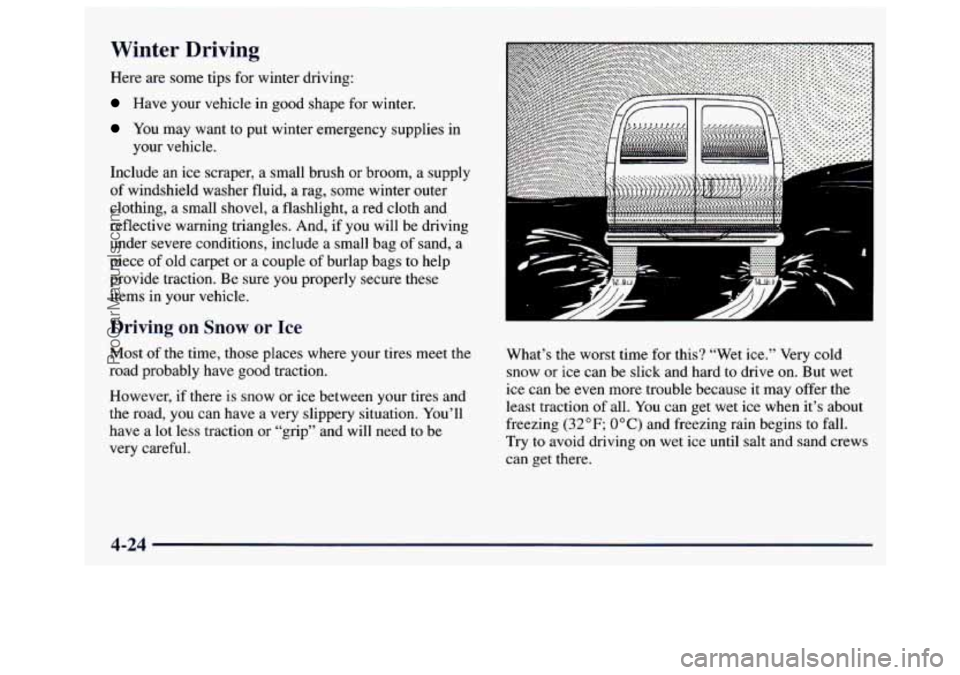
snow or ice can be slick and hard to drive
on. But wet
ice can be even more trouble because it may offer the
least traction
of all. You can get wet ice when it’s about
freezing
(32°F; O’C) and freezing rain begins to fall.
Try
to avoid driving on wet ice until salt and sand crews
can get there.
4-24
ProCarManuals.com
Page 179 of 388
Whatever the condition -- smooth ice, packed, blowing
or loose snow
-- drive with caution.
Accelerate gently. Try not to break the fragile traction.
If you accelerate too fast, the drive wheels will spin and
polish the surface under the tires even more.
Your anti-lock brakes improve your vehicle’s stability
when you make a hard stop on a slippery road. Even
though you have an anti-lock braking system, you’ll
want to begin stopping sooner than you would on dry
pavement. See “Anti-Lock‘’
in the Index.
Allow greater following distance on any slippery road.
Watch for slippery spots. The road might be fine
until you hit a spot that’s covered with ice.
On an
otherwise clear road, ice patches may appear in
shaded areas where the sun
can’t reach: around
clumps of trees, behind buildings or under bridges.
Sometimes the surface
of a curve or an overpass may
remain icy when the surrounding roads are clear.
If
you see a patch of ice ahead of you, brake before you
are on
it. Try not to brake while you’re actually on
the ice, and avoid sudden steering maneuvers.
If You’re Caught in a Blizzard
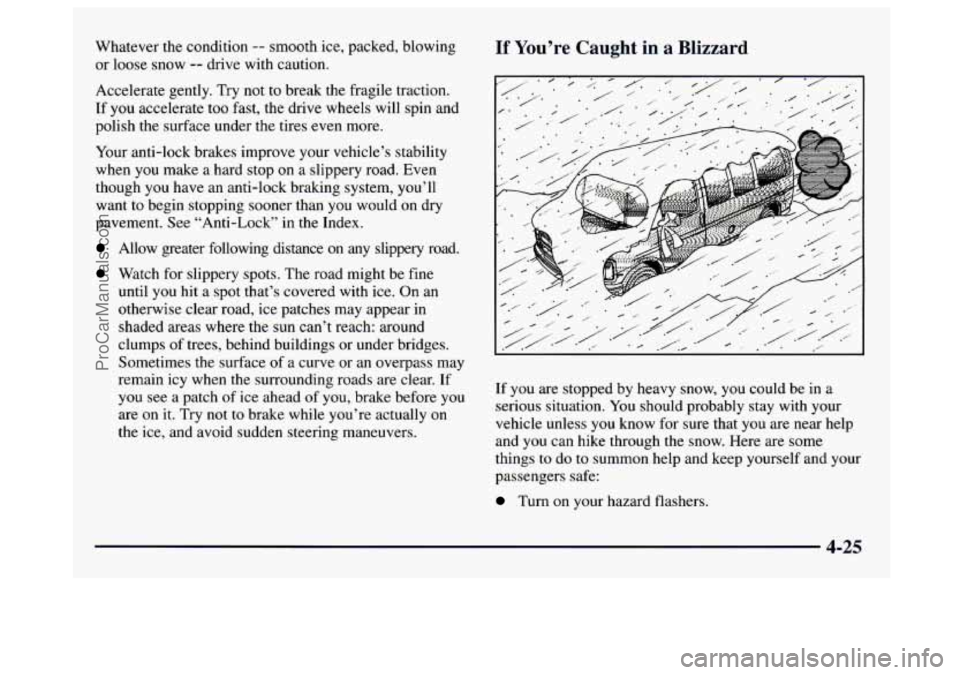
If you are stopped by heavy snow, you could be in a
serious situation. You should probably stay with your
vehicle unless you know for sure that
you are near help
and you can hike through the snow. Here are some
things to
do to summon help and keep yourself and your
passengers safe:
Turn on your hazard flashers.
4-25
ProCarManuals.com
Page 181 of 388
Run your engine only as long as you must. This
saves fuel. When you
run the engine, make it go a
little faster than just idle. That is, push the accelerator
slightly. This uses less fuel for the heat that you get
and it keeps the battery (or batteries) charged.
You will
need a well-charged battery (or batteries) to restart the
vehicle, and possibly for signaling later on with your
headlamps. Let the heater run for awhile. If you have a
diesel engine you may have to
run it at a higher speed
to get enough heat.
Then, shut the engine off and close the window almost
all the way to preserve the heat. Start the engine again
and repeat this only when you feel really uncomfortable
from the cold. But do it as little as possible. Preserve
the
fuel as long as you can. To help keep warm, you can get
out of the vehicle and do some fairly vigorous exercises
every half hour or
so until help comes.
Loading Your Vehicle
COLD TIRE PRESSURE
L
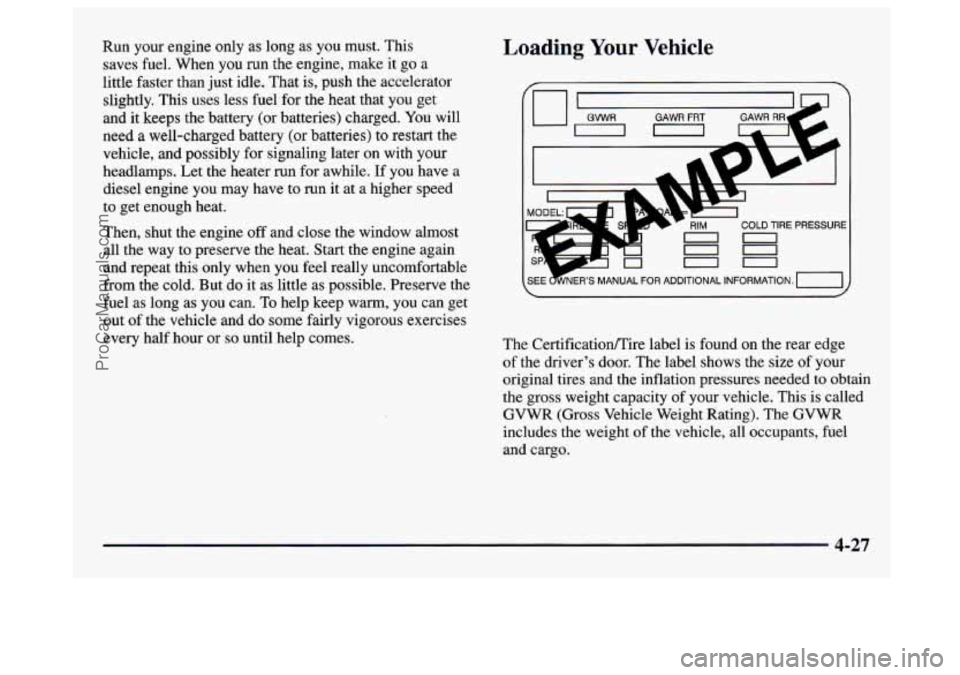
The Certificatioflire label is found on the rear edge
of the driver’s door. The label shows the size of your
original tires and the inflation pressures needed to obtain
the gross weight capacity of your vehicle. This is called
GVWR (Gross Vehicle Weight Rating). The GVWR
includes the weight
of the vehicle, all occupants, fuel
and cargo.
4-27
ProCarManuals.com
Page 184 of 388
If You Do Decide To Pull A Trailer
If you do, here are some important points:
0
0
0
There are many different laws, including speed limit
restrictions, having to do with trailering. Make sure
your
rig will be legal, not only where you live but
also where you’ll be driving.
A good source for this
information can be state or provincial police.
Consider using a sway control if your trailer will
weigh
4,000 lbs. (1 800 kg) or less. You should
always use a sway control if your trailer will weigh
more than
4,000 lbs. (1 800 kg). You can ask a hitch
dealer about sway controls.
Don’t tow a trailer at all during the first
500 miles
(800 km) your new vehicle is driven. Your engine,
axle or other parts could be damaged.
0
a
Then, during the first 500 miles (800 km) that you
tow a trailer, don’t drive over 50 mph (80 ktn/h) and
don’t make starts at full throttle. This helps your
engine and other parts
of your vehicle wear in at the
heavier loads.
You should use
DRIVE (D) (or, as you need to,
a lower gear) when towing a trailer. Operating your
vehicle in DRIVE
(D) when towing a trailer will
minimize heat buildup and extend the life of
your transmission.
Three important considerations have to do with weight:
0 the weight of the trailer,
0 the weight of the trailer tongue
and the weight on your vehicle’s tires.
4-30
ProCarManuals.com
Page 187 of 388
Total Weight on Your Vehicle’s Tires
Be sure your vehicle’s tires are inflated to the upper
limit for cold tires. You’ll find these numbers
on the
Certification label at the rear edge of the driver’s door or
see “Tire Loading” in the Index. Then be sure you don’t
go over the
GVW limit for your vehicle, including the
weight of the trailer tongue.
Hitches
It’s important to have the correct hitch equipment.
Crosswinds, large trucks going by and rough roads
are a
few reasons why you’ll need the right hitch. Here are
some rules to follow:
The bumpers on your vehicle are not intended for
hitches.
Do not attach rental hitches or other
bumper-type hitches to them. Use only
a
frame-mounted hitch that does not attach to the
bumper.
Do not use a ball hitch, because it could pull
the bumper loose.
If you’ll be pulling a trailer that, when loaded, will
weigh more than
4,000 lbs. (1 800 kg), be sure to use
a properly mounted, weight-distributing hitch and
sway control of the proper size. This equipment
is
very important for proper vehicle loading and good
handling when you’re driving.
vehicle when you install a trailer hitch?
Will you have to make any holes in the body of your
If you’re using
the wiring provided by the
factory-installed hitch, you should not need to make
any holes in the body of your vehicle. However, if
you have an aftermarket hitch installed, you may
need to make holes
in the body.
If you do, then be sure to seal the holes later when
you remove the hitch. If you don’t seal them, deadly
carbon monoxide (CO) from your exhaust can get
into your vehicle (see “Carbon Monoxide” in the
Index). Dirt
and water can, too.
4-33
ProCarManuals.com
Page 189 of 388
Towing a trailer requires a certain amount of experience.
Before setting out for the open road, you’ll want to get
to know your rig. Acquaint yourself with the feel
of
handling and braking with the added weight of the
trailer. And always keep in mind that the vehicle you are
driving is now a good deal longer and not nearly as
responsive as your vehicle is by itself.
Before you start, check the trailer hitch and platform
(and attachments), safety chains, electrical connector,
lamps, tires and mirror adjustment.
If the trailer has
electric brakes, start your vehicle and trailer moving and
then apply the trailer brake controller by hand to be sure
the brakes
are working. This lets you check your
electrical connection at the same time.
During your trip, check occasionally to be sure that the
load is secure, and that the lamps and any trailer brakes
are still working.
Following Distance
Stay at least twice as far behind the vehicle ahead as you
would when driving your vehicle without a trailer. This
can help you avoid situations that require heavy braking
and sudden turns.
Passing
You’ll need more passing distance up ahead when
you’re towing a trailer. And, because you’re a good deal
longer, you’ll need to
go much farther beyond the
passed vehicle before you can return to your lane.
Backing Up
Hold the bottom of the steering wheel with one hand.
Then, to move the trailer to the left, just move that hand
to the left. To move the trailer to the right, move your
hand to the right. Always back up slowly and,
if
possible, have someone guide you.
4-35
ProCarManuals.com
Page 202 of 388
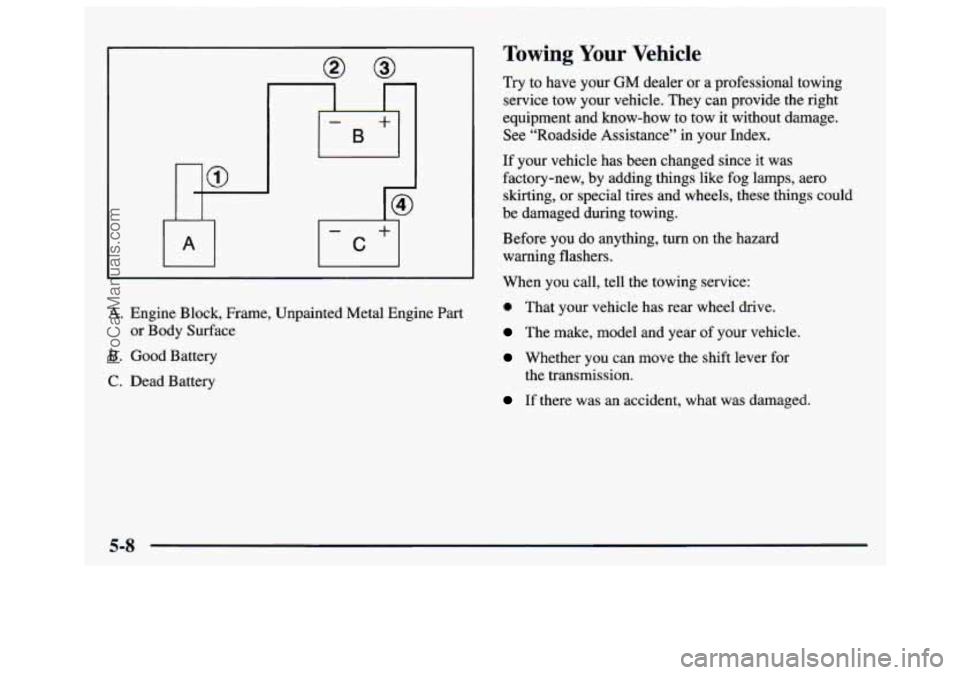
A. Engine Block, Frame, Unpainted Metal Engine Part
or Body Surface
B. Good Battery
C. Dead Battery
Towing Your Vehicle
Try to have your GM dealer or a professional towing
service tow your vehicle. They can provide the right
equipment and know-how to tow it without damage.
See “Roadside Assistance’’ in your Index.
If your vehicle has been changed since it was
factory-new, by adding things like fog lamps, aero
skirting, or special tires and wheels, these things could
be damaged during towing.
Before you do anything, turn on the hazard
warning flashers.
When you call, tell the towing service:
0 That your vehicle has rear wheel drive.
The make, model and year of your vehicle.
Whether you can move the shift lever for
the transmission.
If there was an accident, what was damaged.
5-8
ProCarManuals.com
Page 216 of 388
Engine Fan Noise
Your vehicle has a clutched engine cooling fan. When the
clutch is engaged, the fan spins faster to provide more air
to cool the engine. In most everyday driving conditions,
the fan
is spinning slower and the clutch is not fully
engaged. This improves fuel economy and reduces fan
noise. Under heavy vehicle loading, trailer towing and/or
high outside temperatures, the fan speed increases as the
clutch more fully engages.
So you may hear an increase
in fan noise.
This is normal and should not be mistaken
as the transmission slipping or making extra shifts. It is
merely the cooling system functioning properly. The
fan
will slow down when additional cooling is not required
and the clutch partially disengages.
You may
also hear this fan noise when you start the engine.
It will go away as the fan clutch partially disengages.
If a Tire Goes Flat
It’s unusual for a tire to “blow out” while you’re driving,
especially if you maintain your tires properly.
If air goes
out of a tire, it’s much more likely
to leak out slowly.
But
if you should ever have a “blowout,” here are a
few tips about what to expect and what to do:
If a front tire fails, the flat tire will create a drag that
pulls the vehicle toward that side. Take your foot off the
accelerator pedal and grip the steering wheel firmly.
Steer to maintain lane position, and then gently brake to
a stop
well out of the traffic lane.
A rear blowout, particularly on a curve, acts much like
a skid and may require the same correction you’d use
in a skid. In any rear blowout, remove your foot from
the accelerator pedal. Get the vehicle under control by
steering the way you want the vehicle to go. It may be
very bumpy and noisy, but you can still steer. Gently
brake to a stop
-- well off the road if possible.
If a tire goes flat, the next part shows how to use your
jacking equipment to change a flat tire safely.
5-22
ProCarManuals.com
Page 219 of 388
If you have a vehicle which was completed from a cab
and chassis, refer to the information from the body
supplierhstaller.
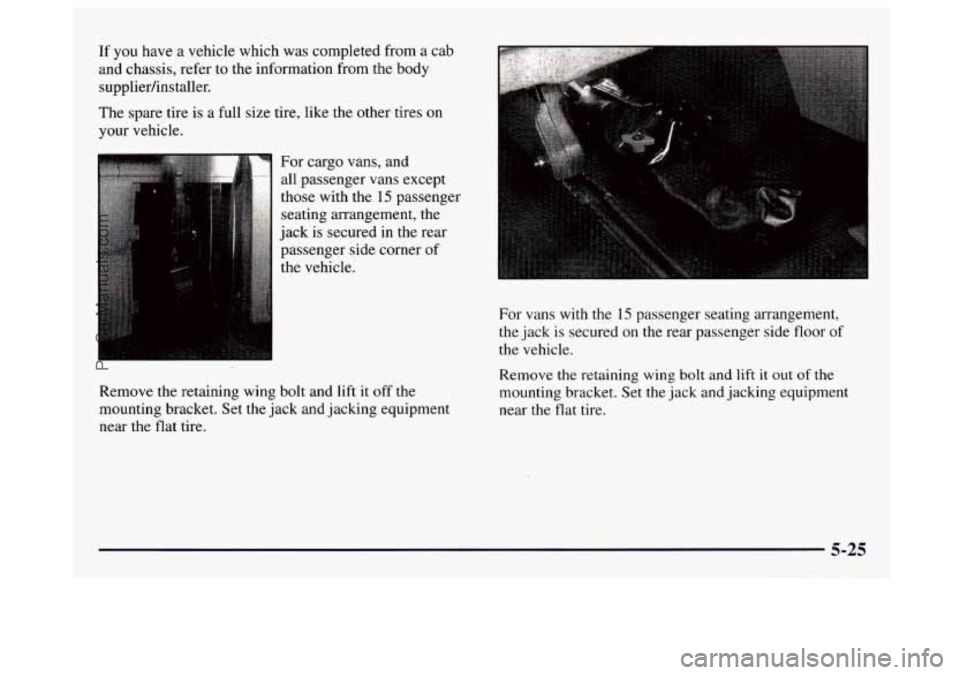
The spare tire is a full size tire, like the other tires
on
your vehicle.
For cargo vans, and
all passenger vans except
those with the
15 passenger
seating arrangement, the
jack is secured in the rear
passenger
side corner of
the vehicle.
Remove the retaining wing bolt and lift it off the
mounting bracket. Set the jack and jacking equipment
near the flat tire. For vans with the
15 passenger seating arrangement,
the jack
is secured on the rear passenger side floor of
the vehicle.
Remove
the retaining wing bolt and lift it out of the
mounting bracket. Set the jack and jacking equipment
near the flat tire.
ProCarManuals.com
Page 231 of 388
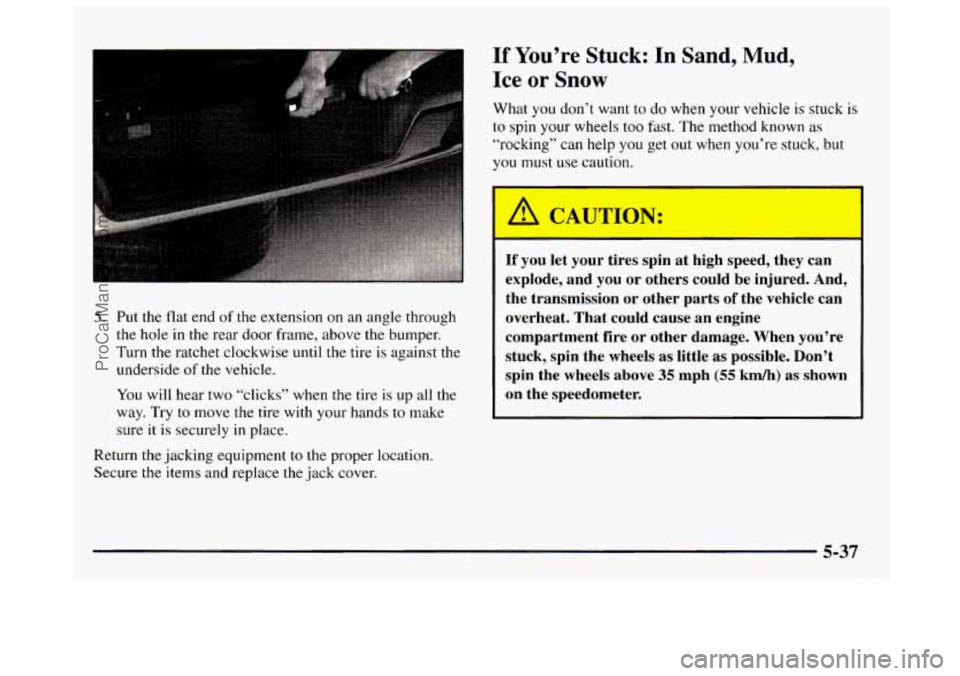
5. Put the flat end of the extension on an angle through
the hole in
the rear door frame, above the bumper.
Turn the ratchet clockwise until the tire is against the
underside
of the vehicle.
You will hear two “clicks” when the tire
is up all the
way. Try
to move the tire with your hands to make
sure
it is securely in place.
Return the jacking equipment
to the proper location.
Secure the items and replace the jack cover.
If You’re Stuck: In Sand, Mud,
Ice or Snow
What you don’t want to do when your vehicle is stuck is
to spin your wheels too fast. The method known as
“rocking” can help you get out when you’re stuck, but
you must use caution.
I
If you let your tires spin at high speed, they can
explode, and you or others could be injured. And,
the transmission or other parts
of the vehicle can
overheat. That could cause an engine
compartment fire or other damage. When you’re
stuck, spin the wheels as little as possible. Don’t
spin the wheels above
35 mph (55 kmh) as shown
on the speedometer.
5-37
ProCarManuals.com