Towing GMC SAVANA 1997 Owner's Manual
[x] Cancel search | Manufacturer: GMC, Model Year: 1997, Model line: SAVANA, Model: GMC SAVANA 1997Pages: 388, PDF Size: 20.17 MB
Page 205 of 388
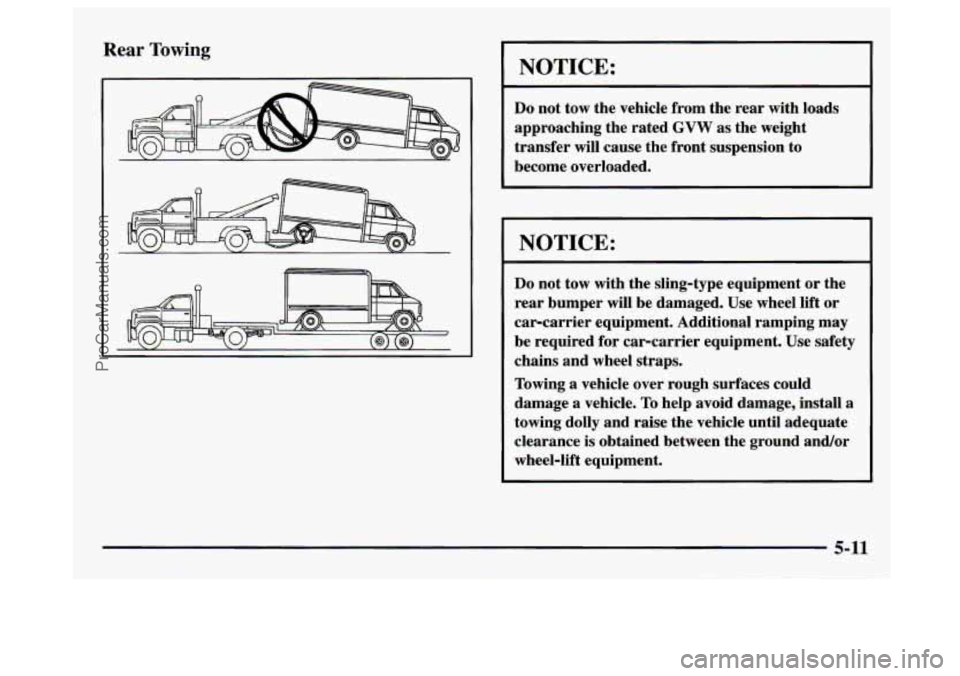
Rear Towing
I NOTICE:
Do not tow the vehicle from the rear with loads
approaching the rated
GVW as the weight
transfer will cause the front suspension to
become overloaded.
NOTICE:
Do not tow with the sling-type equipment or the
rear bumper will be damaged. Use wheel lift or
carcarrier equipment. Additional ramping may
be required for car-carrier equipment. Use safety
chains and wheel straps.
Towing
a vehicle over rough surfaces could
damage a vehicle.
To help avoid damage, install a
towing dolly and raise the vehicle until adequate
clearance is obtained between the ground and/or
wheel-lift equipment.
5-11
ProCarManuals.com
Page 216 of 388
Engine Fan Noise
Your vehicle has a clutched engine cooling fan. When the
clutch is engaged, the fan spins faster to provide more air
to cool the engine. In most everyday driving conditions,
the fan
is spinning slower and the clutch is not fully
engaged. This improves fuel economy and reduces fan
noise. Under heavy vehicle loading, trailer towing and/or
high outside temperatures, the fan speed increases as the
clutch more fully engages.
So you may hear an increase
in fan noise.
This is normal and should not be mistaken
as the transmission slipping or making extra shifts. It is
merely the cooling system functioning properly. The
fan
will slow down when additional cooling is not required
and the clutch partially disengages.
You may
also hear this fan noise when you start the engine.
It will go away as the fan clutch partially disengages.
If a Tire Goes Flat
It’s unusual for a tire to “blow out” while you’re driving,
especially if you maintain your tires properly.
If air goes
out of a tire, it’s much more likely
to leak out slowly.
But
if you should ever have a “blowout,” here are a
few tips about what to expect and what to do:
If a front tire fails, the flat tire will create a drag that
pulls the vehicle toward that side. Take your foot off the
accelerator pedal and grip the steering wheel firmly.
Steer to maintain lane position, and then gently brake to
a stop
well out of the traffic lane.
A rear blowout, particularly on a curve, acts much like
a skid and may require the same correction you’d use
in a skid. In any rear blowout, remove your foot from
the accelerator pedal. Get the vehicle under control by
steering the way you want the vehicle to go. It may be
very bumpy and noisy, but you can still steer. Gently
brake to a stop
-- well off the road if possible.
If a tire goes flat, the next part shows how to use your
jacking equipment to change a flat tire safely.
5-22
ProCarManuals.com
Page 218 of 388
Removing the Spare Tire and Tools
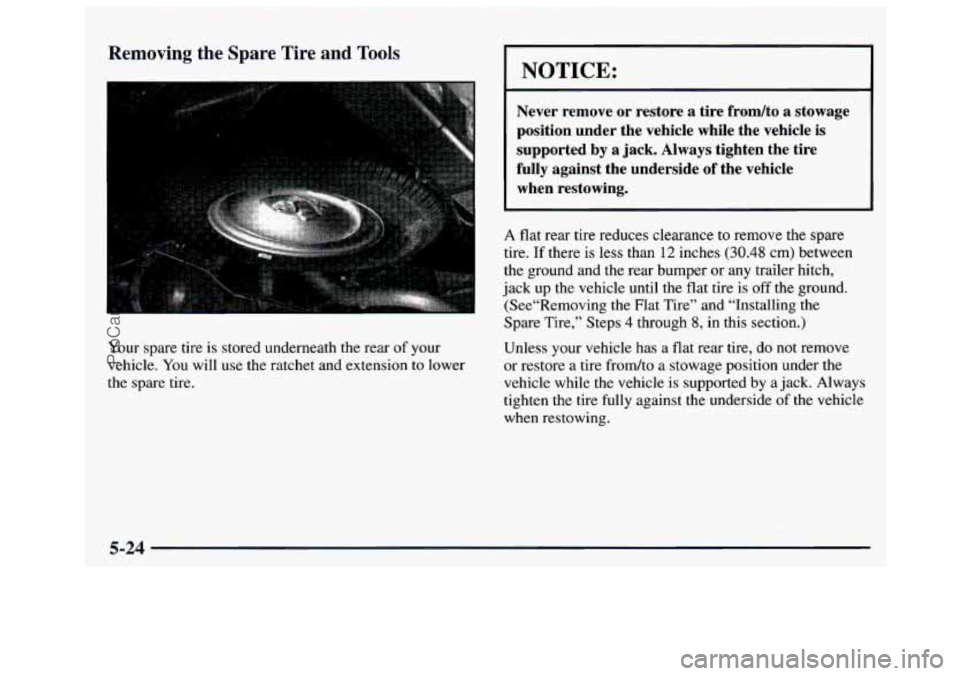
Your spare tire is stored underneath the rear of your
vehicle.
You will use the ratchet and extension to lower
the spare tire.
I NOTICE: I
Never remove or restore a tire frodto a stowage
position under the vehicle while the vehicle
is
supported by a jack. Always tighten the tire
fully against the underside
of the vehicle
when restowing.
A flat rear tire reduces clearance to remove the spare
tire. If there is
less than 12 inches (30.48 cm) between
the ground and the rear bumper
or any trailer hitch,
jack up the vehicle until the flat tire is off the ground.
(See“Removing
the Flat Tire” and “Installing the
Spare Tire,” Steps
4 through 8, in this section.)
Unless your vehicle has a flat rear tire, do
not remove
or restore a tire frodto a stowage position under the
vehicle while the vehicle is supported by a jack. Always
tighten the tire fully against the underside
of the vehicle
when restowing.
5-24
ProCarManuals.com
Page 232 of 388
Rocking Your Vehicle To Get It Out
NOTICE: First, turn your steering wheel left and right. That will
clear the area around your front wheels. Then shift back
Spinning your wheels can destroy parts of your and forth between REVERSE (R) and a forward gear,
vehicle as well as the tires. If you spin the wheels
accelerator pedal while you shift, and press lightly on too fast while shifting your transmission back
spinning the wheels as little as possible. Release the
the accelerator pedal when the transmission is in gear.
and forth, you can destroy your transmission.
If that doesn’t get you out after a few tries, you may
’or information about using tire chains on your vehicle,
;ee “Tire Chains” in the Index. need
to be towed out. If you
do need to be towed out,
see “Towing Your Vehicle” in the Index.
5-38
ProCarManuals.com
Page 252 of 388
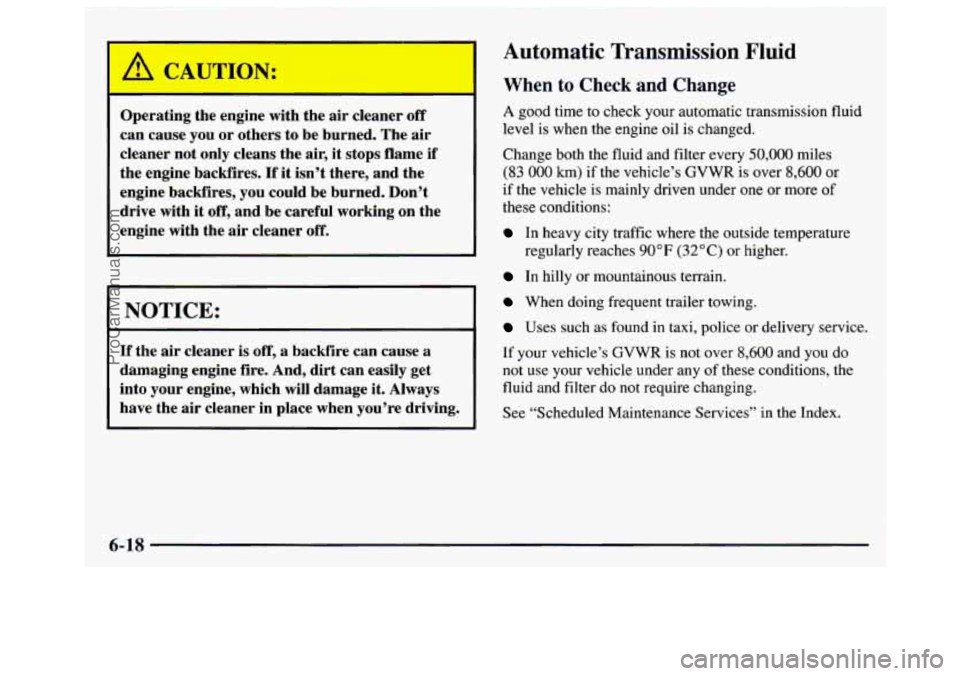
Operating the engine with the air cleaner off
can cause you or others to be burned. The air
cleaner not only cleans the air, it stops flame
if
the engine backfires. If it isn’t there, and the
engine backfires,
you could be burned. Don’t
drive with
it off, and be careful working on the
engine with the air cleaner off.
NOTICE:
If the air cleaner is off, a backfire can cause a
damaging engine fire. And, dirt can easily get
into your engine, which will damage
it. Always
have the air cleaner in place when you’re driving.
~ Automatic Transmission Fluid
~ When to Check and Change
~ A good time to check your automatic transmission fluid
level is when the engine oil
is changed.
Change both the fluid and filter every
50,000 miles
(83 000 km) if the vehicle’s GVWR is over 8,600 or
if the vehicle is mainly driven under one or more of
these conditions:
In heavy city traffic where the outside temperature
regularly reaches
90°F (32°C) or higher.
In hilly or mountainous terrain.
When doing frequent trailer towing.
Uses such as found in taxi, police or delivery service.
If your vehicle’s
GVWR is not over 8,600 and you do
not use your vehicle under any of these conditions, the
fluid and filter do
not require changing.
See “Scheduled Maintenance Services” in the Index.
6-18
ProCarManuals.com
Page 310 of 388
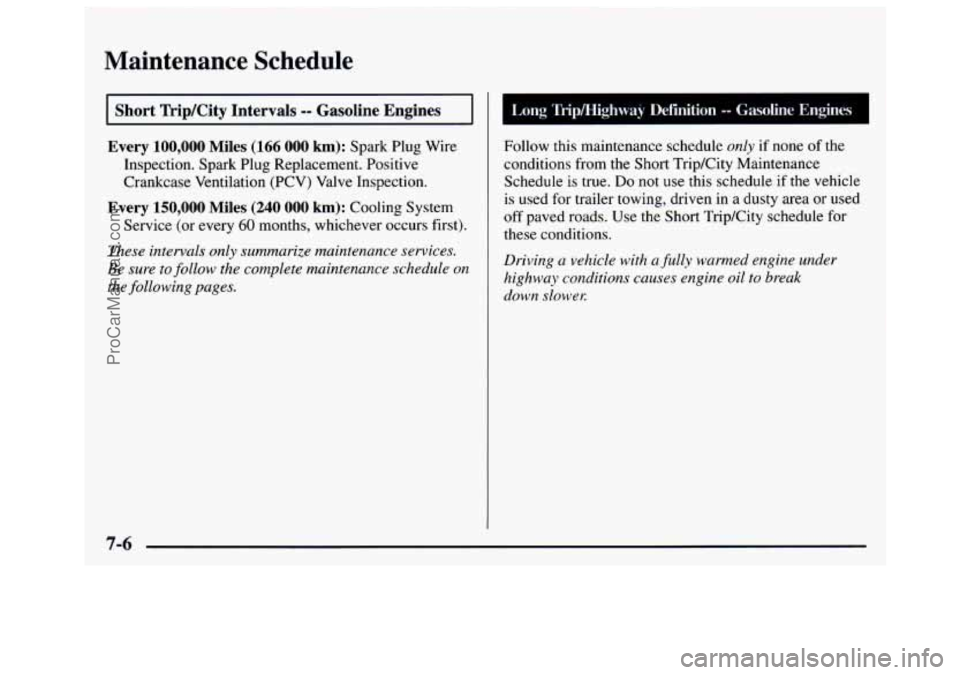
Maintenance Schedule
I
'1 Short TripKity Intervals -- Gasoline Engines
I Every 100,000 Miles (166 000 km): Spark Plug Wire
Inspection. Spark Plug Replacement. Positive
Crankcase Ventilation (PCV) Valve Inspection.
Every 150,000 Miles (240 000 km): Cooling System
Service (or every
60 months, whichever occurs first).
These intervals only summarize maintenance services.
Be sure to
follow the complete maintenance schedule on
the following pages.
Follow this maintenance schedule onZy if none of the
conditions from the Short TripKity Maintenance
Schedule
is true. Do not use this schedule if the vehicle
is used for trailer towing, driven in
a dusty area or used
off paved roads. Use the Short Trip/City schedule for
these conditions.
Driving ci vehicle with n fL1lly warmed engine under
highway conditions causes engine oil to break
down slower.
ProCarManuals.com
Page 312 of 388
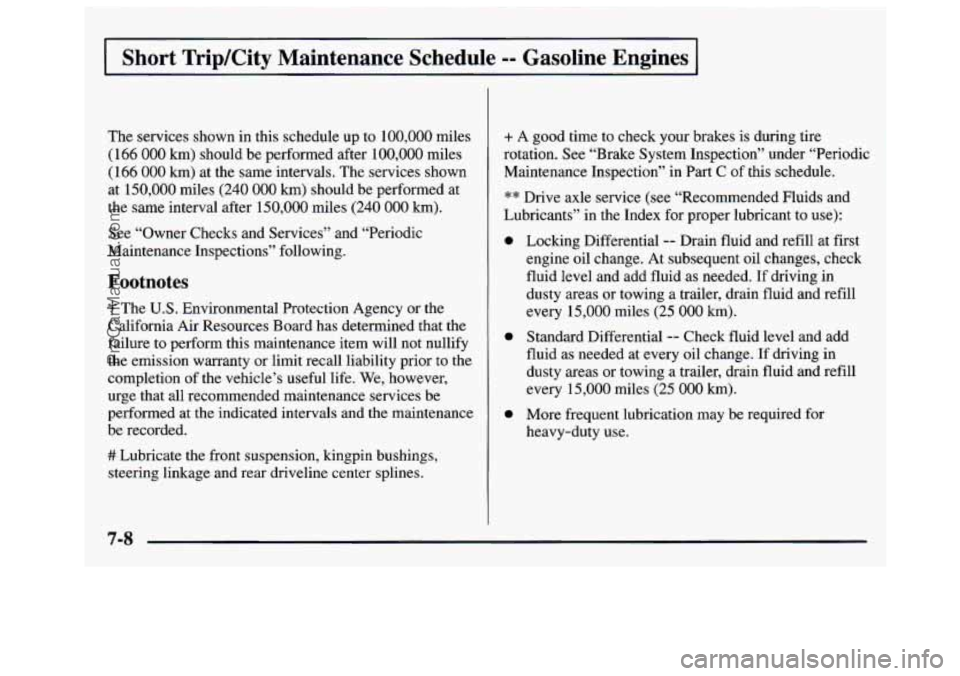
Short TripKity Maintenance Schedule -- Gasoline Engines
The services shown in this schedule up to 100,000 miles
(166
000 km) should be performed after 100,000 miles
(166 000 km) at the same intervals. The services shown
at
150,000 miles (240 000 km) should be performed at
the same interval after
150,000 miles (240 000 km).
See “Owner Checks and Services” and “Periodic
Maintenance Inspections” following.
Footnotes
The U.S. Environmental Protection Agency or the
California Air Resources Board has determined that the
failure to perform this maintenance item will not nullify
the emission warranty or limit recall liability prior to the
completion of the vehicle’s useful life. We, however,
urge that all recommended maintenance services be
performed at the indicated intervals and the maintenance
be recorded.
# Lubricate the front suspension, kingpin bushings,
steering linkage and rear driveline center splines.
+ A good time to check your brakes is during tire
rotation. See “Brake System Inspection” under “Periodic
Maintenance Inspection” in Part C of this schedule.
** Drive axle service (see “Recommended Fluids and
Lubricants” in the Index for proper lubricant to use):
0
a
a
Locking Differential -- Drain fluid and refill at first
engine oil change. At subsequent oil changes, check
fluid level and add fluid
as needed. If driving in
dusty areas or towing a trailer, drain fluid and refill
every 15,000 miles (25
000 km).
Standard Differential -- Check fluid level and add
fluid as needed at every oil change. If driving in
dusty areas or towing a trailer, drain fluid and refill
every 15,000 miles
(25 000 km).
More frequent lubrication may be required for
heavy-duty use.
7-8
ProCarManuals.com
Page 323 of 388
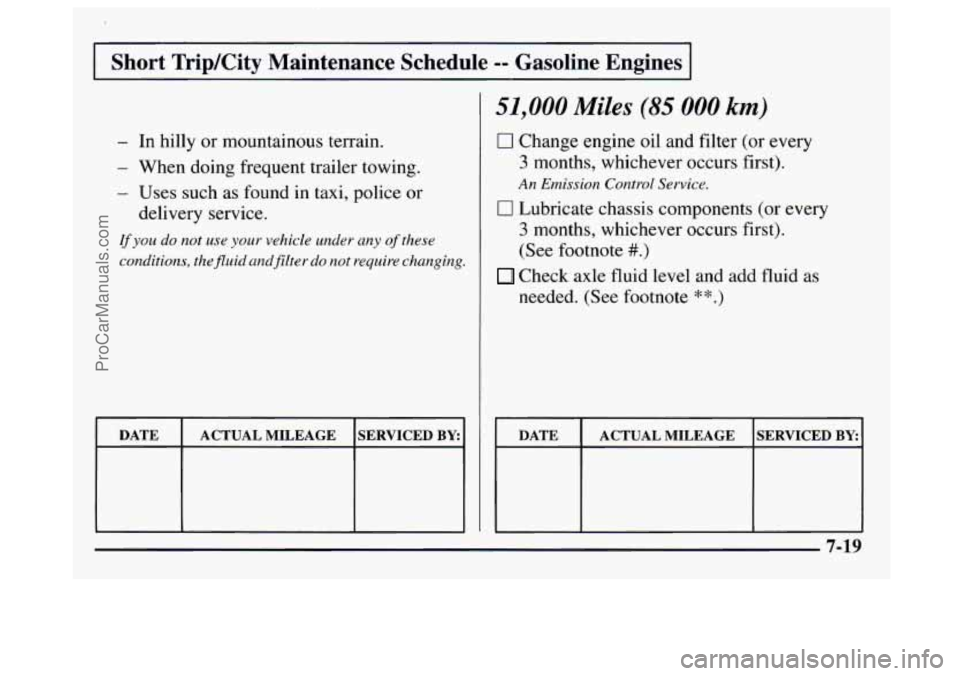
I Short Trip/City Maintenance Schedule -- Gasoline Engines I
In hilly or mountainous terrain.
When doing frequent trailer towing.
Uses such as found in taxi, police
or
delivery service.
Ifyou do not use your vehicle under any of these
conditions, the fluid andfilter
do not require changing.
DATE ACTUAL MILEAGE SERVICED BY
51,000 Miles (85 000 km)
0
0
Change engine oil and filter (or every
3 months, whichever occurs first).
Lubricate chassis components (or every
3 months, whichever occurs first).
(See footnote #.)
Check axle fluid level and add fluid as
needed.
(See footnote **.)
An Emission Control Service.
DATE SERVICED BY ACTUAL MILEAGE
7-19
ProCarManuals.com
Page 335 of 388
I Short TripKity Maintenance Schedule -- Gasoline Engines I
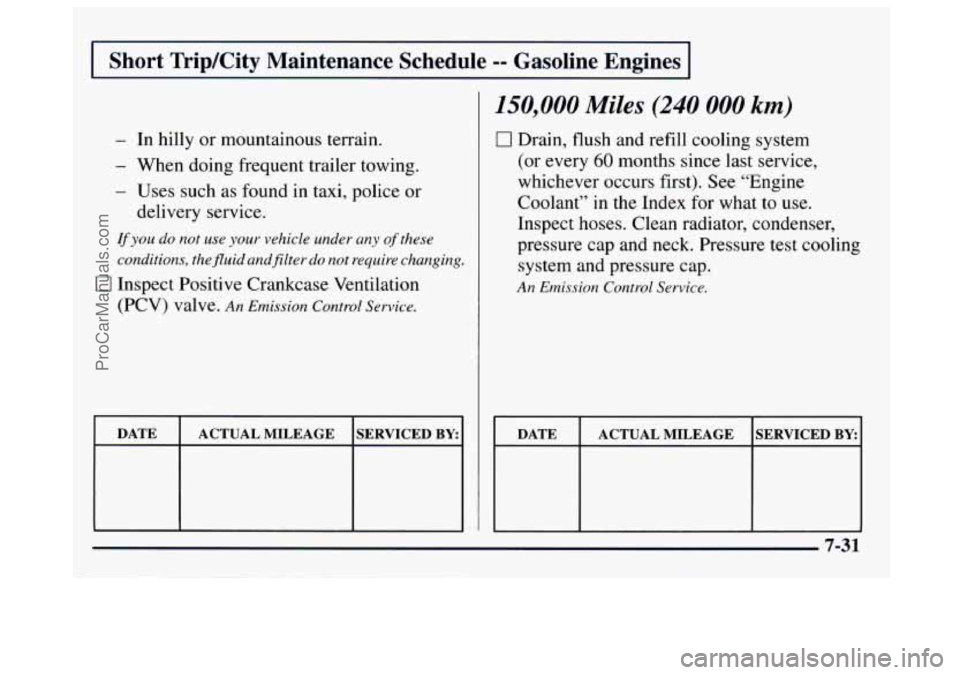
- In hilly or mountainous terrain.
- When doing frequent trailer towing.
- Uses such as found in taxi, police or
delivery service.
Ifyou do not use your vehicle under any of these
conditions, theJiruid andjilter do not require changing.
[7 Inspect Positive Crankcase Ventilation
(Pcv) valve. An Emission Control Service.
DATE ACTUAL MILEAGE
1
SERVICED BY
150,000 Miles (240 000 km)
0 Drain, flush and refill cooling system
(or every
60 months since last service,
whichever occurs first). See “Engine
Coolant”
in the Index for what to use.
Inspect hoses. Clean radiator, condenser,
pressure cap and neck. Pressure test cooling
system and pressure cap.
An Em.ission Control Service.
’/ -31
ProCarManuals.com
Page 341 of 388
1 Long Tripmighway Maintenance Schedule -- Gasoline Engines
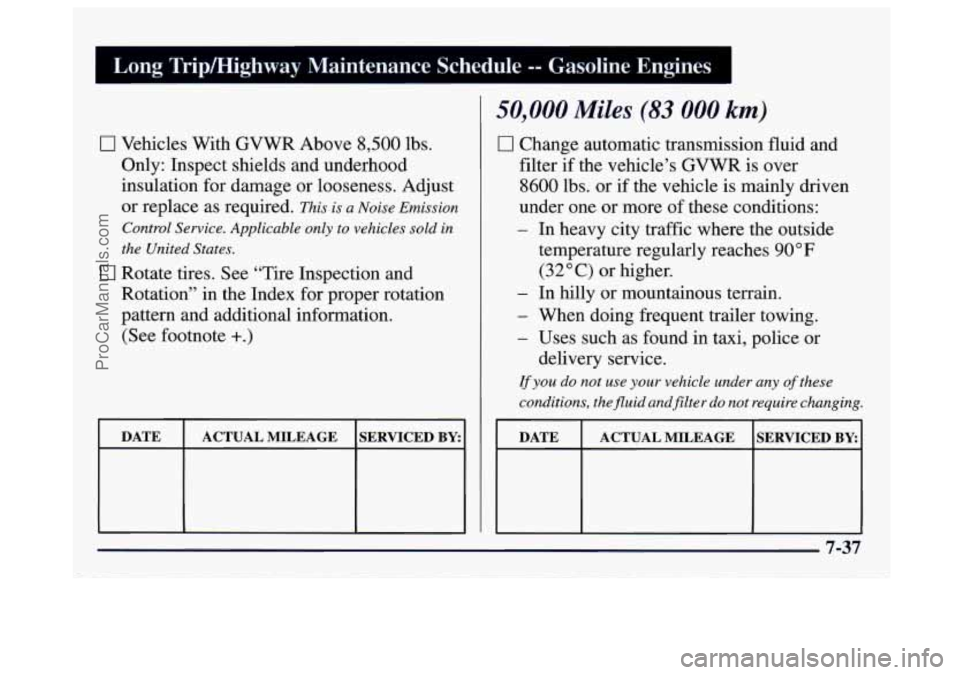
0 Vehicles With GVWR Above 8,500 lbs.
Only: Inspect shields and underhood
insulation for damage or looseness. Adjust
or replace as required.
This is a Noise Emission
Control Service. Applicable only to vehicles sold in
the United States.
0 Rotate tires. See “Tire Inspection and
Rotation”
in the Index for proper rotation
pattern and additional information.
(See footnote
+.)
DATE SERVICED BY ACTUAL MILEAGE
50,OV Miles (83 000 km)
0 Change automatic transmission fluid and
filter
if the vehicle’s GVWR is over
8600 lbs. or if the vehicle is mainly driven
under one or more of these conditions:
- In heavy city traffic where the outside
temperature regularly reaches
90 O F
(32 O C) or higher.
- In hilly or mountainous terrain.
- When doing frequent trailer towing.
- Uses such as found in taxi, police or
delivery service.
If you do not use your vehicle under any of these
conditions, the fluid andfilter
do not require changing.
DATE
SERVICED BY ACTUAL MILEAGE
ProCarManuals.com