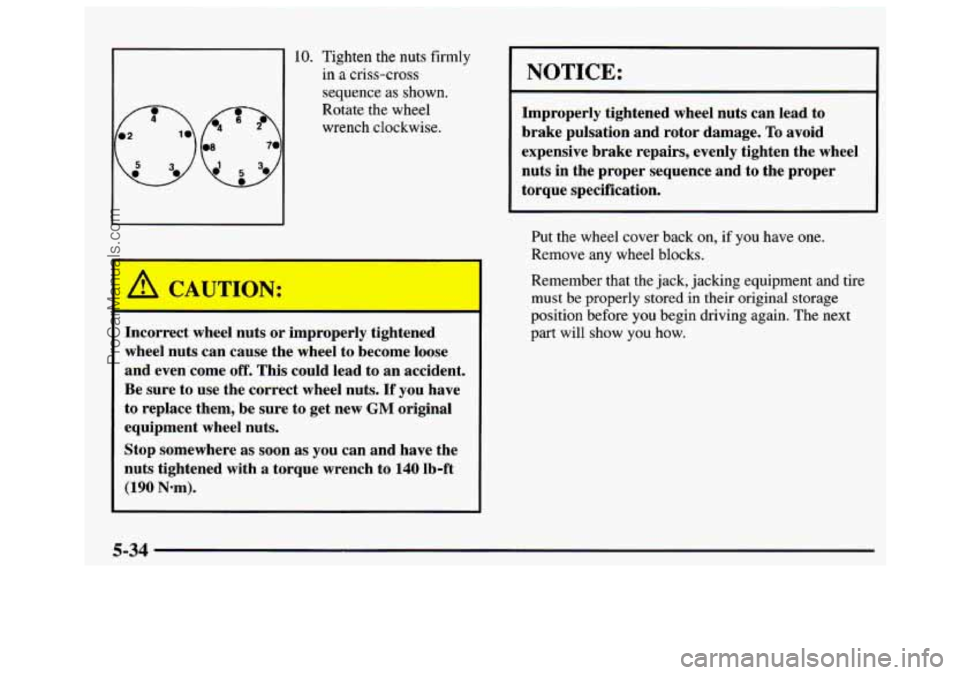
10. Tighten the nuts firmly
in a criss-cross
sequence as shown.
p
Rotate the wheel
wrench clockwise.
A CAUTION:
Incorrect wheel nuts or improperly tightened
wheel nuts can cause the wheel to become loose
and even come
off. This could lead to an accident.
Be sure to use the correct wheel nuts.
If you have
to replace them, be sure to get new
GM original
equipment wheel nuts.
Stop somewhere as soon as
you can and have the
nuts tightened with a torque wrench to
140 lb-ft
(190 Nm).
NOTICE:
Improperly tightened wheel nuts can lead to
brake pulsation and rotor damage.
To avoid
expensive brake repairs, evenly tighten the wheel
nuts in the proper sequence and to the proper
torque specification.
Put the wheel cover back on, if you have one.
Remove any wheel blocks.
Remember that the jack, jacking equipment and tire
must be properly stored
in their original storage
position before
you begin driving again. The next
part will
show you how.
5-34
ProCarManuals.com
Rear Axle Service
Check the gear lubricant level in the rear axle and add
if needed. See “Rear Axle” in the Index, A fluid loss
may indicate a problem. Check the axle and repair it
if needed.
Brake System Inspection
Inspect the complete system. Inspect brake lines and
hoses
for proper hook-up, binding, leaks, cracks,
chafing,
etc. Inspect disc brake pads for wear and rotors
for surface condition.
Also inspect drum brake linings
for wear and cracks. Inspect other brake parts, including
drums, wheel cylinders, calipers, parking brake, etc.
Check parking brake adjustment.
You may need to have
your brakes inspected more often if your driving habits
or conditions result in frequent braking.
7-50
ProCarManuals.com