inflation pressure GMC SAVANA 1997 Owners Manual
[x] Cancel search | Manufacturer: GMC, Model Year: 1997, Model line: SAVANA, Model: GMC SAVANA 1997Pages: 388, PDF Size: 20.17 MB
Page 181 of 388
Run your engine only as long as you must. This
saves fuel. When you
run the engine, make it go a
little faster than just idle. That is, push the accelerator
slightly. This uses less fuel for the heat that you get
and it keeps the battery (or batteries) charged.
You will
need a well-charged battery (or batteries) to restart the
vehicle, and possibly for signaling later on with your
headlamps. Let the heater run for awhile. If you have a
diesel engine you may have to
run it at a higher speed
to get enough heat.
Then, shut the engine off and close the window almost
all the way to preserve the heat. Start the engine again
and repeat this only when you feel really uncomfortable
from the cold. But do it as little as possible. Preserve
the
fuel as long as you can. To help keep warm, you can get
out of the vehicle and do some fairly vigorous exercises
every half hour or
so until help comes.
Loading Your Vehicle
COLD TIRE PRESSURE
L
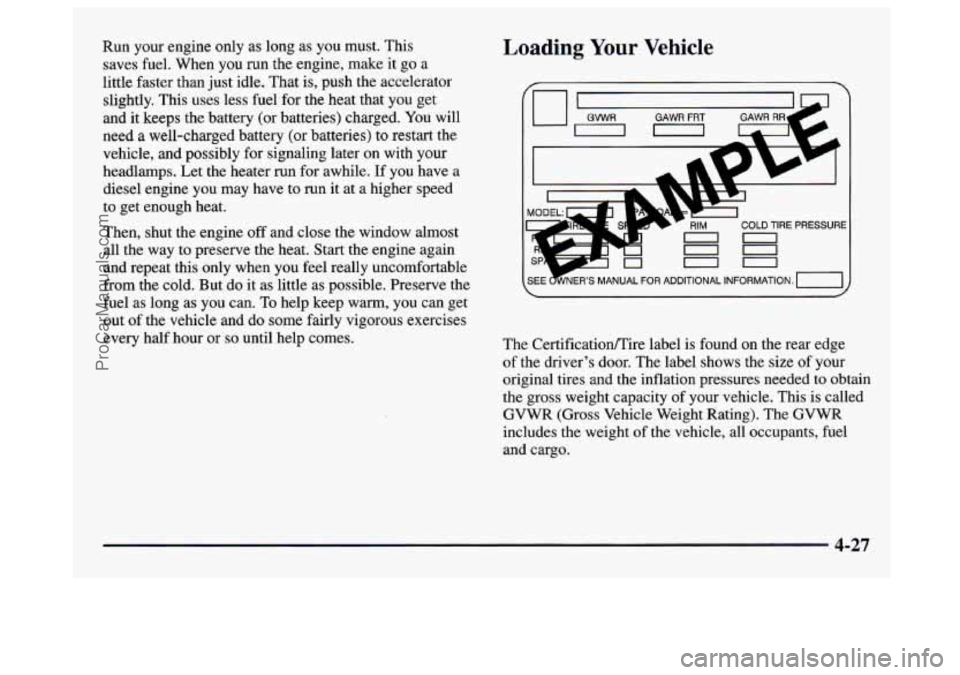
The Certificatioflire label is found on the rear edge
of the driver’s door. The label shows the size of your
original tires and the inflation pressures needed to obtain
the gross weight capacity of your vehicle. This is called
GVWR (Gross Vehicle Weight Rating). The GVWR
includes the weight
of the vehicle, all occupants, fuel
and cargo.
4-27
ProCarManuals.com
Page 276 of 388
Inflation -- Tire Pressure
The Certificationmire label, which is on the rear edge of
the driver’s door, shows the correct inflation pressures
for your tires when they’re cold.
“Cold” means your
vehicle has been sitting for at least three hours or driven
no more than
1 mile (1.6 km).
NOTICE:
Don’t let anyone tell you that underinflation or
overinflation is all right. It’s not.
If your tires
don’t have enough
air (underinflation), you can
get the following:
@ Too much flexing
Too much heat
Tire overloading
Bad wear
Bad handling
Bad fuel economy.
NOTICE: (Continued)
NOTICE: (Continued)
If your tires have too much air (overinflation),
you can get the following:
Unusual wear
Bad handling
Rough ride
Needless damage from road hazards.
I
When to Check
Check your tires once a month or more. Also, check the
tire pressure of the spare tire.
How to Check
Use a good quality pocket-type gage to check tire
pressure. You can’t tell if your tires are properly inflated
simply by looking at them. Radial tires may look
properly inflated even when they’re underinflated.
Be sure
to put the valve caps back on the valve stems.
They help prevent leaks by keeping out dirt and moisture.
6-42
ProCarManuals.com
Page 278 of 388
After the tires have been rotated, adjust the front and rear
inflation pressures
as shown on the Certification/Tire label.
Make
certain that all wheel nuts are properly tightened.
See “Wheel Nut Torque” in the Index.
Rust or dirt on a wheel, or on the parts to which
it
is fastened, can make wheel nuts become loose
after
a time. The wheel could come off and cause
an accident. When you change a wheel, remove
any rust or dirt from places where the wheel
attaches
to the vehicle. In an emergency, you can
use
a cloth or a paper towel to do this; but be
sure to use
a scraper or wire brush later, if you
need to, to get all the rust or dirt
off. (See
“Changing
a Flat Tire” in the Index.) When
It’s Time
for New Tires
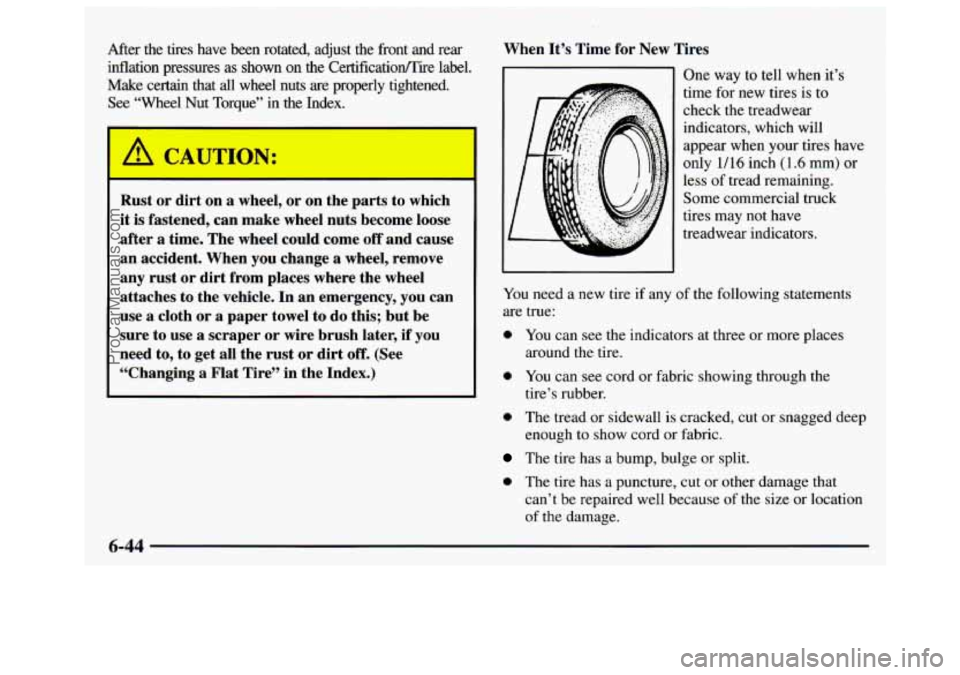
One way to tell when it’s
time for new tires is to
check the treadwear
indicators, which will
appear when your tires have
only 1/16 inch (1.6
mm) or
less
of tread remaining.
Some commercial truck
tires may not have
treadwear indicators.
You need a new tire if any of the following statements
are true:
0 You can see the indicators at three or more places
0 You can see cord or fabric showing through the
0 The tread or sidewall is cracked, cut or snagged deep
enough to show cord
or fabric.
The tire has a bump, bulge or split.
0 The tire has a puncture, cut or other damage that
around the tire.
tire’s rubber.
can’t be repaired well because
of the size or location
of the damage.
ProCarManuals.com
Page 349 of 388
Part B: Owner Checks and Services
Listed below are owner checks and services which
should be performed at the intervals specified to help
ensure the safety, dependability and emission control
performance of your vehicle.
Be sure any necessary repairs are completed at once.
Whenever any fluids or lubricants are added to your
vehicle, make sure they are the proper ones, as shown
in Part
D.
At the First 100, 1,000 and 6,000 Miles
(160,1600 and 10
000 km)
For vehicles with dual wheels, check dual wheel nut
torque. For proper torque, see “Wheel Nut Torque” in
the Index.
At Each Fuel Fill
It is important for you or a service station attendant to
perform these underhood checks at each fuel
fill.
Engine Oil Level Check
Check the engine oil level and add the proper oil if
necessary. See “Engine
Oil” in the Index for
further details.
Engine Coolant Level Check
Check the engine coolant level and add DEX-COOL@
coolant mixture
if necessary. See “Engine Coolant” in the
Index for further details.
Windshield Washer Fluid Level Check
Check the windshield washer fluid level in the
windshield washer tank and add the proper fluid if
necessary. See “Windshield Washer Fluid’’ in the Index
for further details.
At Least Once a Month
Tire Inflation Check
Make sure tires are inflated to the correct pressures. See
“Tires” in the Index for further details.
Cassette Deck Service
Clean cassette deck. Cleaning should be done every
50 hours of tape play. See “Audio Systems’’ in the Index
for further details.
7-45
.~ ~
ProCarManuals.com
Page 383 of 388
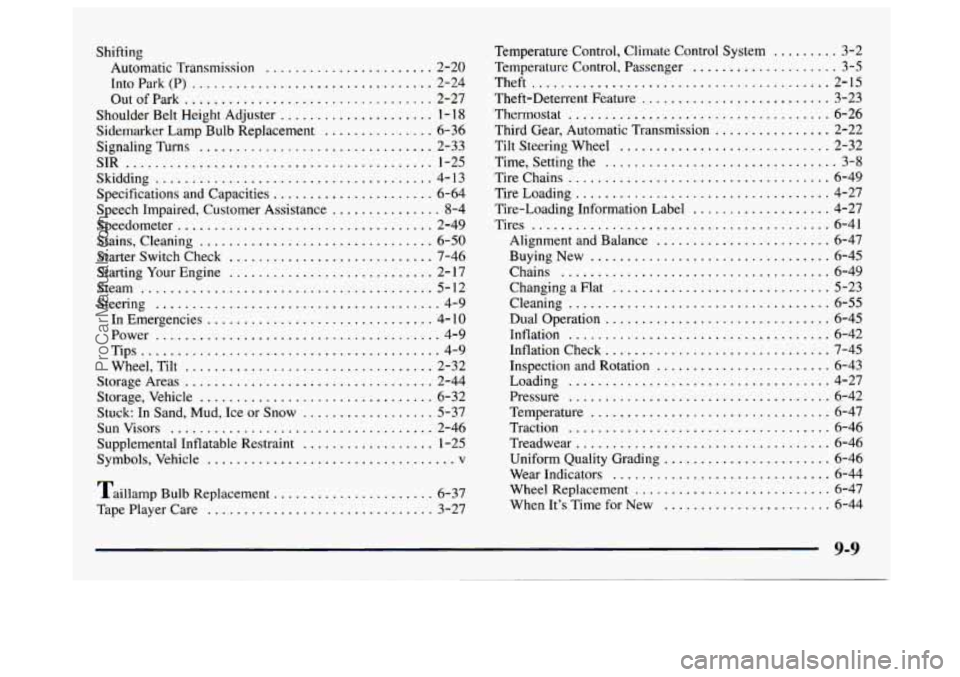
Shifting Automatic Transmission
....................... 2-20
Into Park
(P) ................................. 2-24
OutofPark
.................................. 2-27
Shoulder Belt Height Adjuster
..................... 1 - 18
Sidemarker Lamp Bulb Replacement
............... 6-36
Signaling Turns
................................ 2-33
SIR .......................................... 1-25
Skidding
...................................... 4-13
Specifications and Capacities
...................... 6-64
Speech Impaired. Customer Assistance
............... 8-4
Speedometer
................................... 2-49
Stains. Cleaning
................................ 6-50
Starter Switch Check
............................ 7-46
Starting Your Engine
............................ 2- 17
Steam
........................................ 5-12
Steering
....................................... 4-9
In Emergencies
............................... 4- 10
Power ....................................... 4-9
Tips
......................................... 4-9
Wheel. Tilt
.................................. 2-32
StorageAreas
.................................. 2-44
Storage, Vehicle
................................ 6-32
Stuck: In Sand, Mud. Ice or Snow
.................. 5-37
SunVisors
.................................... 2-46
Supplemental Inflatable Restraint
.................. 1-25
Symbols, Vehicle .................................. v
Taillamp Bulb Replacement ...................... 6-37
TapePlayerCare
............................... 3-27 Temperature Control.
Climate Control System
......... 3-2
Temperature Control. Passenger .................... 3-5
Theft
......................................... 2-15
Theft-Deterrent Feature
.......................... 3-23
Thermostat
.................................... 6-26
Third Gear. Automatic Transmission
................ 2-22
Tilt Steering Wheel
............................. 2-32
Time. Setting the
................................ 3-8
Tire Chains
.................................... 6-49
TireLoading
................................... 4-27
'Tire-Loading Information Label
................... 4-27
Tires
......................................... 6-41
Alignment and Balance
........................ 6-47
Buying New
................................. 6-45
Chains
..................................... 6-49
Changing
a Flat .............................. 5-23
Dual Operation ............................... 6-45
Inflation
.................................... 6-42
Inflation Check
............................... 7-45
Inspection and Rotation
........................ 6-43
Loading
.................................... 4-27
Pressure
.................................... 6-42
Temperature
................................. 6-47
Traction
.................................... 6-46
Treadwear
................................... 6-46
Uniform Quality Grading
....................... 6-46
Wear Indicators
.............................. 6-44
Wheel Replacement
........................... 6-47
When It's Time for New
....................... 6-44
Cleaning
.................................... 6-55
ProCarManuals.com