key battery GMC SAVANA 1997 Owners Manual
[x] Cancel search | Manufacturer: GMC, Model Year: 1997, Model line: SAVANA, Model: GMC SAVANA 1997Pages: 388, PDF Size: 20.17 MB
Page 39 of 388
0 Let only qualified technicians work on your air bag - Servicing Your Air Bag-Equipped Vehicle
system. lmproper service can mean that your air
bag system
won’t work properly. See your dealer
for service. Air bags affect how your vehicle should be
serviced.
There are parts of
the air bag system in several places
around your vehicle.
You don’t want the system to
inflate while someone is working on your vehicle.
Your
GM dealer and the GM Service Manual have
information about servicing your vehicle and the air bag NOTICE:
If you damage the covering for the driver’s or the
right front passenger’s
air bag, the bag may not
system. To purchase a service manual, see “Service and
Owner Publications”
in the Index.
work properly. You may have to replace the air
bag module in the steering wheel or both the
air
bag module and the instrument panel for the
right front passenger’s
air bag. Do not open or
break the air bag coverings. For
up to 10 minutes after the ignition key is
turned off and the battery is disconnected, an air
bag can still inflate during improper service. You
can be injured if you are close to an air bag when
it inflates. Avoid wires wrapped with yellow tape
or yellow connectors. They are probably part of
the air bag system. Be sure to follow proper
service procedures, and make sure the person
performing work for you is qualified to do
so.
The air bag system does not need regular maintenance.
1-31
ProCarManuals.com
Page 68 of 388
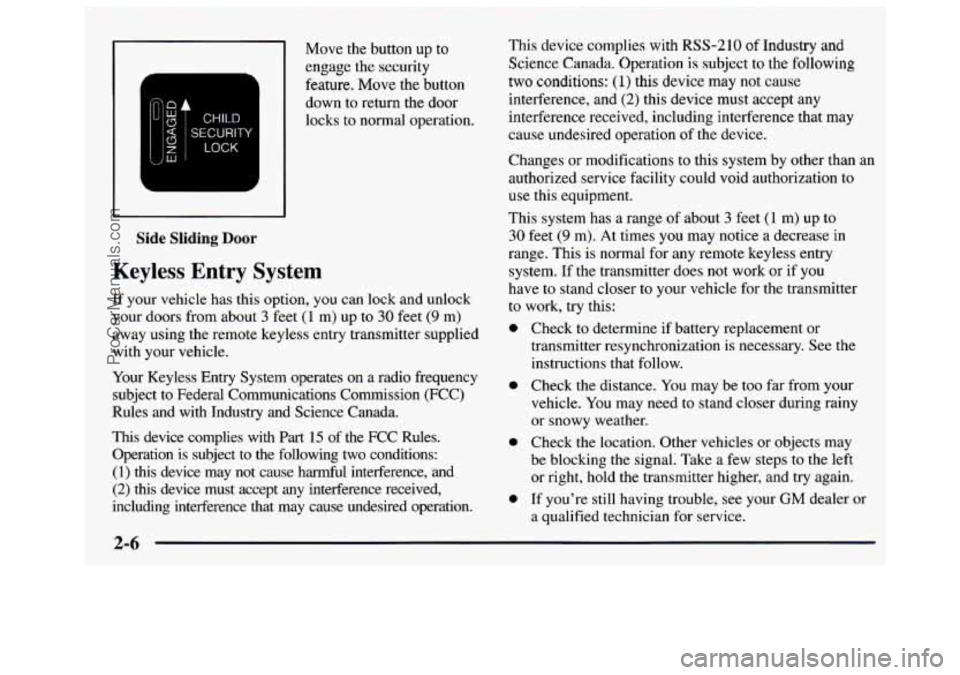
U
Move the button up to
engage the security
feature. Move
the button
down to return the door
locks to normal operation.
Side Sliding Door
Keyless Entry System
If your vehicle has this option, you can lock and unlock
your doors from about
3 feet (1 m) up to 30 feet (9 m)
away using the remote keyless entry transmitter supplied
with your vehicle.
Your Keyless Entry System operates on a radio frequency
subject to Federal Communications Commission (FCC)
Rules and with Industry and Science Canada.
This device complies with Part 15 of the FCC Rules.
Operation is subject to the following two conditions:
(1) this device may not cause harmful interference, and
(2) this device must accept any interference received,
including interference that may cause undesired operation. This device
complies with
RSS-210 of Industry and
Science Canada. Operation is subject to
the following
two conditions: (1) this device may not cause
interference, and
(2) this device must accept any
interference received, including interference that may
cause undesired operation
of the device.
Changes or modifications to this
system by other than an
authorized service facility could void authorization to
use this equipment.
This system has a range of about
3 feet (1 m) up to
30 feet (9 m). At times you may notice a decrease in
range. This is normal for any remote keyless entry
system. If the transmitter does not work or if you
have to stand closer to your vehicle for the transmitter
to work, try this:
0 Check to determine if battery replacement or
transmitter resynchronization is necessary. See the
instructions that follow.
0 Check the distance. You may be too far from your
vehicle. You may need to stand closer during rainy
or snowy weather.
0 Check the location. Other vehicles or objects may
be blocking the signal. Take a few steps to the
left
or right, hold the transmitter higher, and try again.
0 If you’re still having trouble, see your GM dealer or
a qualified technician for service.
2-6
ProCarManuals.com
Page 69 of 388
Operation
To unlock the driver’s door, press the UNLOCK button.
If
you press this button again within five seconds, all
the doors will unlock. Press the
REAR button twice
to unlock the rear door only. When the UNLOCK or
REAR button is pressed, the interior dome lamps are
turned on for
40 seconds or until the ignition switch
is activated. Press
LOCK to lock all the doors.
Matching Transmitter(s) To Your Vehicle
Each remote keyless entry transmitter is coded to
prevent another transmitter from unlocking your vehicle.
If a transmitter is lost or stolen, a replacement can be
purchased through your dealer. Remember to bring
any
remaining transmitters with you when you go to your
dealer. When the dealer matches the replacement
transmitter to your vehicle, any remaining transmitters
must also be matched. Once your dealer has coded the new transmitter, the lost transmitter will not unlock your
vehicle. Each vehicle can have only two transmitters
matched to it.
Battery Replacement
Under normal use, the battery in your key remote
keyless entry transmitter should last about
two years.
You can tell the battery is weak if
the transmitter won’t
work at the normal range in any location.
If you have to
get close to your vehicle before
the transmitter works,
it’s probably time to change the battery.
NOTICE:
When replacing the battery, use care not to touch
any of the circuitry. Static from your body
transferred to these surfaces may damage
the transmitter.
2-7
ProCarManuals.com
Page 70 of 388
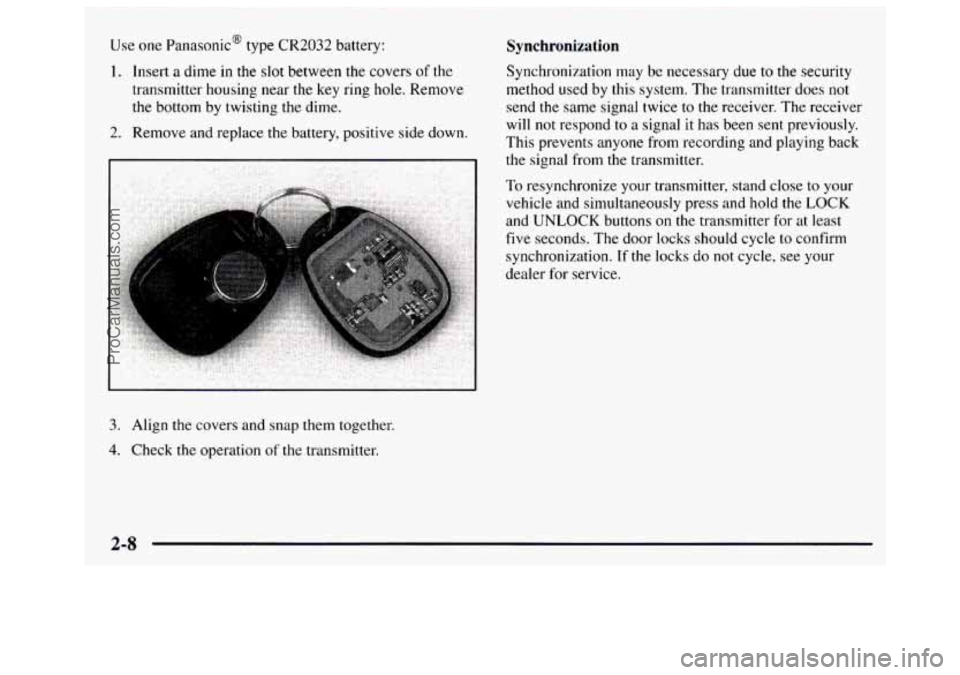
Use one Panasonic@ type CR2032 battery:
1. Insert a dime in the slot between the covers of the
transmitter housing near the key ring
hole. Remove
the bottom by twisting the dime.
2. Remove and replace the battery, positive side down.
r
3. Align the covers and snap them together.
4. Check the operation of the transmitter,
Synchronization
Synchronization may be necessary due to the security
method used by this system. The transmitter does
not
send the same signal twice to the receiver. The receiver
will not respond to
a signal it has been sent previously.
This prevents anyone from recording and playing back
the signal from the transmitter.
To resynchronize your transmitter, stand close
to your
vehicle and simultaneously press and hold the
LOCK
and UNLOCK buttons on the transmitter for at least
five seconds. The door locks should cycle
to confirm
synchronization.
If the locks do not cycle, see your
dealer for service.
2-8
ProCarManuals.com
Page 80 of 388
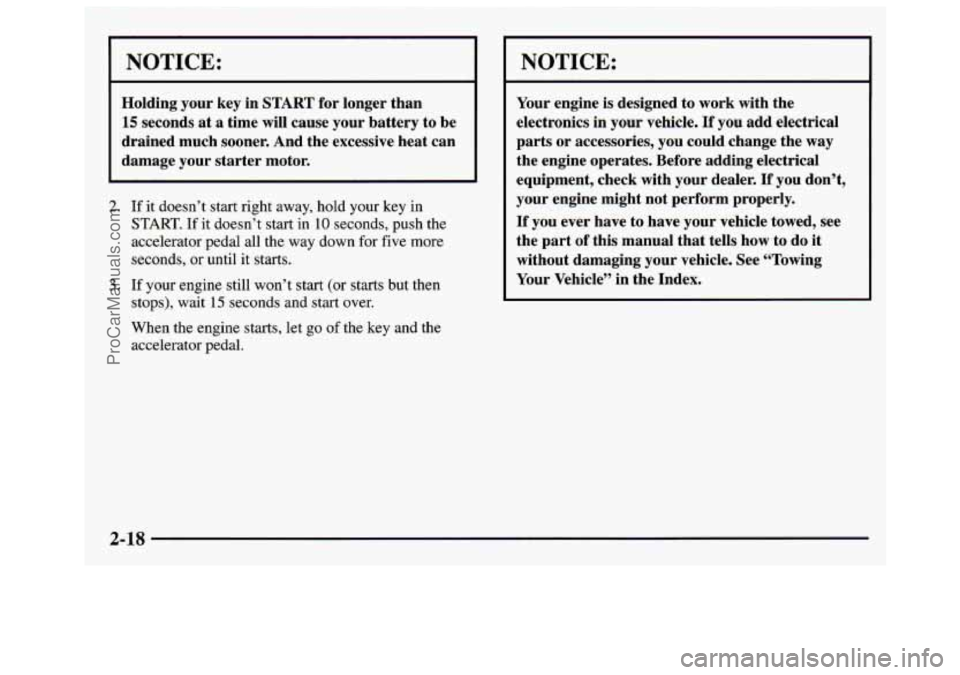
I NOTICE:
Holding your key in START for longer than
15 seconds at a time will cause your battery to be
drained much sooner. And the excessive heat can
damage your starter motor.
2. If it doesn’t start right away, hold your key in
START. If it doesn’t start in 10 seconds, push the
accelerator pedal all the way down for five more
seconds, or until it starts.
3. If your engine still won’t start (or starts but then
stops), wait
15 seconds and start over.
When the engine starts, let go of the key and the
accelerator pedal.
I
NOTICE:
Your engine is designed to work with the
electronics in your vehicle.
If you add electrical
parts or accessories, you could change the way
the engine operates. Before adding electrical
equipment, check with your dealer.
If you don’t,
your engine might not perform properly.
If you ever have to have your vehicle towed, see
the part
of this manual that tells how to do it
without damaging your vehicle. See “Towing
Your Vehicle’’ in the Index.
2-18
ProCarManuals.com
Page 82 of 388
Automatic Transmission Operation
There are several different positions for your shift lever.
If your vehicle is equipped with an automatic
transmission, it now features an electronic shift position
indicator within the instrument cluster. This display
must be powered anytime the shift lever
is capable of
being moved out of the PARK (P) position. This means
that
if your key is in the OFF position, but not locked,
there will be a small current drain on your battery which
could discharge your battery over
a period of time. If
you have a need to leave your key in the ignition in the
OFF position for an extended period for any reason, it is
recommended that you disconnect the battery cable from
the battery to prevent discharging your battery.
PARK (P): This locks your rear wheels. It’s the best
position to
use when you start your engine because your
vehicle can’t move easily.
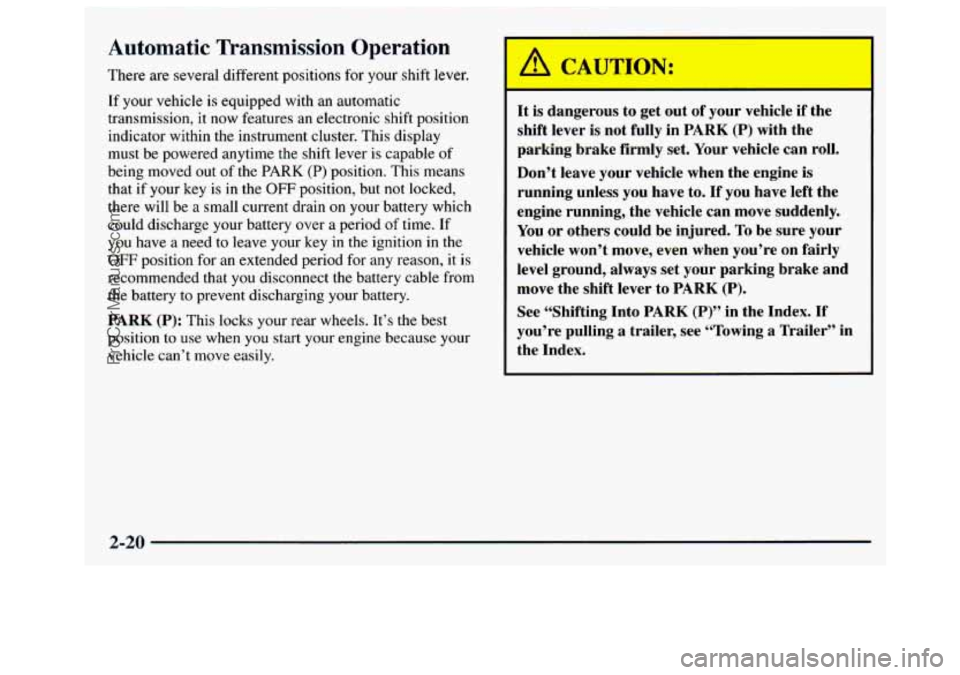
It is dangerous to get out of your vehicle if the
shift lever
is not fully in PARK (P) with the
parking brake firmly set. Your vehicle can roll.
Don’t leave your vehicle when the engine
is
running unless you have to. If you have left the
engine running, the vehicle can move suddenly.
You or others could be injured. To be sure your
vehicle won’t move, even when you’re on fairly
level ground, always set your parking brake and
move the shift lever to
PARK (P).
See “Shifting Into PARK (P)” in the Index. If
you’re pulling
a trailer, see “Towing a Trailer” in
the Index.
2-20
ProCarManuals.com
Page 113 of 388
Air Bag Readiness Light
There is an air bag readiness light on the instrument
panel, which shows
AIR BAG. The system checks the
air bag’s electrical system
for malfunctions. The light
tells you if there
is an electrical problem. The system
check includes the air bag sensor, the
air bag modules,
the wiring and the crash sensing and diagnostic module.
For more information on the air bag system, see “Air
Bag” in the Index.
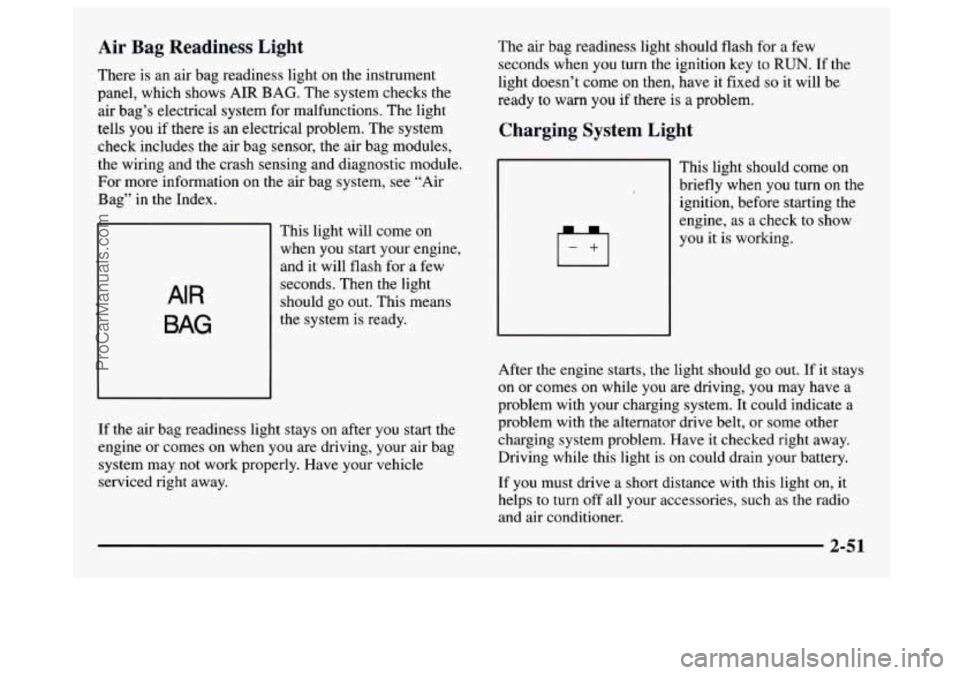
AIR
BAG
This light will come on
when you start your engine,
and it will flash for a few
seconds. Then the light
should go out. This means
the system is ready.
If the air bag readiness light stays on after you start the
engine or comes on when you are driving, your air bag
system may not work properly. Have your vehicle
serviced right away. The
air bag readiness light should
flash for a few
seconds when you turn the ignition key to
RUN. If the
light doesn’t come on then, have it fixed
so it will be
ready to warn
you if there is a problem.
Charging System Light
This light should come on
briefly when you turn
on the
ignition, before starting the
engine, as a check to show
you it is working.
After the engine starts, the light should go out. If
it stays
on or comes on while you are driving, you may have a
problem with your charging system. It could indicate a
problem with the alternator
drive belt, or some other
charging system problem. Have it checked right away.
Driving while this light is on could drain your battery.
If you must drive a short distance with this light on, it
helps to turn off all your accessories, such as the radio
and air conditioner.
2-51
ProCarManuals.com
Page 296 of 388
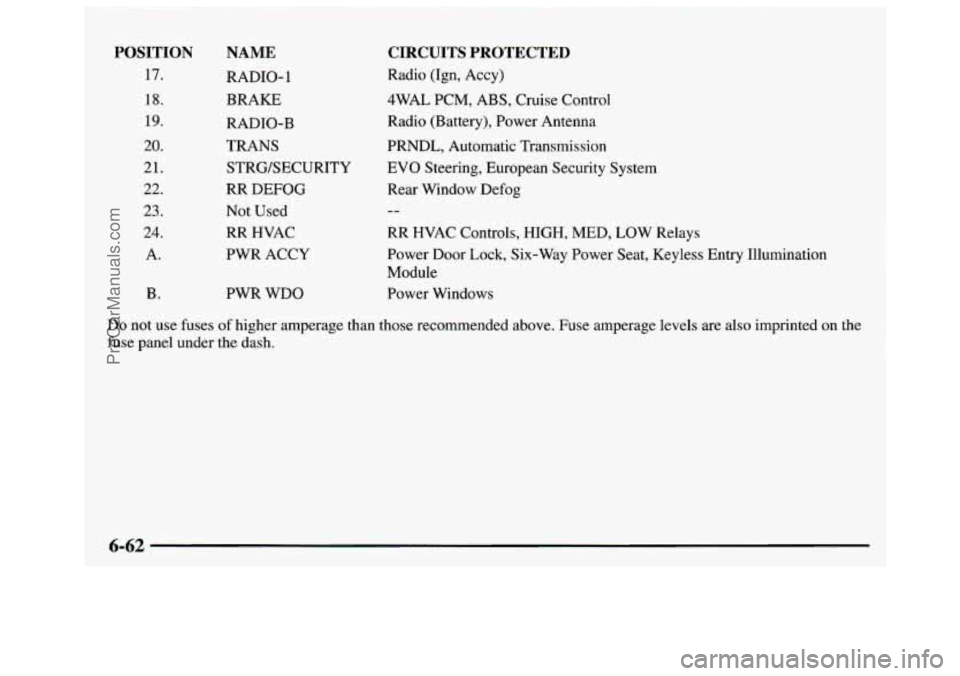
POSITION
17.
18.
19.
20.
21.
22.
23.
24.
A.
B.
NAME
RADIO- 1
BRAKE
RADIO-B TRANS STRGISECURITY
RR DEFOG
Not Used
RR HVAC
PWR ACCY
PWR WDO
CIRCUITS PROTECTED
Radio (Ign, Accy)
4WAL PCM, ABS, Cruise Control
Radio (Battery), Power Antenna
PRNDL, Automatic Transmission
EVO Steering, European Security System
Rear Window Defog
RR HVAC Controls, HIGH, MED, LOW Relays
Power Door Lock, Six-Way Power Seat, Keyless Entry Illumination
Module
Power Windows
Do not use fuses of higher amperage than those recommended above. Fuse amperage levels are also imprinted on the
fuse panel under the dash.
6-62
ProCarManuals.com
Page 365 of 388
Roadside Assistance
In
nnl
GMC’s Roadside Assistance provides stranded owners
with over-the-phone roadside repairs, location of the
nearest GMC dealer or
the following special services:
Flat Tire Change: Installation of spare tire will be
covered at no charge (customer is responsible for repair
or replacement of tire).
Fuel Delivery: Delivery of enough fuel for the customer
to get to the nearest service station (up to
$4.00) will
be covered.
Jump Start: No-start situations which require a battery
jump start will be covered at no charge.
Lock Out: Replacement keys or locksmith service will
be covered
at no charge if you are unable to gain entry
into your vehicle. Delivery
of the replacement key will
be covered at no charge within
10 miles (16 km).
Emergency Towing Service: Towing to the nearest
GMC dealer for warranty related disablements will
be covered.
8-5
ProCarManuals.com
Page 375 of 388
Section 9 Index
Adjustable Mast Antenna ........................ 3-28
AirBag
....................................... 1-25
Adding Equipment
............................ 1-32
How Does it Restrain
.......................... 1-30
How
it Works ................................ 1-28
Location
.................................... 1-28
Readiness Light
......................... 1.27. 2.5 1
Servicing ................................... 1-31
What Makes
it Inflate .......................... 1-29
What Will
You See After it Inflates ............... 1-30
When Should it Inflate
......................... 1-29
Aircleaner
.................................... 6-17
Air Conditioning
................................ 3 -7
Air Conditioning Refrigerants
..................... 6-67
Alignment and Balance. Tire
...................... 6-47
Aluminum Wheels. Cleaning
...................... 6-55
Antenna. Adjustable Mast
........................ 3-28
Antenna. Power
................................ 3-28
Antifreeze
..................................... 6-22
Anti-Lock
Brake System Warning Light
................ 2.53. 4.7
Brakes
...................................... 4-7
Appearance Care
............................... 6-49
Air Control.
Climate Control System
................. 3-3 Appearance
Care Materials
....................... 6-57
Arbitration Program .............................. 8-9
Audio Systems
.................................. 3-8
Automatic Transmission
Transmission Check
........................... 7-46
Transmission Fluid
............................ 6-18
Transmission Operation
........................ 2-20
Transmission Park Mechanism Check
............. 7-48
Axle. Locking Rear
............................. 2-23
Axle. Rear
.................................... 6-22
Ashtrays
...................................... 2-43
Shifting
..................................... 2-20
Battery
...................................... 6-32
Jump Starting
................................. 5-3
Replacement. Remote Keyless Entry
............... 2-8
Warnings
.................................... 5-3
Warnings
.................................... 5-3
Before Leaving on a Long Trip
.................... 4-21
Blizzard. Driving In
............................. 4-25
BBB Auto
Line
................................. 8-9
Better Business Bureau Mediation
................... 8-9
9-1
ProCarManuals.com