engine coolant GMC SAVANA 1998 User Guide
[x] Cancel search | Manufacturer: GMC, Model Year: 1998, Model line: SAVANA, Model: GMC SAVANA 1998Pages: 388, PDF Size: 20.04 MB
Page 216 of 388
Cooling System (Gasoline Engines)
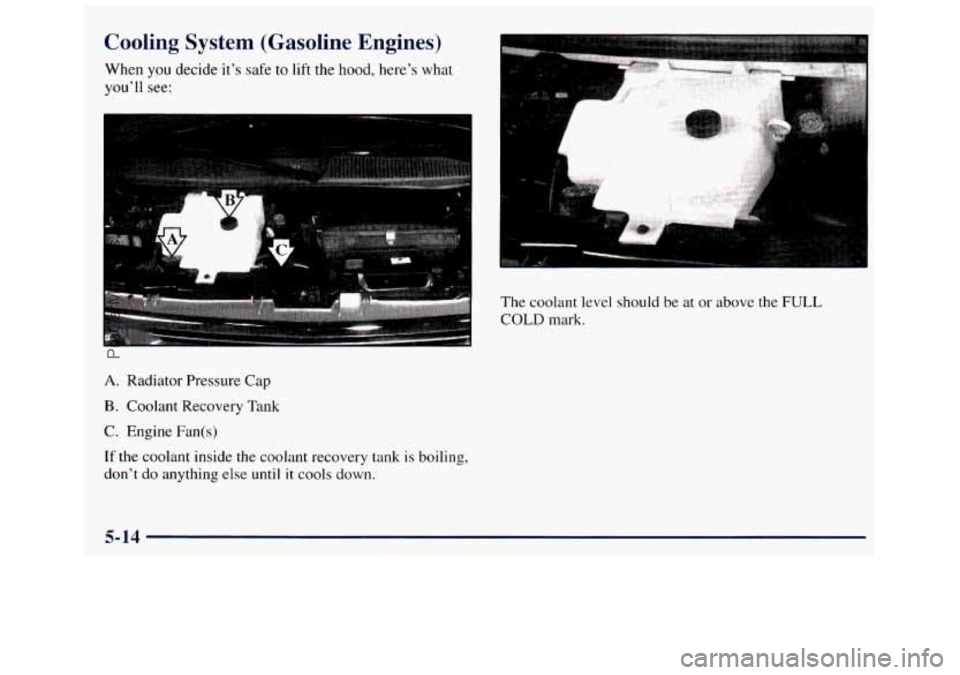
When you decide it’s safe to lift the hood, here’s what
you’ll see:
.. .
A. Radiator Pressure Cap
B. Coolant Recovery Tank
C. Engine Fan(s)
If the coolant inside the coolant recovery tank is boiling,
don’t do anything else
until it cools down.
e;- ..
The coolant level should be at or above the FULL
COLD mark.
5-14
ProCarManuals.com
Page 217 of 388
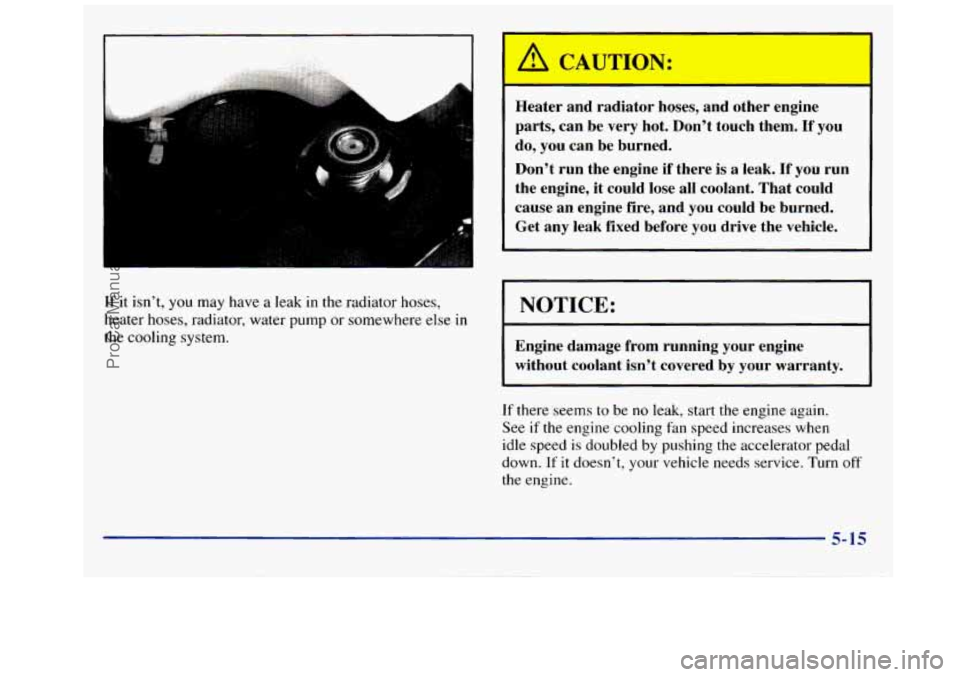
If it isn’t, you may have a leak in the radiator hoses,
heater hoses, radiator, water pump or somewhere else
in
the cooling system.
Heater and radiator hoses, and other engine
parts, can be very hot. Don’t touch them.
If you
do, you can be burned.
Don’t run the engine if there is
a leak. If you run
the engine, it could lose all coolant. That could
cause an engine fire, and you could be burned.
Get any leak fixed before
you drive the vehicle.
I NOTICE:
Engine damage from running your engine
without coolant isn’t covered by your warranty.
If there seems to be no leak, start the engine again.
See
if the engine cooling fan speed increases when
idle speed
is doubled by pushing the accelerator pedal
down.
If it doesn’t, your vehicle needs service. Turn off
the engine.
5-15
ProCarManuals.com
Page 218 of 388
How to Add Coolant to the Coolant
Recovery
Tank
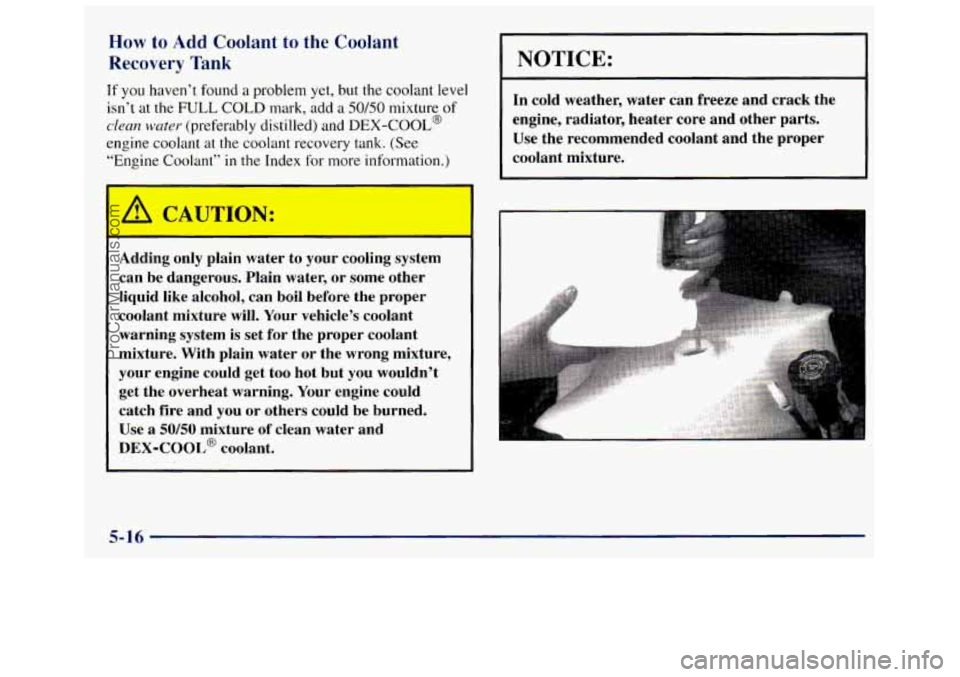
If you haven’t found a problem yet, but the coolant level
isn’t
at the FULL COLD mark, add a 50/50 mixture of
clean water (preferably distilled) and DEX-COOL@
engine coolant at the coolant recovery tank. (See
“Engine Coolant“
in the Index for more information.)
A C”UT1 )N:
Adding only plain water to your cooling system
can be dangerous. Plain water, or some other
liquid like alcohol, can boil before the proper
coolant mixture will. Your vehicle’s coolant
warning system is set for the proper coolant
mixture. With plain water or the wrong mixture,
your engine could get too hot but you wouldn’t
get the overheat warning. Your engine could
catch fire and you or others could be burned.
Use a
50/50 mixture of clean water and
DEX-COOL@ coolant.
I NOTICE:
In cold weather, water can freeze and crack the
engine, radiator, heater core and other parts.
Use the recommended coolant and the proper
coolant mixture.
5-16
ProCarManuals.com
Page 219 of 388
A CAUTION:
You can be burned if you spill coolant on hot
engine parts. Coolant contains ethylene glycol
and
it will burn if the engine parts are hot
enough. Don’t spill coolant on a hot engine.
When the coolant in the coolant recovery tank is at the
FULL COLD mark, start your vehicle.
If the overheat warning continues, there’s one more
thing you can try.
You can add the proper coolant
mixture directly to the radiator, but be sure the cooling
system is cool before you
do it.
-
A CAUTION:
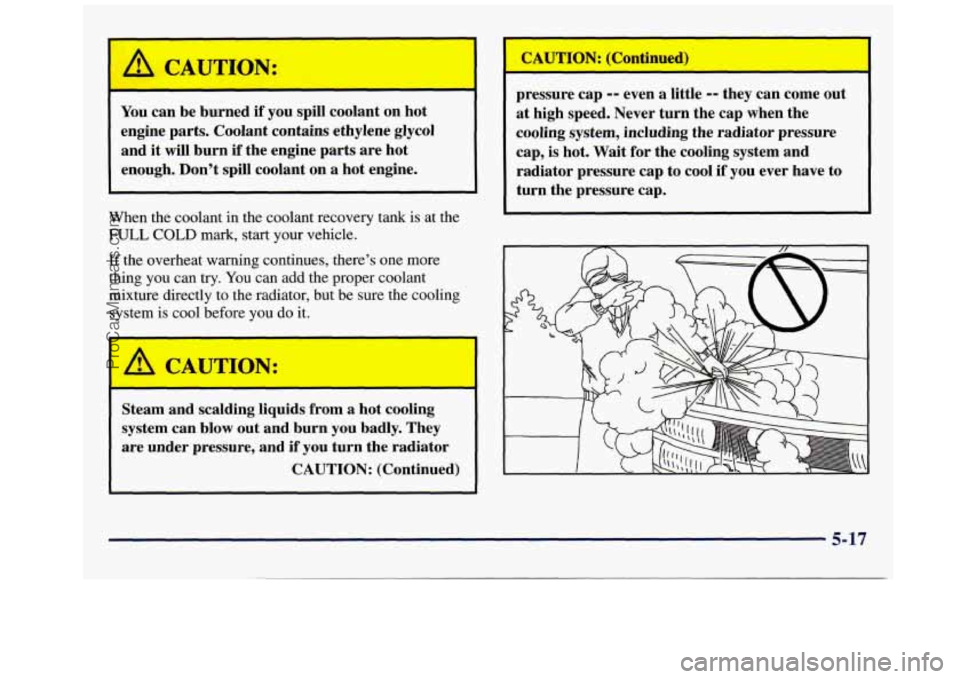
Steam and scalding liquids from a hot cooling
system can blow out and burn you badly. They
are under pressure, and if you turn the radiator
CAUTION: (Continued) CAUTION: (Continued)
pressure cap
-- even a little -- they can come out
at high speed. Never turn the cap when the
cooling system, including the radiator pressure
cap, is hot. Wait for the cooling system and
radiator pressure cap to cool
if you ever have to
turn the pressure cap.
5-17
ProCarManuals.com
Page 221 of 388
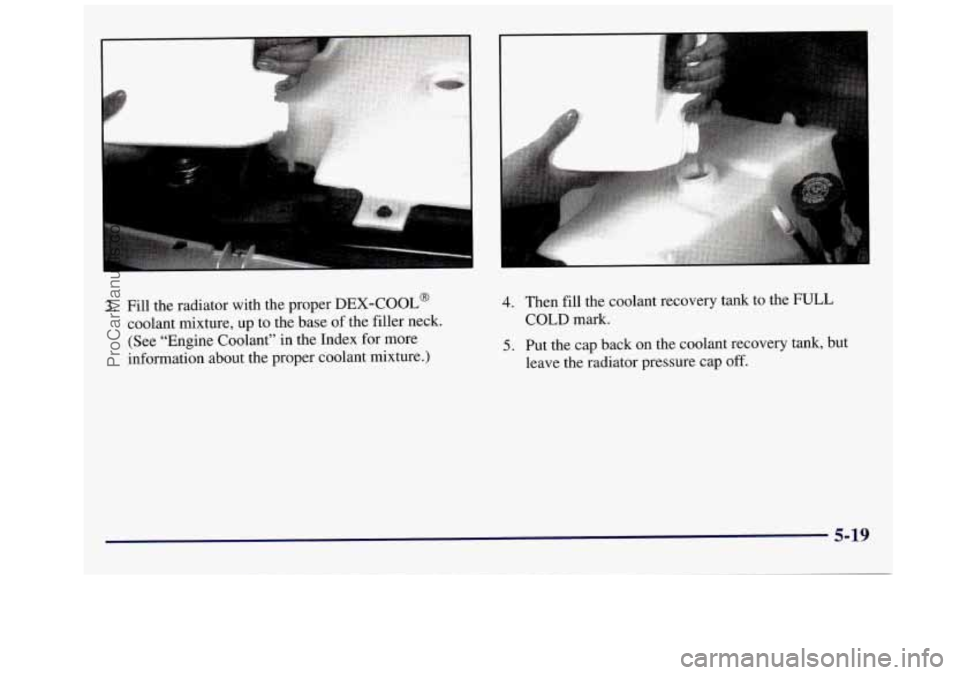
3. Fill the radiator with the proper DEX-COOL@
coolant mixture, up to the base of the filler neck.
(See “Engine Coolant’’ in the Index for more
information about the proper coolant mixture.)
4. Then fill the coolant recovery tank to the
COLD mark.
5. Put the cap back on the coolant recovery tank, but
leave the radiator pressure cap off.
5-19
ProCarManuals.com
Page 222 of 388
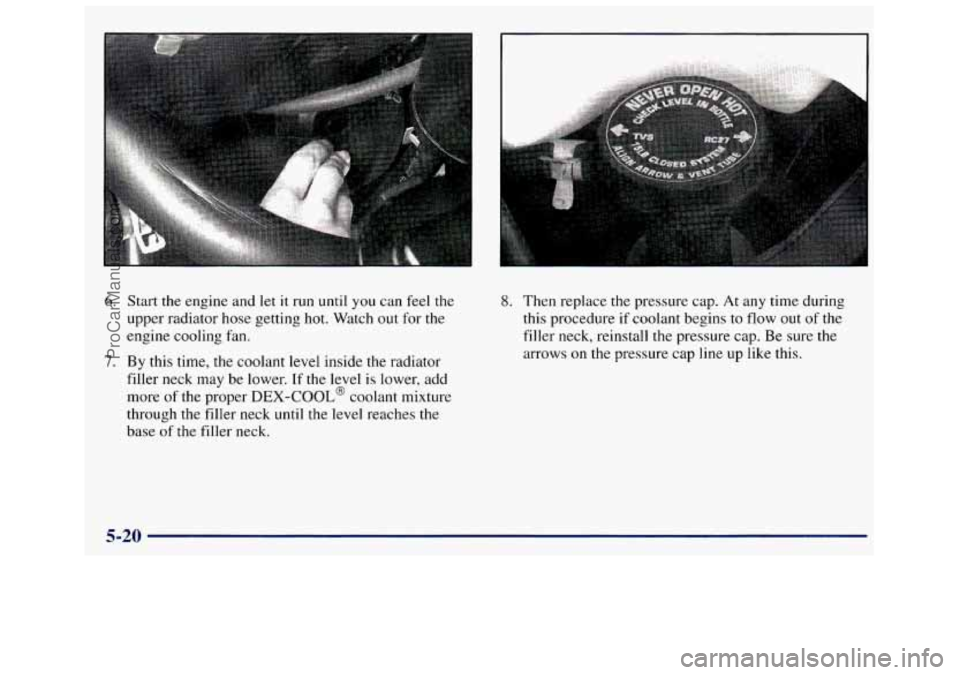
6.
7.
Start the engine and let it run until you can feel the
upper radiator hose getting
hot. Watch out for the
engine cooling fan.
By this time, the coolant level inside the radiator
filler neck may be lower. If the level
is lower, add
more
of the proper DEX-COOL@ coolant mixture
through the filler neck until the
level reaches the
base
of the filler neck.
8. Then replace the pressure cap. At any time during
this procedure
if coolant begins to flow out of the
filler neck, reinstall
the pressure cap. Be sure the
arrows on the pressure cap line up like this.
5-20
ProCarManuals.com
Page 241 of 388
Section 6 Service and Appearance Care
Here you will find information about the care of your vehicle. This section begins with service and fuel information,
and then it shows how to check important fluid and lubricant levels. There is also technical information about your
6-2
6-3
6-5
6-5
6-7
6-8
6- 11
6- 12
6- 16
6-
17
6-2 1
6-2 1
6-24
6-25
6-25
6-26
6-27
6-3
1
vehicle, and a part devoted to its appearance care.
Service
Fuel (Gasoline Engine)
Fuels in Foreign Countries (Gasoline Engines)
Filling Your Tank (Gasoline Engine)
Filling a Portable Fuel Container
Checking Things Under the Hood
Noise Control System Engine Oil (Gasoline Engine)
Air Cleaner (Gasoline Engines)
Automatic Transmission Fluid
Rear Axle
Engine Coolant
Radiator Pressure Cap
Thermostat
Power Steering Fluid
Windshield Washer Fluid
Brakes
Battery
6-32
6-32
6-40
6-4
1
6-5 1
6-5 1
6-55
6-56
6-57
6-57
6-57
6-59
6-60
6-6
1
6-66
6-67
6-69 Bulb
Replacement
Halogen Bulbs
Windshield Wiper Blade Replacement
Tires Appearance Care
Cleaning the Inside
of Your Vehicle
Cleaning the Outside of Your Vehicle
Cleaning Aluminum Wheels (If Equipped)
Cleaning Tires
Sheet Metal Damage
Finish Damage
Appearance Care Materials Chart
Vehicle Identification Number (VJN)
Electrical System
Replacement Bulbs
Capacities and Specifications
Normal Maintenance Replacement Parts
6-1
ProCarManuals.com
Page 248 of 388
Checking Things Under the Hood
A CAUTION:
If your vehicle has air conditioning, the auxiliary
engine fan under the hood can start up and
injure you even when the engine is not running.
Keep hands, clothing and tools
away from any
underhood electric fan.
A CAUTION:
Things that burn can get on hot engine parts
and start
a fire. These include liquids like
gasoline
or diesel fuel, oil, coolant, brake fluid,
windshield washer and other fluids, and plastic
or rubber. You or others could be burned. Be
careful not to drop or spill things that will burn
onto a hot engine.
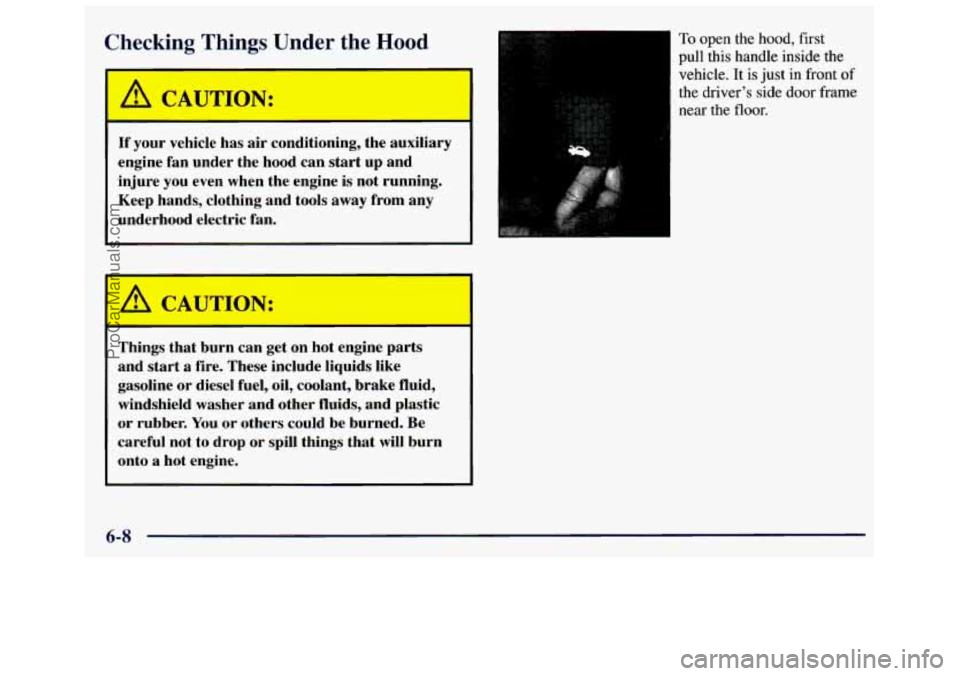
To open the hood, first
pull this handle inside the
vehicle. It is
just in front of
the driver’s side door frame
near the floor.
I
6-8
ProCarManuals.com
Page 250 of 388
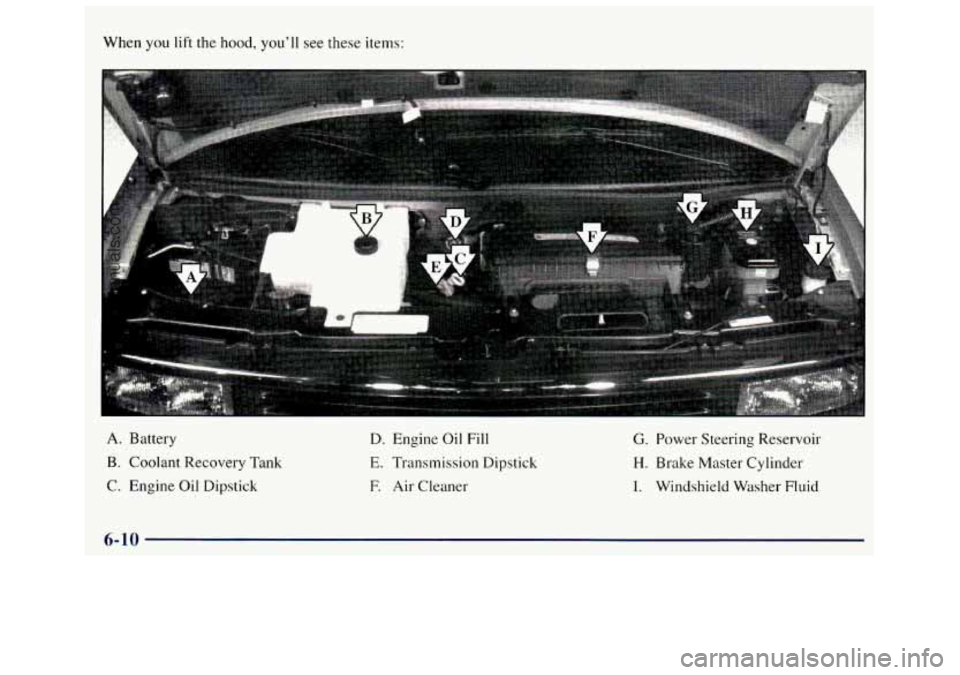
When you lift the hood, you’ll see these items:
A
A. Battery
B. Coolant Recovery I ank
C. Engine Oil Dipstick D.
Engine Oil Fill
E. Transmission Dipstick
E Air Cleaner
G. Power Steering Reservoir
H. Brake Master Cylinder
I. Windshield Washer Fluid
6-10
ProCarManuals.com
Page 253 of 388
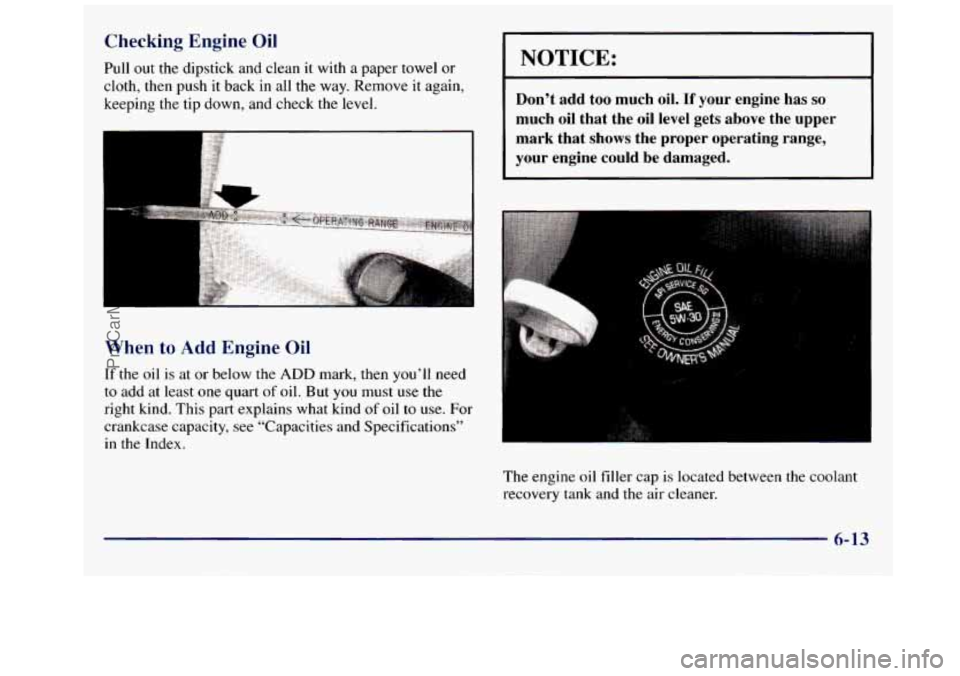
Checking Engine Oil
Pull out the dipstick and clean it with a paper towel or
cloth, then push
it back in all the way. Remove it again,
keeping the tip down, and check the level.
When to Add Engine Oil
If the oil is at or below the ADD mark, then you’ll need
to add at least one quart of oil. But you must use the
right kind. This part explains what kind of oil to use. For
crankcase capacity, see “Capacities and Specifications”
in the Index.
I NOTICE:
Don’t add too much oil. If your engine has so
much oil that the oil level gets above the upper
mark that shows the proper operating range, your engine could be damaged.
The engine oil filler cap is located between the coolant
recovery tank and the air cleaner.
6-13
ProCarManuals.com