engine oil GMC SAVANA 1998 Owner's Manual
[x] Cancel search | Manufacturer: GMC, Model Year: 1998, Model line: SAVANA, Model: GMC SAVANA 1998Pages: 388, PDF Size: 20.04 MB
Page 261 of 388
Rear Axle What to Use
When to Check and Change Lubricant
Refer to the Maintenance Schedule to determine how
often to check the lubricant and when to change it. See
“Scheduled Maintenance Services” in the Index.
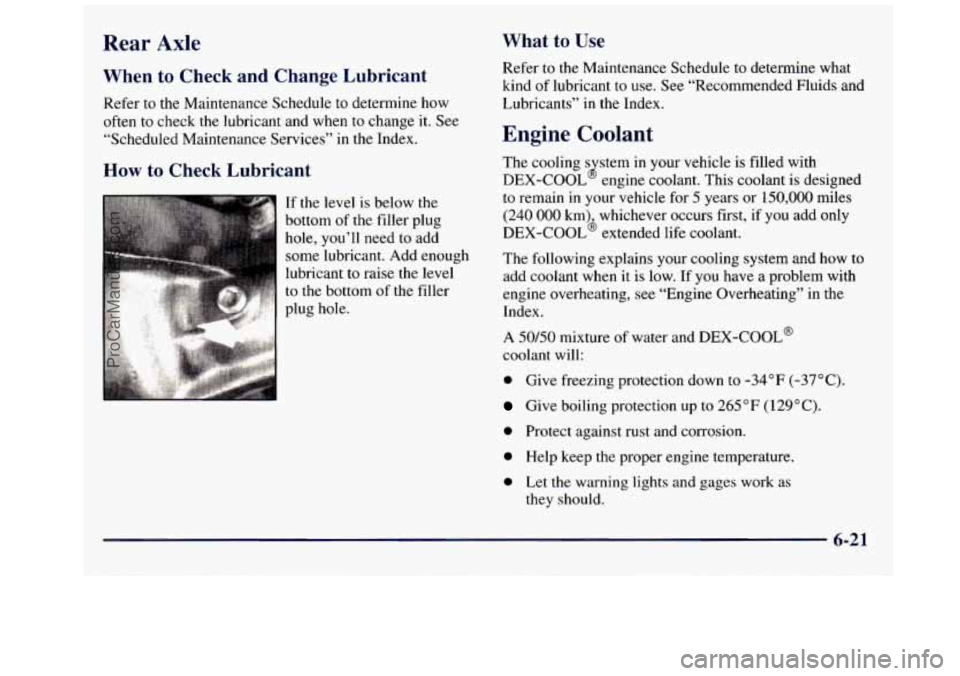
How to Check Lu’_ -~I
If the level is below the
bottom of the filler plug
hole, you’ll need
to add
some lubricant. Add enough
lubricant to raise the level
to the bottom of the filler
plug hole. Refer
to the Maintenance Schedule to determine what
kind of lubricant to use. See “Recommended Fluids and
Lubricants”
in the Index.
Engine Coolant
The cooling s stem in your vehicle is filled with
DEX-COOL engine coolant. This coolant is designea
to remain
in your vehicle for 5 years or 150,000 miles
(240 000 km) whichever occurs first, if you add only
DEX-COOL6 extended life coolant.
The following explains your cooling system and how to
add coolant when it is low. If you have
a problem with
engine overheating, see “Engine Overheating” in the
Index.
A 50/50 mixture of water and DEX-COOL@
coolant will:
2
0 Give freezing protection down to -34°F (-37°C).
Give boiling protection up to 265 “F (129” C).
0 Protect against rust and corrosion.
0 Help keep the proper engine temperature.
0 Let the warning lights and gages work as
they should.
6-21
ProCarManuals.com
Page 262 of 388
NOTICE:
When adding coolant, it is important that you
use only
DEX-COOL@ (silicate-free) coolant.
If coolant other than DEX-COOL is added to
the system, premature engine, heater core or
radiator corrosion may result. In addition, the
engine coolant will require change sooner
-- at
30,000 miles (50 000 km) or 24 months,
whichever occurs
first. Damage caused by the
use of coolant other than DEX-COOL@ is not
covered by your new vehicle warranty.
What to Use
Use a mixture of one-half clean water (preferably
distilled) and one-half
DEX-COOL@ coolant which
won’t damage aluminum parts. If you
use this mixture,
you don’t need
to add anything else.
I
A CAC LILA:
Adding only plain water to your cooling system
can be dangerous. Plain water, or some other
liquid like alcohol, can boil before the proper
coolant mixture will. Your vehicle’s coolant
warning system
is set for the proper coolant
mixture. With plain water or the wrong mixture,
your engine could get too hot but you wouldn’t
get the overheat warning. Your engine could
catch fire and you or others could be burned.
Use
a 50/50 mixture of clean water and
DEX-COOL@ coolant.
6-22
ProCarManuals.com
Page 269 of 388
After work is done on the brake hydraulic system,
make sure the level is above the MIN but not over
the MAX mark or the top of the window on the side
of the reservoir.
What to Add
When you do need brake fluid, use only DOT-3 brake
fluid
-- such as Delco Supreme 11 @ (GM Part
No. 12377967). Use new brake fluid from a sealed
container only.
Always clean the brake fluid reservoir cap and the area
around the cap before removing it. This will help keep
dirt from entering the reservoir.
b CAUTION:
With the wrong kind of fluid in your brake
system, your brakes may not work well, or they
may not even work
at all. This could cause a
crash. Always use the proper brake fluid.
NOTICE:
0 Using the wrong fluid can badly damage
brake system parts. For example,
just a few
drops
of mineral-based oil, such as engine
oil, in your brake system can damage brake
system parts
so badly that they’ll have to be
replaced. Don’t let someone put in the
wrong kind of fluid.
0 If you spill brake fluid on your vehicle’s
painted surfaces, the paint finish can be
damaged. Be careful not to spill brake
fluid on your vehicle.
If’ you do, wash it off
immediately. See “Appearance Care” in
the Index.
6-29
ProCarManuals.com
Page 306 of 388
NAME
RH-HIBM
ECM-I
HORN
LH-HDLP
LH-HIBM
FUEL SOL
IGN-E
ECM-B
CIRCUITS PROTECTED
Right-hand High-beam Headlamp
(Export only)
Ignition Coil, Camshaft Position
Sensor,
VCM, Fuel Injectors, Coil
Driver
Horn Relay, Underhood Lamp( s)
Left-hand Headlamp (Export
only)
Left-hand High-beam Headlamp
(Export only)
PCM,
Fuel Solenoid Driver, Engine
Shutoff Solenoid
Air Conditioning Clutch Relay
Fuel Pump Relay, VCM, PCM, Fuel
Pump and Engine Oil Pressure
Switch
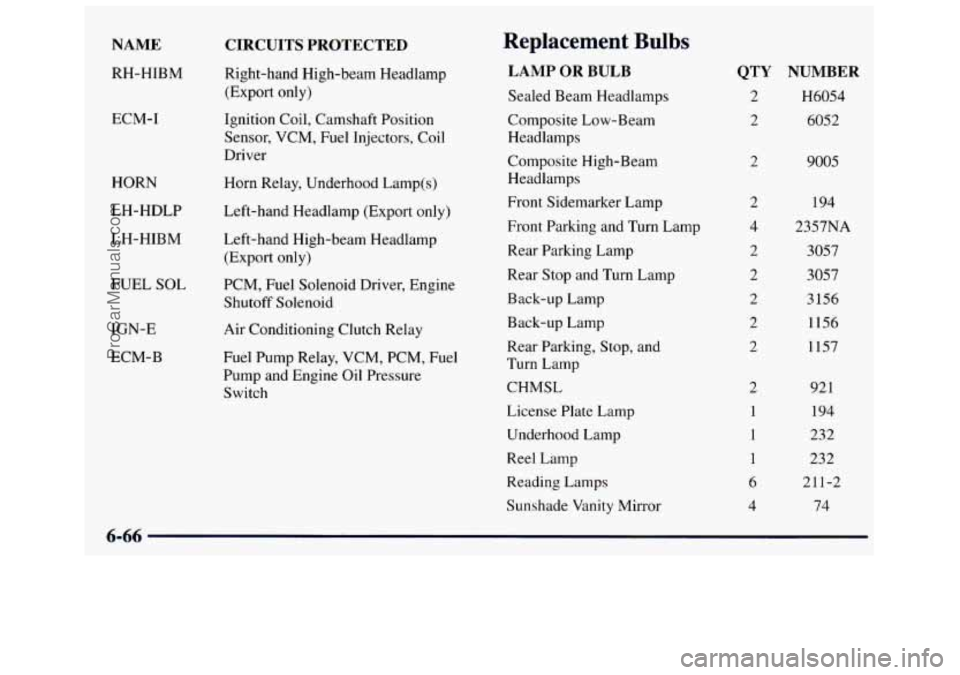
Replacement Bulbs
LAMP OR BULB
Sealed Beam Headlamps
Composite Low-Beam
Headlamps
Composite High-Beam
Headlamps
Front Sidemarker Lamp
Front Parking and Turn Lamp
Rear Parking Lamp
Rear Stop and Turn Lamp
Back- up Lamp
Back-up Lamp
Rear Parking, Stop, and
Turn Lamp
CHMSL
License Plate Lamp
Underhood Lamp
Reel Lamp
Reading Lamps
Sunshade Vanity Mirror
QTY NUMBER
2 H6054
2 6052
2
2
4
2
1
1
1
6
4
9005
194
2357NA
3057
3057
3156
1156 1157
92
1
194
232
232
211-2
74
6-66
ProCarManuals.com
Page 308 of 388
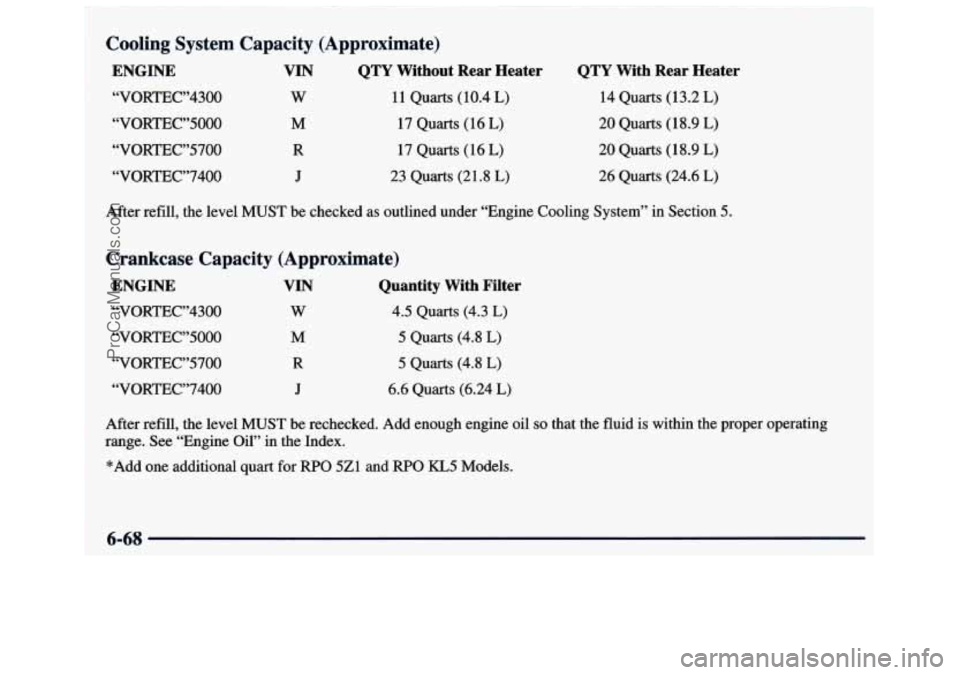
Cooling System Capacity (Approximate)
ENGINE VIN QTY Without Rear Heater
“VORTEC”4300 W 11 Quarts (10.4 L)
“VORTEC”5000 M 17 Quarts (16 L)
“VORTEC”5700 R 17 Quarts (16 L)
“VORTEC”7400 J 23 Quarts (21.8 L)
QTY With Rear Heater
14 Quarts (13.2 L)
20 Quarts (18.9 L)
20 Quarts (18.9 L)
26 Quarts (24.6 L)
After refill, the level MUST be checked as outlined under “Engine Cooling System” in Section 5.
Crankcase Capacity (Approximate)
ENGINE VIN Quantity With Filter
“VORTEC”4300 W 4.5 Quarts (4.3 L)
“VORTEC”5000 M 5 Quarts (4.8 L)
“VORTEC”5700 R 5 Quarts (4.8 L)
“VORTEC”7400 J 6.6 Quarts (6.24 L)
After refill, the level MUST be rechecked. Add enough engine oil so that the fluid is within the proper operating
range. See “Engine Oil” in the Index.
*Add one additional quart for
RPO 5Z1 and RPO KL5 Models.
ProCarManuals.com
Page 309 of 388
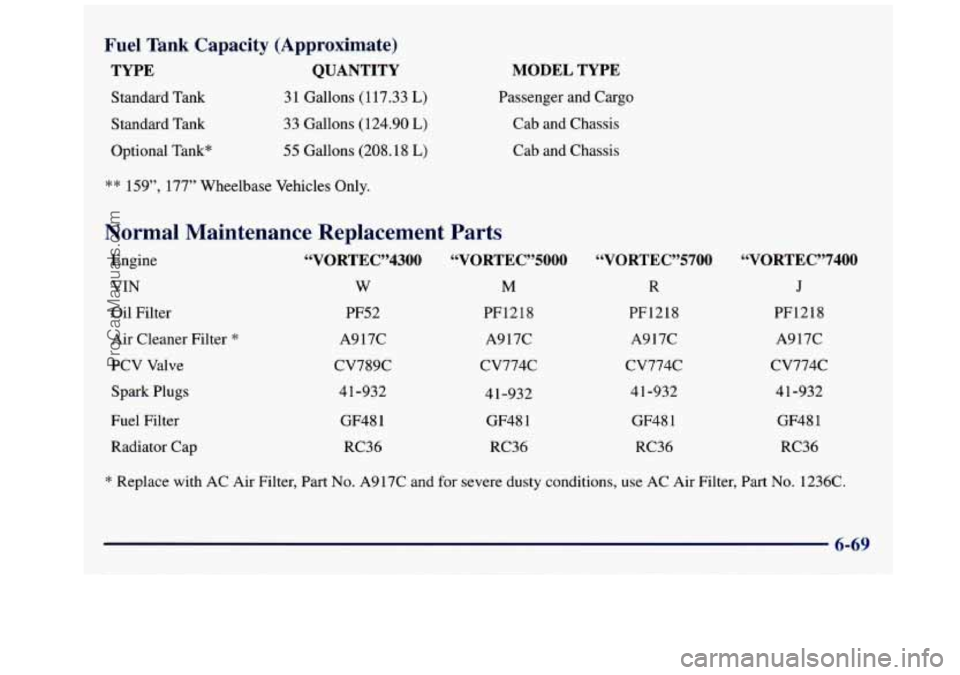
Fuel Tank Capacity (Approximate)
TYPE QUANTITY
Standard Tank 3 1 Gallons (117.33 L)
Standard Tank 33 Gallons (124.90 L)
Optional Tank* 55 Gallons (208.18 L)
** 159”, 177” Wheelbase Vehicles Only.
MODEL TYPE
Passenger and Cargo
Cab and Chassis
Cab and Chassis
Normal Maintenance Replacement Parts
Engine “VORTEC”4300 “VORTEC”5000
VIN W M
Oil Filter PF52 PF1218
Air Cleaner Filter
* A917C A917C
PCV Valve CV789C cv774c
Spark Plugs 41-932 4 1-932
Fuel Filter GF48 1 GF48 1
Radiator Cap
RC36 RC36
“VORTEC”5700
R
PF1218
A917C
cv774c 4 1-932
GF48 1
RC36
“VORTEC”7400
J
PF1218 A917C
cv774c 4 1-932
GF48
1
RC36
* Replace with AC Air Filter, Part No. A917C and for severe dusty conditions, use AC Air Filter, Part No. 1236C.
6-69
ProCarManuals.com
Page 314 of 388
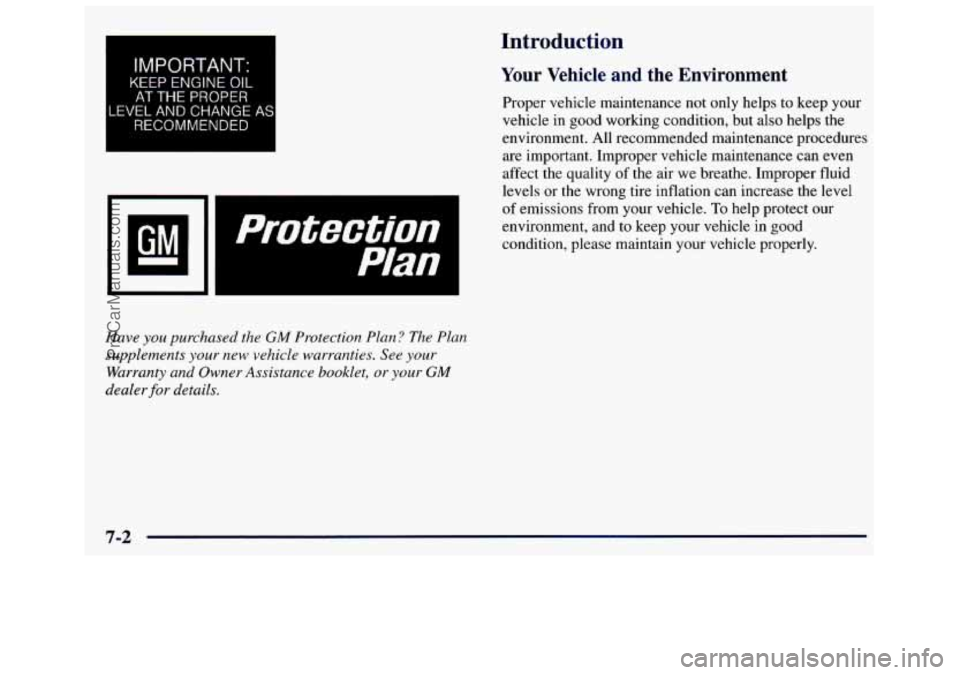
I IMPORTANT: I
KEEP ENGINE OIL
AT THE PROPER
LEVEL AND CHANGE
AS
RECOMMENDED
Introduction
Your Vehicle and the Environment
Proper vehicle maintenance not only helps to keep your
vehicle in good working condition, but also helps the
environment. All recommended maintenance procedures
are important. Improper vehicle maintenance can even
affect the quality
of the air we breathe. Improper fluid
levels or
the wrong tire inflation can increase the level
of emissions from your vehicle. To help protect our
environment, and to keep your vehicle in good
condition, please maintain your vehicle properly.
Have you purchused the GM Protection Plan? The Plan
supplements
your new vehicle warranties. See your
Warranty and Owner Assistance booklet,
or your GM
dealer for detuils.
7-2
ProCarManuals.com
Page 317 of 388
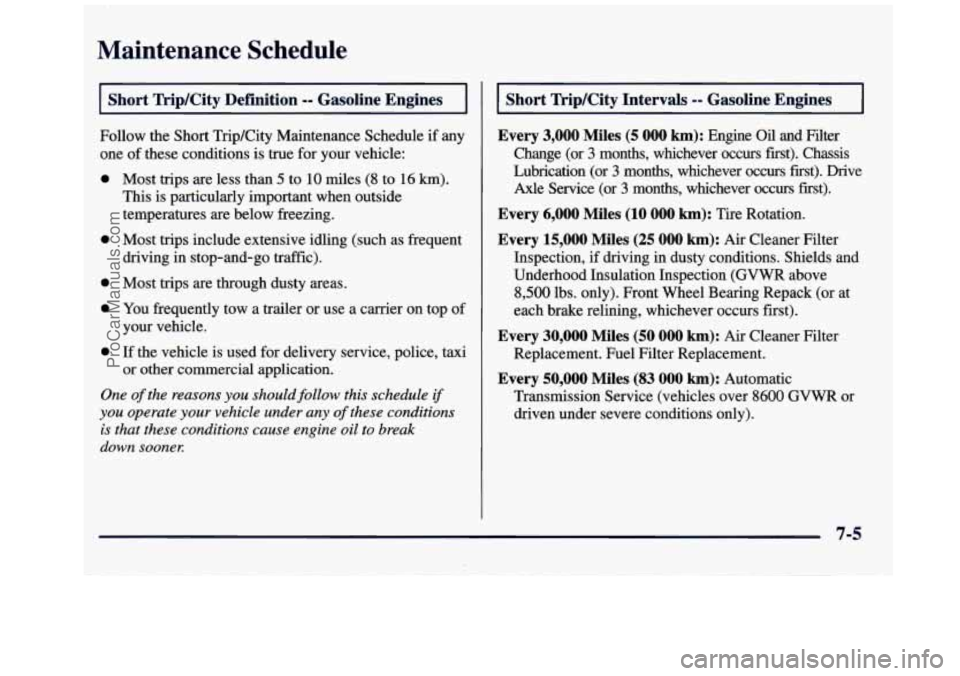
Maintenance Schedule
I Short TripKity Definition -- Gasoline Engines I
Follow the Short TripKity Maintenance Schedule if any
one of these conditions is true for your vehicle:
0
0
0
0
0
Most trips are less than 5 to 10 miles (8 to 16 km).
This is particularly important when outside
temperatures are below freezing.
Most trips include extensive idling (such as frequent
driving in stop-and-go traffic).
Most trips are through dusty areas.
You frequently tow a hailer or use a carrier on top of
your vehicle.
If the vehicle is used for delivery service, police, taxi
or other commercial application.
One of the reasons you should follow this schedule if
you operate your vehicle under any of these conditions
is that these conditions cause engine oil to break
down soonex
Short TriplCity Intervals -- Gasoline Engines
Every
3,000 Miles (5 000 km): Engine Oil and Filter
Change (or
3 months, whichever occurs fist). Chassis
Lubrication (or
3 months, whichever occurs first). Drive
Axle Service (or 3 months, whichever occurs first).
Every 6,000 Miles (10 000 km): Tire Rotation.
Every 15,000 Miles (25 000 km): Air Cleaner Filter
Inspection, if driving in dusty conditions. Shields and
Underhood Insulation Inspection
(GVWR above
8,500 lbs. only). Front Wheel Bearing Repack (or at
each brake relining, whichever occurs first).
Every 30,000 Miles (50 000 km): Air Cleaner Filter
Replacement. Fuel Filter Replacement.
Every 50,000 Miles (83 000 km): Automatic
Transmission Service (vehicles over 8600
GVWR or
driven under severe conditions only).
7-5
ProCarManuals.com
Page 318 of 388
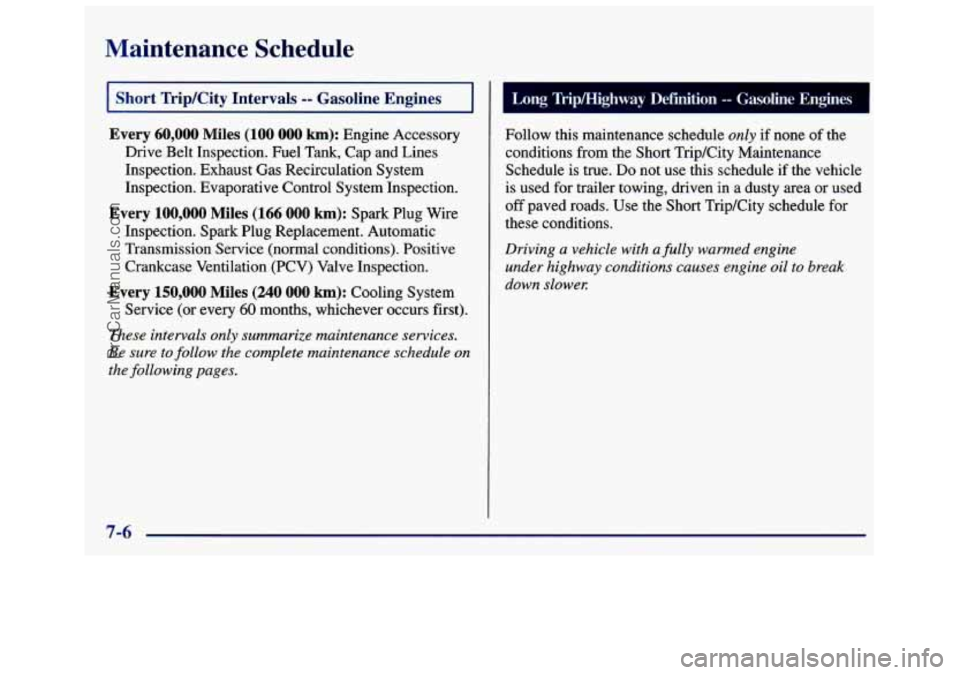
Maintenance Schedule
I Short TripKity Intervals -- Gasoline Engines I
Every 60,000 Miles (100 000 km): Engine Accessory
Drive Belt Inspection. Fuel Tank, Cap and Lines
Inspection. Exhaust Gas Recirculation System
Inspection. Evaporative Control System Inspection.
Every 100,000 Miles (166 000 km): Spark Plug Wire
Inspection. Spark Plug Replacement. Automatic
Transmission Service (normal conditions). Positive
Crankcase Ventilation (PCV) Valve Inspection.
Every 150,000 Miles (240 000 km): Cooling System
Service (or
every 60 months, whichever occurs first).
These intervals only summarize maintenance services.
Be sure to follow the complete maintenance schedule on
the following pages.
1 Long Wp/Highway Def~tion -- Gasoline Engine
Follow this maintenance schedule only if none of the
conditions from the Short Trip/City Maintenance
Schedule is true.
Do not use this schedule if the vehicle
is used for trailer towing, driven in a dusty area or used
off paved roads. Use the Short Trip/City schedule for
these conditions.
Driving a vehicle with a fully warmed engine
under highway conditions causes engine oil to break
down slower:
7-6
ProCarManuals.com
Page 319 of 388
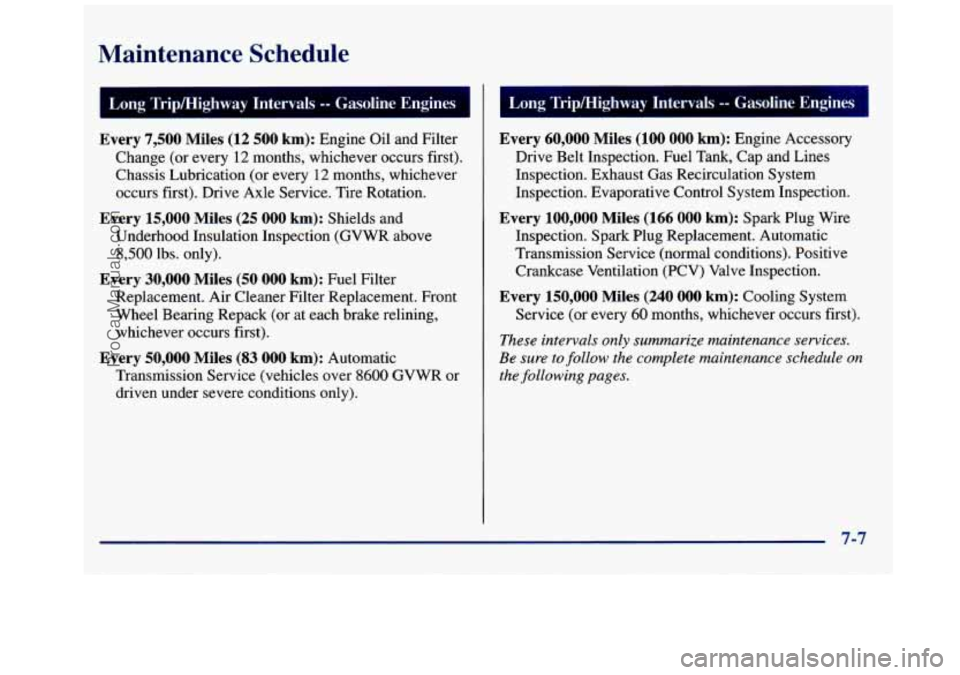
Maintenance Schedule
I Long Tripmighway Intervals -- Gasoline Engines J
Every 7,500 Miles (12 500 km): Engine Oil and Filter
Change (or every
12 months, whichever occurs first).
Chassis Lubrication (or every
12 months, whichever
occurs first). Drive Axle Service. Tire Rotation.
Every 15,000 Miles (25 000 km): Shields and
Underhood Insulation Inspection (GVWR above
8,500 lbs. only).
Every 30,000 Miles (50 000 km): Fuel Filter
Replacement. Air Cleaner Filter Replacement. Front
Wheel Bearing Repack (or at each brake relining,
whichever occurs first).
Transmission Service (vehicles over
8600 GVWR or
driven under severe conditions only).
Every 50,000 Miles (83 000 km): Automatic
1 Long Tripmighway Intervals -- Gasoline Engines
Every 60,000 Miles
(100 000 km): Engine Accessory
Drive Belt Inspection. Fuel Tank, Cap and Lines
Inspection. Exhaust Gas Recirculation System
Inspection. Evaporative Control System Inspection.
Every 100,000 Miles (166 000 km): Spark Plug Wire
Inspection. Spark Plug Replacement. Automatic
Transmission Service (normal conditions). Positive
Crankcase Ventilation (PCV) Valve Inspection.
Every 150,000 Miles (240 000 km): Cooling System
Service (or every
60 months, whichever occurs first).
These intervals only summarize maintenance services.
Be
sure to follow the complete maintenance schedule on
the following pages.
7-7
ProCarManuals.com