service GMC SAVANA 1998 Owner's Manual
[x] Cancel search | Manufacturer: GMC, Model Year: 1998, Model line: SAVANA, Model: GMC SAVANA 1998Pages: 388, PDF Size: 20.04 MB
Page 200 of 388
Parking on Hills
You really should not park your vehicle, with a trailer
attached, on a hill. If something goes wrong, your rig
could start to move. People can be injured, and both
your vehicle and the trailer can be damaged.
But if you ever have to park your rig on a hill, here’s
how to do it:
1. Apply your regular brakes, but don’t shift into
PARK
(P) yet. Then turn your wheels into the curb if
facing downhill or into traffic if facing uphill.
2. Have someone place chocks under the trailer wheels.
3. When the wheel chocks are in place, release the
regular brakes until the chocks absorb the load.
4. Reapply the regular brakes. Then apply your parking
brake and then shift to
PARK (P).
5. Release the regular brakes.
When You Are Ready to Leave After
Parking
on a Hill
1. Apply your regular brakes and hold the pedal down
while you:
Start your engine;
Shift into a gear; and
Release the parking brake.
2. Let up on the brake pedal.
3. Drive slowly until the trailer is clear of the chocks.
4. Stop and have someone pick up and store the chocks.
Maintenance When Trailer Towing
Your vehicle will need service more often when you’re
pulling a trailer. See the Maintenance Schedule for more
on this. Things that are especially important in trailer
operation are automatic transmission fluid (don’t
overfill), engine oil, axle lubricant, belt, cooling system
and brake adjustment. Each of these
is covered in this
manual, and the Index will help you find them quickly.
If you’re trailering, it’s a good idea to review these
sections before you start your trip.
Check periodically to see that all hitch nuts and bolts
are tight.
4-36
ProCarManuals.com
Page 209 of 388
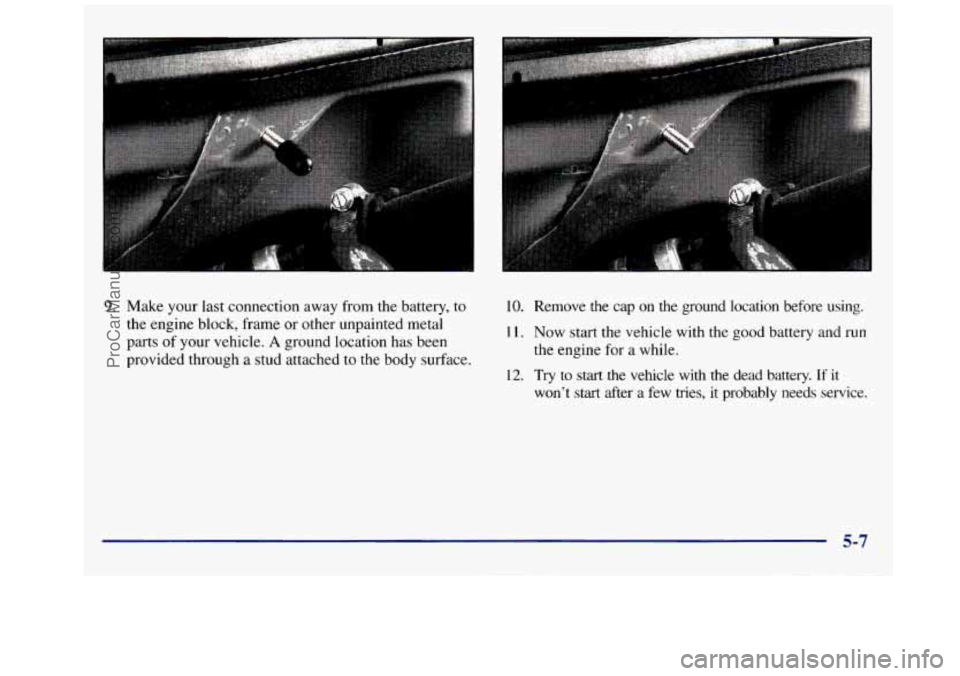
9. Make your last connection away from the battery, to
the engine block, frame or other unpainted metal
parts
of your vehicle. A ground location has been
provided through a stud attached
to the body surface.
10. Remove the cap on the ground location before using.
11. Now start the vehicle with the good battery and run
the engine for a while.
12. Try to start the vehicle with the dead battery. If it
won’t start after
a few tries, it probably needs service.
5-7
ProCarManuals.com
Page 210 of 388
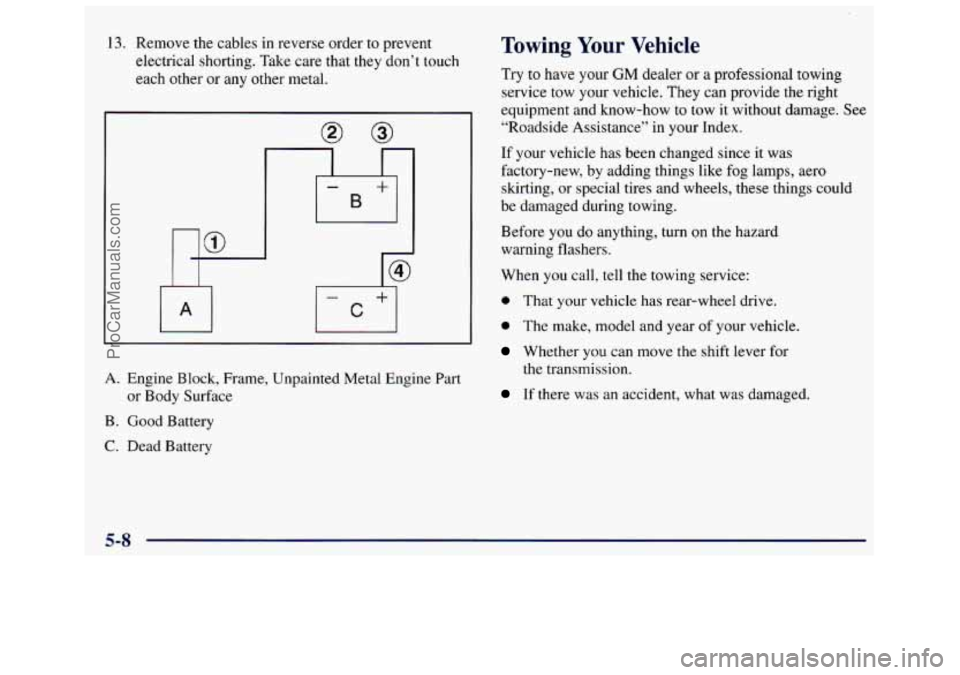
13. Remove the cables in reverse order to prevent
electrical shorting. Take care that they don’t touch
each other or any other metal.
A. Engine Block, Frame, Unpainted Metal Engine Part
or Body Surface
Towing Your Vehicle
Try to have your GM dealer or a professional towing
service tow your vehicle. They can provide the right
equipment and know-how to
tow it without damage. See
“Roadside Assistance” in your Index.
If your vehicle has been changed since it was
factory-new,
by adding things like fog lamps, aero
skirting, or special tires and wheels, these things could
be damaged during towing.
Before you do anything, turn
on the hazard
warning flashers.
When
you call, tell the towing service:
0 That your vehicle has rear-wheel drive.
0 The make, model and year of your vehicle.
Whether you can move the shift lever for
the transmission.
If there was an accident, what was damaged.
B. Good Battery
C. Dead Battery
5-8
ProCarManuals.com
Page 211 of 388
A I
I /! CAUTION:
To
0
0
0
0 0
help avoid injury
to you or others:
Never let passengers ride in a vehicle that is
being towed.
Never tow faster than safe or posted speeds.
Never tow with damaged parts not
fully secured. Never get under your vehicle after it has
been lifted by the tow truck.
Always use separate safety chains on each
side when towing a vehicle.
When your vehicle is being towed, have the ignition
key off. The steering wheel should be clamped in a
straight ahead position, with a clamping device designed
for towing service.
Do not use the vehicle’s steering
column lock for this. The transmission should be
in NEUTRAL (N) and the parking brake should
be released.
A CAUTION:
A vehicle can fall from a car carrier if it isn’t
adequately secured. This can cause a collision,
serious personal injury and vehicle damage. The
vehicle should be tightly secured with chains or
steel cables before it is transported.
Don’t use substitutes (ropes, leather straps,
canvas webbing, etc.) that can be cut by sharp
edges underneath the towed vehicle.
5-9
ProCarManuals.com
Page 215 of 388
If No Steam Is Coming From Your Engine
If you get the overheat warning but see or hear no
steam, the problem may not be too serious. Sometimes
the engine can get a little too hot when
you:
0 Climb a long hill on a hot day.
0 Stop after high-speed driving.
0 Idle for long periods in traffic.
0 Tow a trailer. See “Driving on Grades” in the Index.
If
you get the overheat warning with no sign of steam,
try this for a minute or
so:
1. If you have an air conditioner, turn it off.
2. Turn on your heater to full hot at the highest fan
speed and open the window as necessary. If
you no longer
have the overheat warning, you can
drive. Just
to be safe, drive slower for about 10 minutes.
If the warning doesn’t come back on,
you can
drive normally.
If the warning continues, pull over, stop, and park your
vehicle right away.
If there’s still no sign
of steam, push the accelerator until
the engine speed
is about twice as fast as normal idle
speed. Bring the engine speed back to normal idle speed
after two
or three minutes. Now see if the warning stops.
But then, if
you still have the warning, turn ofSthe
engine
and get everyone out of the vehicle until it
cools down.
You may decide not to lift the hood but to get service
help right away.
3. If you’re in a traffic jam, shift to NEUTRAL (N);
otherwise, shift to the highest gear while
driving
-- DRIVE (D).
5-13
ProCarManuals.com
Page 217 of 388
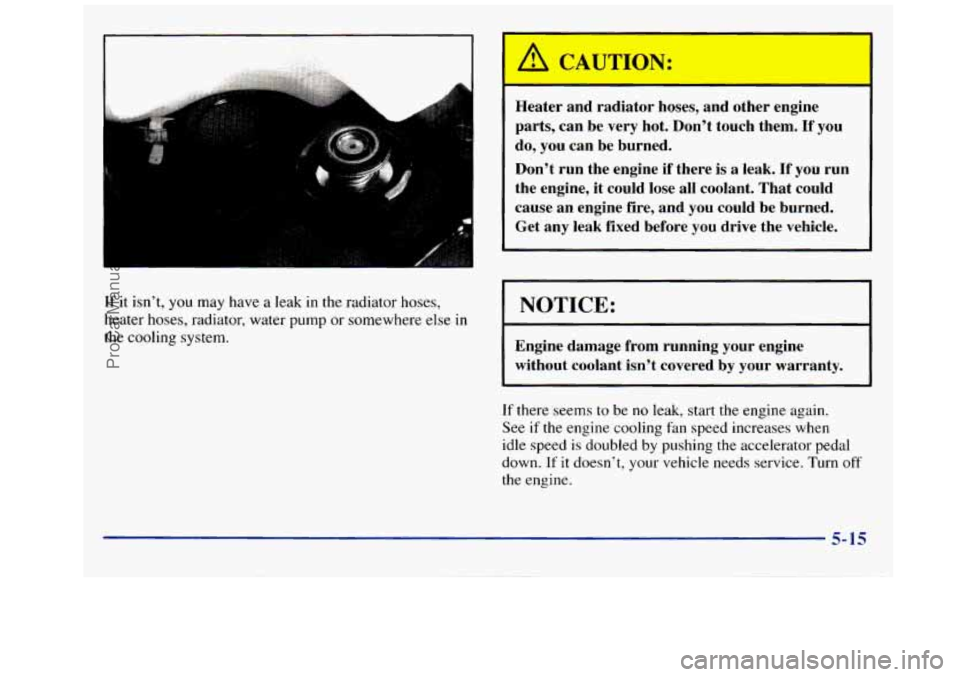
If it isn’t, you may have a leak in the radiator hoses,
heater hoses, radiator, water pump or somewhere else
in
the cooling system.
Heater and radiator hoses, and other engine
parts, can be very hot. Don’t touch them.
If you
do, you can be burned.
Don’t run the engine if there is
a leak. If you run
the engine, it could lose all coolant. That could
cause an engine fire, and you could be burned.
Get any leak fixed before
you drive the vehicle.
I NOTICE:
Engine damage from running your engine
without coolant isn’t covered by your warranty.
If there seems to be no leak, start the engine again.
See
if the engine cooling fan speed increases when
idle speed
is doubled by pushing the accelerator pedal
down.
If it doesn’t, your vehicle needs service. Turn off
the engine.
5-15
ProCarManuals.com
Page 241 of 388
Section 6 Service and Appearance Care
Here you will find information about the care of your vehicle. This section begins with service and fuel information,
and then it shows how to check important fluid and lubricant levels. There is also technical information about your
6-2
6-3
6-5
6-5
6-7
6-8
6- 11
6- 12
6- 16
6-
17
6-2 1
6-2 1
6-24
6-25
6-25
6-26
6-27
6-3
1
vehicle, and a part devoted to its appearance care.
Service
Fuel (Gasoline Engine)
Fuels in Foreign Countries (Gasoline Engines)
Filling Your Tank (Gasoline Engine)
Filling a Portable Fuel Container
Checking Things Under the Hood
Noise Control System Engine Oil (Gasoline Engine)
Air Cleaner (Gasoline Engines)
Automatic Transmission Fluid
Rear Axle
Engine Coolant
Radiator Pressure Cap
Thermostat
Power Steering Fluid
Windshield Washer Fluid
Brakes
Battery
6-32
6-32
6-40
6-4
1
6-5 1
6-5 1
6-55
6-56
6-57
6-57
6-57
6-59
6-60
6-6
1
6-66
6-67
6-69 Bulb
Replacement
Halogen Bulbs
Windshield Wiper Blade Replacement
Tires Appearance Care
Cleaning the Inside
of Your Vehicle
Cleaning the Outside of Your Vehicle
Cleaning Aluminum Wheels (If Equipped)
Cleaning Tires
Sheet Metal Damage
Finish Damage
Appearance Care Materials Chart
Vehicle Identification Number (VJN)
Electrical System
Replacement Bulbs
Capacities and Specifications
Normal Maintenance Replacement Parts
6-1
ProCarManuals.com
Page 242 of 388
Service
Your dealer knows your vehicle best and wants you to
be happy with it. We hope you’ll go to your dealer for
all your service needs. You’ll get genuine GM parts and
GM-trained and supported service people.
We hope you’ll want to keep your GM vehicle all GM.
Genuine GM parts have one of these marks:
Genuine
Doing Your Own Service Work
If you want to do some of your own service work, you’ll
want
to use the proper GM Service Manual. It tells you
much more about how to service your vehicle than this
manual can.
To order the proper service manual, see
“Service and Owner Publications” in the Index.
Your vehicle may have an air bag system. If it does,
see “Servicing Your Air Bag-Equipped Vehicle’’ in the
Index before attempting to do your own service work.
You should keep
a record with all parts receipts and list
the mileage and the date of any service work you
perform. See “Maintenance Record” in the Index.
6-2
ProCarManuals.com
Page 243 of 388
You can be injured and your vehicle could be
damaged
if you try to do service work on a
vehicle without knowing enough about it.
Be sure you have sufficient knowledge,
experience, the proper replacement parts
and tools before you attempt any vehicle
maintenance task.
Be sure to use the proper nuts, bolts and
other fasteners. “English” and “metric”
fasteners can be easily confused.
If you use
the wrong fasteners, parts can later break
or fall off. You could be hurt.
Adding Equipment to the Outside of
Your Vehicle
Things you might add to the outside of your vehicle can
affect the airflow around
it. This may cause wind noise
and affect windshield washer performance. Check with
your dealer before adding equipment to the outside of
your vehicle.
Fuel (Gasoline Engine)
If your vehicle has a diesel engine, see “Diesel Fuel
Requirements and
Fuel System” in the Diesel Engine
Supplement. For vehicles with gasoline engines,
please read this.
Use regular unleaded gasoline rated at 87 octane or
higher. At a minimum, it should meet specifications
ASTM D4814 in the United States and CGSB
3.5-M93
in Canada. Improved gasoline specifications have
been developed by the American Automobile
Manufacturers Association (AAMA) for better
vehicle performance and engine protection. Gasolines
meeting the AAMA specification could provide
improved driveability and emission control system
protection compared
to other gasolines.
Be sure the posted octane
is at least 87. If the octane is
less than 87, you may get a heavy knocking noise when
you drive.
If it’s bad enough, it can damage your engine.
If you’re using fuel rated at 87 octane or higher and you
hear heavy knocking, your engine needs service. But
don’t worry if you hear a little pinging noise when
you’re accelerating or driving up a hill. That’s normal,
and
you don’t have to buy a higher octane fuel to get rid
of pinging. It’s the heavy, constant knock that means
you have
a problem.
6-3
ProCarManuals.com
Page 244 of 388
If your vehicle is certified to meet California Emission
Standards (indicated on the underhood emission control
label), it is designed to operate on fuels that meet
California specifications. If such fuels are not available
in states adopting California emissions standards, your
vehicle will operate satisfactorily on fuels meeting
federal specifications, but emission control system
performance may be affected. The malfunction indicator
lamp on your instrument panel may turn on and/or your
vehicle may fail a smog-check test. If this occurs, return
to your authorized
GM dealer for diagnosis to determine
the cause of failure. In the event it is determined that
the
cause of the condition is the type of fuels used, repairs
may not be covered by your warranty.
Some gasolines that are not reformulated for
low
emissions contain an octane-enhancing additive called
methylcyclopentadienyl manganese tricarbonyl (MMT);
ask your service station operator whether or not his fuel
contains MMT. General Motors does not recommend the
use of such gasolines. If fuels containing MMT are used,
spark plug life may be reduced and your emission
control system performance may be affected. The
malfunction indicator lamp on your instrument panel
may turn on. If this occurs, return to your authorized
GM dealer for service.
To provide cleaner air, all gasolines in the United States
are now required to contain additives that will help
prevent deposits from forming
in your engine and fuel
system, allowing your emission control system to
function properly. Therefore,
you should not have to add
anything to the fuel. In addition, gasolines containing
oxygenates, such as ethers and ethanol, and
reformulated gasolines may be available in your area to
help clean the air. General Motors recommends that you
use these gasolines
if they comply with the
specifications described earlier.
NOTICE:
Your vehicle was not designed for fuel that
contains methanol. Don’t use it. It can corrode
metal parts in your fuel system and also damage
plastic and rubber parts. That damage wouldn’t
be covered under your warranty.
6-4
ProCarManuals.com