transmission GMC SAVANA 1998 Owner's Manual
[x] Cancel search | Manufacturer: GMC, Model Year: 1998, Model line: SAVANA, Model: GMC SAVANA 1998Pages: 388, PDF Size: 20.04 MB
Page 257 of 388
5. Install a new filter element with the folds in the
down position.
Reverse Steps
1 through 4 to replace the air cleaner.
See “Normal Replacement Parts” for the proper filter
to use.
Refer to the Maintenance Schedule
to determine when to
replace the air filter and crankcase ventilation filter.
See “Scheduled Maintenance Services” in the Index.
I
Operating the engine with the air cleaner off can
cause you or others to be burned. The air cleaner
not only cleans the air,
it stops flame if the engine
backfires.
If it isn’t there, and the engine
backfires, you could be burned. Don’t drive with
it
off, and be careful working on the engine with
the air cleaner
off.
NOTICE:
If the air cleaner is off, a backfire can cause a
damaging engine fire. And, dirt can easily get
into your engine, which will damage
it. Always
have the air cleaner in place when you’re driving.
Automatic Transmission Fluid
If your vehicle has a diesel engine, see “Automatic
Transmission Fluid” in the Diesel Supplement.
When to Check and Change
A good time to check your automatic transmission fluid
level
is when the engine oil is changed.
Change both the fluid and filter every
50,000 miles
(83 000 km) if the vehicle’s GVWR is over 8,600 or
if the vehicle is mainly driven under one or more of
these conditions:
0 In heavy city traffic where the outside temperature
regularly reaches
90°F (32°C) or higher.
0 In hilly or mountainous terrain.
0 When doing frequent trailer towing.
6-17
ProCarManuals.com
Page 258 of 388
Uses such as found in taxi, police or delivery service.
If your vehicle’s
GVWR is not over 8,600 and you
do not use your vehicle under any of these conditions,
change the fluid and filter every
100,000 miles
(166 000 km).
See “Scheduled Maintenance Services” in the Index.
How to Check
Because this operation can be a little difficult, you
may choose to have this done at your
GM dealership
Service Department.
If you
do it yourself, be sure to follow all the
instructions here, or
you could get a false reading
on the dipstick.
NOTICE:
Too much or too little fluid can damage your
transmission.
Too much can mean that some of
the fluid could come out and fall on hot engine
parts or exhaust system parts, starting a fire. Be
sure to get an accurate reading if you check your
transmission fluid.
Wait at least 30 minutes before checking the
transmission fluid level if
you have been driving:
0 When outside temperatures are above 90°F (32°C).
0 At high speed for quite a while.
In heavy traffic -- especially in hot weather.
While pulling a trailer.
To get the right reading, the fluid should be at normal
operating temperature, which is 180°F to 200°F
(82°C
to 93 O C). See “Checking Transmission Fluid
Hot”
in the Index.
Checking Transmission Fluid Hot
Get the vehicle warmed up by driving about 15 miles
(24
km) when outside temperatures are above 50°F
(10°C). If it’s colder than 50°F (IOOC), drive the
vehicle in in DRIVE
(D) until the engine temperature
gage moves and
then remains steady for 10 minutes.
Then follow the hot check procedures.
6-18
ProCarManuals.com
Page 259 of 388
Checking Transmission Fluid Cold
A cold check is made after the vehicle has been sitting
for eight hours or more with the engine off and is used
only as a reference. Let the engine run at idle for five
minutes if outside temperatures are
50°F (10°C) or
more. If it’s colder than
50°F (IOOC), you may have
to idle the engine longer. Should the fluid level be low
during a cold check, you
must perform a hot check
before adding fluid. This will give you a more
accurate reading
of the fluid level.
Checking the Fluid Hot or Cold
0 Park your vehicle on a level place. Keep the engine
running.
0 With the parking brake applied, place the shift lever
in
PARK (P).
With your foot on the brake pedal, move the shift
lever through
each gear range, pausing for about
three seconds in each range. Then, position
the
shift lever in PARK (P).
0 Let the engine run at idle for three minutes or more. Then, without shutting
off the engine, follow these steps:
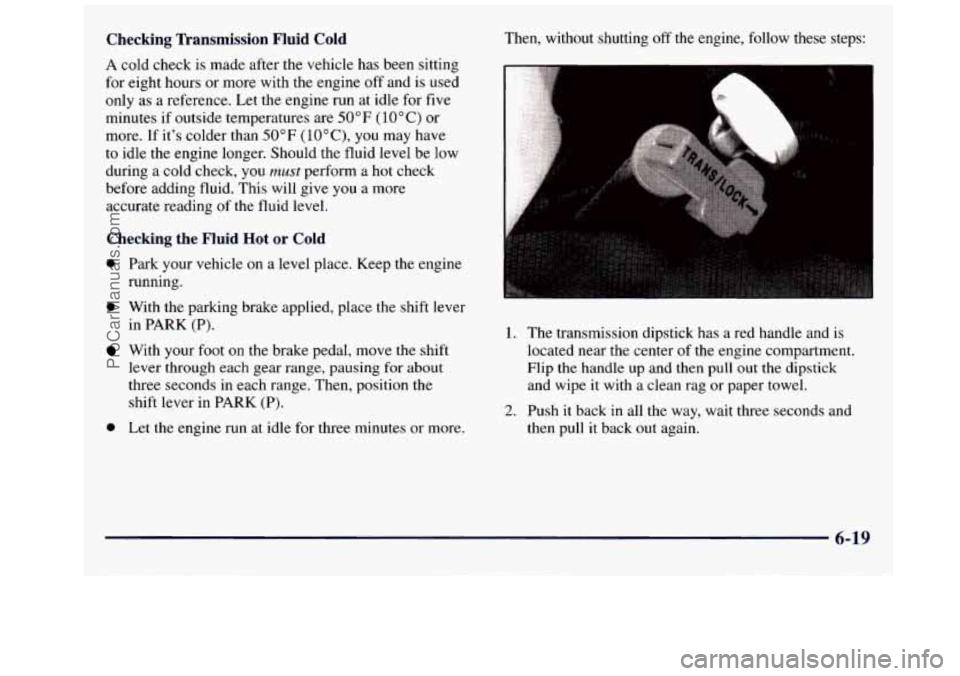
1. The
transmission dipstick has a red handle and is
located near the center of the engine compartment.
Flip the handle up and then pull out the dipstick
and wipe
it with a clean rag or paper towel.
2. Push it back in all the way, wait three seconds and
then pull it back out again.
6-19
ProCarManuals.com
Page 260 of 388
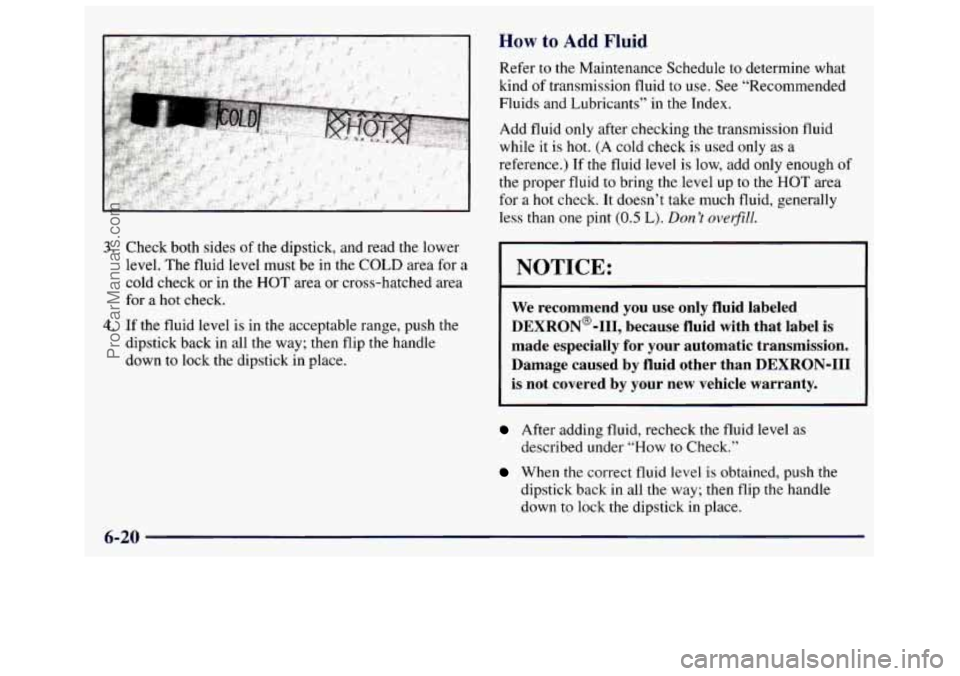
3. Check both sides of the dipstick, and read the lower
level. The fluid level must be in the COLD area for a
cold check or in the
HOT area or cross-hatched area
for
a hot check.
4. If the fluid level is in the acceptable range, push the
dipstick back in all the way; then flip
the handle
down
to lock the dipstick in place.
How to Add Fluid
Refer to the Maintenance Schedule to determine what
kind
of transmission fluid to use. See “Recommended
Fluids and Lubricants”
in the Index.
Add fluid
only after checking the transmission fluid
while
it is hot. (A cold check is used only as a
reference.) If the fluid level is low, add only enough
of
the proper fluid to bring the level up to the HOT area
for a hot check. It doesn’t take much fluid, generally
less than one pint
(0.5 L). Don’t overfill.
I NOTICE:
We recommend you use only fluid labeled
DEXRON@-111, because fluid with that label is
made especially for your automatic transmission.
Damage caused by fluid other than DEXRON-I11
is not covered by your new vehicle warrantv.
After adding fluid, recheck the fluid level as
described under “How
to Check.”
When the correct fluid level is obtained, push the
dipstick back in all
the way; then flip the handle
down to lock the dipstick in place.
6-20
ProCarManuals.com
Page 304 of 388
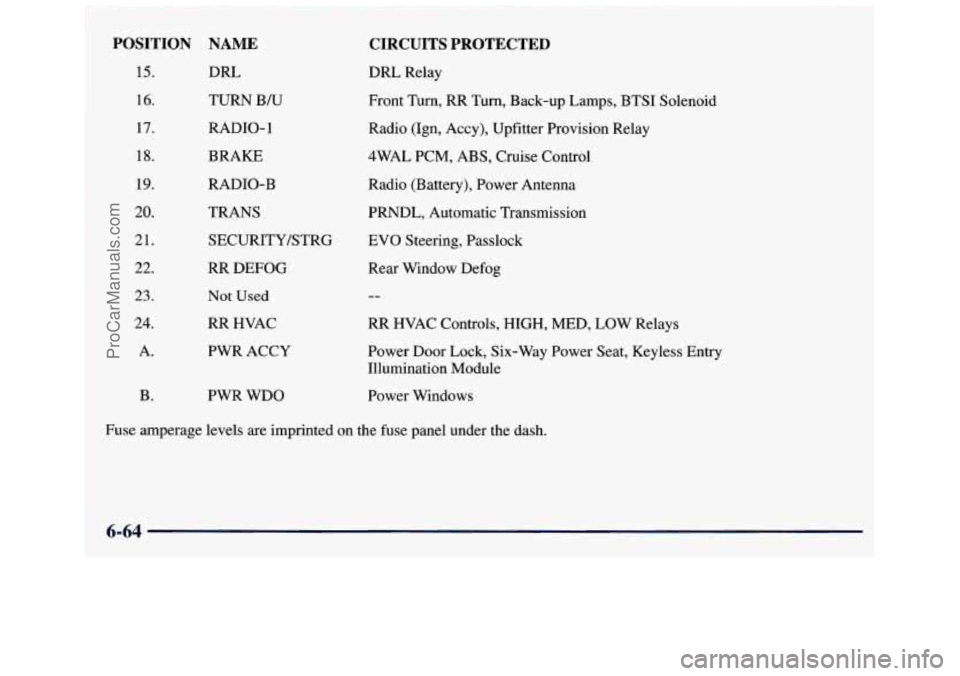
POSITION
15.
16.
17.
18.
19.
20.
21.
22.
23.
24.
A. B.
NAME
DRL TURN
B/U
RADIO- 1
BRAKE
RADIO-B
TRANS SECURITY/STRG
RR DEFOG
Not Used
RR HVAC
PWR ACCY
CIRCUITS PROTECTED
DRL Relay
Front Turn,
RR Turn, Back-up Lamps, BTSI Solenoid
Radio (Ign, Accy), Upfitter Provision Relay
4WAL PCM, ABS, Cruise Control
Radio (Battery), Power Antenna
PRNDL, Automatic Transmission
EVO Steering, Passlock
Rear Window Defog
--
RR HVAC Controls, HIGH, MED, LOW Relays
Power Door Lock, Six-Way Power Seat, Keyless Entry
Illumination Module
PWR WDO Power Windows
~ Fuse amperage levels are imprinted on the fuse panel under the dash.
' 6-64
ProCarManuals.com
Page 317 of 388
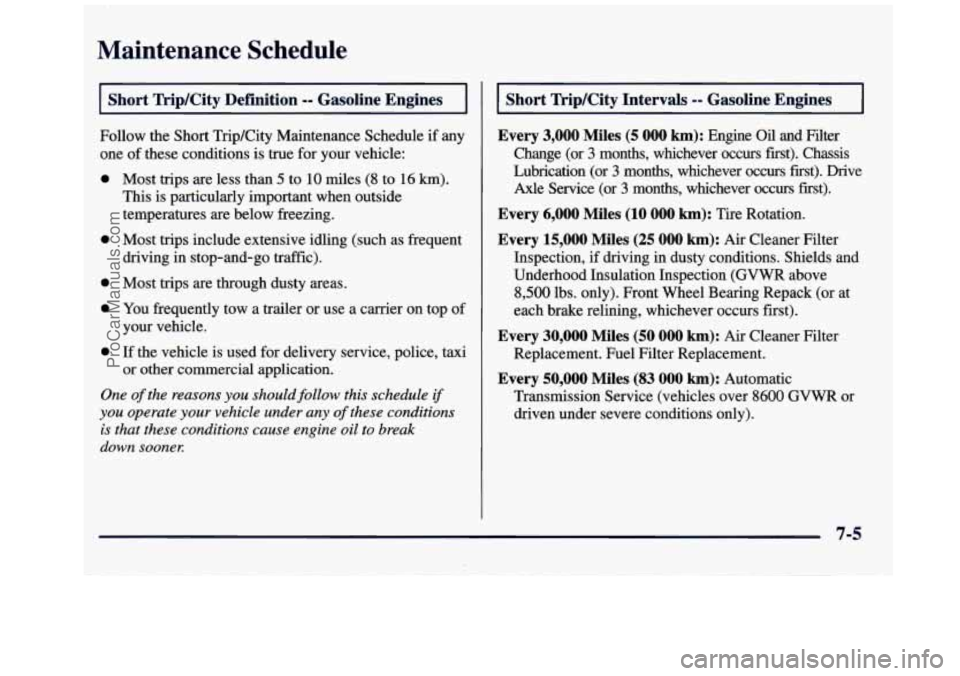
Maintenance Schedule
I Short TripKity Definition -- Gasoline Engines I
Follow the Short TripKity Maintenance Schedule if any
one of these conditions is true for your vehicle:
0
0
0
0
0
Most trips are less than 5 to 10 miles (8 to 16 km).
This is particularly important when outside
temperatures are below freezing.
Most trips include extensive idling (such as frequent
driving in stop-and-go traffic).
Most trips are through dusty areas.
You frequently tow a hailer or use a carrier on top of
your vehicle.
If the vehicle is used for delivery service, police, taxi
or other commercial application.
One of the reasons you should follow this schedule if
you operate your vehicle under any of these conditions
is that these conditions cause engine oil to break
down soonex
Short TriplCity Intervals -- Gasoline Engines
Every
3,000 Miles (5 000 km): Engine Oil and Filter
Change (or
3 months, whichever occurs fist). Chassis
Lubrication (or
3 months, whichever occurs first). Drive
Axle Service (or 3 months, whichever occurs first).
Every 6,000 Miles (10 000 km): Tire Rotation.
Every 15,000 Miles (25 000 km): Air Cleaner Filter
Inspection, if driving in dusty conditions. Shields and
Underhood Insulation Inspection
(GVWR above
8,500 lbs. only). Front Wheel Bearing Repack (or at
each brake relining, whichever occurs first).
Every 30,000 Miles (50 000 km): Air Cleaner Filter
Replacement. Fuel Filter Replacement.
Every 50,000 Miles (83 000 km): Automatic
Transmission Service (vehicles over 8600
GVWR or
driven under severe conditions only).
7-5
ProCarManuals.com
Page 318 of 388
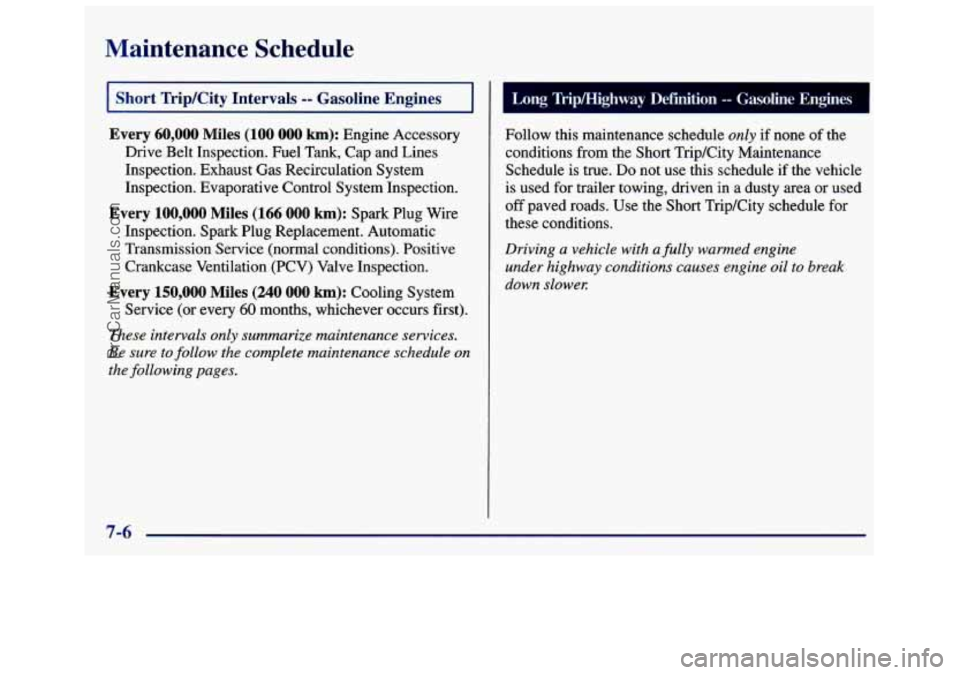
Maintenance Schedule
I Short TripKity Intervals -- Gasoline Engines I
Every 60,000 Miles (100 000 km): Engine Accessory
Drive Belt Inspection. Fuel Tank, Cap and Lines
Inspection. Exhaust Gas Recirculation System
Inspection. Evaporative Control System Inspection.
Every 100,000 Miles (166 000 km): Spark Plug Wire
Inspection. Spark Plug Replacement. Automatic
Transmission Service (normal conditions). Positive
Crankcase Ventilation (PCV) Valve Inspection.
Every 150,000 Miles (240 000 km): Cooling System
Service (or
every 60 months, whichever occurs first).
These intervals only summarize maintenance services.
Be sure to follow the complete maintenance schedule on
the following pages.
1 Long Wp/Highway Def~tion -- Gasoline Engine
Follow this maintenance schedule only if none of the
conditions from the Short Trip/City Maintenance
Schedule is true.
Do not use this schedule if the vehicle
is used for trailer towing, driven in a dusty area or used
off paved roads. Use the Short Trip/City schedule for
these conditions.
Driving a vehicle with a fully warmed engine
under highway conditions causes engine oil to break
down slower:
7-6
ProCarManuals.com
Page 319 of 388
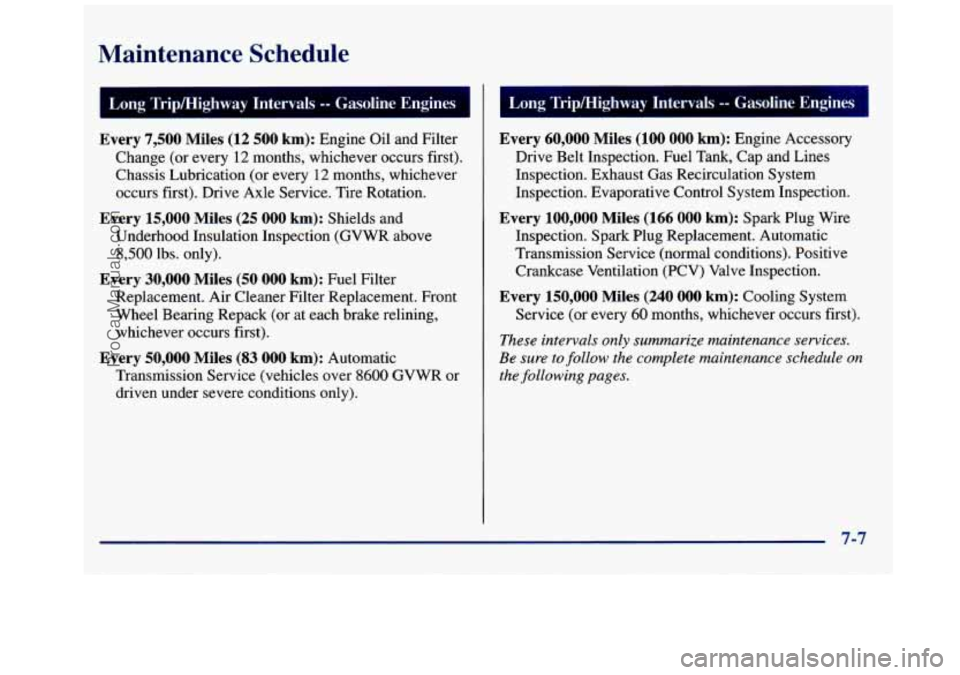
Maintenance Schedule
I Long Tripmighway Intervals -- Gasoline Engines J
Every 7,500 Miles (12 500 km): Engine Oil and Filter
Change (or every
12 months, whichever occurs first).
Chassis Lubrication (or every
12 months, whichever
occurs first). Drive Axle Service. Tire Rotation.
Every 15,000 Miles (25 000 km): Shields and
Underhood Insulation Inspection (GVWR above
8,500 lbs. only).
Every 30,000 Miles (50 000 km): Fuel Filter
Replacement. Air Cleaner Filter Replacement. Front
Wheel Bearing Repack (or at each brake relining,
whichever occurs first).
Transmission Service (vehicles over
8600 GVWR or
driven under severe conditions only).
Every 50,000 Miles (83 000 km): Automatic
1 Long Tripmighway Intervals -- Gasoline Engines
Every 60,000 Miles
(100 000 km): Engine Accessory
Drive Belt Inspection. Fuel Tank, Cap and Lines
Inspection. Exhaust Gas Recirculation System
Inspection. Evaporative Control System Inspection.
Every 100,000 Miles (166 000 km): Spark Plug Wire
Inspection. Spark Plug Replacement. Automatic
Transmission Service (normal conditions). Positive
Crankcase Ventilation (PCV) Valve Inspection.
Every 150,000 Miles (240 000 km): Cooling System
Service (or every
60 months, whichever occurs first).
These intervals only summarize maintenance services.
Be
sure to follow the complete maintenance schedule on
the following pages.
7-7
ProCarManuals.com
Page 328 of 388
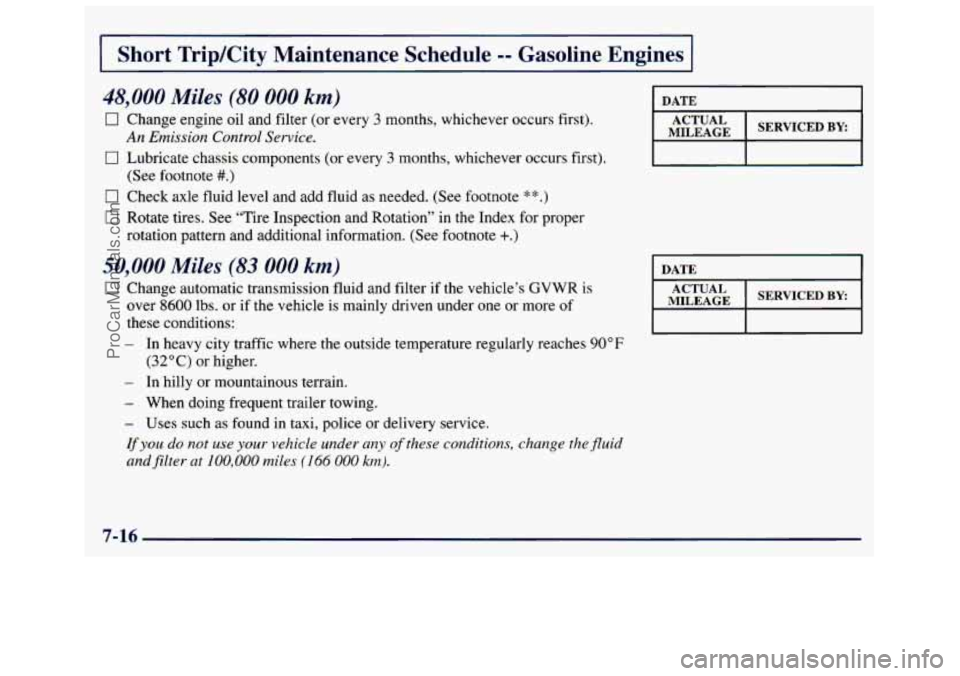
I Short TripKity Maintenance Schedule =- Gasoline Engines I
48,000 Miles (80 000 km)
Change engine oil and filter (or every 3 months, whichever occurs first).
An Emission Control Service.
Lubricate chassis components (or every 3 months, whichever occurs first).
(See footnote
#.)
Check axle fluid level and add fluid as needed. (See footnote **.)
Rotate tires. See “Tire Inspection and Rotation’’ in the Index for proper
rotation pattern and additional information. (See footnote
+.)
50,000 Miles (83 000 km)
0 Change automatic transmission fluid and filter if the vehicle’s GVWR is
over
8600 lbs. or if the vehicle is mainly driven under one or more of
DATE I
MILEAGE
DATE
I
~EAGE SERVICED BY: ACTUAL
these conditions: ’
- In heavy city traffic where the outside temperature regularly reaches 90°F
- In hilly or mountainous terrain.
- When doing frequent trailer towing.
- Uses such as found in taxi, police or delivery service.
If you do not use your vehicle under any of these conditions, change the fluid
andfilter
at 100,000 miles (166 000 kin).
(32 O C) or higher.
7-16
ProCarManuals.com
Page 337 of 388
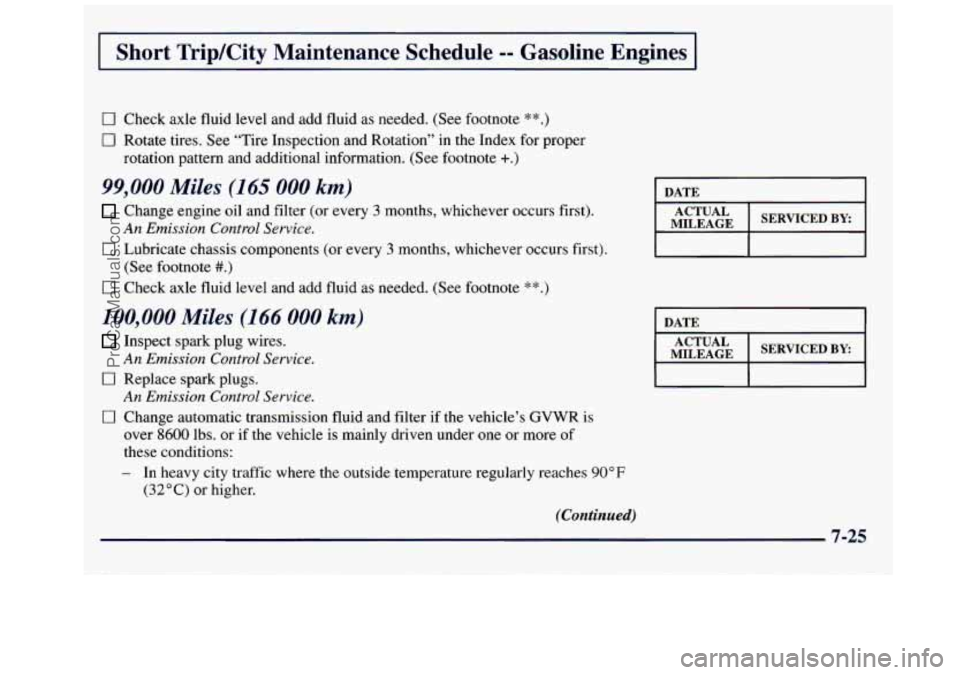
I Short Trip/City Maintenance Schedule =- Gasoline Engines I
0 Check axle fluid level and add fluid as needed. (See footnote **.)
0 Rotate tires. See “Tire Inspection and Rotation” in the Index for proper
rotation pattern and additional information. (See footnote
+.)
99,000 Miles (165 000 km)
Change engine oil and filter (or every 3 months, whichever occurs first).
17 Lubricate chassis components (or every 3 months, whichever occurs first).
0 Check axle fluid level and add fluid as needed. (See footnote **.)
An Emission Control Service.
(See footnote #.)
100,000 Miles (166 000 km)
Inspect spark plug wires.
An Emission Control Service.
0 Replace spark plugs.
An Emission Control Service.
0 Change automatic transmission fluid and filter if the vehicle’s GVWR is
over 8600 lbs. or if the vehicle is mainly driven under one or more of
these conditions:
- In heavy city traffic where the outside temperature regularly reaches 90°F
(32°C) or higher.
DATE-
-
DATE 1
ProCarManuals.com