light GMC SAVANA 1998 Workshop Manual
[x] Cancel search | Manufacturer: GMC, Model Year: 1998, Model line: SAVANA, Model: GMC SAVANA 1998Pages: 388, PDF Size: 20.04 MB
Page 213 of 388
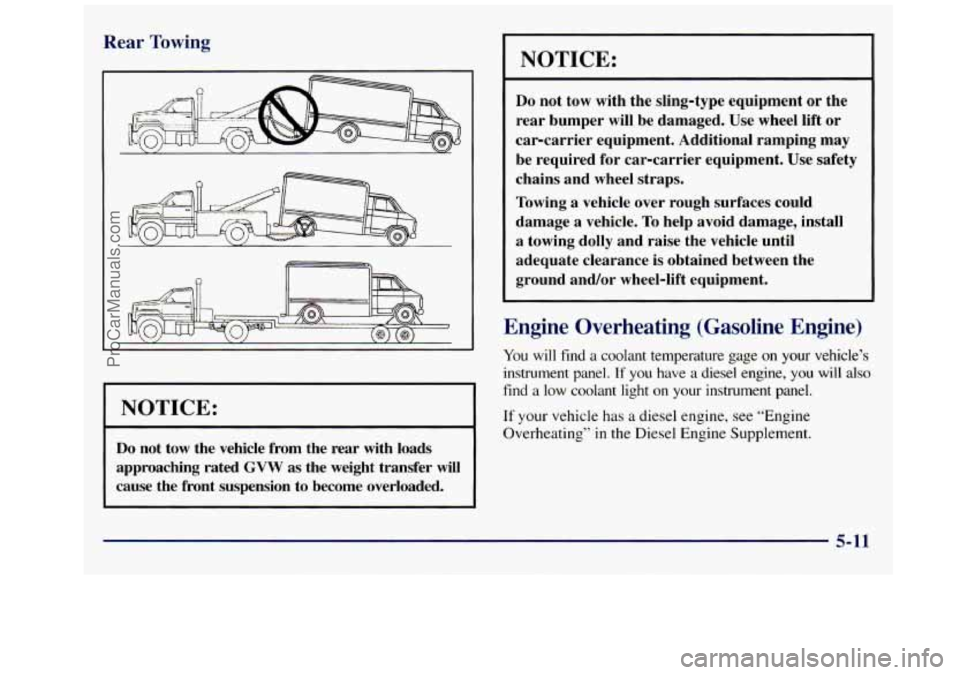
Rear Towir -
I NOTICE:
Do not tow the vehicle from the rear with loads
approaching rated
GVW as the weight transfer will
cause the front suspension to become overloaded.
NOTICE:
Do not tow with the sling-type equipment or the
rear bumper will be damaged. Use wheel lift
or
car-carrier equipment. Additional ramping may
be required for car-carrier equipment. Use safety
chains and wheel straps.
Towing a vehicle over rough surfaces could
damage a vehicle. To help avoid damage, install
a towing dolly and raise the vehicle until
adequate clearance is obtained between the
ground and/or wheel-lift equipment.
Engine Overheating (Gasoline Engine)
You will find a coolant temperature gage on your vehicle’s
instrument panel.
If you have a diesel engine, you will also
find a low coolant light on your instrument panel.
If your vehicle has a diesel engine, see “Engine
Overheating”
in the Diesel Engine Supplement.
5-11
ProCarManuals.com
Page 238 of 388
If You’re Stuck: In Sand, Mud, Ice
or
Snow
What you don’t want to do when your vehicle is stuck is
to spin your wheels too fast. The method known as
“rocking” can help you get out when you’re stuck, but
you must use caution.
‘I 1
If you let your tires spin at high speed, they can
explode, and you or others could be injured. And,
the transmission or other parts of the vehicle can
overheat. That could cause an engine
compartment fire
or other damage. When you’re
stuck, spin the wheels
as little as possible. Don’t
spin the wheels above
35 mph ‘(55 kmh) as shown
on the speedometer.
I NOTICE:
Spinning your wheels can destroy parts of your
vehicle
as well as the tires. If you spin the wheels
too fast while shifting your transmission back
and forth, you can destroy your transmission.
For information about using tire chains on your vehicle,
see “Tire Chains” in the Index.
Rocking Your Vehicle To Get It Out
First, turn your steering wheel left and right. That will
clear the area around your front wheels. Then shift back
and forth between REVERSE (R) and a forward gear,
spinning the wheels as little as possible. Release the
accelerator pedal while you shift, and press lightly on
the accelerator pedal when the transmission is in gear.
If
that doesn’t get you out after a few tries, you may need
to be towed out.
If you do need to be towed out, see
“Towing Your Vehicle” in the Index.
5-36
ProCarManuals.com
Page 247 of 388
When you put the cap back on, turn it to the right
(clockwise) until you hear a clicking sound. Make
sure you fully install the cap. The diagnostic system
can determine
if the fuel cap has been left off or
improperly installed. This would allow fuel to
evaporate into the atmosphere. See “Malfunction
Indicator Lamp” in the Index.
NOTICE:
If you need a new cap, be sure to get the right
type. Your dealer can get one for you.
If you get
the wrong type, it may not
fit properly. This may
cause your malfunction indicator lamp to light
and your fuel tank and emissions system may be
damaged. See “Malfunction Indicator Lamp” in
the Index.
Filling a Portable Fuel Container
I
Never fill a portable fuel container while it is in
your vehicle. Static electricity discharge from the
container can ignite the gasoline vapor. You can
be badly burned and your vehicle damaged
if this
occurs.
To help avoid injury to you and others:
0 Dispense gasoline only into approved
containers.
0 Do not fill a container while it is inside a
vehicle, in a vehicle’s trunk, pickup bed or
on any surface other than the ground.
inside of the fill opening before operating
the nozzle. Contact should be maintained
until the filling
is complete.
0 Bring the fill nozzle in contact with the
0 Don’t smoke while pumping gasoline.
6-7
ProCarManuals.com
Page 261 of 388
Rear Axle What to Use
When to Check and Change Lubricant
Refer to the Maintenance Schedule to determine how
often to check the lubricant and when to change it. See
“Scheduled Maintenance Services” in the Index.
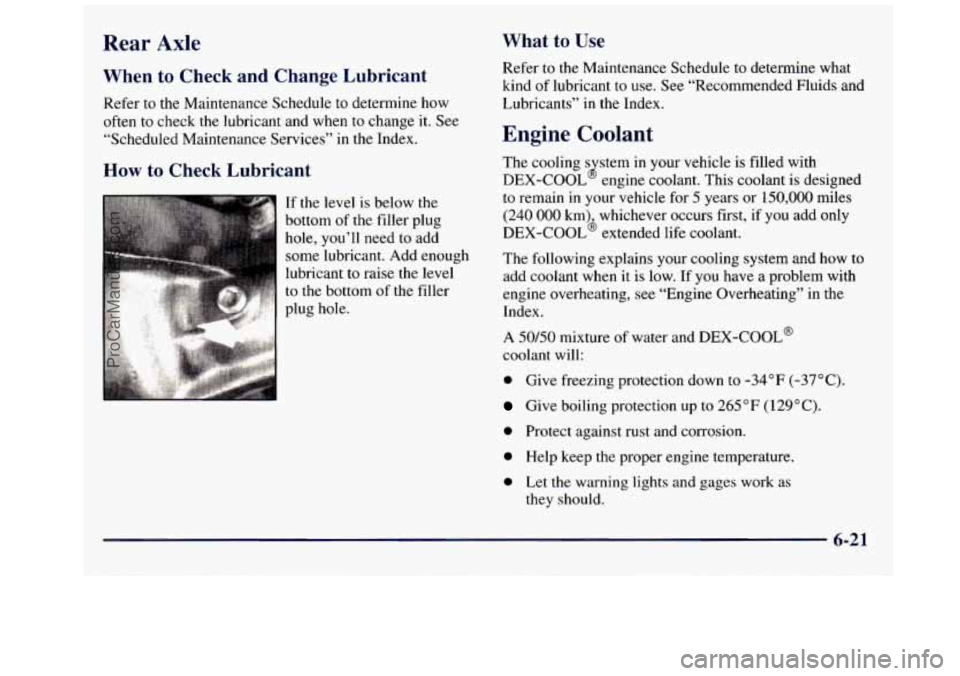
How to Check Lu’_ -~I
If the level is below the
bottom of the filler plug
hole, you’ll need
to add
some lubricant. Add enough
lubricant to raise the level
to the bottom of the filler
plug hole. Refer
to the Maintenance Schedule to determine what
kind of lubricant to use. See “Recommended Fluids and
Lubricants”
in the Index.
Engine Coolant
The cooling s stem in your vehicle is filled with
DEX-COOL engine coolant. This coolant is designea
to remain
in your vehicle for 5 years or 150,000 miles
(240 000 km) whichever occurs first, if you add only
DEX-COOL6 extended life coolant.
The following explains your cooling system and how to
add coolant when it is low. If you have
a problem with
engine overheating, see “Engine Overheating” in the
Index.
A 50/50 mixture of water and DEX-COOL@
coolant will:
2
0 Give freezing protection down to -34°F (-37°C).
Give boiling protection up to 265 “F (129” C).
0 Protect against rust and corrosion.
0 Help keep the proper engine temperature.
0 Let the warning lights and gages work as
they should.
6-21
ProCarManuals.com
Page 270 of 388
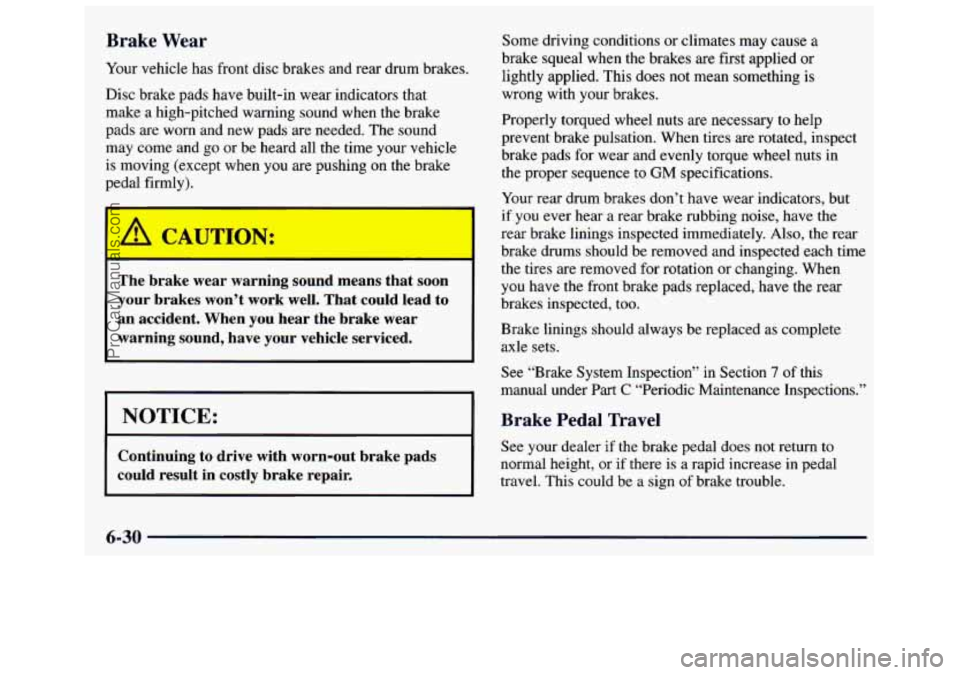
Brake Wear
Your vehicle has front disc brakes and rear drum brakes.
Disc brake pads have built-in wear indicators
that
make a high-pitched warning sound when the brake
pads are worn and new pads are needed. The sound
may come and go or be heard all the time your vehicle
is moving (except when you are pushing on the brake
pedal firmly).
The brake wear warning sound means that soon
your brakes won’t work well. That could lead to
an accident. When you hear the brake wear
warning sound, have your vehicle serviced.
I NOTICE:
Continuing to drive with worn-out brake pads
could result in costly brake repair.
Some driving conditions or climates may cause a
brake squeal when the brakes are first applied or
lightly applied. This does not mean something is
wrong with your brakes.
Properly torqued wheel nuts
are necessary to help
prevent brake pulsation. When tires are rotated, inspect
brake pads for wear and evenly torque wheel nuts in
the proper sequence
to GM specifications.
Your rear drum brakes don’t have wear indicators, but
if you ever hear a rear brake rubbing noise, have the
rear brake linings inspected immediately.
Also, the rear
brake drums should be removed and inspected each time
the tires are removed for rotation or changing. When
you have the front brake pads replaced, have the rear
brakes inspected, too.
Brake linings should always
be replaced as complete
axle sets.
See “Brake System Inspection” in Section
7 of this
manual under Part
C “Periodic Maintenance Inspections.”
Brake Pedal Travel
See your dealer if the brake pedal does not return to
normal height, or if there
is a rapid increase in pedal
travel. This could be a sign of brake trouble.
6-30
ProCarManuals.com
Page 287 of 388
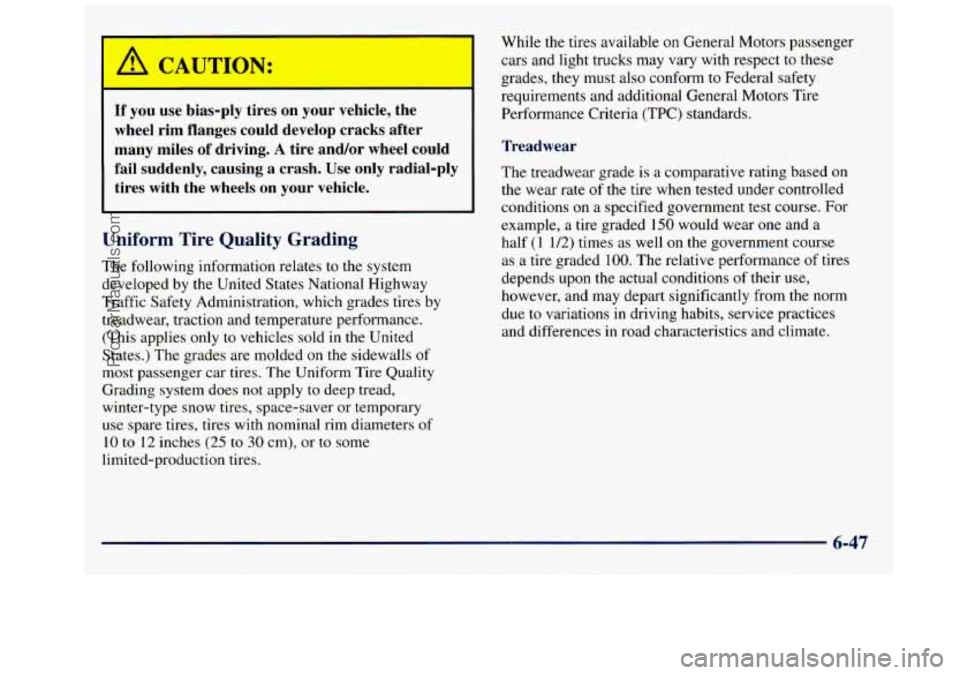
I A CAUTION:
If you use bias-ply tires on your vehicle, the
wheel rim flanges could develop cracks after
many miles of driving.
A tire and/or wheel could
fail suddenly, causing a crash. Use only radial-ply
tires with the wheels on your vehicle.
Uniform Tire Quality Grading
The following information relates to the system
developed by the United States National Highway
Traffic Safety Administration, which grades tires by
treadwear, traction and temperature performance.
(This applies only to vehicles sold in the United
States.) The grades are molded on the sidewalls of
most passenger car tires.
The Uniform Tire Quality
Grading system does
not apply to deep tread,
winter-type snow tires, space-saver or temporary
use spare tires, tires with nominal rim diameters
of
10 to 12 inches (25 to 30 cm), or to some
limited-production tires. While
the tires available
on General Motors passenger
cars and light trucks may vary with respect to these
grades, they must also conform to Federal safety
requirements and additional General Motors Tire Performance Criteria (TPC) standards.
Treadwear
The treadwear grade is a comparative rating based on
the wear rate
of the tire when tested under controlled
conditions on a specified government test course. For
example, a tire graded
150 would wear one and a
half
(1 1/2) times as well on the government course
as a tire graded
100. The relative performance of tires
depends upon
the actual conditions of their use,
however, and may depart significantly from the norm
due
to variations in driving habits, service practices
and differences in road characteristics and climate.
ProCarManuals.com
Page 299 of 388
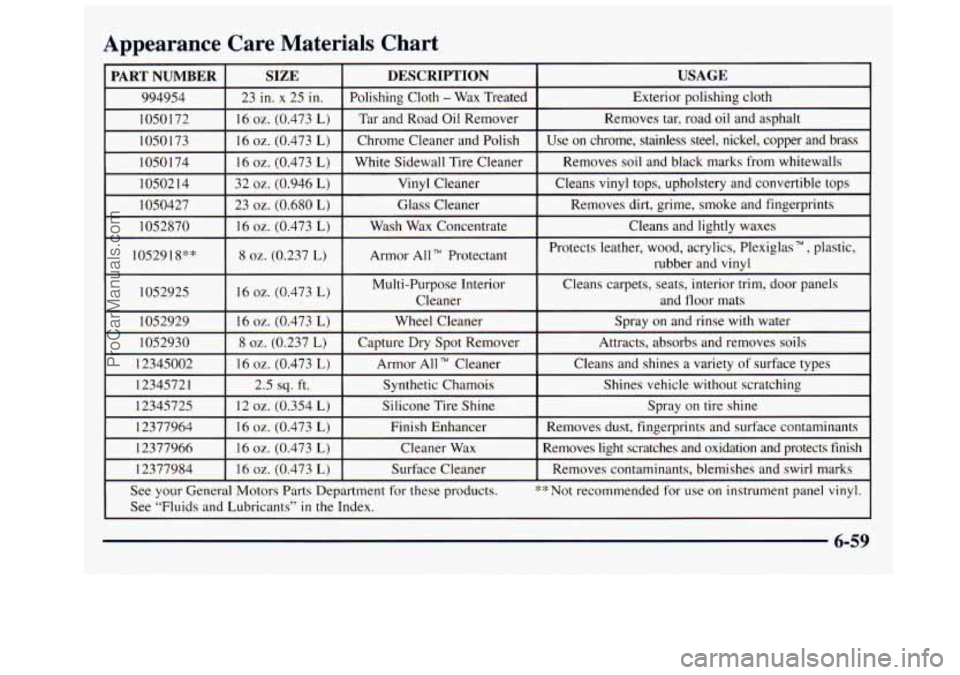
Appearance Care Materials Chart
PART NUMBER SIZE DESCRIPTION USAGE
994954 23 in. x 25 in. Polishing Cloth - Wax
Treated
Exterior polishing cloth
1050172 16
oz. (0.473 L) Tar and Road Oil Remover Removes tar, road oil and asphalt
1050 173 16
oz. (0.473 L) Chrome Cleaner and Polish
Use on chrome, stainless steel, nickel, copper and brass
1050174 16 oz. (0.473 L) White
Sidewall Tire Cleaner Removes soil and black marks from whitewalls
10502 I4 32
oz. (0.946 L) Vinyl Cleaner Cleans vinyl tops, upholstery and
convertible tops
I050427
23 oz. (0.680 L) Glass Cleaner Removes
dirt, grime, smoke and fingerprints
1052870 16
oz. (0.473 L) Wash Wax
Concentrate Cleans
and lightly waxes
I 10529 18”“ I 8 oz. (0.237 L) I Armor All Protectant Protects leather, wood,
acrylics, Plexiglas l‘, plastic,
rubber and vinyl
I 1052925 1 16 oz. (0.473 L) I I
Multi-Purpose Interior Cleans
carpets, seats, interior trim, door panels
Cleaner and floor mats
1052929
16 oz. (0.473 L) Wheel Cleaner
Spray on and rinse with water
1052930
8 oz. (0.237 L) Capture Dry Spot Remover Attracts, absorbs and removes
soils
12345002 16
oz. (0.473 L) Armor All TM Cleaner Cleans
and shines a variety of surface types
1234572
1 2.5 sq. ft. Synthetic Chamois Shines
vehicle without scratching
12345725 12
oz. (0.354 L) Silicone Tire Shine Spray on tire shine
12377964
16 02. (0.473 L) Finish Enhancer Removes dust, fingerprints and surface contaminants
I 12377966 I 16 oz. (0.473 L) I Cleaner Wax I Removes light scratches and oxidation and protects finish
I 12377984 I 16 oz. (0.473 L) I Surface Cleaner I Removes contaminants, blemishes and swirl marks
See your General Motors
Parts Department for these products. **Not recommended for use on instrument panel vinyl.
See “Fluids and Lubricants’’ in the Index.
6-59
ProCarManuals.com
Page 302 of 388
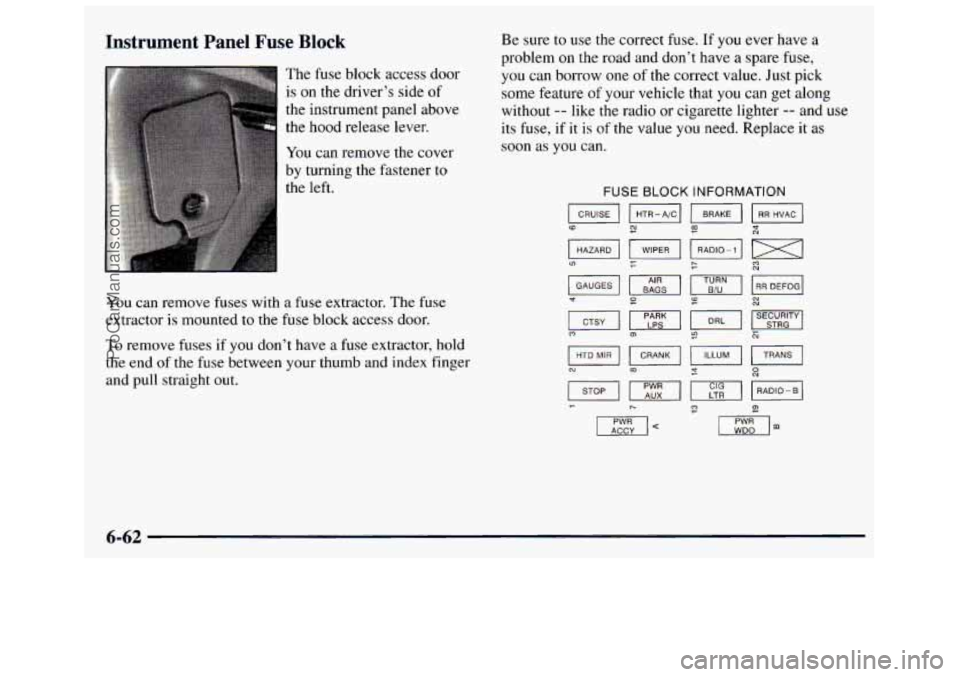
Instrument Panel Fuse Block
The fuse block access door
is
on the driver's side of
the instrument panel above
the hood release lever.
You can remove the cover
by turning the fastener to
the left.
You can remove fuses with
a fuse extractor. The fuse
extractor is mounted
to the fuse block access door.
To remove fuses if you don't have a fuse extractor, hold
the end
of the fuse between your thumb and index finger
and pull straight out. Be
sure
to use the correct fuse. If you ever have a
problem
on the road and don't have a spare fuse,
you can borrow
one of the correct value. Just pick
some feature
of your vehicle that you can get along
without
-- like the radio or cigarette lighter -- and use
its fuse, if
it is of the value you need. Replace it as
soon as
you can.
FUSE BLOCK INFORMATION
6-62
ProCarManuals.com
Page 303 of 388
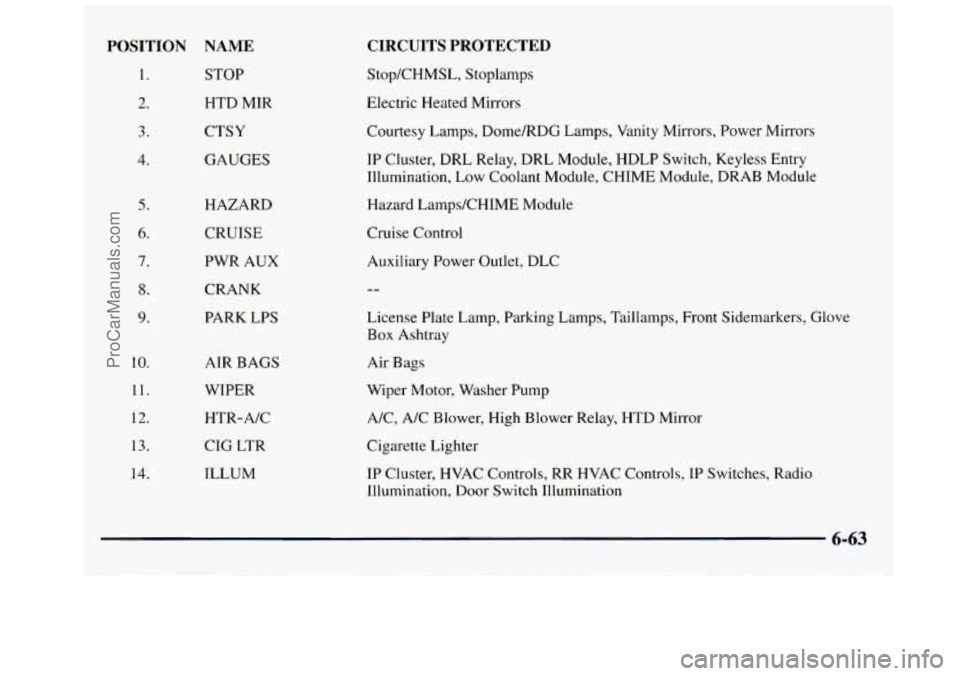
POSITION NAME
1. STOP
2. HTD MIR
3. CTSY
4. GAUGES
5.
6.
7.
8.
9.
10.
11.
12.
13.
14.
HAZARD
CRUISE
PWR AUX
CRANK
PARK LPS
AIR BAGS
WIPER
HTR-A/C
CIG LTR
ILLUM
CIRCUITS PROTECTED
StopKHMSL, Stoplamps
Electric Heated Mirrors
Courtesy Lamps, Dome/RDG Lamps, Vanity Mirrors, Power Mirrors
IP Cluster, DRL Relay, DRL Module, HDLP Switch, Keyless Entry
Illumination, Low Coolant Module, CHIME Module, DRAB Module
Hazard LampdCHIME Module
Cruise Control
Auxiliary Power Outlet, DLC
License Plate Lamp, Parking Lamps, Taillamps, Front Sidemarkers, Glove
Box Ashtray
Air Bags
Wiper Motor, Washer Pump
A/C, A/C Blower, High Blower Relay, HTD Mirror
Cigarette Lighter
IP Cluster, HVAC Controls, RR HVAC Controls, IP Switches, Radio
Illumination, Door Switch Illumination
6-63
ProCarManuals.com
Page 305 of 388
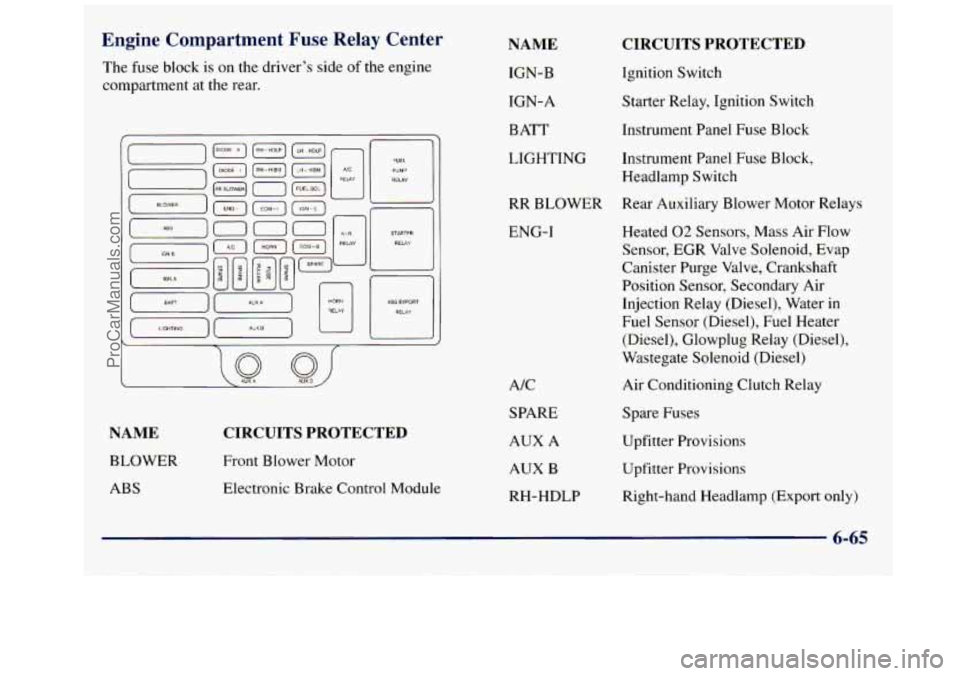
Engine Compartment Fuse Relay Center
The fuse block is on the driver’s side of the engine
compartment at the rear.
NAME
BLOWER
ABS
CIRCUITS PROTECTED
Front Blower Motor
Electronic Brake Control Module
NAME
IGN-B
IGN-A
BATT
LIGHTING
CIRCUITS PROTECTED
Ignition Switch
Starter Relay, Ignition Switch
Instrument Panel Fuse Block
Instrument Panel Fuse Block,
Headlamp Switch
RR BLOWER Rear Auxiliary Blower Motor Relays
ENG-I
AIC
SPARE
AUX A
AUX B
RH-HDLP
Heated 02 Sensors, Mass Air Flow
Sensor, EGR Valve Solenoid, Evap
Canister Purge Valve, Crankshaft
Position Sensor, Secondary Air
Injection Relay (Diesel), Water in
Fuel Sensor (Diesel), Fuel Heater
(Diesel), Glowplug Relay (Diesel),
Wastegate Solenoid (Diesel)
Air Conditioning Clutch Relay
Spare Fuses
Upfitter Provisions
Upfitter Provisions Right-hand Headlamp (Export only)
6-65
ProCarManuals.com