stop start GMC SAVANA 1998 Owners Manual
[x] Cancel search | Manufacturer: GMC, Model Year: 1998, Model line: SAVANA, Model: GMC SAVANA 1998Pages: 388, PDF Size: 20.04 MB
Page 88 of 388
Parking Lots
If you park in a lot where someone will be watching
your vehicle, it’s best to lock it up and take your keys.
But what if
you have to leave your ignition key? What if
you have to leave something valuable in your vehicle?
Put your valuables in a storage area, like your front
storage compartment.
Lock all the doors excePt the driver’s.
Passlock’
Your vehicle is equipped with the Passlock
theft-deterrent system.
Passlock is a passive theft-deterrent system. The system
is armed once the key is removed from the ignition.
Passlock enables fuel if the ignition lock cylinder is
turned with a valid key.
If a correct key is not used,
fuel is disabled. During
normal operation, the SECURITY light will go
off after the engine is started.
If the engine stalls and the SECURITY light flashes,
wait until the light stops flashing before trying to restart
the engine. Remember to release the key from the
START position as soon
as the engine starts.
If you are driving and the SECURITY light comes on, you
will be able
to restart the engine if you turn the engine off.
However, your Passlock system is not working properly
and must
be serviced by your dealer. Your vehicle is not
protected by Passlock at
this time. You may also want to
check the
fuse (see “Fuses and Circuit Breakers” in the
Index). See your dealer for service.
If the SECURITY light comes on while
the engine is
running, a problem has been detected and the system
may need service. See your dealer for service.
In an emergency, call the
GM Roadside Assistance
Center. See “Roadside Assistance” in the Index.
2-16
ProCarManuals.com
Page 89 of 388
New Vehicle LLBreak-In”
-
NOTICE:
Your vehicle doesn’t need an elaborate
“break-in.” But it will perform better in the long
run if you follow these guidelines:
e
e
e
0
Keep your speed at 55 mph (88 km/h) or
less for the
first 500 miles (805 km).
Don’t drive at any one speed
-- fast or
slow
-- for the first 500 miles (805 km).
Don’t make full-throttle starts.
Avoid making hard stops for the first
200 miles (322 km) or so. During this time
your new brake linings aren’t yet broken
in. Hard stops with new linings can mean
premature wear and earlier replacement.
Follow this breaking-in guideline every
time you get new brake linings.
Don’t tow a trailer during break-in.
See “Towing a Trailer” in the Index for
more information.
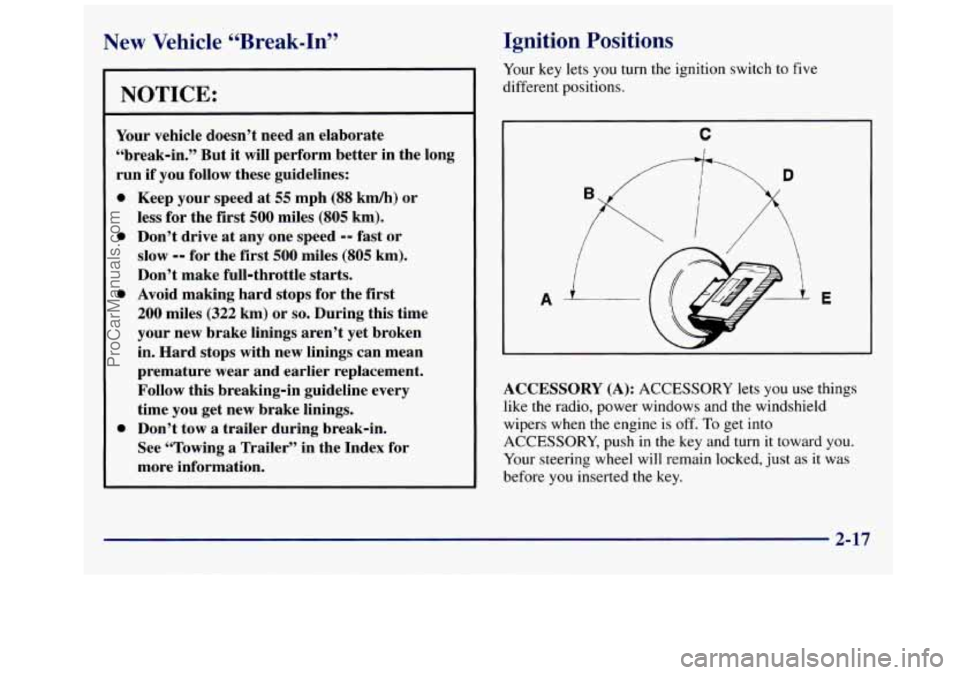
Ignition Positions
Your key lets you turn the ignition switch to five
different positions.
C
E
ACCESSORY (A): ACCESSORY lets you use things
like the radio, power windows and the windshield
wipers when the engine is off.
To get into
ACCESSORY, push in the key and turn it toward you.
Your steering wheel will remain locked, just as it was
before
you inserted the key.
2-17
ProCarManuals.com
Page 90 of 388
LOCK (B): This position locks your ignition, steering
wheel and transmission. It’s a theft-deterrent feature.
You will only be able to remove your key when the
ignition is turned
to LOCK.
OFF (C): This position lets you turn off the engine but
still turn the steering wheel. It doesn’t lock the steering
wheel like
LOCK. Use OFF if you must have your
vehicle in motion while the engine is off (for example, if
your vehicle is being pushed).
RUN (I)): This is the position for driving.
START (E): This starts your engine.
I NOTICE:
If your key seems stuck in LOCK and you can’t
turn it, be sure you are using the correct key; if
so, is it all the way in? If it is, then turn the
steering wheel left and right while you turn the
key hard. But turn the key only with your hand.
Using
a tool to force it could break the key or the
ignition switch. If none of this
works, then your
vehicle needs service.
Starting Your Gasoline Engine
If you have a diesel engine, see “Starting Your Diesel
Engine” in
the Diesel Engine Supplement.
Move your shift lever to
PARK (P) or NEUTRAL (N).
Your engine won’t start in any other position -- that’s a
safety feature.
To restart when you’re already moving,
use NEUTRAL
(N) only.
I NOTICE:
Don’t try to shift to PARK (P) if your vehicle is
moving. If you do, you could damage the
transmission. Shift to
PARK (P) only when your
vehicle is stopped.
1. Without pushing the accelerator pedal, turn your
ignition key
to START. When the engine starts, let
go of the key. The idle speed will go down as your
engine gets warm.
2-18
ProCarManuals.com
Page 91 of 388
NOTICE:
Holding your key in START for longer than
15 seconds at a time will cause your battery to be
drained much sooner. And the excessive heat can
damage your starter motor.
2.
3.
If it doesn’t start right away, hold your key in
START. If it doesn’t start in 10 seconds, push the
accelerator pedal all the way down for five
more
seconds, unless it starts sooner.
If your engine still won’t start (or starts but then
stops), wait
15 seconds and start over.
When the engine starts, let go
of the key and the
accelerator pedal.
NOTICE:
Your engine is designed to work with the
electronics in your vehicle.
If you add electrical
parts or accessories, you could change the way
the engine operates. Before adding electrical
equipment, check with your dealer.
If you don’t,
your engine might not perform properly.
If you ever have to have your vehicle towed, see
the part
of this manual that tells how to do it
without damaging your vehicle. See “Towing
Your Vehicle” in the Index.
.,
ProCarManuals.com
Page 94 of 388
It is dangerous to get out of your vehicle if the
shift lever is not fully in PARK
(P) with the
parking brake firmly set. Your vehicle can roll.
Don’t leave your vehicle when the engine is
running unless you have to.
If you have left the
engine running, the vehicle can move suddenly.
You or others could be injured. To be sure your
vehicle won’t move, even when you’re on fairly
level ground, always set your parking brake and
move the shift lever to PARK
(P).
See “Shifting Into PARK (P)” in the Index. If
you’re pulling a trailer, see “Towing a Trailer” in
the Index.
Ensure the shift lever is fully in PARK (P) before
starting the engine. Your vehicle has
a
brake-transmission shift interlock. With the ignition in
the RUN position, you must fully apply your regular
brakes before you can shift from PARK
(P).
If you cannot shift out of PARK (P), ease pressure on
the shift lever and push the shift lever all the way into
PARK (P) as you continue pressing the brake pedal.
Then move the shift lever into
the gear you want. See
“Shifting Out
of PARK (P)” later in this section.
REVERSE (R): Use this gear to back up.
NOTICE:
Shifting into REVERSE (R) while your vehicle is
moving forward could damage your
transmission. Shift to REVERSE
(R) only after
your vehicle is stopped.
To rock your vehicle back and forth to get out of snow,
ice or sand without damaging your transmission, see
“Stuck: In Sand, Mud, Ice or Snow” in the Index.
NEUTRAL
(N): In this position, your engine doesn’t
connect with the wheels.
To restart when you’re already
moving, use
NEUTRAL (N) only. Also, use
NEUTRAL (N) when your vehicle is being towed.
2-22
ProCarManuals.com
Page 95 of 388
r
I I - CAUTION:
Shifting out of PARK (P) or NEUTRAL (N) while
your engine is “racing” (running at high speed) is
1 dangerous. Unless your foot is firmly on the
brake pedal, your vehicle could move very rapidly.
You could lose control and hit people or
objects. Don’t shift
out of PARK (P) or
NEUTRAL (N) while your engine
is racing.
NOTICE:
Damage to your transmission caused by shifting
out
of PARK (P) or NEUTRAL (N) with the
engine racing isn’t covered by your warranty.
DRIVE
(D): This position is for normal driving. If you
need more power for passing, and you’re:
0 Going less than about 35 mph (55 km/h), push your
accelerator pedal about halfway down.
Going about 35 mph (55 km/h) or more, push the
accelerator all the way down.
You’ll shift down
to the next gear and have more power.
You should use DRIVE (D) (or, as
you need to, a lower
gear) when towing a trailer
to minimize heat build-up
and extend the life
of your transmission.
THIRD (3): This position is also used for normal
driving, however, it offers more power and lower fuel
economy than DRIVE (D). You should use THIRD
(3)
when carrying a heavy load or driving on steep hills.
SECOND (2): This position gives you more power but
lower fuel economy. You can use
SECOND (2) on hills.
It can help control your speed as you go down steep
mountain roads, but then you would also want
to use
your brakes off and on. If you manually select
SECOND
(2), the transmission will drive in
SECOND
(2). You may use this feature for reducing
torque
to the rear wheels when you are trying to start
your vehicle from a stop on slippery road surfaces.
FIRST (1): This position gives you even more power
(but lower fuel economy) than
SECOND (2). You can
use it on very steep hills, or
in deep snow or mud. If
the selector lever is put in FIRST(
l), the transmission
won’t shift into first gear until the vehicle is going
slowly enough.
ProCarManuals.com
Page 108 of 388
Windshield Wipers
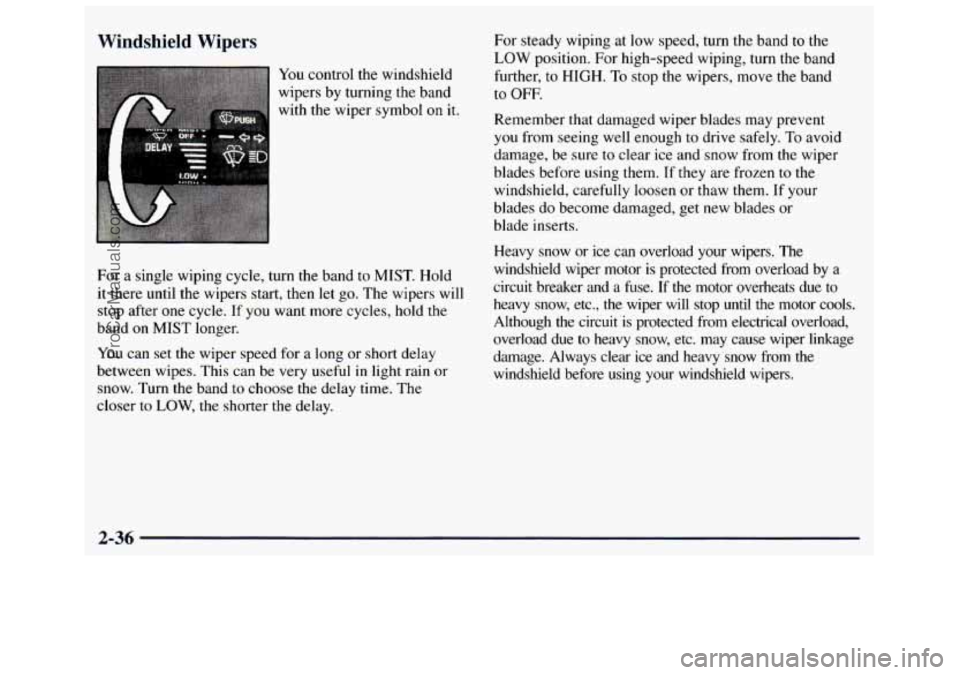
You control the windshield
wipers by turning the band
with the wiper symbol on it.
For a single wiping cycle, turn the band
to MIST. Hold
it there until the wipers start, then let
go. The w-ipers will
stop after one cycle. If you want more cycles, hold the
band
on MIST longer.
You can
set the wiper speed for a long or short delay
between wipes. This can be very useful
in light rain or
snow. Turn the band
to choose the delay time. The
closer to
LOW, the shorter the delay. For steady wiping at low speed, turn the band
to the
LOW position.
For high-speed wiping, turn the band
further, to HIGH.
To stop the wipers, move the band
to OFF.
Remember that damaged wiper blades may prevent
you from seeing well enough to drive safely. To avoid
damage, be sure to clear ice and snow from the wiper
blades before using them. If they are frozen to
the
windshield, carefully loosen or thaw them. If your
blades do become damaged, get new blades or
blade inserts.
Heavy snow or ice
can overload your wipers. The
windshield wiper motor
is protected from overload by a
circuit breaker and a fuse. If
the motor overheats due to
heavy snow, etc., the wiper will stop until the motor cools.
Although the circuit is protected from electrical overload,
overload due
to heavy snow, etc. may cause wiper linkage
damage. Always clear ice and heavy snow from the
windshield before using your windshield wipers.
2-36
ProCarManuals.com
Page 129 of 388
Anti-Lock Brake System Warning Light
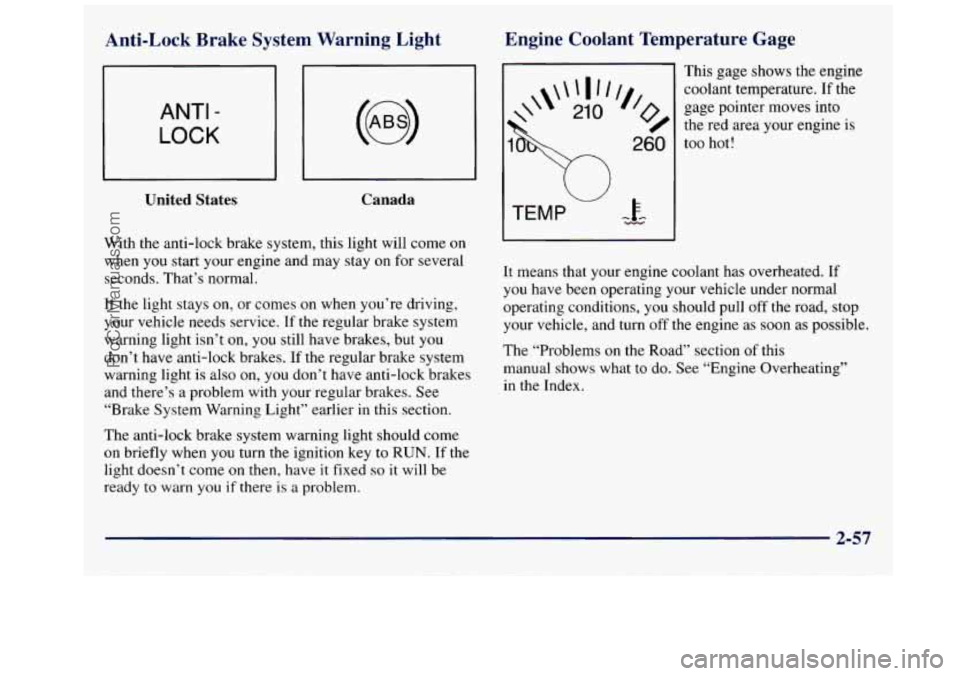
ANTI -
LOCK
United States Canada
With
the anti-lock brake system, this light will come on
when you start your engine and may stay on for several
seconds. That’s normal.
If the light stays on, or comes
on when you’re driving,
your vehicle needs service. If the regular brake system
warning light isn’t
on, you still have brakes, but you
don’t have anti-lock brakes. If the regular brake system
warning light is also
on, you don’t have anti-lock brakes
and there’s a problem with your regular brakes. See
“Brake System Warning Light” earlier in this section.
The anti-lock brake system warning light should come
on briefly when
you turn the ignition key to RUN. If the
light doesn’t come on then, have it fixed
so it will be
ready
to warn you if there is a problem.
Engine Coolant Temperature Gage
This gage shows the engine
gage pointer moves into
the red area your engine is
coolant temperature.
If the
260 too
hot!
It means that your engine coolant has overheated.
If
you have been operating your vehicle under normal
operating conditions,
you should pull off the road, stop
your vehicle, and turn off the engine as soon as possible.
The “Problems on the Road’’ section of this
manual shows what
to do. See “Engine Overheating”
in the Index.
2-57
ProCarManuals.com
Page 131 of 388
If the Light Is Flashing If the Light Is On Steady
The following may prevent more serious damage to
your vehicle:
Reducing vehicle speed.
Avoiding hard accelerations.
Avoiding steep uphill grades.
If you are towing a trailer, reduce the amount of
cargo being hauled as soon as it is possible.
If the light stops flashing and remains on steady, see “If
the Light Is On Steady” following.
If the light continues
to flash, when it is safe to do so,
stop the vehicle. Find a safe place to park your vehicle.
Turn the key
off, wait at least 10 seconds and restart the
engine. If
the light remains on steady, see “If the Light
Is On Steady” following. If the light is still flashing,
follow the previous steps, and drive the vehicle to your
dealer or qualified service center for service. You
may be able to correct the emission system
malfunction by considering the following:
Did you recently put fuel into your vehicle?
If
so, reinstall the fuel cap, making sure to fully install
the cap. The diagnostic system can determine if
the fuel
cap has been left off or improperly installed.
A loose or
missing fuel cap will allow fuel to evaporate into the
atmosphere.
A few driving trips with the cap properly
installed should turn the light off.
Did you just drive through a deep puddle of water?
If
so, your electrical system may be wet. The condition
will usually be corrected when the electrical system
dries
out. A few driving trips should turn the light off.
Are you low
on fuel?
As your engine starts to run out of fuel, your engine may
not run as efficiently as designed since small amounts
of
air are sucked into the fuel line causing a misfire. The
system can detect this. Adding fuel should correct
this
condition. Make sure to install the fuel cap properly. It
will take a few driving trips
to turn the light off.
2-59
ProCarManuals.com
Page 155 of 388
RDM (2): Press this button to play the tracks on the disc
in random order. While in
the RDM mode, RANDOM
appears on the display. Press RDM again to return
to
normal play.
NEXT (3): Press NEXT or the SEEK right arrow to
search for the next selection. If you hold this button or
press
it more than once, the disc will advance further.
The next track number will appear
on the display. Sound
is muted in this mode.
REV (4): Press and hold REV to return rapidly to a
favorite passage. You will hear the disc selection play at
high speed while
you press the REV button. This allows
you
to listen and find out when the disc is at the desired
selection. Release
REV to resume playing.
FWD (6): Press and hold this button to advance rapidly
within a track. You will hear the disc selection play at
high speed while
you press the FWD button. This allows
you to listen and find out when the disc is at the desired
selection. Release FWD
to resume playing.
RECALL: Press this button to see what track is playing.
Press it again within five seconds
to see how long the
CD has been playing that track. Elapsed time
is
displayed in minutes and tenths of a second. The track
number will also appear when a new track begins to
play. Press
RECALL again to return to the time display.
AM-FM: While in the CD mode, press this button to
stop playing the
CD and play the radio. The CD symbol
will still display but the word CD will be replaced with
either AM, FMl or
FM2. (If the radio is turned off, the
disc stays in the player and will resume playing at the
point where it stopped.)
CD AUX: To switch between the player and the radio
when a disc is playing, press the
AM-FM button. To
return to the player, press CD AUX. When a disc is
playing, the letters CD and the CD symbol will appear
on the display. (If
the radio is turned off, the disc stays
in
the player and will resume playing at the point where
it stopped.)
EJECT Press this button to eject the disc from the
player and play the radio. When the same or a new disc
is inserted, the disc will start playing on track
one. If a
compact disc
is left sitting in the opening for more than
a few seconds, the player will pull the CD back
in. The
radio will
continue playing. When the ignition is off,
press this button to load a CD.
3-19
ProCarManuals.com