trailer GMC SAVANA 1998 Owners Manual
[x] Cancel search | Manufacturer: GMC, Model Year: 1998, Model line: SAVANA, Model: GMC SAVANA 1998Pages: 388, PDF Size: 20.04 MB
Page 89 of 388
New Vehicle LLBreak-In”
-
NOTICE:
Your vehicle doesn’t need an elaborate
“break-in.” But it will perform better in the long
run if you follow these guidelines:
e
e
e
0
Keep your speed at 55 mph (88 km/h) or
less for the
first 500 miles (805 km).
Don’t drive at any one speed
-- fast or
slow
-- for the first 500 miles (805 km).
Don’t make full-throttle starts.
Avoid making hard stops for the first
200 miles (322 km) or so. During this time
your new brake linings aren’t yet broken
in. Hard stops with new linings can mean
premature wear and earlier replacement.
Follow this breaking-in guideline every
time you get new brake linings.
Don’t tow a trailer during break-in.
See “Towing a Trailer” in the Index for
more information.
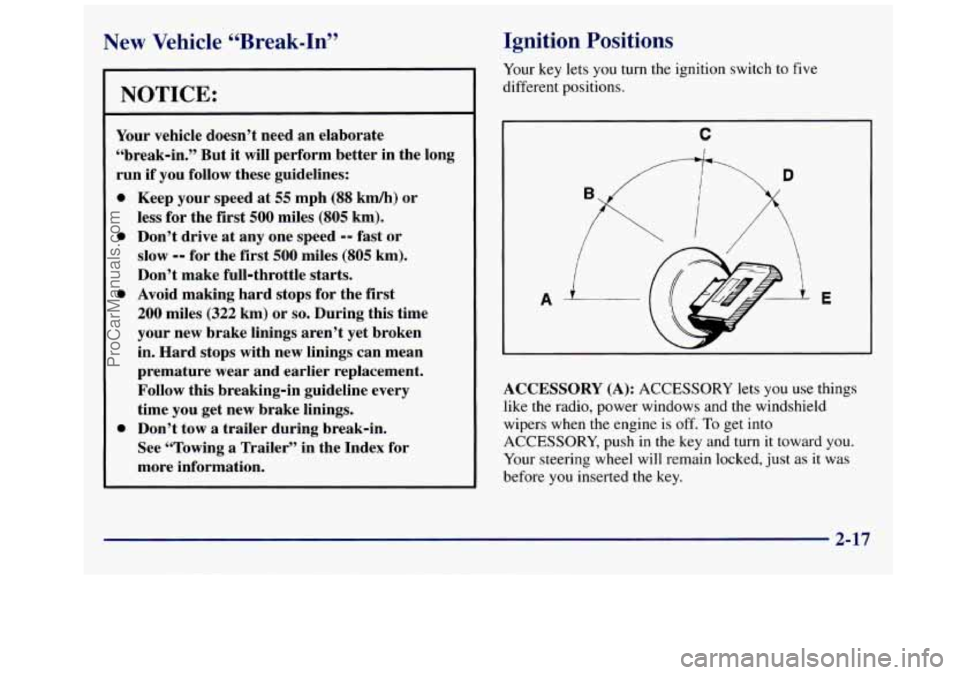
Ignition Positions
Your key lets you turn the ignition switch to five
different positions.
C
E
ACCESSORY (A): ACCESSORY lets you use things
like the radio, power windows and the windshield
wipers when the engine is off.
To get into
ACCESSORY, push in the key and turn it toward you.
Your steering wheel will remain locked, just as it was
before
you inserted the key.
2-17
ProCarManuals.com
Page 94 of 388
It is dangerous to get out of your vehicle if the
shift lever is not fully in PARK
(P) with the
parking brake firmly set. Your vehicle can roll.
Don’t leave your vehicle when the engine is
running unless you have to.
If you have left the
engine running, the vehicle can move suddenly.
You or others could be injured. To be sure your
vehicle won’t move, even when you’re on fairly
level ground, always set your parking brake and
move the shift lever to PARK
(P).
See “Shifting Into PARK (P)” in the Index. If
you’re pulling a trailer, see “Towing a Trailer” in
the Index.
Ensure the shift lever is fully in PARK (P) before
starting the engine. Your vehicle has
a
brake-transmission shift interlock. With the ignition in
the RUN position, you must fully apply your regular
brakes before you can shift from PARK
(P).
If you cannot shift out of PARK (P), ease pressure on
the shift lever and push the shift lever all the way into
PARK (P) as you continue pressing the brake pedal.
Then move the shift lever into
the gear you want. See
“Shifting Out
of PARK (P)” later in this section.
REVERSE (R): Use this gear to back up.
NOTICE:
Shifting into REVERSE (R) while your vehicle is
moving forward could damage your
transmission. Shift to REVERSE
(R) only after
your vehicle is stopped.
To rock your vehicle back and forth to get out of snow,
ice or sand without damaging your transmission, see
“Stuck: In Sand, Mud, Ice or Snow” in the Index.
NEUTRAL
(N): In this position, your engine doesn’t
connect with the wheels.
To restart when you’re already
moving, use
NEUTRAL (N) only. Also, use
NEUTRAL (N) when your vehicle is being towed.
2-22
ProCarManuals.com
Page 95 of 388
r
I I - CAUTION:
Shifting out of PARK (P) or NEUTRAL (N) while
your engine is “racing” (running at high speed) is
1 dangerous. Unless your foot is firmly on the
brake pedal, your vehicle could move very rapidly.
You could lose control and hit people or
objects. Don’t shift
out of PARK (P) or
NEUTRAL (N) while your engine
is racing.
NOTICE:
Damage to your transmission caused by shifting
out
of PARK (P) or NEUTRAL (N) with the
engine racing isn’t covered by your warranty.
DRIVE
(D): This position is for normal driving. If you
need more power for passing, and you’re:
0 Going less than about 35 mph (55 km/h), push your
accelerator pedal about halfway down.
Going about 35 mph (55 km/h) or more, push the
accelerator all the way down.
You’ll shift down
to the next gear and have more power.
You should use DRIVE (D) (or, as
you need to, a lower
gear) when towing a trailer
to minimize heat build-up
and extend the life
of your transmission.
THIRD (3): This position is also used for normal
driving, however, it offers more power and lower fuel
economy than DRIVE (D). You should use THIRD
(3)
when carrying a heavy load or driving on steep hills.
SECOND (2): This position gives you more power but
lower fuel economy. You can use
SECOND (2) on hills.
It can help control your speed as you go down steep
mountain roads, but then you would also want
to use
your brakes off and on. If you manually select
SECOND
(2), the transmission will drive in
SECOND
(2). You may use this feature for reducing
torque
to the rear wheels when you are trying to start
your vehicle from a stop on slippery road surfaces.
FIRST (1): This position gives you even more power
(but lower fuel economy) than
SECOND (2). You can
use it on very steep hills, or
in deep snow or mud. If
the selector lever is put in FIRST(
l), the transmission
won’t shift into first gear until the vehicle is going
slowly enough.
ProCarManuals.com
Page 97 of 388
NOTICE:
Driving with the parking brake on can cause your
rear brakes to overheat. You may have to replace
them, and you could also damage other parts of
your vehicle. Always check to
be sure your parking
brake
is fully released before you drive.
If you are towing a trailer and are parking on any hill,
see “Towing a Trailer” in the Index. That section shows
what to do first to keep the trailer from moving.
Shifting Into PARK (P)
It can be dangerous to get out of your vehicle if
the shift lever is not fully in PARK
(P) with the
parking brake firmly set. Your vehicle can roll.
If
you have left the engine running, the vehicle can
move suddenly. You or others could be injured.
To be sure your vehicle won’t move, even when
you’re on fairly level ground, use the steps that
follow.
If you’re pulling a trailer, see “Towing a
Trailer” in the Index.
1. Hold the brake pedal down with your right foot and
set the parking brake.
2-25
ProCarManuals.com
Page 102 of 388
Running Your Engine While
You’re Parked
It’s better not to park with the engine running. But if
ever you have to, here are some things to know.
t-
Idling the engine with the air system control off
could allow dangerous exhaust into your vehicle
(see the earlier Caution under “Engine Exhaust”).
I Also, idling in a closed-in place can let deadly
carbon monoxide
(CO) into your vehicle even
if the fan switch is
at the highest setting. One
place this can happen
is a garage. Exhaust -- with
CO -- can come in easily. NEVER park in a
garage with the engine running.
Another closed-in place can be
a blizzard.
(See “Blizzard” in the Index.) It can
be dangerous to get out of
yvur vehicle if
the shift lever is not fully in PARK
(P) with the
parking brake firmly set. Your vehicle can roll.
Don’t leave your vehicle when the engine is
running unless you have to. If you’ve left the
engine running, the vehicle can move suddenly.
You
or others could be injured. To be sure your
vehicle won’t move, even when you’re
on fairly
level ground, always set your parking brake and
move the shift lever to PARK (P).
Follow the proper steps to be sure your vehicle won’t
move. See “Shifting Into
PARK (P)” in the Index.
If you’re pulling a trailer, see “Towing
a Trailer” in
the Index.
Locking Rear Axle (If Equipped)
If you have this feature, your locking rear axle can give
you additional traction on snow, mud, ice, sand or
gravel. It works like a standard axle most of the time,
but when
one of the rear wheels has no traction and the
other does, this feature will allow
the wheel with
traction to move the vehicle.
2-30
ProCarManuals.com
Page 114 of 388
The DRL system will make your headlamps come on at
a reduced brightness when:
The ignition is on,
The headlamp switch is off, and
The parking brake is released.
When the DRL are
on, only your headlamps will be on.
The taillamps, sidemarker and other lamps won’t be on.
Your instrument panel won’t be lit up either.
When it begins
to get dark, your DRL indicator light is
a reminder
to turn your headlamp switch on. The other
lamps that come
on with your headlamps will also
come
on.
When you turn off the headlamp switch, the regular
lamps will go off, and your headlamps will change to
the reduced brightness of
DRL.
To idle your vehicle with the engine on and the DRL off,
set the parking brake. The DRL will stay off until you
release the parking brake.
As with any vehicle, you should turn on the regular
headlamp system when you need it.
Center High-Mounted Stoplamp
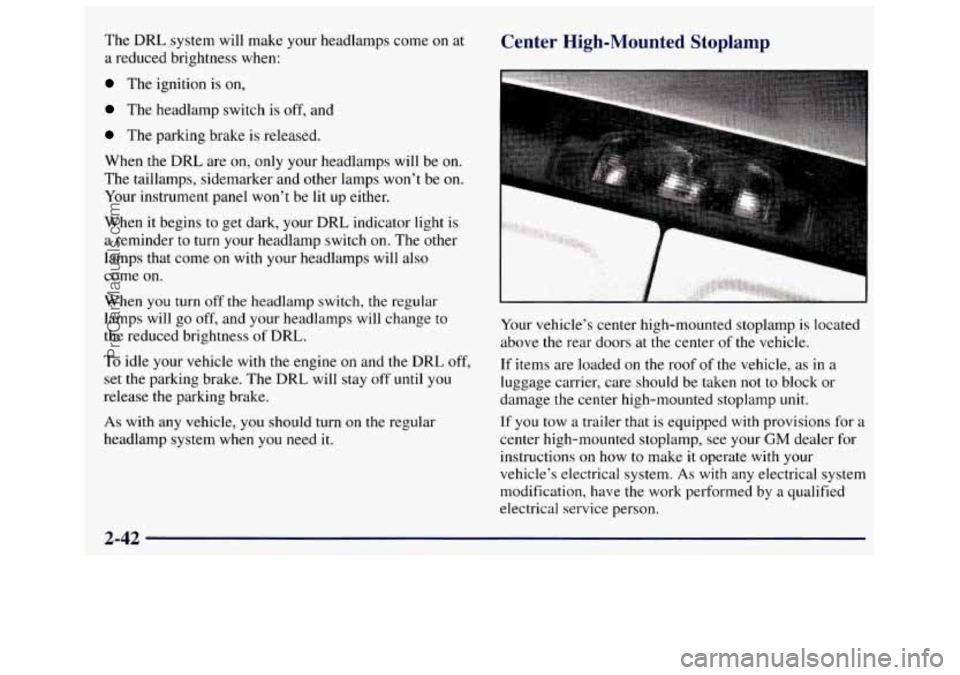
Your vehicle’s center high-mounted stoplamp is located
above the rear doors at the center of the vehicle.
If items are loaded on the roof of the vehicle, as in a
luggage carrier, care should be taken
not to block or
damage the center high-mounted stoplamp unit.
If you tow a trailer that is equipped with provisions for a
center high-mounted stoplamp, see your
GM dealer for
instructions
on how to make it operate with your
vehicle’s electrical system.
As with any electrical system
modification, have the work performed by a qualified
electrical service person.
2-42
ProCarManuals.com
Page 119 of 388
Camper-vpe Mirrors (If Equipped)
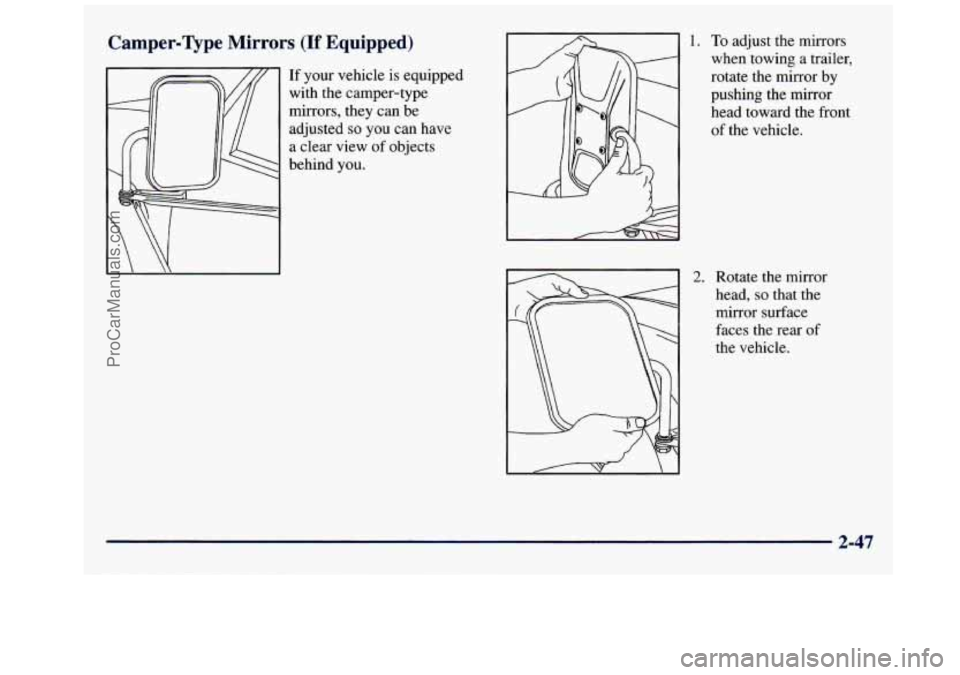
If your vehicle is equipped
with the camper-type
mirrors, they can be
adjusted
so you can have
a clear view of objects
behind you.
1. To adjust the mirrors
when towing a trailer,
rotate the mirror by
pushing the mirror
head toward the front
of the vehicle.
2. Rotate the mirror
head,
so that the
mirror surface
faces the rear
of
the vehicle.
2-47
ProCarManuals.com
Page 131 of 388
If the Light Is Flashing If the Light Is On Steady
The following may prevent more serious damage to
your vehicle:
Reducing vehicle speed.
Avoiding hard accelerations.
Avoiding steep uphill grades.
If you are towing a trailer, reduce the amount of
cargo being hauled as soon as it is possible.
If the light stops flashing and remains on steady, see “If
the Light Is On Steady” following.
If the light continues
to flash, when it is safe to do so,
stop the vehicle. Find a safe place to park your vehicle.
Turn the key
off, wait at least 10 seconds and restart the
engine. If
the light remains on steady, see “If the Light
Is On Steady” following. If the light is still flashing,
follow the previous steps, and drive the vehicle to your
dealer or qualified service center for service. You
may be able to correct the emission system
malfunction by considering the following:
Did you recently put fuel into your vehicle?
If
so, reinstall the fuel cap, making sure to fully install
the cap. The diagnostic system can determine if
the fuel
cap has been left off or improperly installed.
A loose or
missing fuel cap will allow fuel to evaporate into the
atmosphere.
A few driving trips with the cap properly
installed should turn the light off.
Did you just drive through a deep puddle of water?
If
so, your electrical system may be wet. The condition
will usually be corrected when the electrical system
dries
out. A few driving trips should turn the light off.
Are you low
on fuel?
As your engine starts to run out of fuel, your engine may
not run as efficiently as designed since small amounts
of
air are sucked into the fuel line causing a misfire. The
system can detect this. Adding fuel should correct
this
condition. Make sure to install the fuel cap properly. It
will take a few driving trips
to turn the light off.
2-59
ProCarManuals.com
Page 165 of 388
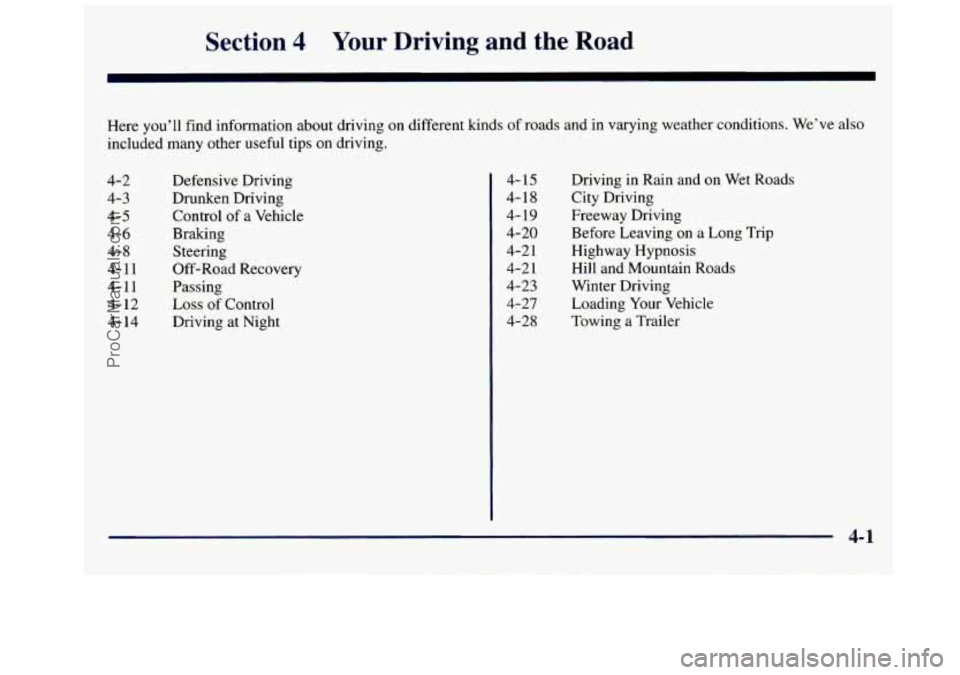
Section 4 Your Driving and the Road
Here you’ll find information about driving on different kinds of roads and in varying weather conditions. We’ve also
included many other useful tips on driving.
4-2 4-3
4-5
4-6
4-8 4-1 1
4-11
4- 12
4-
14
Defensive Driving
Drunken Driving
Control
of a Vehicle
Braking Steering
Off-Road Recovery
Passing
Loss
of Control
Driving at Night Driving in Rain and
on Wet Roads
City Driving
Freeway Driving
Before Leaving on a Long Trip
Highway Hypnosis Hill and Mountain Roads
Winter Driving
Loading Your Vehicle
Towing a Trailer
4-
15
4-18
4- 19
4-20
4-2 1
4-2 1
4-23
4-27
4-28
4-1
ProCarManuals.com
Page 192 of 388
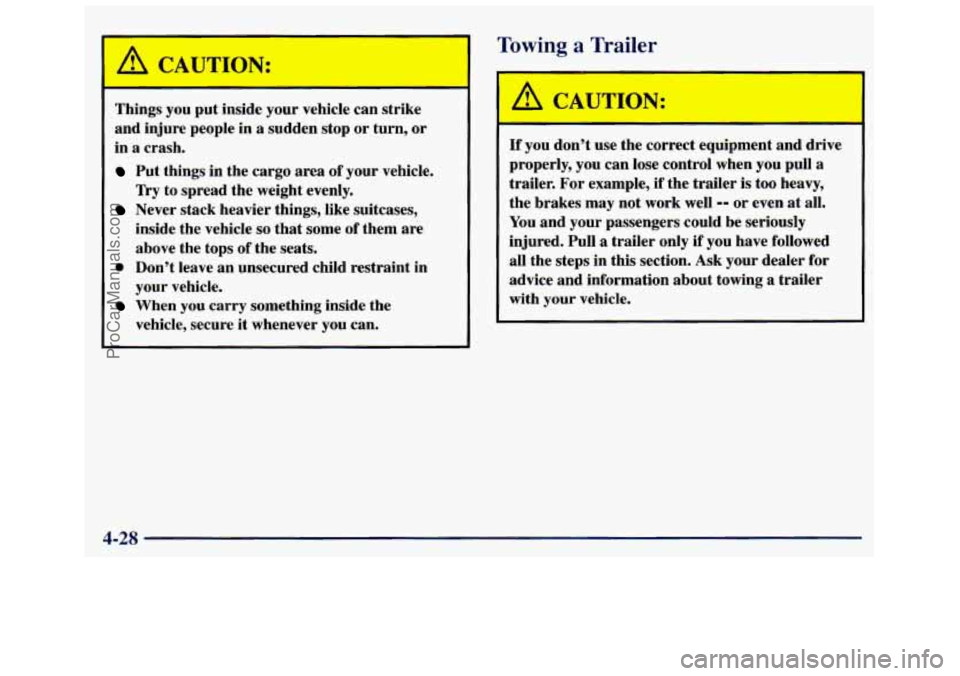
CAUTION:
Things you put inside your vehicle can strike
and injure people in
a sudden stop or turn, or
in a crash.
Put things in the cargo area of your vehicle.
Try to spread the weight evenly.
Never stack heavier things, like suitcases,
inside the vehicle
so that some of them are
above the tops
of the seats.
0 Don’t leave an unsecured child restraint in
your vehicle.
When you carry something inside the
vehicle, secure it whenever you can.
Towing a Trailer
A CAUTION:
If you don’t use the correct equipment and drive
properly, you can lose control when you pull a
trailer. For example,
if the trailer is too heavy,
the brakes may not work well
-- or even at all.
You and your passengers could be seriously
injured. Pull
a trailer only if you have followed
all the steps in this section. Ask your dealer for
advice and information about towing a trailer
with your vehicle.
4-28
ProCarManuals.com