ad blue GMC SAVANA 1999 User Guide
[x] Cancel search | Manufacturer: GMC, Model Year: 1999, Model line: SAVANA, Model: GMC SAVANA 1999Pages: 398, PDF Size: 2.67 MB
Page 18 of 398
yellowblue
1-6
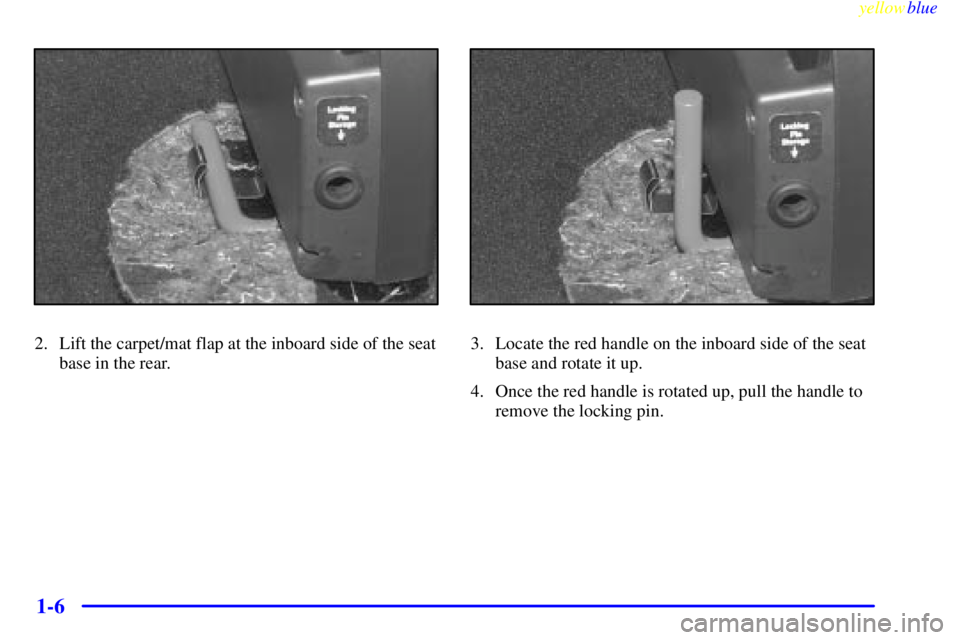
2. Lift the carpet/mat flap at the inboard side of the seat
base in the rear.3. Locate the red handle on the inboard side of the seat
base and rotate it up.
4. Once the red handle is rotated up, pull the handle to
remove the locking pin.
Page 19 of 398
yellowblue
1-7
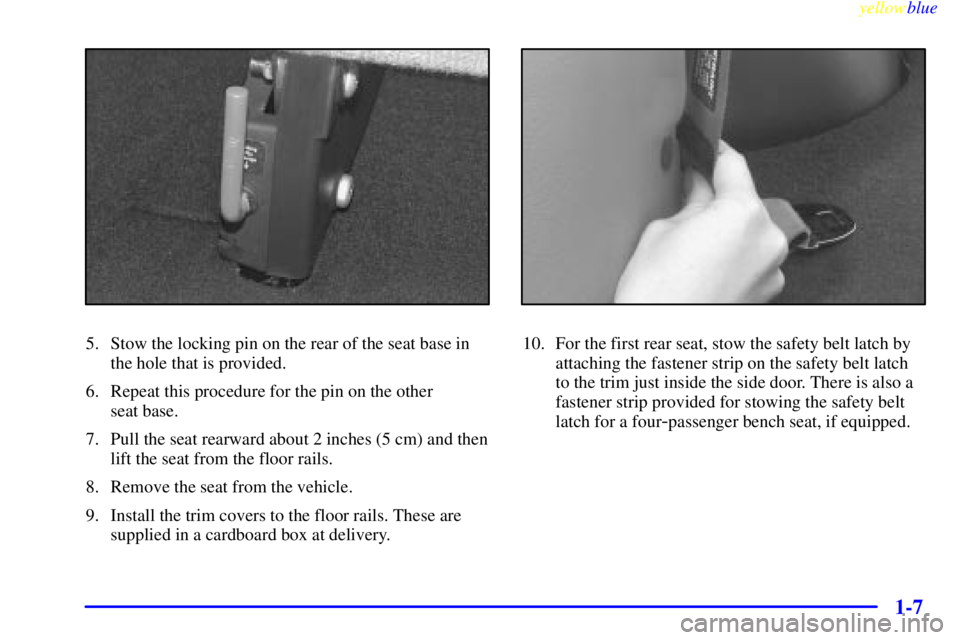
5. Stow the locking pin on the rear of the seat base in
the hole that is provided.
6. Repeat this procedure for the pin on the other
seat base.
7. Pull the seat rearward about 2 inches (5 cm) and then
lift the seat from the floor rails.
8. Remove the seat from the vehicle.
9. Install the trim covers to the floor rails. These are
supplied in a cardboard box at delivery.10. For the first rear seat, stow the safety belt latch by
attaching the fastener strip on the safety belt latch
to the trim just inside the side door. There is also a
fastener strip provided for stowing the safety belt
latch for a four
-passenger bench seat, if equipped.
Page 20 of 398
yellowblue
1-8
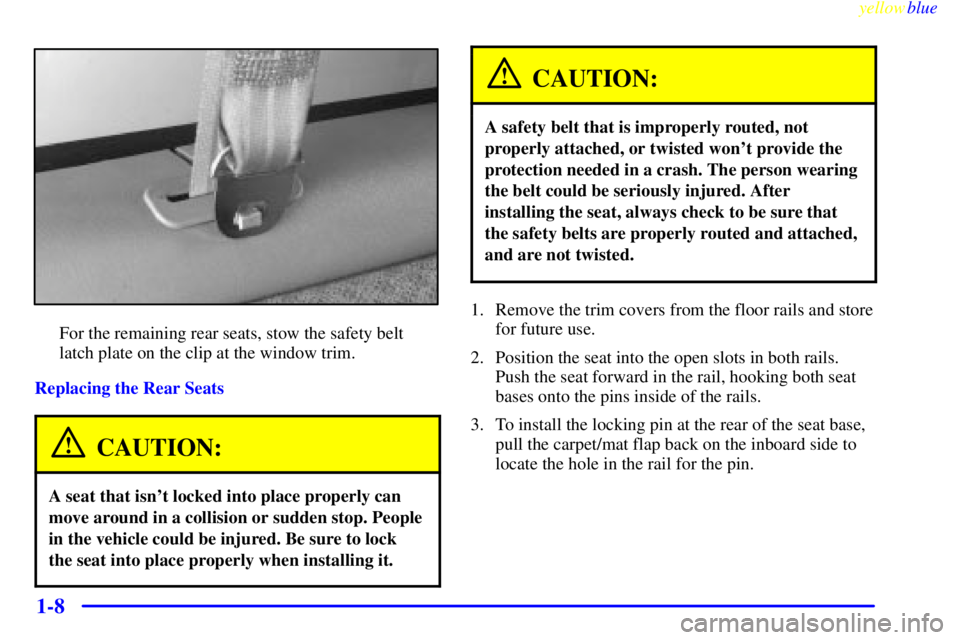
For the remaining rear seats, stow the safety belt
latch plate on the clip at the window trim.
Replacing the Rear Seats
CAUTION:
A seat that isn't locked into place properly can
move around in a collision or sudden stop. People
in the vehicle could be injured. Be sure to lock
the seat into place properly when installing it.
CAUTION:
A safety belt that is improperly routed, not
properly attached, or twisted won't provide the
protection needed in a crash. The person wearing
the belt could be seriously injured. After
installing the seat, always check to be sure that
the safety belts are properly routed and attached,
and are not twisted.
1. Remove the trim covers from the floor rails and store
for future use.
2. Position the seat into the open slots in both rails.
Push the seat forward in the rail, hooking both seat
bases onto the pins inside of the rails.
3. To install the locking pin at the rear of the seat base,
pull the carpet/mat flap back on the inboard side to
locate the hole in the rail for the pin.
Page 21 of 398
yellowblue
1-9
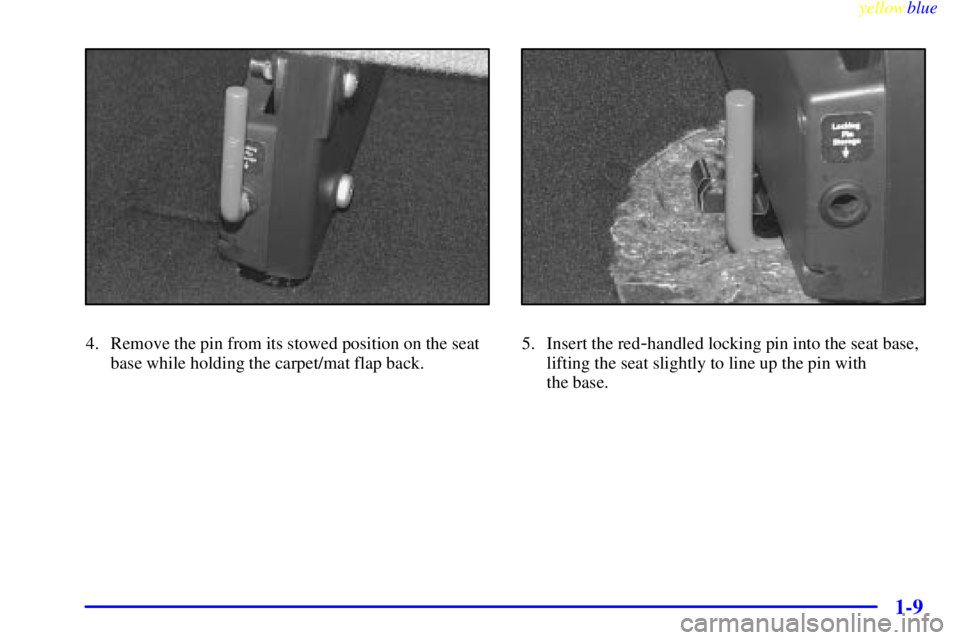
4. Remove the pin from its stowed position on the seat
base while holding the carpet/mat flap back.5. Insert the red-handled locking pin into the seat base,
lifting the seat slightly to line up the pin with
the base.
Page 22 of 398
yellowblue
1-10
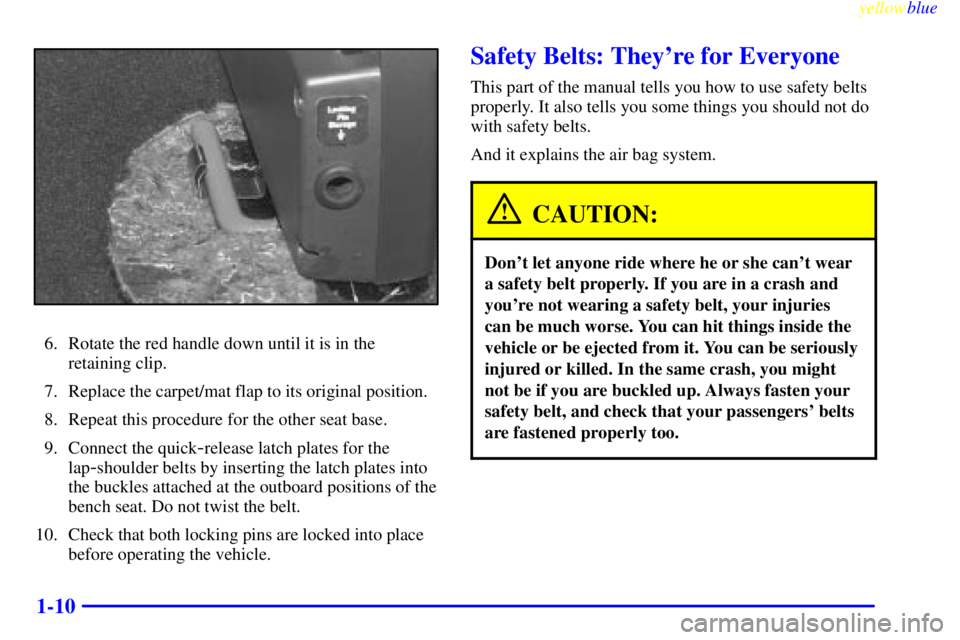
6. Rotate the red handle down until it is in the
retaining clip.
7. Replace the carpet/mat flap to its original position.
8. Repeat this procedure for the other seat base.
9. Connect the quick
-release latch plates for the
lap
-shoulder belts by inserting the latch plates into
the buckles attached at the outboard positions of the
bench seat. Do not twist the belt.
10. Check that both locking pins are locked into place
before operating the vehicle.
Safety Belts: They're for Everyone
This part of the manual tells you how to use safety belts
properly. It also tells you some things you should not do
with safety belts.
And it explains the air bag system.
CAUTION:
Don't let anyone ride where he or she can't wear
a safety belt properly. If you are in a crash and
you're not wearing a safety belt, your injuries
can be much worse. You can hit things inside the
vehicle or be ejected from it. You can be seriously
injured or killed. In the same crash, you might
not be if you are buckled up. Always fasten your
safety belt, and check that your passengers' belts
are fastened properly too.
Page 23 of 398
yellowblue
1-11
CAUTION:
It is extremely dangerous to ride in a cargo area,
inside or outside of a vehicle. In a collision,
people riding in these areas are more likely to be
seriously injured or killed. Do not allow people to
ride in any area of your vehicle that is not
equipped with seats and safety belts. Be sure
everyone in your vehicle is in a seat and using a
safety belt properly.
Your vehicle has a light that
comes on as a reminder to
buckle up. (See ªSafety
Belt Reminder Lightº in
the Index.)
In most states and Canadian provinces, the law says to
wear safety belts. Here's why: They work.
You never know if you'll be in a crash. If you do have a
crash, you don't know if it will be a bad one.
A few crashes are mild, and some crashes can be so
serious that even buckled up a person wouldn't survive.
But most crashes are in between. In many of them,
people who buckle up can survive and sometimes walk
away. Without belts they could have been badly hurt
or killed.
After more than 30 years of safety belts in vehicles, the
facts are clear. In most crashes buckling up does
matter ... a lot!
Page 24 of 398
yellowblue
1-12 Why Safety Belts Work
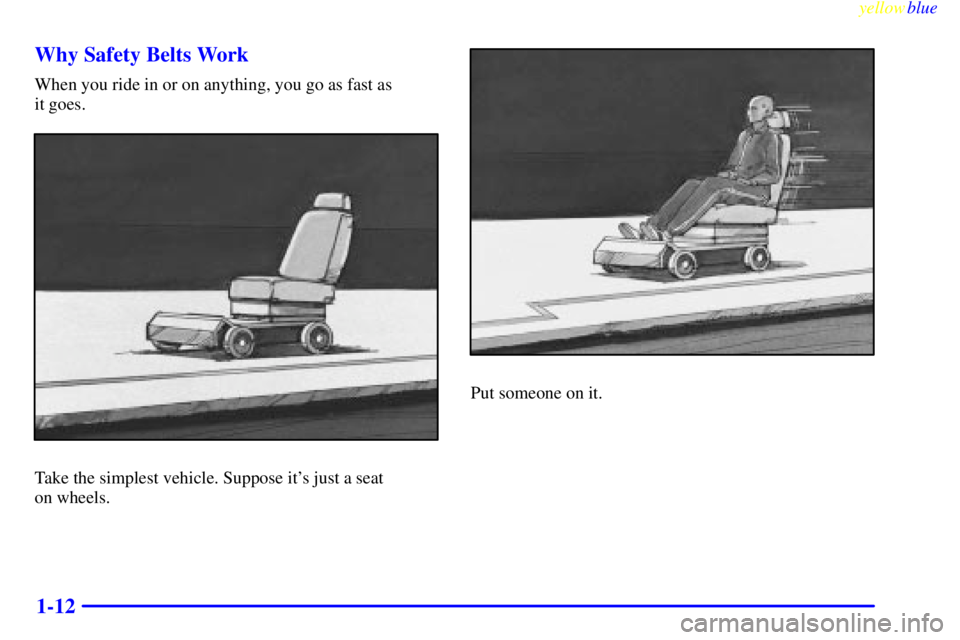
When you ride in or on anything, you go as fast as
it goes.
Take the simplest vehicle. Suppose it's just a seat
on wheels.
Put someone on it.
Page 25 of 398
yellowblue
1-13
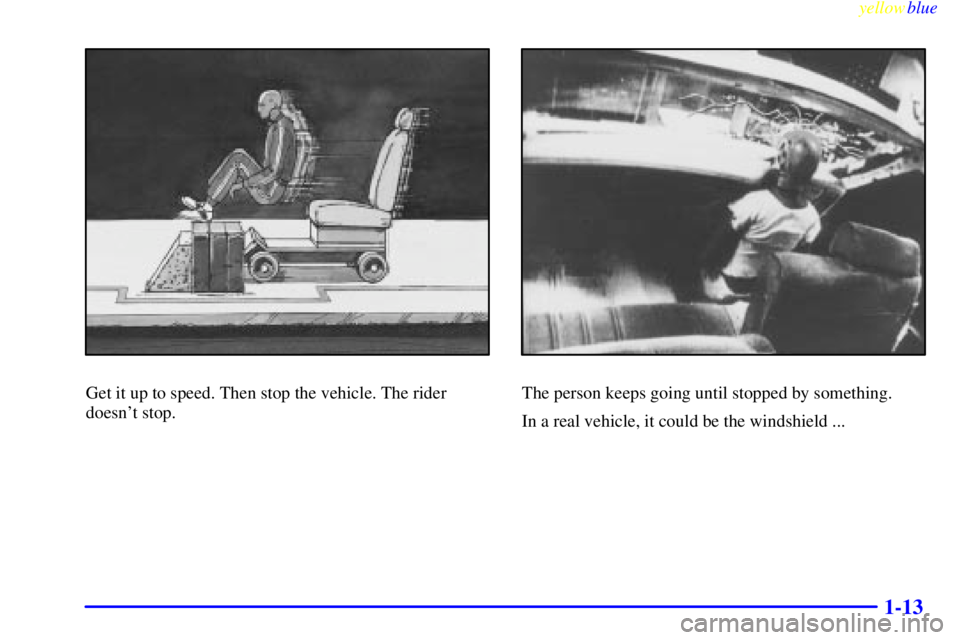
Get it up to speed. Then stop the vehicle. The rider
doesn't stop.The person keeps going until stopped by something.
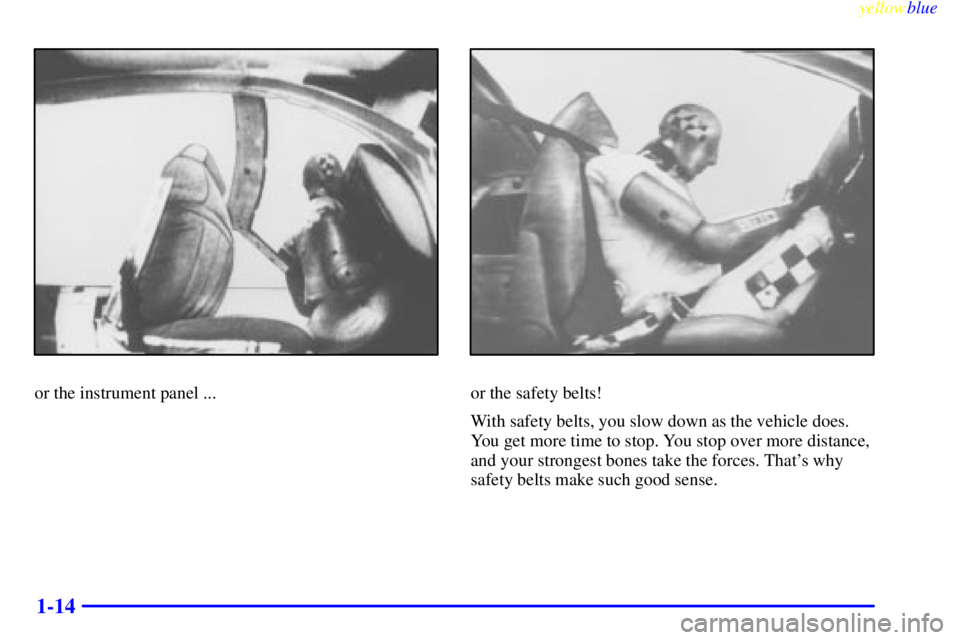
In a real vehicle, it could be the windshield ...
Page 26 of 398
yellowblue
1-14
or the instrument panel ...or the safety belts!
With safety belts, you slow down as the vehicle does.
You get more time to stop. You stop over more distance,
and your strongest bones take the forces. That's why
safety belts make such good sense.
Page 27 of 398
yellowblue
1-15
Here Are Questions Many People Ask
About Safety Belts
-- and the Answers
Q:
Won't I be trapped in the vehicle after an
accident if I'm wearing a safety belt?
A:You could be -- whether you're wearing a safety
belt or not. But you can unbuckle a safety belt,
even if you're upside down. And your chance of
being conscious during and after an accident, so
you can unbuckle and get out, is much greater if
you are belted.
Q:If my vehicle has air bags, why should I have to
wear safety belts?
A:Air bags are in many vehicles today and will be in
most of them in the future. But they are
supplemental systems only; so they work with
safety belts
-- not instead of them. Every air bag
system ever offered for sale has required the use of
safety belts. Even if you're in a vehicle that has air
bags, you still have to buckle up to get the most
protection. That's true not only in frontal collisions,
but especially in side and other collisions.
Q:If I'm a good driver, and I never drive far from
home, why should I wear safety belts?
A:You may be an excellent driver, but if you're in an
accident
-- even one that isn't your fault -- you and
your passengers can be hurt. Being a good driver
doesn't protect you from things beyond your
control, such as bad drivers.
Most accidents occur within 25 miles (40 km) of home.
And the greatest number of serious injuries and deaths
occur at speeds of less than 40 mph (65 km/h).
Safety belts are for everyone.
How to Wear Safety Belts Properly
Adults
This part is only for people of adult size.
Be aware that there are special things to know about
safety belts and children. And there are different rules for
smaller children and babies. If a child will be riding in
your vehicle, see the part of this manual called
ªChildren.º Follow those rules for everyone's protection.
First, you'll want to know which restraint systems your
vehicle has.
We'll start with the driver position.