child restraint GMC SAVANA 2003 User Guide
[x] Cancel search | Manufacturer: GMC, Model Year: 2003, Model line: SAVANA, Model: GMC SAVANA 2003Pages: 392, PDF Size: 2.34 MB
Page 45 of 392
{CAUTION:
The body structure of a young child is quite
unlike that of an adult or older child, for whom
the safety belts are designed. A young child’s
hip bones are still so small that the vehicle’s
regular safety belt may not remain lowon the
hip bones, as it should. Instead, it may settle
up around the child’s abdomen. In a crash,
the belt would apply force on a body area
that’s unprotected by any bony structure.
This alone could cause serious or fatal
injuries. Young children always should be
secured in appropriate child restraints.
Cargo Vans with a Passenger Air Bag
and without an Air Bag Off Switch
{CAUTION:
Children who are up against, or very close to,
an air bag when it inflates can be seriously
injured or killed. Air bags plus lap-shoulder
belts offer outstanding protection for adults
and older children, but not for young children
and infants. Neither the vehicle’s safety belt
system nor its air bag system is designed
for them. Young children and infants need the
protection that a child restraint system can
provide.
1-39
2003 - Savana OM
Page 46 of 392
{CAUTION:
Newborn infants need complete support,
including support for the head and neck.
This is necessary because a newborn infant’s
neck is weak and its head weighs so much
compared with the rest of its body.
In a crash, an infant in a rear-facing seat
settles into the restraint, so the crash forces
can be distributed across the strongest part
of an infant’s body, the back and shoulders.
Infants always should be restrained in
appropriate infant restraints. However, infants,
who should be restrained in a rear-facing child
restraint, cannot ride safely in this vehicle.
{CAUTION:
The body structure of a young child is quite
unlike that of an adult or older child, for whom
the safety belts are designed. A young child’s
hip bones are still so small that the vehicle’s
regular safety belt may not remain lowon the
hip bones, as it should. Instead, it may settle
up around the child’s abdomen. In a crash,
the belt would apply force on a body area
that’s unprotected by any bony structure.
This alone could cause serious or fatal
injuries. Young children always should be
secured in appropriate child restraints.
1-40
2003 - Savana OM
Page 48 of 392

Child Restraint Systems
An infant car bed (A), a special bed made for use in a
motor vehicle, is an infant restraint system designed
to restrain or position a child on a continuousflat
surface. Make sure that the infant’s head rests toward
the center of the vehicle.A rear-facing infant seat (B) provides restraint with
the seating surface against the back of the infant.
The harness system holds the infant in place and,
in a crash, acts to keep the infant positioned in
the restraint.
1-42
2003 - Savana OM
Page 49 of 392
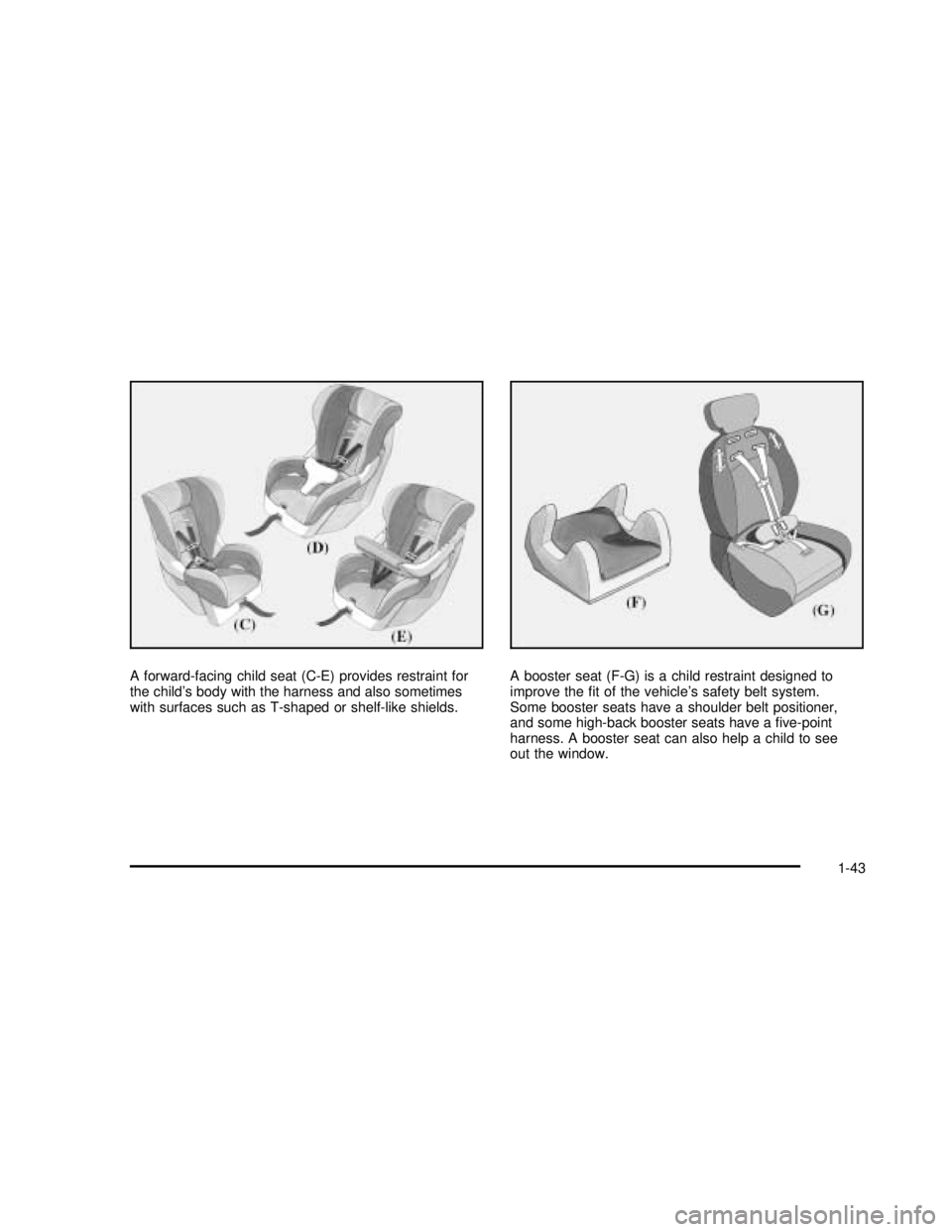
A forward-facing child seat (C-E) provides restraint for
the child’s body with the harness and also sometimes
with surfaces such as T-shaped or shelf-like shields.A booster seat (F-G) is a child restraint designed to
improve thefit of the vehicle’s safety belt system.
Some booster seats have a shoulder belt positioner,
and some high-back booster seats have afive-point
harness. A booster seat can also help a child to see
out the window.
1-43
2003 - Savana OM
Page 50 of 392
Q:Howdo child restraints work?
A:A child restraint system is any device designed for
use in a motor vehicle to restrain, seat, or position
children. A built-in child restraint system is a
permanent part of the motor vehicle. An add-on
child restraint system is a portable one, which
is purchased by the vehicle’s owner.
For many years, add-on child restraints have used
the adult belt system in the vehicle. To help reduce
the chance of injury, the child also has to be secured
within the restraint. The vehicle’s belt system secures
the add-on child restraint in the vehicle, and the
add-on child restraint’s harness system holds the
child in place within the restraint.
One system, the three-point harness, has straps that
come down over each of the infant’s shoulders and
buckle together at the crotch. Thefive-point harness
system has two shoulder straps, two hip straps and a
crotch strap. A shield may take the place of hip
straps. A T-shaped shield has shoulder straps that
are attached to aflat pad which rests low against the
child’s body. A shelf- or armrest-type shield has
straps that are attached to a wide, shelf-like shield
that swings up or to the side.When choosing a child restraint, be sure the child
restraint is designed to be used in a vehicle. If it is,
it will have a label saying that it meets federal motor
vehicle safety standards.
Then follow the instructions for the restraint. You may
find these instructions on the restraint itself or in a
booklet, or both. These restraints use the belt system
in your vehicle, but the child also has to be secured
within the restraint to help reduce the chance of personal
injury. When securing an add-on child restraint, refer
to the instructions that come with the restraint which may
be on the restraint itself or in a booklet, or both, and
to this manual. The child restraint instructions are
important, so if they are not available, obtain a
replacement copy from the manufacturer.
1-44
2003 - Savana OM
Page 51 of 392
Where to Put the Restraint
Passenger Vans without an Air Bag
Off Switch
Accident statistics show that children are safer if they
are restrained in the rear rather than the front seat.
We, therefore, recommend that child restraints be
secured in a rear seat including an infant riding in a
rear-facing infant seat, a child riding in a forward-facing
child seat and an older child riding in a booster seat. If
your vehicle has a front passenger air bag,neverput a
rear-facing child restraint in the front passenger seat.
Here’s why:
{CAUTION:
A child in a rear-facing child restraint can be
seriously injured or killed if the air bag inflates.
This is because the back of the rear-facing
child restraint would be very close to the
inflating air bag. If your vehicle has a right
front passenger’s air bag, always secure a
rear-facing child restraint in a rear seat.
CAUTION: (Continued)
CAUTION: (Continued)
You may secure a forward-facing child restraint
in the right front seat, but before you do, always
move the front passenger seat as far back as it
will go. It’s better to secure the child restraint in
a rear seat.
Wherever you install it, be sure to secure the child
restraint properly.
Keep in mind that an unsecured child restraint can
move around in a collision or sudden stop and injure
people in the vehicle. Be sure to properly secure
any child restraint in your vehicle–even when no
child is in it.
1-45
2003 - Savana OM
Page 52 of 392
Passenger Vans with an Air Bag
Off Switch
Accident statistics show that children are safer if they
are restrained in the rear rather than the front seat.
We, therefore, recommend that child restraints be
secured in a rear seat, including an infant riding in a
rear-facing infant seat, a child riding in a forward-facing
child seat and an older child riding in a booster seat.
If you need to secure a rear-facing child restraint in the
right front passenger’s seat, turn off the passenger’s
air bag. SeeAir Bag Off Switch on page 1-71and
Securing a Child Restraint in the Right Front Seat
Position on page 1-58for more on this, including
important safety information.
{CAUTION:
A child in a rear-facing child restraint can be
seriously injured or killed if the air bag inflates.
This is because the back of the rear-facing
child restraint would be very close to the
inflating air bag. Be sure to turn off the air bag
before using a rear-facing child restraint in the
right front seat position.
CAUTION: (Continued)
CAUTION: (Continued)
Even though the AIR BAG OFF switch is
designed to turn off the passenger’s frontal
air bag, no system is fail-safe, and no one can
guarantee that an air bag will not deploy under
some unusual circumstance, even though it
is turned off. We, therefore recommend that
rear-facing child restraints be transported in
vehicles with a rear seat that will accommodate
a rear-facing child restraint, whenever possible.
Wherever you install it, be sure to secure the child
restraint properly.
Keep in mind that an unsecured child restraint can
move around in a collision or sudden stop and injure
people in the vehicle. Be sure to properly secure
any child restraint in your vehicle–even when no
child is in it.
1-46
2003 - Savana OM
Page 53 of 392

Cargo Vans and Cab and Chassis
Models without an Air Bag Off Switch
The child restraint must be secured properly in the right
front passenger seat. If your vehicle has a passenger
air bag,neveruse a rear-facing child restraint in
this vehicle Here’s why:
{CAUTION:
A child in a rear-facing child restraint can be
seriously injured or killed if the air bag inflates.
This is because the back of the rear-facing
child restraint would be very close to the
inflating air bag. Do not use a rear-facing child
restraint in this vehicle.
CAUTION: (Continued)
CAUTION: (Continued)
If a forward-facing child restraint is suitable for
your child, first move the front passenger seat
as far back as it will go.
Keep in mind that an unsecured child restraint can
move around in a collision or sudden stop and injure
people in the vehicle. Be sure to properly secure
any child restraint in your vehicle–even when no
child is in it.
1-47
2003 - Savana OM
Page 54 of 392
Cargo Vans and Cab and Chassis
Models with an Air Bag Off Switch
The child restraint must be secured properly in the
right front passenger seat. If you need to secure
a rear-facing child restraint in the right front passenger’s
seat, turn off the passenger’s air bag. SeeAir Bag
Off Switch on page 1-71andSecuring a Child Restraint
in the Right Front Seat Position on page 1-58for
more on this, including important safety information.
{CAUTION:
A child in a rear-facing child restraint can be
seriously injured or killed if the air bag inflates.
This is because the back of the rear-facing
child restraint would be very close to the
inflating air bag. Be sure to turn off the air bag
before using a rear-facing child restraint in the
right front seat position.
CAUTION: (Continued)
CAUTION: (Continued)
Even though the AIR BAG OFF switch is
designed to turn off the passenger’s frontal
air bag, no system is fail-safe, and no one can
guarantee that an air bag will not deploy under
some unusual circumstance, even though it
is turned off. We, therefore recommend that
rear-facing child restraints be transported in
vehicles with a rear seat that will accommodate
a rear-facing child restraint, whenever possible.
Keep in mind that an unsecured child restraint can
move around in a collision or sudden stop and injure
people in the vehicle. Be sure to properly secure
any child restraint in your vehicle–even when no
child is in it.
1-48
2003 - Savana OM
Page 55 of 392

Top Strap
Some child restraints have a top strap, or“top tether.”
It can help restrain the child restraint during a collision.
For it to work, a top strap must be properly anchored
to the vehicle. Some top strap-equipped child restraints
are designed for use with or without the top strap
being anchored. Others require the top strap always
to be anchored. Be sure to read and follow the
instructions for your child restraint. If yours requires
that the top strap be anchored, don’t use the restraint
unless it is anchored properly.
If the child restraint does not have a top strap, one can
be obtained, in kit form, for many child restraints.
Ask the child restraint manufacturer whether or not a
kit is available.
In Canada, the law requires that forward-facing child
restraints have a top strap, and that the strap be
anchored. In the United States, some child restraints
also have a top strap. If your child restraint has a
top strap, it should be anchored.
1-49
2003 - Savana OM