maintenance GMC SAVANA 2003 User Guide
[x] Cancel search | Manufacturer: GMC, Model Year: 2003, Model line: SAVANA, Model: GMC SAVANA 2003Pages: 392, PDF Size: 2.34 MB
Page 256 of 392

When to Change Engine Oil
If any one of these are true for you, use the short
trip/city maintenance schedule:
•Most trips are less than 5 miles (8 km). This is
particularly important when outside temperatures
are below freezing.
•Most trips include extensive idling (such as frequent
driving in stop-and-go traffic).
•You frequently tow a trailer or use a carrier on top
of your vehicle.
•The vehicle is used for delivery service, police, taxi
or other commercial application.
Driving under these conditions causes engine oil to
break down sooner. If any one of these is true for your
vehicle, then you need to change your oil andfilter
every 3,000 miles (5 000 km) or 3 months—whichever
occursfirst.
If none of them is true, use the long trip/highway
maintenance schedule. Change the oil andfilter every
7,500 miles (12 500 km) or 12 months—whichever
occursfirst. Driving a vehicle with a fully warmed engine
under highway conditions will cause engine oil to
break down slower.
How to Reset the CHANGE ENGINE
OIL Light
The GM Oil Life System calculates when to change your
engine oil andfilter based on vehicle use. Anytime your
oil is changed, reset the system so it can calculate when
the next oil change is required. If a situation occurs where
you chang your oil prior to a CHANGE ENGINE OIL light
being turned on, reset the system.
To reset the CHANGE ENGINE OIL light, do the
following:
1. Turn the ignition key to RUN with the engine off.
2. Fully press and release the accelerator pedal
three times withinfive seconds.
3. If the CHANGE ENGINE OIL lightflashes for
five seconds, the system is reset.
If the system does not reset, try the procedure once
again. If it still does not reset, see your dealer for
service.
SeeChange Engine Oil Light on page 3-37.
5-16
2003 - Savana OM
Page 259 of 392

Automatic Transmission Fluid
When to Check and Change
A good time to check your automatic transmissionfluid
level is when the engine oil is changed.
Change both thefluid andfilter every 50,000 miles
(83,000 km) if the vehicle’s GVWR is over 8,600 or if
the vehicle is mainly driven under one or more of these
conditions:
•In heavy city traffic where the outside temperature
regularly reaches 90°F (32°C) or higher.
•In hilly or mountainous terrain.
•When doing frequent trailer towing.
•Uses such as found in taxi, police or delivery
service.
If your vehicle’s GVWR is not over 8,600 and you do
not use your vehicle under any of these conditions,
change thefluid andfilter every 100,000 miles
(166 000 km).
SeePart A: Scheduled Maintenance Services on
page 6-4.
How to Check
Because this operation can be a little difficult, you may
choose to have this done at the dealership service
department.
If you do it yourself, be sure to follow all the instructions
here, or you could get a false reading on the dipstick.
Notice:Too much or too littlefluid can damage
your transmission. Too much can mean that some
of thefluid could come out and fall on hot engine
part or exhaust system parts, starting afire.
Too littlefluid could cause the transmission to
overheat. Be sure to get an accurate reading if you
check your transmissionfluid.
Wait at least 30 minutes before checking the
transmissionfluid level if you have been driving:
•When outside temperatures are above 90°F (32°C).
•At high speed for quite a while.
•In heavy traffic–especially in hot weather.
•While pulling a trailer.
5-19
2003 - Savana OM
Page 262 of 392

How to Add Fluid
Refer to the Maintenance Schedule to determine
what kind of transmissionfluid to use. SeePart D:
Recommended Fluids and Lubricants on page 6-18.
Using a funnel, addfluid down the transmission dipstick
tube only after checking the transmissionfluid while it
is hot. (A cold check is used only as a reference.)
If thefluid level is low, add only enough of the proper
fluid to bring the level up to the HOT area for a hot
check. It doesn’t take muchfluid, generally less than
one pint (0.5 L).Don’t overfill.
Notice:We recommend you use onlyfluid labeled
DEXRON
®-III, becausefluid with that label is
made especially for your automatic transmission.
Damage caused byfluid other than DEXRON
®-III
is not covered by your new vehicle warranty.
•After addingfluid, recheck thefluid level as
described under″How to Check.″
•When the correctfluid level is obtained, push the
dipstick back in all the way; thenflip the handle
down to lock the dipstick in place.
Engine Coolant
The cooling system in your vehicle isfilled with
DEX-COOL®engine coolant. This coolant is designed
to remain in your vehicle for 5 years or 150,000 miles
(240 000 km), whichever occursfirst, if you add
only DEX-COOL
®extended life coolant.
The following explains your cooling system and how to
add coolant when it is low. If you have a problem
with engine overheating, seeEngine Overheating on
page 5-26.
A 50/50 mixture of clean, drinkable water and
DEX-COOL
®coolant will:
•Give freezing protection down to−34°F(−37°C).
•Give boiling protection up to 265°F (129°C).
•Protect against rust and corrosion.
•Help keep the proper engine temperature.
•Let the warning lights and gages work as they
should.
5-22
2003 - Savana OM
Page 277 of 392
Brakes
Brake Fluid
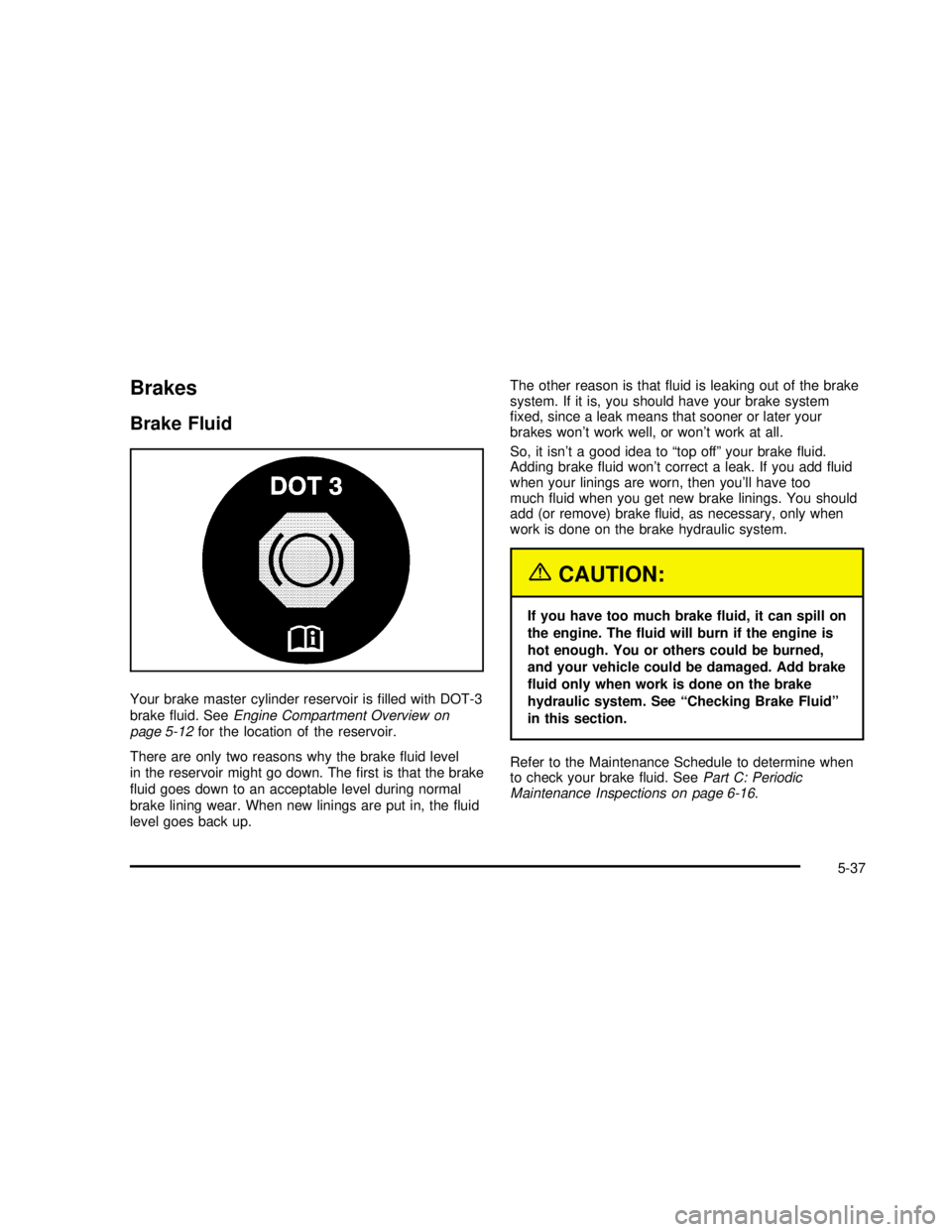
Your brake master cylinder reservoir isfilled with DOT-3
brakefluid. SeeEngine Compartment Overview on
page 5-12for the location of the reservoir.
There are only two reasons why the brakefluid level
in the reservoir might go down. Thefirst is that the brake
fluid goes down to an acceptable level during normal
brake lining wear. When new linings are put in, thefluid
level goes back up.The other reason is thatfluid is leaking out of the brake
system. If it is, you should have your brake system
fixed, since a leak means that sooner or later your
brakes won’t work well, or won’t work at all.
So, it isn’t a good idea to“top off”your brakefluid.
Adding brakefluid won’t correct a leak. If you addfluid
when your linings are worn, then you’ll have too
muchfluid when you get new brake linings. You should
add (or remove) brakefluid, as necessary, only when
work is done on the brake hydraulic system.
{CAUTION:
If you have too much brakefluid, it can spill on
the engine. Thefluid will burn if the engine is
hot enough. You or others could be burned,
and your vehicle could be damaged. Add brake
fluid only when work is done on the brake
hydraulic system. See“Checking Brake Fluid”
in this section.
Refer to the Maintenance Schedule to determine when
to check your brakefluid. SeePart C: Periodic
Maintenance Inspections on page 6-16.
5-37
2003 - Savana OM
Page 280 of 392
Replacing Brake System Parts
The braking system on a vehicle is complex. Its many
parts have to be of top quality and work well together if
the vehicle is to have really good braking. Your vehicle
was designed and tested with top-quality GM brake parts.
When you replace parts of your braking system—for
example, when your brake linings wear down and you
need new ones put in—be sure you get new approved
GM replacement parts. If you don’t, your brakes may no
longer work properly. For example, if someone puts in
brake linings that are wrong for your vehicle, the balance
between your front and rear brakes can change—for the
worse. The braking performance you’ve come to expect
can change in many other ways if someone puts in the
wrong replacement brake parts.
Battery
Your new vehicle comes with a maintenance free
ACDelco®battery. When it’s time for a new battery, get
one that has the replacement number shown on the
original battery’s label. We recommend an ACDelco
®
battery. SeeEngine Compartment Overview on
page 5-12for battery location.Warning:Battery posts, terminals and related
accessories contain lead and lead compounds,
chemicals known to the State of California to cause
cancer and reproductive harm. Wash hands after
handling.
Vehicle Storage
If you’re not going to drive your vehicle for 25 days
or more, remove the black, negative (−) cable from
the battery. This will help keep your battery from
running down.
{CAUTION:
Batteries have acid that can burn you and gas
that can explode. You can be badly hurt if you
aren’t careful. See“Jump Starting”next for
tips on working around a battery without
getting hurt.
Contact your dealer to learn how to prepare your
vehicle for longer storage periods.
Also, for your audio system, seeTheft-Deterrent
Feature (Non-RDS Radios) on page 3-73or
Theft-Deterrent Feature (RDS Radios) on page 3-73.
5-40
2003 - Savana OM
Page 286 of 392
All-Wheel Drive
Lubricant checks in this section also apply to these
vehicles. However, there are two additional systems that
need lubrication.
Transfer Case
When to Check Lubricant
Refer to the Maintenance Schedule to determine how
often to check the lubricant. SeePart C: Periodic
Maintenance Inspections on page 6-16.
How to Check Lubricant
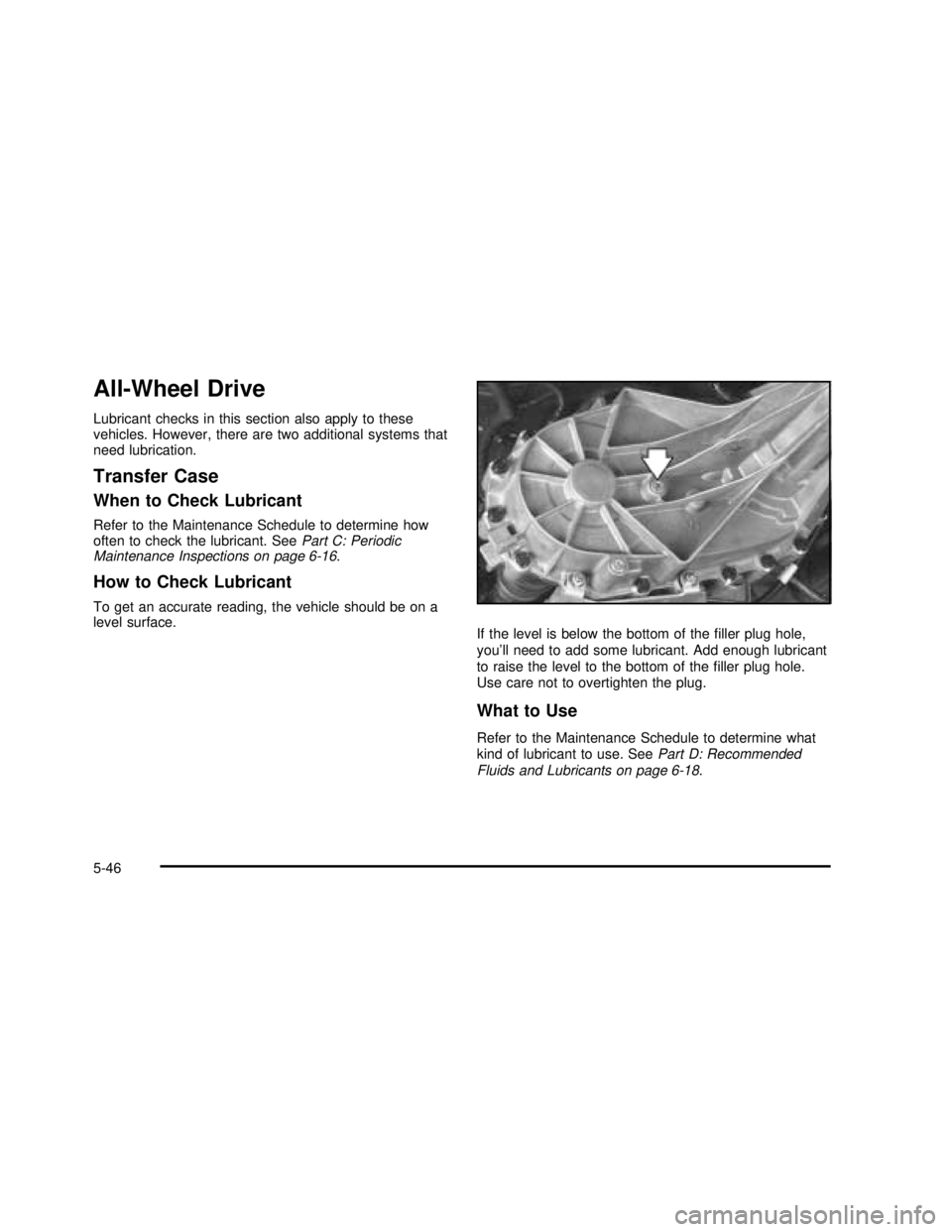
To get an accurate reading, the vehicle should be on a
level surface.
If the level is below the bottom of thefiller plug hole,
you’ll need to add some lubricant. Add enough lubricant
to raise the level to the bottom of thefiller plug hole.
Use care not to overtighten the plug.
What to Use
Refer to the Maintenance Schedule to determine what
kind of lubricant to use. SeePart D: Recommended
Fluids and Lubricants on page 6-18.
5-46
2003 - Savana OM
Page 287 of 392
Rear Axle
When to Check Lubricant
Refer to the Maintenance Schedule to determine how
often to check the lubricant. SeePart A: Scheduled
Maintenance Services on page 6-4.
How to Check Lubricant
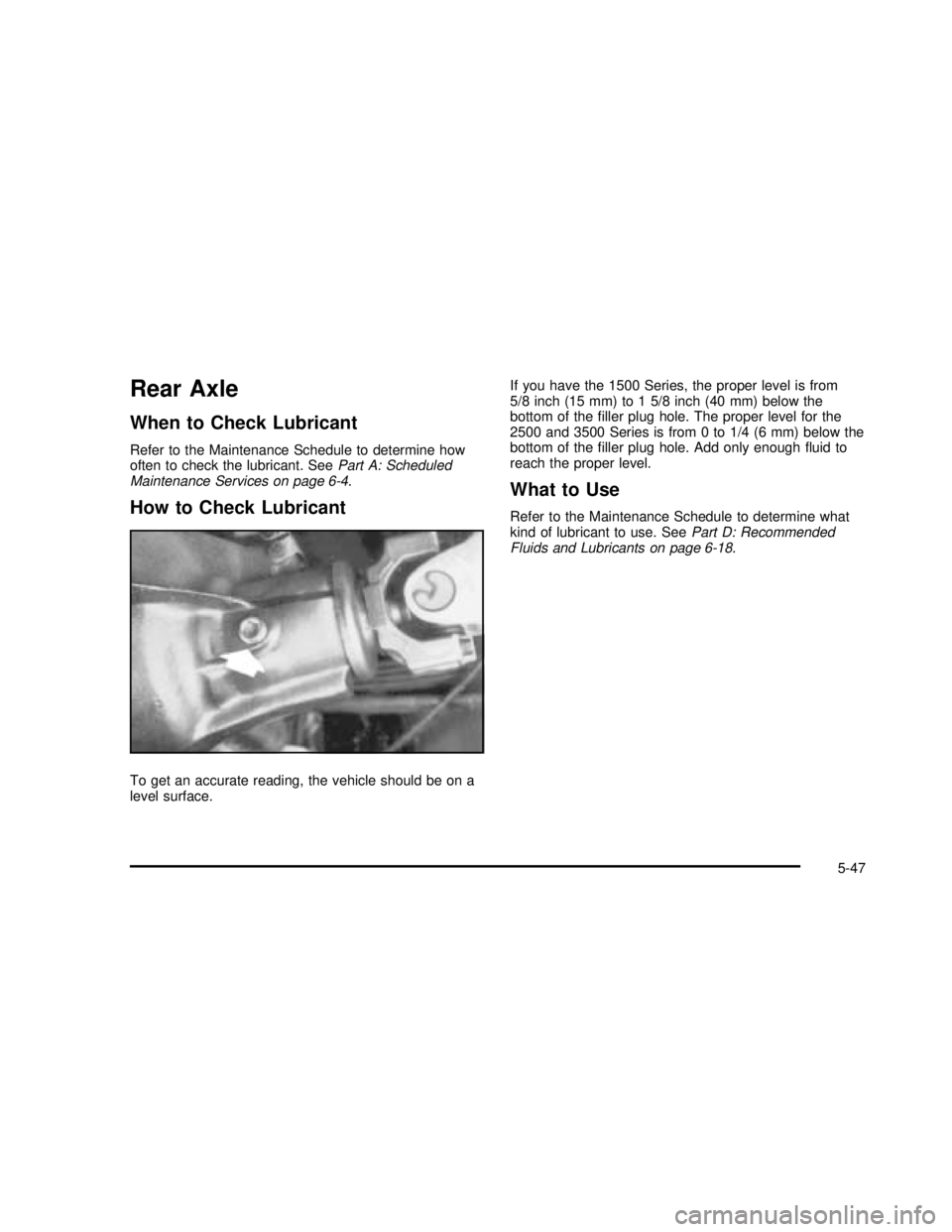
To get an accurate reading, the vehicle should be on a
level surface.If you have the 1500 Series, the proper level is from
5/8 inch (15 mm) to 1 5/8 inch (40 mm) below the
bottom of thefiller plug hole. The proper level for the
2500 and 3500 Series is from 0 to 1/4 (6 mm) below the
bottom of thefiller plug hole. Add only enoughfluid to
reach the proper level.
What to Use
Refer to the Maintenance Schedule to determine what
kind of lubricant to use. SeePart D: Recommended
Fluids and Lubricants on page 6-18.
5-47
2003 - Savana OM
Page 288 of 392
Front Axle
When to Check and Change Lubricant
Refer to the Maintenance Schedule to determine how
often to check the lubricant and when to change it.
SeePart A: Scheduled Maintenance Services on
page 6-4.
How to Check Lubricant
To get an accurate reading, the vehicle should be on
a level surface.
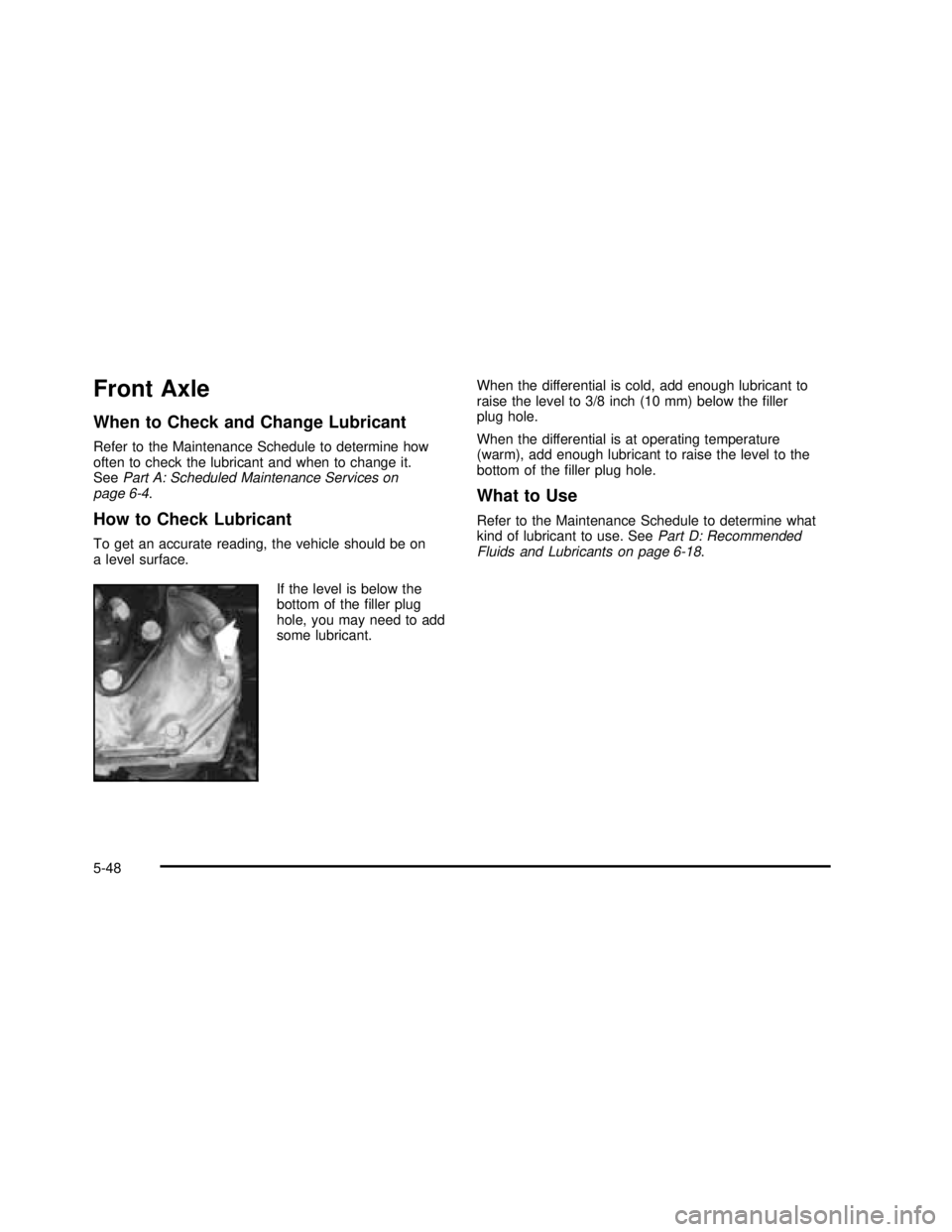
If the level is below the
bottom of thefiller plug
hole, you may need to add
some lubricant.When the differential is cold, add enough lubricant to
raise the level to 3/8 inch (10 mm) below thefiller
plug hole.
When the differential is at operating temperature
(warm), add enough lubricant to raise the level to the
bottom of thefiller plug hole.
What to Use
Refer to the Maintenance Schedule to determine what
kind of lubricant to use. SeePart D: Recommended
Fluids and Lubricants on page 6-18.
5-48
2003 - Savana OM
Page 289 of 392

Noise Control System
Tampering with Noise Control
System Prohibited
The following information relates to compliance with
federal noise emission standards for vehicles with a
Gross Vehicle Weight Rating (GVWR) of more than
10,000 lbs (4 536 kg). The Maintenance Schedule
provides information on maintaining the noise control
system to minimize degradation of the noise emission
control system during the life of your vehicle. The noise
control system warranty is given in your warranty booklet.
These standards apply only to vehicles sold in the
United States.
Tampering With Noise Control System
Prohibited
Federal law prohibits the following acts or the causing
thereof:
1. The removal or rendering inoperative by any person,
other than for purposes of maintenance, repair or
replacement, of any device or element of design
incorporated into any new vehicle for the purpose of
noise control, prior to its sale or delivery to the
ultimate purchaser or while it is in use; or2. The use of the vehicle after such device or element
of design has been removed or rendered inoperative
by any person.
Among those acts presumed to constitute tampering are
the acts listed below.
Insulation:
•
Removal of the noise shields or any underhood
insulation.
Engine:
•
Removal or rendering engine speed governor
(if equipped) inoperative so as to allow engine
speed to exceed manufacturer specifications.
Fan and Drive:
•
Removal of fan clutch (if equipped) or rendering
clutch inoperative.
•Removal of the fan shroud (if equipped).
Air Intake:
•
Removal of the air cleaner silencer.
•Modification of the air cleaner.
Exhaust:
•
Removal of the muffler and/or resonator.
•Removal of the exhaust pipes and exhaust pipe
clamps.
5-49
2003 - Savana OM
Page 298 of 392
Dual Tire Operation
When the vehicle is new, or whenever a wheel, wheel bolt
or wheel nut is replaced, check the wheel nut torque after
100, 1,000 and 6,000 miles (160, 1 600 and 10 000 km)
of driving. For proper torque and wheel nut tightening
information, see“Tightening the Wheel Nuts”later in
this section.
The outer tire on a dual wheel setup generally wears
faster than the inner tire. Your tires will wear more
evenly and last longer if you rotate the tires periodically.
See“Tire Inspection and Rotation”earlier in this section.
Also see“Scheduled Maintenance Services”in the Index
for scheduled rotation intervals
{CAUTION:
If you operate your vehicle with a tire that is
badly underinflated, the tire can overheat. An
overheated tire can lose air suddenly or catch
fire. You or others could be injured. Be sure all
tires (including the spare) are properly inflated.
See“Tires”and“Inflation–Tire Pressure”in the Index
for more information on proper tire inflation.
Tire Inspection and Rotation
Tires should be rotated every 6,000 to 8,000 miles
(10 000 to 13 000 km).
Any time you notice unusual wear, rotate your tires as
soon as possible and check wheel alignment. Also
check for damaged tires or wheels. SeeWhen It Is Time
for New Tires on page 5-60andWheel Replacement
on page 5-63for more information.
Make sure the spare tire is stored securely. Push, pull,
and then try to rotate or turn the tire. If it moves,
use the ratchet/wheel wrench to tighten the cable.
SeeChanging a Flat Tire on page 5-66.
If your vehicle has dual rear wheels, also seeDual Tire
Operation on page 5-58.
5-58
2003 - Savana OM