transmission GMC SAVANA 2003 Owner's Guide
[x] Cancel search | Manufacturer: GMC, Model Year: 2003, Model line: SAVANA, Model: GMC SAVANA 2003Pages: 392, PDF Size: 2.34 MB
Page 274 of 392
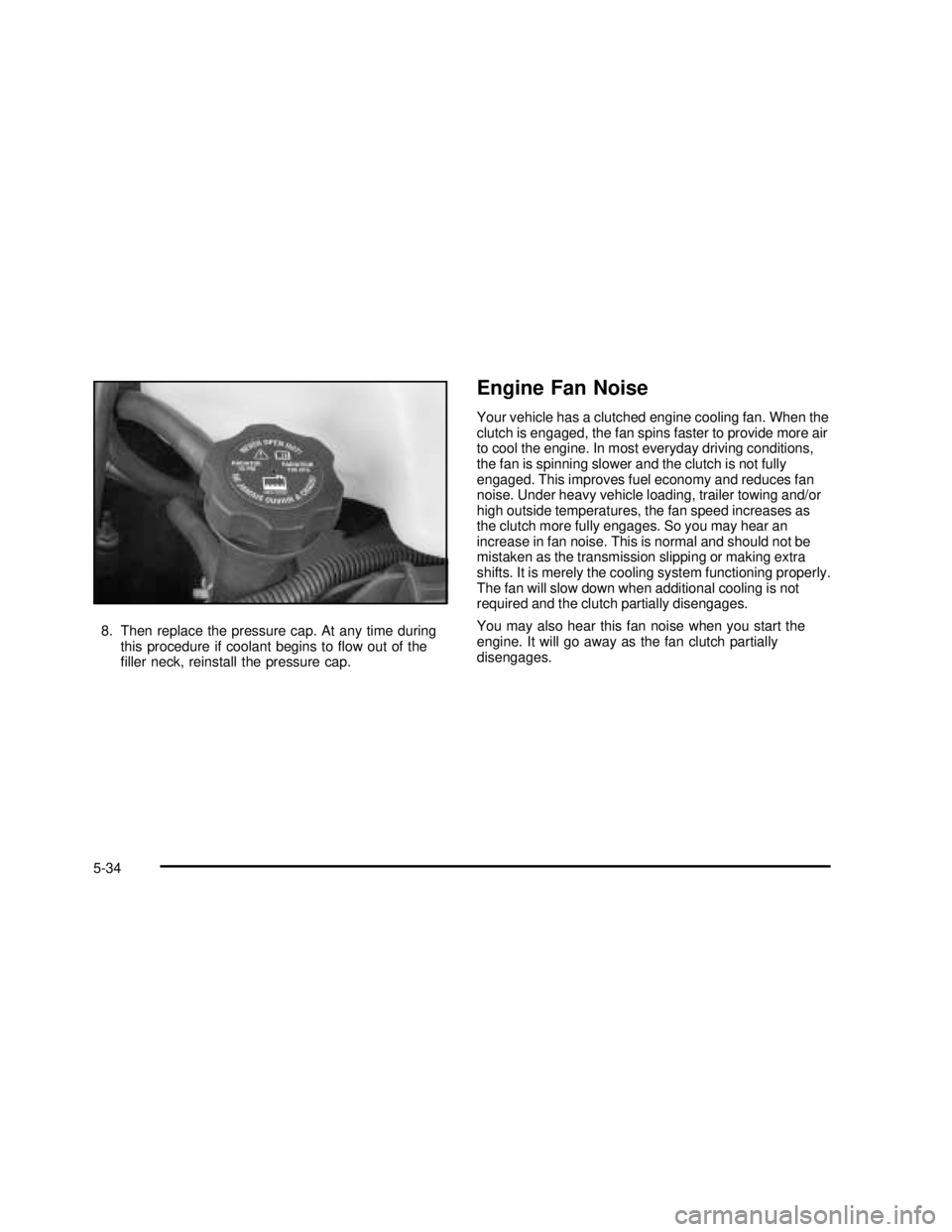
8. Then replace the pressure cap. At any time during
this procedure if coolant begins toflow out of the
filler neck, reinstall the pressure cap.
Engine Fan Noise
Your vehicle has a clutched engine cooling fan. When the
clutch is engaged, the fan spins faster to provide more air
to cool the engine. In most everyday driving conditions,
the fan is spinning slower and the clutch is not fully
engaged. This improves fuel economy and reduces fan
noise. Under heavy vehicle loading, trailer towing and/or
high outside temperatures, the fan speed increases as
the clutch more fully engages. So you may hear an
increase in fan noise. This is normal and should not be
mistaken as the transmission slipping or making extra
shifts. It is merely the cooling system functioning properly.
The fan will slow down when additional cooling is not
required and the clutch partially disengages.
You may also hear this fan noise when you start the
engine. It will go away as the fan clutch partially
disengages.
5-34
2003 - Savana OM
Page 281 of 392
Jump Starting
If your battery has run down, you may want to use
another vehicle and some jumper cables to start your
vehicle. Be sure to follow the steps below to do it safely.
{CAUTION:
Batteries can hurt you. They can be dangerous
because:
•They contain acid that can burn you.
•They contain gas that can explode or
ignite.
•They contain enough electricity to
burn you.
If you don’t follow these steps exactly, some
or all of these things can hurt you.
Notice:Ignoring these steps could result in costly
damage to your vehicle that wouldn’t be covered
by your warranty.
Trying to start your vehicle by pushing or pulling it
won’t work, and it could damage your vehicle.1. Check the other vehicle. It must have a 12-volt
battery with a negative ground system.
Notice:If the other system isn’t a 12-volt system
with a negative ground, both vehicles can be
damaged.
2. Get the vehicles close enough so the jumper cables
can reach, but be sure the vehicles aren’t touching
each other. If they are, it could cause a ground
connection you don’t want. You wouldn’t be able to
start your vehicle, and the bad grounding could
damage the electrical systems.
To avoid the possibility of the vehicles rolling, set
the parking brakefirmly on both vehicles involved
in the jump start procedure. Put an automatic
transmission in PARK (P) or a manual transmission
in NEUTRAL before setting the parking brake.
Notice:If you leave your radio on, it could be badly
damaged. The repairs wouldn’t be covered by
your warranty.
3. Turn off the ignition on both vehicles. Unplug
unnecessary accessories plugged into the cigarette
lighter or in the accessory power outlet. Turn off
the radio and all lamps that aren’t needed. This will
avoid sparks and help save both batteries. And it
could save your radio!
5-41
2003 - Savana OM
Page 335 of 392

Fuse Usage
1 Radio Battery
2 Powertrain Control Module Battery
3 Left Rear Turn Lamp
4 Right Rear Turn Lamp
5 Backup Lamps Trailer Wiring
6 Ignition 0
7 Stop Lamp
8 Right Rear Defogger/Heated Mirror
9Right Daytime Running Lamp/
Turn Signal
10Left Daytime Running Lamp/
Turn Signal
11 Truck Body Control Module 4
12 Fuel Pump
13 Trailer
14 Flasher
15 Horn
16 Truck Body Control Module 3
17 Trailer Stop/Turn Signal
18 Truck Body Control Module 2
19 Truck Body Control ModuleFuse Usage
20 Remote Function Actuator
21 Engine 2
22 Ignition E
23 Engine 1
24Truck Body Control Module
Ignition 1
25 Spare
26 RPA/Inside Rearview Mirror
27 Crankcase
28Brake Transmission Shift
Interlock System
29 Auxiliary Power Outlets
30 Cigarette Lighter
31 Instrument Panel Cluster
32 Air Conditioning
36 Vehicle Back Up
37Supplemental Inflatable
Restraint System
38 Powertrain Control Module Ignition 1
39 Oxygen Sensor B
40 Oxygen Sensor A
5-95
2003 - Savana OM
Page 337 of 392

Capacities and Specifications
All capacities are approximate. When adding, be sure tofill to the appropriate level or as recommended in this manual.
See refrigerant charge label under the hood for charge capacity information and requirements.
Engine Specifications
Engine VIN Code Transmission Spark Plug Gap Firing OrderWheel Nut
Torque
VORTEC™4300
V6 MFI
1WM300.060 inches
(1.52 mm)1–6–5–4–3–2140 lb ft
190Y
VORTEC™4800
V8 MFI
1VMT10.060 inches
(1.52 mm)1–8–7–2–6–5–4–3140 lb ft
190Y
VORTEC™5300
V8 MFI
1TM300.060 Inches
(1.52 mm)1–8–7–2–6–5–4–3140 lb ft
190Y
VORTEC™6000
V8 MFI
1UMT10.060 inches
(1.52 mm)1–8–7–2–6–5–4–3140 lb ft
190Y
1Sequential Fuel Injection
5-97
2003 - Savana OM
Page 348 of 392

45,000 Miles (75 000 km)
❑Inspect engine air cleanerfilter change indicator.
If necessary, replace thefilter. If vehicle is driven in
dusty/dirty conditions, inspectfilter change indicator at
every engine oil change. SeeEngine Air Cleaner/Filter
on page 5-17for more information.An Emission
Control Service. (See footnote†.)
❑Check rear/front axlefluid level and addfluid as
needed. Check constant velocity joints and axle seals
for leaking.
❑Vehicles With GVWR Above 10,000 lbs. Only: Inspect
shields for damage or looseness. Adjust or replace as
required.This is a Noise Emission Control Service.
Applicable only to vehicles sold in the United States.
❑Rotate tires. SeeTire Inspection and Rotation on
page 5-58for proper rotation pattern and additional
information.(See footnote +.)
50,000 Miles (83 000 km)
❑Change automatic transmissionfluid andfilter if the
vehicle’s GVWR is over 8,600 lbs or if the vehicle is
mainly driven under one or more of these conditions:
In heavy city traffic where the outside
temperature regularly reaches 90°F (32°C)
or higher.
In hilly or mountainous terrain.
When doing frequent trailer towing.
Uses such as found in taxi, police or delivery
service.
If you do not use your vehicle under any of these
conditions, change the fluid and filter at 100,000 miles
(166 000 km).
52,500 Miles (87 500 km)
❑Check rear/front axle uid level and add uid as
needed. Check constant velocity joints and axle seals
for leaking.
❑Rotate tires. SeeTire Inspection and Rotation on
page 5-58for proper rotation pattern and additional
information.(See footnote +.)
6-8
2003 - Savana OM
Page 351 of 392

100,000 Miles (166 000 km)
❑Inspect spark plug wires.An Emission Control
Service.
❑Replace spark plugs.An Emission Control Service.
❑Change automatic transmissionuid andlter if the
vehicle’s GVWR is over 8600 lbs or if the vehicle is
mainly driven under one or more of these conditions:
In heavy city traffic where the outside
temperature regularly reaches 90°F (32°C)
or higher.
In hilly or mountainous terrain.
When doing frequent trailer towing.
Uses such as found in taxi, police or delivery
service.
❑If you haven’t used your vehicle under severe service
conditions listed previously and, therefore, haven’t
changed your automatic transmissionuid, change
both theuid andlter.
❑Inspect Positive Crankcase Ventilation (PCV) valve.
An Emission Control Service.
150,000 Miles (240 000 km)
❑Drain,ush and rell cooling system (or every
60 months since last service, whichever occursrst).
SeeEngine Coolant on page 5-22for what to use.
Inspect hoses. Clean radiator, condenser, pressure
cap and neck. Pressure test the cooling system
and pressure cap.An Emission Control Service.
❑Inspect engine accessory drive belt.An Emission
Control Service.
6-11
2003 - Savana OM
Page 353 of 392

At Least Twice a Year
Restraint System Check
Make sure the safety belt reminder light and all your belts,
buckles, latch plates, retractors and anchorages are
working properly. Look for any other loose or damaged
safety belt system parts. If you see anything that might
keep a safety belt system from doing its job, have it
repaired. Have any torn or frayed safety belts replaced.
Also look for any opened or broken air bag coverings,
and have them repaired or replaced. (The air bag
system does not need regular maintenance.)
Wiper Blade Check
Inspect wiper blades for wear or cracking. Replace
blade inserts that appear worn or damaged or that
streak or miss areas of the windshield. Also see
Cleaning the Outside of Your Vehicle on page 5-85.
Spare Tire Check
At least twice a year, after the monthly ination check of
the spare tire determines that the spare is inated to the
correct tire ination pressure, make sure that the spare
tire is stored securely. Push, pull, and then try to rotate or
turn the tire. If it moves, use the ratchet/wheel wrench to
tighten the cable. SeeChanging a Flat Tire on page 5-66.
Weatherstrip Lubrication
Silicone grease on weatherstrips will make them last
longer, seal better, and not stick or squeak. Apply
silicone grease with a clean cloth. During very cold,
damp weather more frequent application may be
required. SeePart D: Recommended Fluids and
Lubricants on page 6-18.
Automatic Transmission Check
Check the transmissionuid level; add if needed.
SeeAutomatic Transmission Fluid on page 5-19.
Auid loss may indicate a problem. Check the
system and repair if needed.
At Least Once a Year
Key Lock Cylinders Service
Lubricate the key lock cylinders with the lubricant
specied in Part D.
Body Lubrication Service
Lubrcate all hood hinges, hood prop rod pivot, fuelller
door, rear compartment hinges, latches, locks, hood
latch assembly, secondary latch, pivots, spring anchor,
release pawl and any moving seat hardware. Part D
tells you what to use. More frequent lubrication may be
required when exposed to a corrosive environment.
6-13
2003 - Savana OM
Page 354 of 392
Starter Switch Check
{CAUTION:
When you are doing this check, the vehicle
could move suddenly. If it does, you or others
could be injured. Follow the steps below.
1. Before you start, be sure you have enough room
around the vehicle.
2. Firmly apply both the parking brake and the regular
brake. SeeParking Brake on page 2-26if
necessary.
Do not use the accelerator pedal, and be ready to
turn off the engine immediately if it starts.
3. Try to start the engine in each gear. The starter
should work only in PARK (P) or NEUTRAL (N).
If the starter works in any other position, your
vehicle needs service.
Automatic Transmission Shift Lock
Control System Check
{CAUTION:
When you are doing this check, the vehicle
could move suddenly. If it does, you or others
could be injured. Follow the steps below.
1. Before you start, be sure you have enough room
around the vehicle. It should be parked on a level
surface.
2. Firmly apply the parking brake. SeeParking Brake
on page 2-26if necessary.
Be ready to apply the regular brake immediately if
the vehicle begins to move.
3. With the engine off, turn the key to the RUN
position, but don’t start the engine. Without applying
the regular brake, try to move the shift lever out
of PARK (P) with normal effort. If the shift lever
moves out of PARK (P), your vehicle needs service.
6-14
2003 - Savana OM
Page 355 of 392
Ignition Transmission Lock Check
While parked, and with the parking brake set, try to turn
the ignition key to LOCK in each shift lever position.
The key should turn to LOCK only when the
shift lever is in PARK (P).
The key should come out only in LOCK.
Parking Brake and Automatic
Transmission Park (P) Mechanism
Check
{CAUTION:
When you are doing this check, your vehicle
could begin to move. You or others could be
injured and property could be damaged. Make
sure there is room in front of your vehicle in
case it begins to roll. Be ready to apply the
regular brake at once should the vehicle begin
to move.Park on a fairly steep hill, with the vehicle facing
downhill. Keeping your foot on the regular brake,
set the parking brake.
To check the parking brake’s holding ability:
With the engine running and transmission in
NEUTRAL (N), slowly remove foot pressure from
the regular brake pedal. Do this until the vehicle is
held by the parking brake only.
To check the PARK (P) mechanism’s holding
ability: With the engine running, shift to PARK (P).
Then release the parking brake followed by the
regular brake.
Underbody Flushing Service
At least every spring, use plain water toush any
corrosive materials from the underbody. Take care to
clean thoroughly any areas where mud and other
debris can collect.
6-15
2003 - Savana OM
Page 358 of 392

Part D: Recommended Fluids
and Lubricants
Fluids and lubricants identied below by name,
part number or specication may be obtained from
your dealer.
Usage Fluid/Lubricant
Engine OilEngine oil with the American
Petroleum Institute Certied for
Gasoline Engines starburst symbol
of the proper viscosity. To determine
the preferred viscosity for your
vehicle’s engine, seeEngine Oil
on page 5-13.
Engine Coolant50/50 mixture of clean,
drinkable water and use only
DEX-COOL
®Coolant. SeeEngine
Coolant on page 5-22.
Hydraulic
Brake SystemDelco Supreme 11 Brake Fluid or
equivalent DOT-3 brakeuid.
Windshield
Washer SolventGM Optikleen
®Washer Solvent or
equivalent.
Usage Fluid/Lubricant
Parking Brake
Cable GuidesChassis Lubricant
(GM Part No. U.S. 12377985,
in Canada 88901242, or equivalent)
or lubricant meeting requirements
of NLGI #2, Category LB or GC-LB.
Power Steering
SystemGM Power Steering Fluid
(GM Part No. U.S. 1052884,
in Canada 993294, or equivalent).
Automatic
TransmissionDEXRON
®-III Automatic
Transmission Fluid.
Key Lock
CylindersMulti-Purpose Lubricant, Superlube
(GM Part No. U.S. 12346241,
in Canada 10953474, or equivalent).
Chassis
LubricationChassis Lubricant
(GM Part No. U.S. 12377985,
in Canada 88901242, or equivalent)
or lubricant meeting requirements
of NLGI #2, Category LB or GC-LB.
Front Wheel
BearingsWheel bearing lubricant meeting
requirements of NLGI #2,
Category GC or GC-LB
(GM Part No. U.S. 1051344,
in Canada 993037, or equivalent).
6-18
2003 - Savana OM