tires GMC SAVANA 2003 Owner's Guide
[x] Cancel search | Manufacturer: GMC, Model Year: 2003, Model line: SAVANA, Model: GMC SAVANA 2003Pages: 392, PDF Size: 2.34 MB
Page 304 of 392
Each new wheel should have the same load-carrying
capacity, diameter, width, offset and be mounted
the same way as the one it replaces.
If you need to replace any of your wheels, wheel bolts or
wheel nuts, replace them only with new GM original
equipment parts. This way, you will be sure to have the
right wheel, wheel bolts and wheel nuts for your vehicle.
{CAUTION:
Using the wrong replacement wheels, wheel
bolts or wheel nuts on your vehicle can be
dangerous. It could affect the braking and
handling of your vehicle, make your tires lose
air and make you lose control. You could have
a collision in which you or others could be
injured. Always use the correct wheel, wheel
bolts and wheel nuts for replacement.
Notice:The wrong wheel can also cause problems
with bearing life, brake cooling, speedometer or
odometer calibration, headlamp aim, bumper height,
vehicle ground clearance and tire or tire chain
clearance to the body and chassis.Whenever a wheel, wheel bolt or wheel nut is replaced on
a dual wheel setup, check the wheel nut torque after
100, 1,000 and 6,000 miles (160, 1 600 and 10 000 km)
of driving. For proper torque, see“Wheel Nut Torque”
underCapacities and Specifications on page 5-97.
SeeChanging a Flat Tire on page 5-66for more
information.
Used Replacement Wheels
{CAUTION:
Putting a used wheel on your vehicle is
dangerous. You can’t know how it’s been used
or how far it’s been driven. It could fail suddenly
and cause a crash. If you have to replace a
wheel, use a new GM original equipment wheel.
5-64
2003 - Savana OM
Page 305 of 392

Tire Chains
Notice:Use tire chains only where legal and only
when you must. Use chains that are the proper size
for your tires. Install them on the tires of the rear
axle. Tighten them as tightly as possible with
the ends securely fastened. Drive slowly and follow
the chain manufacturer’s instructions. If you can
hear the chains contacting your vehicle, stop
and retighten them. If the contact continues, slow
down until it stops. Driving too fast or spinning the
wheels with chains on will damage your vehicle.
If a Tire Goes Flat
It’s unusual for a tire to“blowout”while you’re driving,
especially if you maintain your tires properly. If air goes
out of a tire, it’s much more likely to leak out slowly.
But if you should ever have a“blowout”, here are a few
tips about what to expect and what to do:
If a front tire fails, theflat tire will create a drag that
pulls the vehicle toward that side. Take your foot off the
accelerator pedal and grip the steering wheelfirmly.
Steer to maintain lane position, and then gently brake to
a stop well out of the traffic lane.
A rear blowout, particularly on a curve, acts much like a
skid and may require the same correction you’d use
in a skid. In any rear blowout, remove your foot from the
accelerator pedal. Get the vehicle under control by
steering the way you want the vehicle to go. It may be
very bumpy and noisy, but you can still steer. Gently
brake to a stop—well off the road if possible.
If a tire goesflat, the next part shows how to use your
jacking equipment to change aflat tire safely.
5-65
2003 - Savana OM
Page 309 of 392
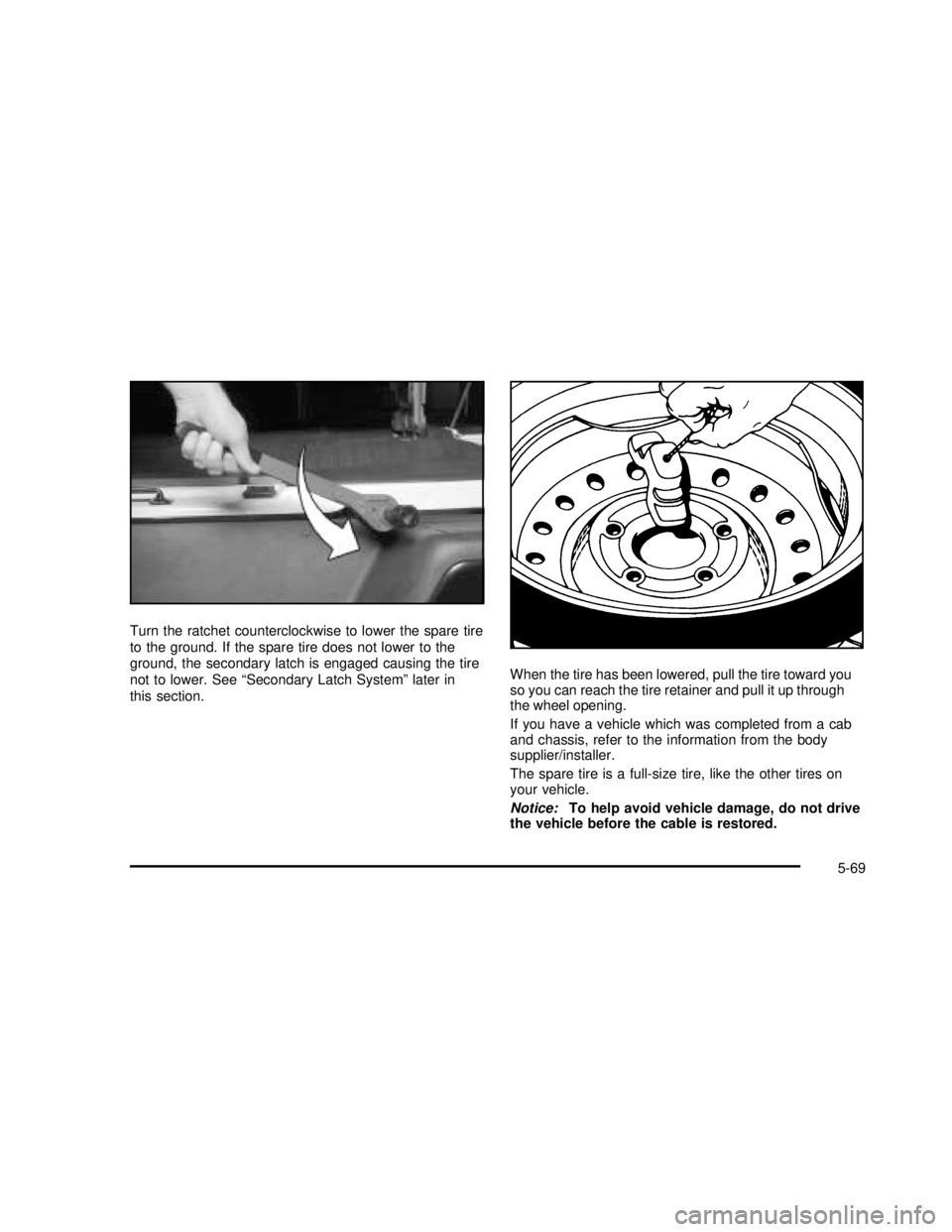
Turn the ratchet counterclockwise to lower the spare tire
to the ground. If the spare tire does not lower to the
ground, the secondary latch is engaged causing the tire
not to lower. See“Secondary Latch System”later in
this section.When the tire has been lowered, pull the tire toward you
so you can reach the tire retainer and pull it up through
the wheel opening.
If you have a vehicle which was completed from a cab
and chassis, refer to the information from the body
supplier/installer.
The spare tire is a full-size tire, like the other tires on
your vehicle.
Notice:To help avoid vehicle damage, do not drive
the vehicle before the cable is restored.
5-69
2003 - Savana OM
Page 327 of 392

Windshield and Wiper Blades
If the windshield is not clear after using the windshield
washer, or if the wiper blade chatters when running,
wax, sap or other material may be on the blade or
windshield.
Clean the outside of the windshield with a full-strength
glass cleaning liquid. The windshield is clean if beads
do not form when you rinse it with water.
Grime from the windshield will stick to the wiper blades
and affect their performance. Clean the blade by
wiping vigorously with a cloth soaked in full-strength
windshield washer solvent. Then rinse the blade
with water.
Check the wiper blades and clean them as necessary;
replace blades that look worn.
Aluminum Wheels
Keep your wheels clean using a soft clean cloth
with mild soap and water. Rinse with clean water.
After rinsing thoroughly, dry with a soft clean towel.
A wax may then be applied.
The surface of these wheels is similar to the painted
surface of your vehicle. Don’t use strong soaps,
chemicals, abrasive polishes, abrasive cleaners,cleaners with acid, or abrasive cleaning brushes on
them because you could damage the surface. Do not
use chrome polish on aluminum wheels.
Don’t take your vehicle through an automatic car
wash that has silicone carbide tire cleaning brushes.
These brushes can also damage the surface of
these wheels.
Tires
To clean your tires, use a stiff brush with tire cleaner.
Notice:When applying a tire dressing, always take
care to wipe off any overspray or splash from all
painted surfaces on the body or wheels of the
vehicle. Petroleum-based products may damage
the paintfinish and tires.
Sheet Metal Damage
If your vehicle is damaged and requires sheet metal
repair or replacement, make sure the body repair shop
applies anti-corrosion material to parts repaired or
replaced to restore corrosion protection.
Original manufacturer replacement parts will provide the
corrosion protection while maintaining the warranty.
5-87
2003 - Savana OM
Page 346 of 392

It is also important to check your oil regularly and keep
it at the proper level.
If the system is ever reset accidentally, you must
change your oil at 3,000 miles (5 000 km) since your
last oil change. Remember to reset the oil life system
whenever the oil is changed. SeeEngine Oil on
page 5-13for information on resetting the system.
An Emission Control Service.
Lubricate chassis components with each engine oil
and filter change.
Lubricate the front suspension, kingpin bushings,
steering linkage and rear driveline center splines.
See the mileage intervals following for additional
services that may be performed with an engine oil
change and chassis lubrication. After the services are
performed, record the date, odometer reading and
who performed the service on the maintenance record
pages in Part E of this schedule.7,500 Miles (12 500 km)
❑Check rear/front axlefluid level and addfluid as
needed. Check constant velocity joints and axle seals
for leaking.
❑Rotate tires. SeeTire Inspection and Rotation on
page 5-58for proper rotation pattern and additional
information.(See footnote +.)
15,000 Miles (25 000 km)
❑Inspect engine air cleanerfilter change indicator.
If necessary, replace thefilter. If vehicle is driven in
dusty/dirty conditions, inspectfilter change indicator at
every engine oil change. SeeEngine Air Cleaner/Filter
on page 5-17for more information.An Emission
Control Service. (See footnote†.)
❑Check rear/front axlefluid level and addfluid as
needed. Check constant velocity joints and axle seals
for leaking.
❑Vehicles With GVWR Above 10,000 lbs. Only: Inspect
shields for damage or looseness. Adjust or replace as
required.This is a Noise Emission Control Service.
Applicable only to vehicles sold in the United States.
❑Rotate tires. SeeTire Inspection and Rotation on
page 5-58for proper rotation pattern and additional
information.(See footnote +.)
6-6
2003 - Savana OM
Page 347 of 392

22,500 Miles (37 500 km)
❑Check rear/front axlefluid level and addfluid as
needed. Check constant velocity joints and axle seals
for leaking.
❑Rotate tires. SeeTire Inspection and Rotation on
page 5-58for proper rotation pattern and additional
information.(See footnote +.)
30,000 Miles (50 000 km)
❑Inspect engine air cleanerfilter change indicator.
If necessary, replace thefilter. If vehicle is driven in
dusty/dirty conditions, inspectfilter change indicator at
every engine oil change. SeeEngine Air Cleaner/Filter
on page 5-17for more information.An Emission
Control Service. (See footnote†.)
❑Check rear/front axlefluid level and addfluid as
needed. Check constant velocity joints and axle seals
for leaking.
❑Clean and repack the front wheel bearings
(or at each brake relining, whichever occursfirst).❑Rotate tires. SeeTire Inspection and Rotation on
page 5-58for proper rotation pattern and additional
information.(See footnote +.)
❑Replace fuelfilter.An Emission Control Service.
(See footnote†.)
❑Vehicles With GVWR Above 10,000 lbs. Only: Inspect
shields for damage or looseness. Adjust or replace as
required.This is a Noise Emission Control Service.
Applicable only to vehicles sold in the United States.37,500 Miles (62 500 km)
❑Check rear/front axlefluid level and addfluid as
needed. Check constant velocity joints and axle seals
for leaking.
❑Rotate tires. SeeTire Inspection and Rotation on
page 5-58for proper rotation pattern and additional
information.(See footnote +.)
6-7
2003 - Savana OM
Page 348 of 392

45,000 Miles (75 000 km)
❑Inspect engine air cleanerfilter change indicator.
If necessary, replace thefilter. If vehicle is driven in
dusty/dirty conditions, inspectfilter change indicator at
every engine oil change. SeeEngine Air Cleaner/Filter
on page 5-17for more information.An Emission
Control Service. (See footnote†.)
❑Check rear/front axlefluid level and addfluid as
needed. Check constant velocity joints and axle seals
for leaking.
❑Vehicles With GVWR Above 10,000 lbs. Only: Inspect
shields for damage or looseness. Adjust or replace as
required.This is a Noise Emission Control Service.
Applicable only to vehicles sold in the United States.
❑Rotate tires. SeeTire Inspection and Rotation on
page 5-58for proper rotation pattern and additional
information.(See footnote +.)
50,000 Miles (83 000 km)
❑Change automatic transmissionfluid andfilter if the
vehicle’s GVWR is over 8,600 lbs or if the vehicle is
mainly driven under one or more of these conditions:
In heavy city traffic where the outside
temperature regularly reaches 90°F (32°C)
or higher.
In hilly or mountainous terrain.
When doing frequent trailer towing.
Uses such as found in taxi, police or delivery
service.
If you do not use your vehicle under any of these
conditions, change the fluid and filter at 100,000 miles
(166 000 km).
52,500 Miles (87 500 km)
❑Check rear/front axle uid level and add uid as
needed. Check constant velocity joints and axle seals
for leaking.
❑Rotate tires. SeeTire Inspection and Rotation on
page 5-58for proper rotation pattern and additional
information.(See footnote +.)
6-8
2003 - Savana OM
Page 349 of 392

60,000 Miles (100 000 km)
❑Inspect engine air cleanerlter change indicator.
If necessary, replace thelter. If vehicle is driven in
dusty/dirty conditions, inspectlter change indicator at
every engine oil change. SeeEngine Air Cleaner/Filter
on page 5-17for more information.An Emission
Control Service. (See footnote†.)
❑Check rear/front axleuid level and adduid as
needed. Check constant velocity joints and axle seals
for leaking.
❑Clean and repack the front wheel bearings
(or at each brake relining, whichever occursrst).
❑Rotate tires. SeeTire Inspection and Rotation on
page 5-58for proper rotation pattern and additional
information.(See footnote +.)
❑Replace fuellter.An Emission Control Service.
(See footnote†.)
❑Vehicles With GVWR Above 10,000 lbs. Only: Inspect
shields for damage or looseness. Adjust or replace as
required.This is a Noise Emission Control Service.
Applicable only to vehicles sold in the United States.
❑Inspect Evaporative Control System. Check all fuel
and vapor lines and hoses for proper hook-up, routing
and condition. Check that the purge valve works
properly, if equipped. Replace as needed.
An Emission Control Service. (See footnote†.)
67,500 Miles (112 500 km)
❑Check rear/front axleuid level and adduid as
needed. Check constant velocity joints and axle seals
for leaking.
❑Rotate tires. SeeTire Inspection and Rotation on
page 5-58for proper rotation pattern and additional
information.(See footnote +.)
75,000 Miles (125 000 km)
❑Inspect engine air cleanerlter change indicator.
If necessary, replace thelter. If vehicle is driven in
dusty/dirty conditions, inspectlter change indicator at
every engine oil change. SeeEngine Air Cleaner/Filter
on page 5-17for more information.An Emission
Control Service. (See footnote†.)
❑Check rear/front axleuid level and adduid as
needed. Check constant velocity joints and axle seals
for leaking.
❑Vehicles With GVWR Above 10,000 lbs. Only: Inspect
shields for damage or looseness. Adjust or replace as
required.This is a Noise Emission Control Service.
Applicable only to vehicles sold in the United States.
❑Rotate tires. SeeTire Inspection and Rotation on
page 5-58for proper rotation pattern and additional
information.(See footnote +.)
6-9
2003 - Savana OM
Page 350 of 392

82,500 Miles (137 500 km)
❑Check rear/front axleuid level and adduid as
needed. Check constant velocity joints and axle seals
for leaking.
❑Rotate tires. SeeTire Inspection and Rotation on
page 5-58for proper rotation pattern and additional
information.(See footnote +.)
90,000 Miles (150 000 km)
❑Inspect engine air cleanerlter change indicator.
If necessary, replace thelter. If vehicle is driven in
dusty/dirty conditions, inspectlter change indicator at
every engine oil change. SeeEngine Air Cleaner/Filter
on page 5-17for more information.An Emission
Control Service. (See footnote†.)
❑Check rear/front axleuid level and adduid as
needed. Check constant velocity joints and axle seals
for leaking.
❑Clean and repack the front wheel bearings
(or at each brake relining, whichever occursrst.)❑Replace fuellter.An Emission Control Service.
(See footnote†.)
❑Vehicles With GVWR Above 10,000 lbs. Only: Inspect
shields for damage or looseness. Adjust or replace as
required.This is a Noise Emission Control Service.
Applicable only to vehicles sold in the United States.
❑Rotate tires. SeeTire Inspection and Rotation on
page 5-58for proper rotation pattern and additional
information.(See footnote +.)97,500 Miles (162 500 km)
❑Check rear/front axleuid level and adduid as
needed. Check constant velocity joints and axle seals
for leaking.
❑Rotate tires. SeeTire Inspection and Rotation on
page 5-58for proper rotation pattern and additional
information.(See footnote +.)
6-10
2003 - Savana OM
Page 352 of 392

Part B: Owner Checks and Services
Listed in this part are owner checks and services
which should be performed at the intervals specied to
help ensure the safety, dependability and emission
control performance of your vehicle.
Be sure any necessary repairs are completed at once.
Whenever anyuids or lubricants are added to your
vehicle, make sure they are the proper ones, as shown
in Part D.
At the First 100, 1,000 and 6,000
Miles (160, 1 600 and 10 000km)
For vehicles with dual wheels, check dual wheel nut
torque. For proper torque, seeCapacities and
Specifications on page 5-97.
At Each Fuel Fill
It is important for you or a service station attendant to
perform these underhood checks at each fuelfill.
Engine Oil Level Check
Check the engine oil level and add the proper oil if
necessary. SeeEngine Oil on page 5-13for further
details.
Engine Coolant Level Check
Check the engine coolant level and add DEX-COOL®
coolant mixture if necessary. SeeEngine Coolant
on page 5-22for further details.
Windshield Washer Fluid Level Check
Check the windshield washeruid level in the windshield
washer tank and add the properuid if necessary.
SeeWindshield Washer Fluid on page 5-36for further
details.
At Least Once a Month
Tire Inflation Check
Make sure tires are inated to the correct pressures.
Don’t forget to check your spare tire. SeeTires on
page 5-56for further details.
Cassette Tape Player Service
Clean cassette tape player. Cleaning should be done
every 50 hours of tape play. SeeAudio System(s)
on page 3-41for further details.
6-12
2003 - Savana OM