low beam GMC SAVANA 2003 Owner's Manual
[x] Cancel search | Manufacturer: GMC, Model Year: 2003, Model line: SAVANA, Model: GMC SAVANA 2003Pages: 392, PDF Size: 2.34 MB
Page 124 of 392

Turn Signal/Multifunction Lever
The lever on the left side of the steering column
includes the following:
•Turn and Lane Change Signals
•Headlamp High/Low Beam Changer
•Flash-to-Pass Feature
•Windshield Wipers
•Windshield Washer
•Cruise Control
For information on the exterior lamps, seeExterior
Lamps on page 3-12later in this section.
Turn and Lane Change Signals
The turn signal has two upward (for right) and two
downward (for left) positions. These positions allow you
to signal a turn or a lane change.
To signal a turn, move the lever all the way up or
down. When the turn isfinished, the lever will return
automatically.
An arrow on the instrument
panel cluster willflash in
the direction of the
turn or lane change.
To signal a lane change, just raise or lower the lever
until the arrow starts toflash. Hold it there until you
complete your lane change. The lever will return by
itself when you release it.
If you move the lever all the way up or down, and the
arrowflashes at twice the normal rate, a signal bulb
may be burned out and other drivers may not see your
turn signal.
3-6
2003 - Savana OM
Page 125 of 392

If a bulb is burned out, replace it to help avoid an
accident. If the arrows don’t go on at all when you
signal a turn, check for burned-out bulbs or a blown
fuse. SeeFuses and Circuit Breakers on page 5-92.
Turn Signal On Chime
If your turn signal is left on for more than 3/4 of a mile
(1.2 km), a chime will sound at eachflash of the
turn signal. To turn off the chime, move the turn signal
lever to the off position.
Headlamp High/Low Beam Changer
23
(Headlamp High/Low Beam Changer):
To change the headlamps from low to high beam,
pull the mutlifunction lever all the way toward you.
Then release it.
When the high beams
are on, this light on the
instrument panel cluster
also will be on.
Flash-To-Pass Feature
This feature allows you to use your high-beam
headlamps to signal a driver in front of you that you
want to pass. It works even if your headlamps are off.
To use it, pull the turn signal lever toward you, but not so
far that you hear it click.
If your headlamps are off or on low-beam, your
high-beam headlamps will turn on and stay on as long
as you hold the lever toward you and the high-beam
indicator on the instrument panel will come on. Release
the lever to turn the high-beam headlamps off.
3-7
2003 - Savana OM
Page 131 of 392

5(Headlamps):Turning the control to this position
will turn on the headlamps together with the parking
lamps and turn off the daytime running lamps.
You can switch your headlamps from high to
low-beam by pulling the turn signal/high-beam lever
toward you.
A circuit breaker protects your headlamps. If you have
an electrical overload, your headlamps willflicker on
and off. Have your headlamp wiring checked right away
if this happens.
Lamps On Reminder
A reminder chime will sound when your control is turned
to the headlamps or parking lamps position, your key
is out of the ignition, and your driver’s door is open.
To disable the chime, turn the control to the Daytime
Running Lamp (DRL) position and then back to the
parking lamps or headlamps position.
Daytime Running Lamps
Daytime Running Lamps (DRL) can make it easier for
others to see the front of your vehicle during the
day. DRL can be helpful in many different driving
conditions, but they can be especially helpful in the short
periods after dawn and before sunset. Fully functional
daytime running lamps are required on all vehicles
first sold in Canada.
The DRL system will come on when the following
conditions are met:
•the ignition is on,
•the exterior lamps control in DRL mode and not in
the defeat position.
When the DRL are on, only your headlamps will be on.
The taillamps, sidemarker and other lamps won’tbe
on. The instrument panel will be lit.
When you turn the headlamp switch off, the headlamps
will go off, and your DRL lamps will illuminate.
Turn the exterior lamp control to the defeat position or
shift into PARK (P). The DRLs will stay off until the
control is toggled again or the vehicle is shifted out
of PARK (P).
This procedure applies only to vehiclesfirst sold in
the United States.
3-13
2003 - Savana OM
Page 209 of 392

Here are some tips on night driving.
Drive defensively.
Don’t drink and drive.
Adjust your inside rearview mirror to reduce the
glare from headlamps behind you.
Since you can’t see as well, you may need to slow
down and keep more space between you and
other vehicles.
Slow down, especially on higher speed roads. Your
headlamps can light up only so much road ahead.
In remote areas, watch for animals.
If you’re tired, pull off the road in a safe place
and rest.
No one can see as well at night as in the daytime.
But as we get older these differences increase.
A 50-year-old driver may require at least twice as much
light to see the same thing at night as a 20-year-old.
What you do in the daytime can also affect your
night vision. For example, if you spend the day in
bright sunshine you are wise to wear sunglasses.
Your eyes will have less trouble adjusting to night.But if you’re driving, don’t wear sunglasses at night.
They may cut down on glare from headlamps, but they
also make a lot of things invisible.
You can be temporarily blinded by approaching
headlamps. It can take a second or two, or even
several seconds, for your eyes to re-adjust to the dark.
When you are faced with severe glare (as from a
driver who doesn’t lower the high beams, or a vehicle
with misaimed headlamps), slow down a little. Avoid
staring directly into the approaching headlamps.
Keep your windshield and all the glass on your vehicle
clean—inside and out. Glare at night is made much
worse by dirt on the glass. Even the inside of the glass
can build up alm caused by dust. Dirty glass makes
lights dazzle andash more than clean glass would,
making the pupils of your eyes contract repeatedly.
Remember that your headlamps light up far less of a
roadway when you are in a turn or curve. Keep
your eyes moving; that way, it’s easier to pick out dimly
lighted objects. Just as your headlamps should be
checked regularly for proper aim, so should your eyes
be examined regularly. Some drivers suffer from
night blindness—the inability to see in dim light—and
aren’t even aware of it.
4-15
2003 - Savana OM
Page 294 of 392
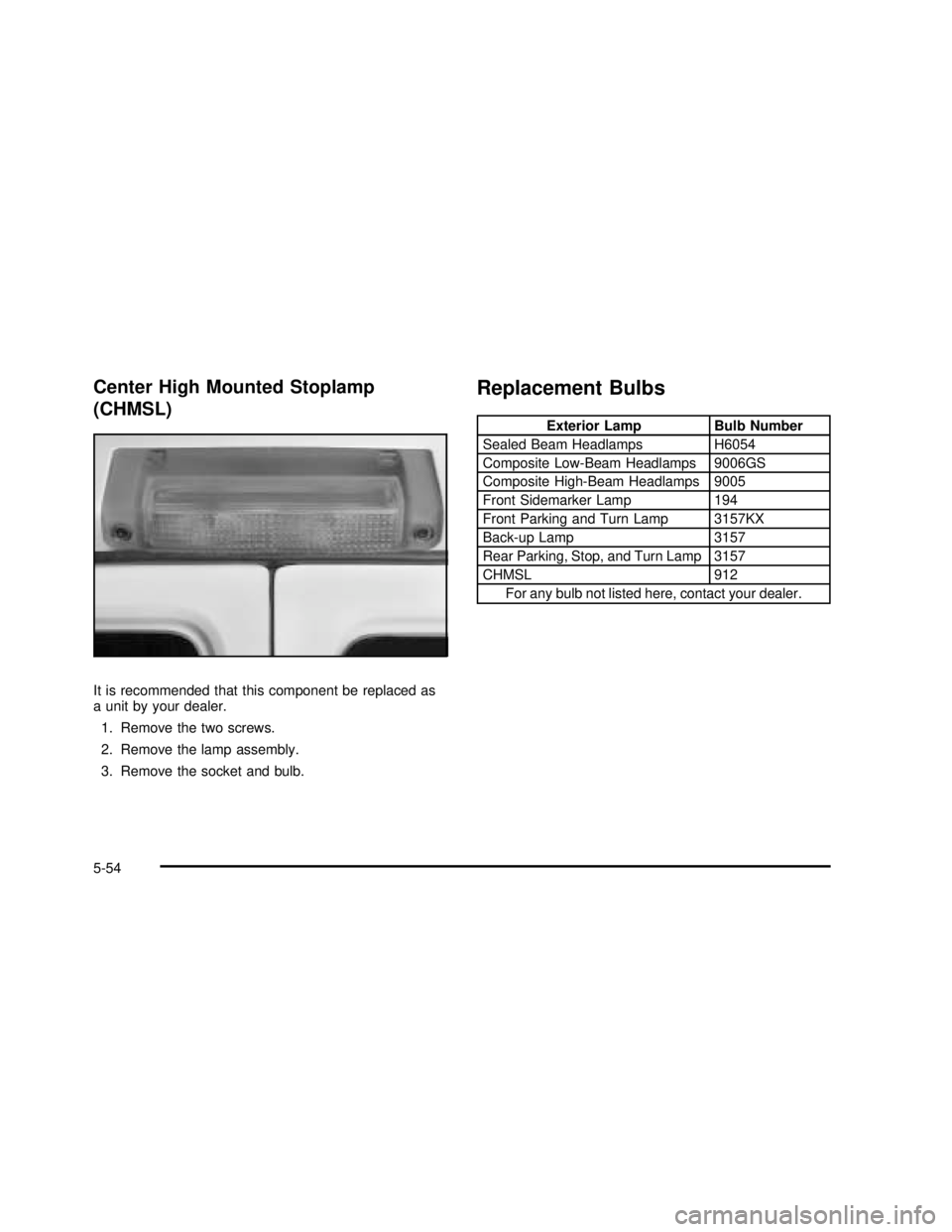
Center High Mounted Stoplamp
(CHMSL)
It is recommended that this component be replaced as
a unit by your dealer.
1. Remove the two screws.
2. Remove the lamp assembly.
3. Remove the socket and bulb.
Replacement Bulbs
Exterior Lamp Bulb Number
Sealed Beam Headlamps H6054
Composite Low-Beam Headlamps 9006GS
Composite High-Beam Headlamps 9005
Front Sidemarker Lamp 194
Front Parking and Turn Lamp 3157KX
Back-up Lamp 3157
Rear Parking, Stop, and Turn Lamp 3157
CHMSL 912
For any bulb not listed here, contact your dealer.
5-54
2003 - Savana OM
Page 336 of 392

Fuse Usage
41 Windshield Wipers
42 Right Headlamp—Low Beam
43 Left Headlamp—Low Beam
44 Left Headlamp—High Beam
45 Right Headlamp—High Beam
46Truck Body Control
Module-Accessory
47 Front Windshield Wiper
48 Anti-Lock Brakes
49 Ignition A
50 Trailer
51 Climate Control Blower
52 Ignition B
63 Spare
64 SpareFuse Usage
Relay Usage
53 Windshield Wiper
54 Air Conditioning
55 Spare
56 Headlamp—High Beam
57 Fuel Pump
58 Headlamp—Low Beam
59 Horn
61 Starter
62 Spare
Circuit Breaker Usage
60 Power Seat
5-96
2003 - Savana OM
Page 381 of 392

Gasoline
Octane........................................................ 5-4
Specifications............................................... 5-5
Glass Surfaces...............................................5-84
GM Mobility Program for Persons with
Disabilities.................................................... 7-5
H
Hazard Warning Flashers................................... 3-4
Headlamp High/Low Beam Changer.................... 3-7
Headlamp Wiring............................................5-91
Headlamps....................................................5-50
Bulb Replacement.......................................5-50
Front Turn Signal, Sidemarker and
Parking Lamps.........................................5-52
Halogen Bulbs............................................5-50
Highway Hypnosis...........................................4-22
Hill and Mountain Roads..................................4-22
Hitches..........................................................4-41
Hood
Checking Things Under.................................. 5-9
Release.....................................................5-10
Horn ............................................................... 3-5
How to Add Coolant to the Coolant
Recovery Tank............................................5-29How to Add Coolant to the Radiator..................5-31
How to Add Fluid............................................5-22
How to Check........................................5-19, 5-57
How to Check Lubricant...................................5-47
How to Check Power Steering Fluid..................5-35
How to Inspect the Engine Air Cleaner/Filter..........5-18
How to Reset the CHANGE ENGINE OIL Light......5-16
How to Use This Manual...................................... ii
How to Wear Safety Belts Properly...................1-14
Hydroplaning..................................................4-18
I
If No Steam Is Coming From Your Engine..........5-27
If Steam Is Coming From Your Engine...............5-26
If the Light Is Flashing.....................................3-34
If the Light Is On Steady.................................3-35
If You Are Stuck in Sand, Mud, Ice or Snow.......4-28
If You Do Decide To Pull A Trailer.....................4-32
If You’re Caught in a Blizzard...........................4-26
Ignition Positions.............................................2-21
Ignition Transmission Lock Check......................6-15
Infants and Young Children, Restraints...............1-36
Inflation–Tire Pressure...................................5-57
Inside Day/Night Rearview Mirror......................2-32
7
2003 - Savana OM