mirror GMC SAVANA 2003 Owner's Manual
[x] Cancel search | Manufacturer: GMC, Model Year: 2003, Model line: SAVANA, Model: GMC SAVANA 2003Pages: 392, PDF Size: 2.34 MB
Page 1 of 392

Seats and Restraint Systems........................... 1-1
Front Seats
............................................... 1-2
Rear Seats
............................................... 1-5
Safety Belts
.............................................. 1-9
Child Restraints
.......................................1-33
Air Bag System
.......................................1-63
Restraint System Check
............................1-75
Features and Controls..................................... 2-1
Keys
........................................................ 2-2
Doors and Locks
....................................... 2-8
Windows
.................................................2-16
Theft-Deterrent Systems
............................2-19
Starting and Operating Your Vehicle
...........2-20
Mirrors
....................................................2-32
OnStar
®System
......................................2-35
Storage Areas
.........................................2-36
Instrument Panel............................................. 3-1
Instrument Panel Overview
.......................... 3-2
Climate Controls
......................................3-17
Warning Lights, Gages and Indicators
.........3-23
Audio System(s)
.......................................3-41
Driving Your Vehicle....................................... 4-1
Your Driving, the Road, and Your Vehicle
..... 4-2
Towing
...................................................4-29Service and Appearance Care.......................... 5-1
Service
..................................................... 5-3
Fuel
......................................................... 5-4
Checking Things Under the Hood
................. 5-9
All-Wheel Drive
........................................5-46
Rear Axle
...............................................5-47
Front Axle
...............................................5-48
Noise Control System
...............................5-49
Bulb Replacement
....................................5-50
Windshield Wiper Blade Replacement
.........5-55
Tires
......................................................5-56
Appearance Care
.....................................5-82
Vehicle Identication
.................................5-90
Electrical System
......................................5-91
Capacities and Specications
.....................5-97
Normal Maintenance Replacement Parts
......5-100
Maintenance Schedule..................................... 6-1
Maintenance Schedule
................................ 6-2
Customer Assistance Information.................... 7-1
Customer Assistance Information
.................. 7-2
Reporting Safety Defects
............................ 7-9
Index.................................................................1
2003 GMC Savana Owner ManualM
2003 - Savana Owner Manual
Page 83 of 392

Keys...............................................................2-2
Remote Keyless Entry System.........................2-4
Remote Keyless Entry System Operation...........2-5
Doors and Locks.............................................2-8
Door Locks....................................................2-8
Power Door Locks..........................................2-9
Cargo Door Relocking.....................................2-9
Rear Door Security Locks..............................2-10
Lockout Protection........................................2-11
Leaving Your Vehicle....................................2-11
Sliding Side Door..........................................2-11
60/40 Swing-Out Side Door............................2-13
Rear Doors..................................................2-15
Windows........................................................2-16
Manual Windows..........................................2-17
Power Windows............................................2-17
Swing-Out Windows......................................2-18
Sun Visors...................................................2-19
Theft-Deterrent Systems..................................2-19
Passlock
®....................................................2-20Starting and Operating Your Vehicle................2-20
New Vehicle Break-In....................................2-20
Ignition Positions..........................................2-21
Starting Your Engine.....................................2-22
Engine Coolant Heater..................................2-23
Automatic Transmission Operation...................2-24
All-Wheel Drive............................................2-26
Parking Brake..............................................2-26
Shifting Into Park (P).....................................2-27
Shifting Out of Park (P).................................2-29
Parking Over Things That Burn.......................2-30
Engine Exhaust............................................2-30
Running Your Engine While You Are Parked.......2-31
Mirrors...........................................................2-32
Manual Rearview Mirror.................................2-32
Outside Manual Mirror...................................2-32
Outside Remote Control Mirror.......................2-32
Outside Camper-Type Mirrors.........................2-33
Outside Power Mirrors...................................2-34
Outside Convex Mirror...................................2-34
Outside Heated Mirrors..................................2-35
OnStar
®System.............................................2-35
Storage Areas................................................2-36
Section 2 Features and Controls
2-1
2003 - Savana OM
Page 101 of 392
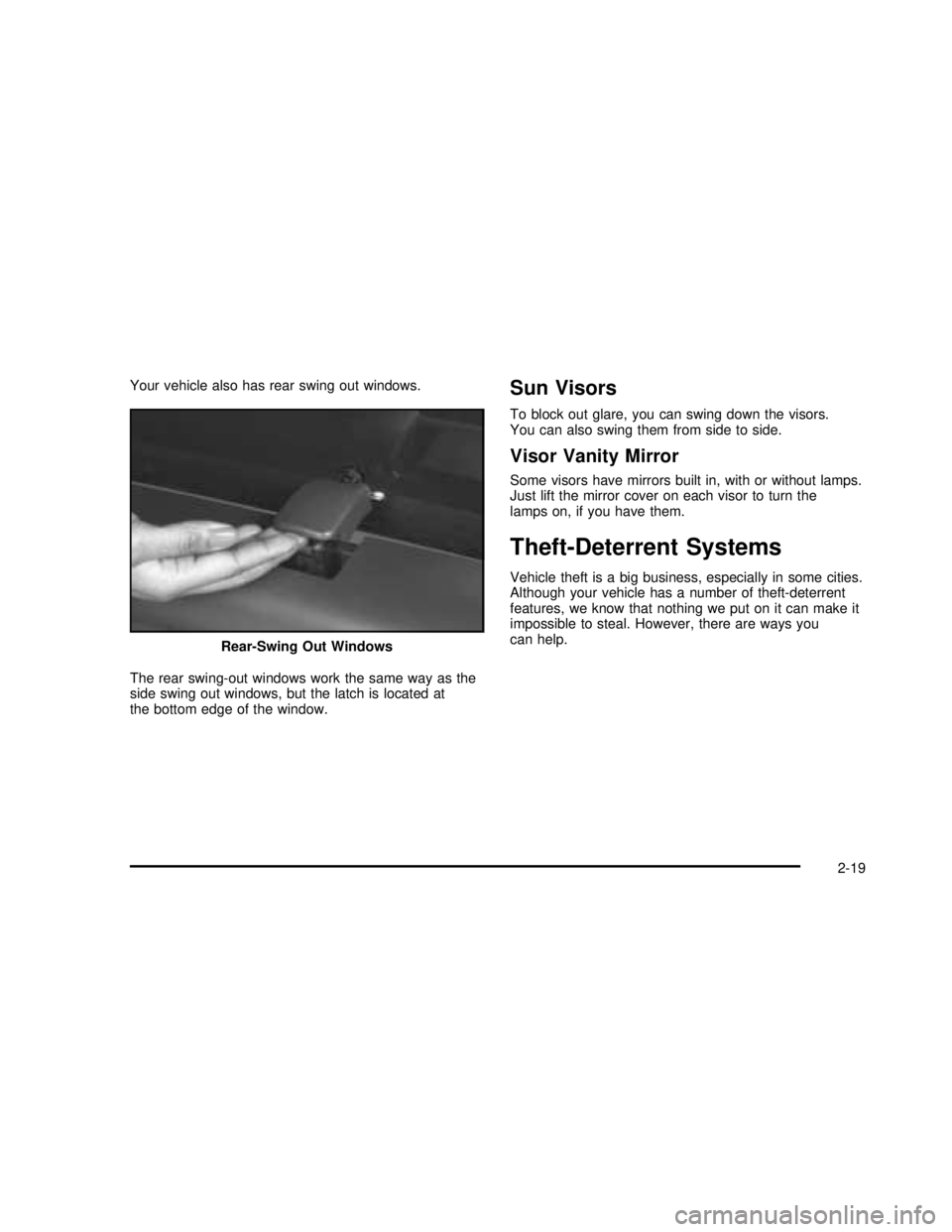
Your vehicle also has rear swing out windows.
The rear swing-out windows work the same way as the
side swing out windows, but the latch is located at
the bottom edge of the window.Sun Visors
To block out glare, you can swing down the visors.
You can also swing them from side to side.
Visor Vanity Mirror
Some visors have mirrors built in, with or without lamps.
Just lift the mirror cover on each visor to turn the
lamps on, if you have them.
Theft-Deterrent Systems
Vehicle theft is a big business, especially in some cities.
Although your vehicle has a number of theft-deterrent
features, we know that nothing we put on it can make it
impossible to steal. However, there are ways you
can help.
Rear-Swing Out Windows
2-19
2003 - Savana OM
Page 114 of 392

Mirrors
Manual Rearview Mirror
Inside Day/Night Rearview Mirror
If you have a cargo van without the rear door glass,
your vehicle may not have a rearview mirror.
Pull the tab under the mirror toward you to reduce glare
from headlamps behind you after dark. Push the tab
away from you to restore the mirror to the original
position.
Outside Manual Mirror
Adjust your outside mirrors so you can see a little of the
side of your vehicle, and have a clear view of objects
behind you. Some mirrors can be folded in to enter
narrow passageways.
Outside Remote Control Mirror
If your vehicle has power mirrors, they can be adjusted
from inside the vehicle.
Select the mirror you want
to move by turning the
knob clockwise to adjust
the passenger’s side mirror
and counterclockwise to
adjust the driver’s side
mirror. The center position
is neutral.
Then, adjust the mirror angle by pushing the knob in the
direction desired until the mirror is adjusted to where
you want it.
2-32
2003 - Savana OM
Page 115 of 392

Outside Camper-Type Mirrors
If your vehicle is equipped
with the camper-type
mirrors, they can be
adjusted so you can have
a clear view of any
objects behind you.1. To adjust the mirrors
when towing a trailer,
turn the mirror by
pushing the mirror
head toward the front
of the vehicle.
2. Turn the mirror head
so that it swings further
outboard and adjust
the mirror surface
as needed.
2-33
2003 - Savana OM
Page 116 of 392
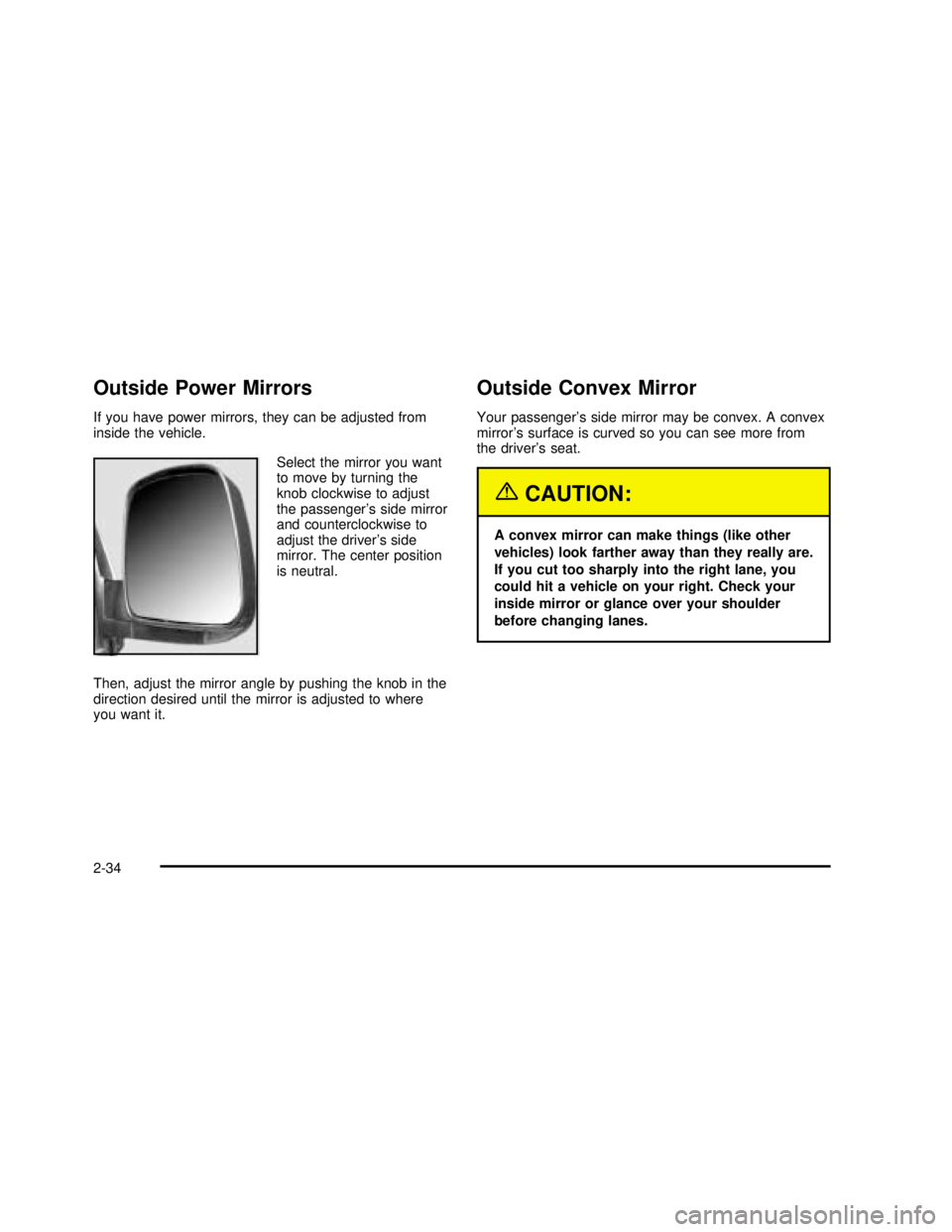
Outside Power Mirrors
If you have power mirrors, they can be adjusted from
inside the vehicle.
Select the mirror you want
to move by turning the
knob clockwise to adjust
the passenger’s side mirror
and counterclockwise to
adjust the driver’s side
mirror. The center position
is neutral.
Then, adjust the mirror angle by pushing the knob in the
direction desired until the mirror is adjusted to where
you want it.
Outside Convex Mirror
Your passenger’s side mirror may be convex. A convex
mirror’s surface is curved so you can see more from
the driver’s seat.
{CAUTION:
A convex mirror can make things (like other
vehicles) look farther away than they really are.
If you cut too sharply into the right lane, you
could hit a vehicle on your right. Check your
inside mirror or glance over your shoulder
before changing lanes.
2-34
2003 - Savana OM
Page 117 of 392
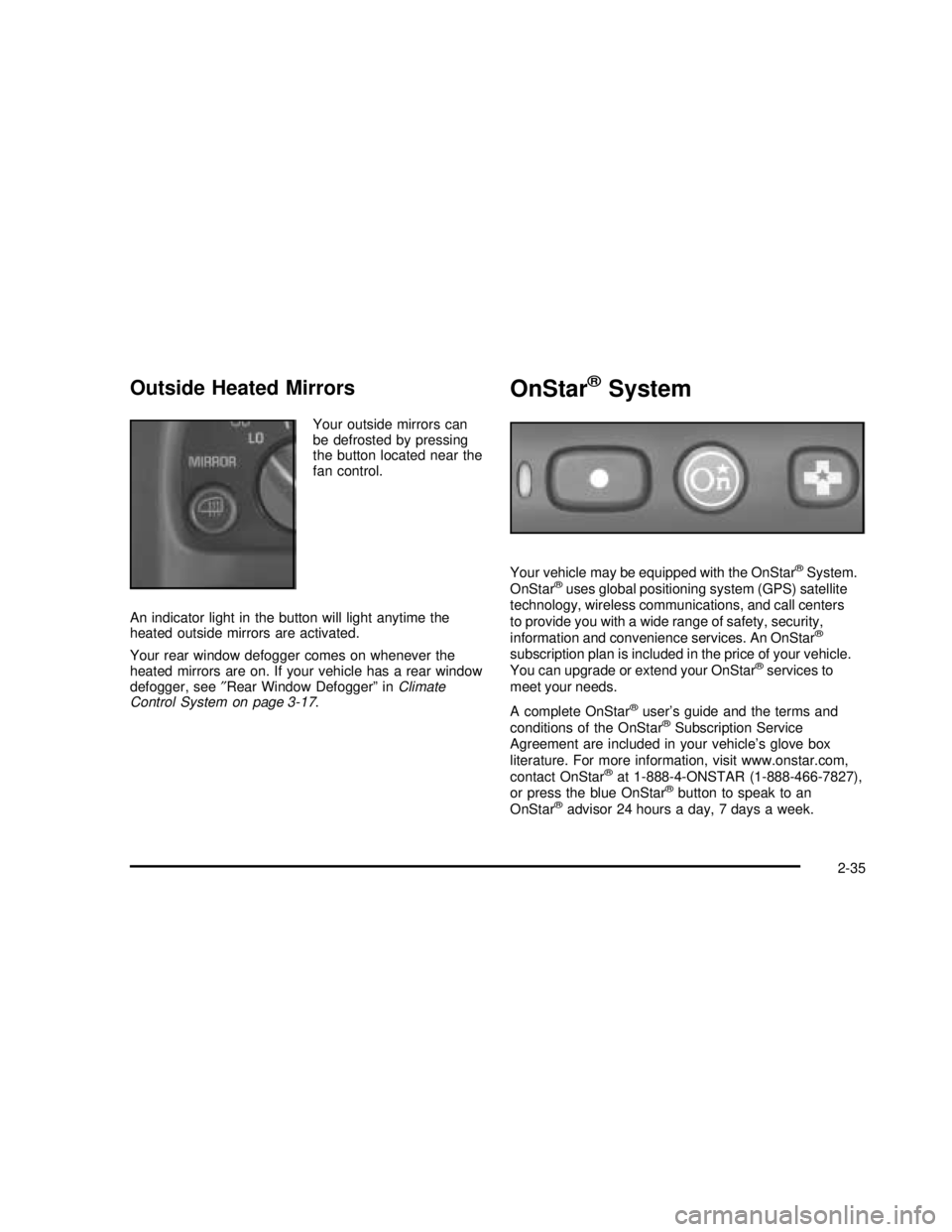
Outside Heated Mirrors
Your outside mirrors can
be defrosted by pressing
the button located near the
fan control.
An indicator light in the button will light anytime the
heated outside mirrors are activated.
Your rear window defogger comes on whenever the
heated mirrors are on. If your vehicle has a rear window
defogger, see″Rear Window Defogger”inClimate
Control System on page 3-17.
OnStar®System
Your vehicle may be equipped with the OnStar®System.
OnStar®uses global positioning system (GPS) satellite
technology, wireless communications, and call centers
to provide you with a wide range of safety, security,
information and convenience services. An OnStar
®
subscription plan is included in the price of your vehicle.
You can upgrade or extend your OnStar®services to
meet your needs.
A complete OnStar
®user’s guide and the terms and
conditions of the OnStar®Subscription Service
Agreement are included in your vehicle’s glove box
literature. For more information, visit www.onstar.com,
contact OnStar
®at 1-888-4-ONSTAR (1-888-466-7827),
or press the blue OnStar®button to speak to an
OnStar®advisor 24 hours a day, 7 days a week.
2-35
2003 - Savana OM
Page 207 of 392

Check your mirrors, glance over your shoulder, and
start your left lane change signal before moving out
of the right lane to pass. When you are far enough
ahead of the passed vehicle to see its front in your
inside mirror, activate your right lane change signal
and move back into the right lane. (Remember that
your right outside mirror is convex. The vehicle you
just passed may seem to be farther away from you
than it really is.)
Try not to pass more than one vehicle at a time on
two-lane roads. Reconsider before passing the
next vehicle.
Don’t overtake a slowly moving vehicle too rapidly.
Even though the brake lamps are notashing, it may
be slowing down or starting to turn.
If you’re being passed, make it easy for the following
driver to get ahead of you. Perhaps you can ease a
little to the right.
Loss of Control
Let’s review what driving experts say about what
happens when the three control systems (brakes,
steering and acceleration) don’t have enough friction
where the tires meet the road to do what the driver
has asked.
In any emergency, don’t give up. Keep trying to steer
and constantly seek an escape route or area of
less danger.
Skidding
In a skid, a driver can lose control of the vehicle.
Defensive drivers avoid most skids by taking reasonable
care suited to existing conditions, and by not“overdriving”
those conditions. But skids are always possible.
The three types of skids correspond to your vehicle’s
three control systems. In the braking skid, your wheels
aren’t rolling. In the steering or cornering skid, too much
speed or steering in a curve causes tires to slip and lose
cornering force. And in the acceleration skid, too much
throttle causes the driving wheels to spin.
A cornering skid is best handled by easing your foot off
the accelerator pedal.
4-13
2003 - Savana OM
Page 208 of 392

If your vehicle starts to slide, ease your foot off the
accelerator pedal and quickly steer the way you want
the vehicle to go. If you start steering quickly enough,
your vehicle may straighten out. Always be ready
for a second skid if it occurs.
Of course, traction is reduced when water, snow, ice,
gravel or other material is on the road. For safety, you’ll
want to slow down and adjust your driving to these
conditions. It is important to slow down on slippery
surfaces because stopping distance will be longer and
vehicle control more limited.
While driving on a surface with reduced traction, try
your best to avoid sudden steering, acceleration
or braking (including engine braking by shifting to a
lower gear). Any sudden changes could cause the tires
to slide. You may not realize the surface is slippery
until your vehicle is skidding. Learn to recognize warning
clues—such as enough water, ice or packed snow
on the road to make a“mirrored surface”—and slow
down when you have any doubt.
Remember: Any anti-lock brake system (ABS) helps
avoid only the braking skid.Driving at Night
Night driving is more dangerous than day driving. One
reason is that some drivers are likely to be impaired—by
alcohol or drugs, with night vision problems, or by fatigue.
4-14
2003 - Savana OM
Page 209 of 392

Here are some tips on night driving.
Drive defensively.
Don’t drink and drive.
Adjust your inside rearview mirror to reduce the
glare from headlamps behind you.
Since you can’t see as well, you may need to slow
down and keep more space between you and
other vehicles.
Slow down, especially on higher speed roads. Your
headlamps can light up only so much road ahead.
In remote areas, watch for animals.
If you’re tired, pull off the road in a safe place
and rest.
No one can see as well at night as in the daytime.
But as we get older these differences increase.
A 50-year-old driver may require at least twice as much
light to see the same thing at night as a 20-year-old.
What you do in the daytime can also affect your
night vision. For example, if you spend the day in
bright sunshine you are wise to wear sunglasses.
Your eyes will have less trouble adjusting to night.But if you’re driving, don’t wear sunglasses at night.
They may cut down on glare from headlamps, but they
also make a lot of things invisible.
You can be temporarily blinded by approaching
headlamps. It can take a second or two, or even
several seconds, for your eyes to re-adjust to the dark.
When you are faced with severe glare (as from a
driver who doesn’t lower the high beams, or a vehicle
with misaimed headlamps), slow down a little. Avoid
staring directly into the approaching headlamps.
Keep your windshield and all the glass on your vehicle
clean—inside and out. Glare at night is made much
worse by dirt on the glass. Even the inside of the glass
can build up alm caused by dust. Dirty glass makes
lights dazzle andash more than clean glass would,
making the pupils of your eyes contract repeatedly.
Remember that your headlamps light up far less of a
roadway when you are in a turn or curve. Keep
your eyes moving; that way, it’s easier to pick out dimly
lighted objects. Just as your headlamps should be
checked regularly for proper aim, so should your eyes
be examined regularly. Some drivers suffer from
night blindness—the inability to see in dim light—and
aren’t even aware of it.
4-15
2003 - Savana OM