instrument panel GMC SAVANA 2004 Owner's Guide
[x] Cancel search | Manufacturer: GMC, Model Year: 2004, Model line: SAVANA, Model: GMC SAVANA 2004Pages: 398, PDF Size: 4.4 MB
Page 244 of 398
Passing
You’ll need more passing distance up ahead when
you’re towing a trailer. And, because you’re a good deal
longer, you’ll need to go much farther beyond the
passed vehicle before you can return to your lane.
Backing Up
Hold the bottom of the steering wheel with one hand.
Then, to move the trailer to the left, just move that hand
to the left. To move the trailer to the right, move your
hand to the right. Always back up slowly and, if possible,
have someone guide you.
Making Turns
Notice:Making very sharp turns while trailering
could cause the trailer to come in contact with the
vehicle. Your vehicle could be damaged. Avoid
making very sharp turns while trailering.
When you’re turning with a trailer, make wider turns
than normal. Do this so your trailer won’t strike
soft shoulders, curbs, road signs, trees or other objects.
Avoid jerky or sudden maneuvers. Signal well in
advance.
Turn Signals When Towing a Trailer
When you tow a trailer, your vehicle has to have extra
wiring and a heavy-duty turn signal asher (included
in the optional trailering package).
The arrows on your instrument panel will ash whenever
you signal a turn or lane change. Properly hooked up,
the trailer lamps will also ash, telling other drivers
you’re about to turn, change lanes or stop.
When towing a trailer, the arrows on your instrument
panel will ash for turns even if the bulbs on the trailer
are burned out. Thus, you may think drivers behind
you are seeing your signal when they are not. It’s
important to check occasionally to be sure the trailer
bulbs are still working.
Driving On Grades
Reduce speed and shift to a lower gearbeforeyou start
down a long or steep downgrade. If you don’t shift
down, you might have to use your brakes so much that
they would get hot and no longer work well.
You can tow in DRIVE (D). You may want to shift the
transmission to THIRD (3) or a lower gear under heavy
loads and/or hilly conditions.
4-48
Page 246 of 398
Maintenance When Trailer Towing
Your vehicle will need service more often when you’re
pulling a trailer. See the Maintenance Schedule for more
on this. Things that are especially important in trailer
operation are automatic transmission uid (don’t overll),
engine oil, axle lubricant, belt, cooling system and
brake system. Each of these is covered in this manual,
and the Index will help you nd them quickly. If
you’re trailering, it’s a good idea to review these sections
before you start your trip.
Check periodically to see that all hitch nuts and bolts
are tight.
Trailer Wiring Harness
The optional heavy-duty trailer wiring package includes
a seven-wire harness assembly at the rear of the
vehicle and a four-wire harness assembly under the left
hand side of the instrument panel. The seven-wire
harness assembly is taped together and located in a
frame pocket at the driver side rear left corner of
the frame. The seven-wire harness includes a 30-amp
feed wire. Both harnesses come without connectors and
should be wired by a qualied electrical technician.
The technician can use the following color code chart
when connecting the wiring harness to your trailer
and trailer brake controller.Seven-Wire Harness
Light Green: Back-up lamps
Brown: Parking lamps
Yellow: Left stoplamp and turn signal
Dark Green: Right stoplamp and turn signal
Dark Blue: Use for electric trailer brakes
Orange: Trailer accessory
White (heavy gage): Ground wire
Four-Wire Harness (Trailer Brake Controller)
Black: Ground
Red/White Stripe: Fused Battery
Dark Blue: Trailer Brake Feed
Light Blue: Fused Stop/CHMSL
4-50
Page 271 of 398

Radiator Pressure CapThe radiator pressure cap is located near the center of
the engine compartment. SeeEngine Compartment
Overview on page 5-12for more information on location.
Notice:If the pressure cap is not tightly installed,
coolant loss and possible engine damage may
occur. Be sure the cap is properly and tightly
secured.
Engine Overheating
You will nd a coolant temperature gage on your
vehicle’s instrument panel.
5-25
Page 340 of 398
Cleaning Vinyl
Use warm water and a clean cloth.
Rub with a clean, damp cloth to remove dirt. You
may have to do this more than once.
Things like tar, asphalt and shoe polish will stain if
you do not get them off quickly. Use a clean cloth
and vinyl cleaner. See your dealer for this product.
Cleaning Leather
Use a soft cloth with lukewarm water and a mild soap or
saddle soap and wipe dry with a soft cloth. Then, let
the leather dry naturally. Do not use heat to dry.
For stubborn stains, use a leather cleaner.
Neveruse oils, varnishes, solvent-based or abrasive
cleaners, furniture polish or shoe polish on leather.
Soiled or stained leather should be cleaned
immediately. If dirt is allowed to work into the nish,
it can harm the leather.
Cleaning the Top of the Instrument
Panel
Use only mild soap and water to clean the top surfaces
of the instrument panel. Sprays containing silicones
or waxes may cause annoying reections in the
windshield and even make it difficult to see through the
windshield under certain conditions.
Cleaning Interior Plastic Components
Use only a mild soap and water solution on a soft cloth
or sponge. Commercial cleaners may affect the
surface nish.
Cleaning Glass Surfaces
Glass should be cleaned often. GM Glass Cleaner or a
liquid household glass cleaner will remove normal
tobacco smoke and dust lms on interior glass. See
Vehicle Care/Appearance Materials on page 5-99.
Notice:If you use abrasive cleaners when cleaning
glass surfaces on your vehicle, you could scratch
the glass and/or cause damage to the rear window
defogger and the integrated radio antenna. When
cleaning the glass on your vehicle, use only a soft
cloth and glass cleaner.
5-94
Page 346 of 398
Vehicle Identication
Vehicle Identication Number (VIN)
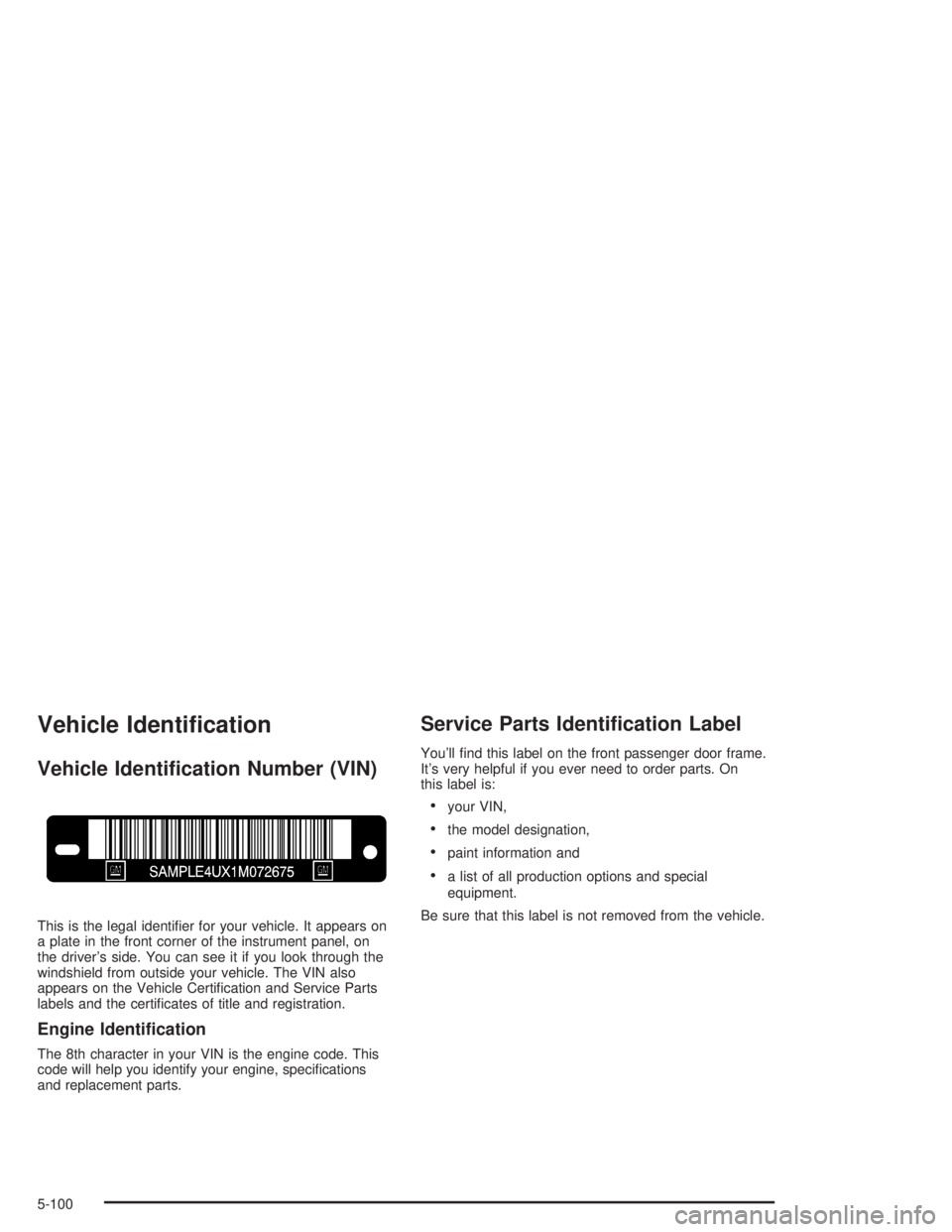
This is the legal identier for your vehicle. It appears on
a plate in the front corner of the instrument panel, on
the driver’s side. You can see it if you look through the
windshield from outside your vehicle. The VIN also
appears on the Vehicle Certication and Service Parts
labels and the certicates of title and registration.
Engine Identication
The 8th character in your VIN is the engine code. This
code will help you identify your engine, specications
and replacement parts.
Service Parts Identication Label
You’ll nd this label on the front passenger door frame.
It’s very helpful if you ever need to order parts. On
this label is:
your VIN,
the model designation,
paint information and
a list of all production options and special
equipment.
Be sure that this label is not removed from the vehicle.
5-100
Page 350 of 398

Fuse Usage
4 Right Rear Turn Lamp
5 Backup Lamps Trailer Wiring
6 Ignition 0
7 Stop Lamp
8 Right Rear Defogger/Heated Mirror
9 Right Daytime Running Lamp/Turn Signal
10 Left Daytime Running Lamp/Turn Signal
11 Truck Body Control Module 4
12 Fuel Pump
13 Trailer
14 Flasher
15 Horn
16 Truck Body Control Module 3
17 Trailer Stop/Turn Signal
18 Truck Body Control Module 2
19 Truck Body Control Module
20 Remote Function Actuator
21 Engine 2Fuse Usage
22 Ignition E
23 Engine 1
24 Truck Body Control Module Ignition 1
25 Spare
26 RPA/Inside Rearview Mirror
27 Crankcase
28 Brake Transmission Shift Interlock System
29 Auxiliary Power Outlets
30 Cigarette Lighter
31 Instrument Panel Cluster
32 Air Conditioning
33 Spare
34 Vent
35 Spare
36 Vehicle Back Up
37 Supplemental Inatable Restraint System
38 Powertrain Control Module Ignition 1
39 Oxygen Sensor B
5-104
Page 374 of 398
Customer Assistance and
Information
Customer Satisfaction Procedure
Your satisfaction and goodwill are important to
your dealer and to GMC. Normally, any concerns with
the sales transaction or the operation of your vehicle will
be resolved by your dealer’s sales or service
departments. Sometimes, however, despite the best
intentions of all concerned, misunderstandings can
occur. If your concern has not been resolved to your
satisfaction, the following steps should be taken:
STEP ONE:Discuss your concern with a member of
dealership management. Normally, concerns can
be quickly resolved at that level. If the matter has
already been reviewed with the sales, service or parts
manager, contact the owner of the dealership or
the general manager.
STEP TWO:If after contacting a member of dealership
management, it appears your concern cannot be
resolved by the dealership without further help, contact
the GMC Consumer Relations Manager by calling
1-800-GMC-8782 (1-800-462-8782, Customer
Assistance prompt). In Canada, contact GM of Canada
Customer Communication Centre in Oshawa by calling
1-800-263-3777 (English) or 1-800-263-7854 (French).We encourage you to call the toll-free number in order to
give your inquiry prompt attention. Please have the
following information available to give the Customer
Assistance Representative:
Vehicle Identication Number (This is available from
the vehicle registration or title, or the plate at the top
left of the instrument panel and visible through the
windshield.)
Dealership name and location
Vehicle delivery date and present mileage
When contacting GMC, please remember that your
concern will likely be resolved at a dealer’s facility. That
is why we suggest you follow Step One rst if you
have a concern.
STEP THREE:Both General Motors and your dealer
are committed to making sure you are completely
satised with your new vehicle. However, if you continue
to remain unsatised after following the procedure
outlined in Steps One and Two, you should le with the
BBB Auto Line Program to enforce any additional
rights you may have. Canadian owners refer to your
Warranty and Owner Assistance Information booklet for
information on the Canadian Motor Vehicle Arbitration
Plan (CAMVAP).
7-2
Page 387 of 398
Cargo Vans with a Passenger Air Bag and
an Air Bag Off Switch, Passenger Vans
and Cab and Chassis Models.......................1-36
Cargo Vans with a Passenger Air Bag and
without an Air Bag Off Switch........................1-39
Cassette Tape Messages.................................3-58
CD Adapter Kits.............................................3-58
CD Messages................................3-50, 3-60, 3-71
Center High Mounted
Stoplamp (CHMSL)......................................5-55
Center High-Mounted Stoplamp.........................3-16
Center Passenger Position, Safety Belts.......1-24, 1-25
Chains, Tires..................................................5-73
Charging System Light....................................3-30
Check
Engine Light...............................................3-35
Gages Warning Light...................................3-41
Check Engine Light.........................................3-35
Checking Brake Fluid......................................5-39
Checking Coolant............................................5-23
Checking Engine Oil........................................5-13
Checking Things Under the Hood....................... 5-9
Checking Your Restraint Systems......................1-79
Chemical Paint Spotting...................................5-98
Child Restraints
Child Restraint Systems...............................1-42
Infants and Young Children...........................1-36
Lower Anchorages and Top Tethers for
Children (LATCH System)..........................1-52Child Restraints (cont.)
Older Children.............................................1-32
Securing a Child Restraint Designed for
the LATCH System...................................1-54
Securing a Child Restraint in a
Center Seat Position.........................1-59, 1-60
Securing a Child Restraint in a
Rear Outside Seat Position........................1-57
Securing a Child Restraint in the
Right Front Seat Position..........................1-62
Top Strap...................................................1-49
Top Strap Anchor Location............................1-50
Where to Put the Restraint...........................1-45
Chime Level Adjustment..................................3-74
Cigarette Lighter.............................................3-18
Cleaning
Inside of Your Vehicle..................................5-92
Outside of Your Vehicle................................5-95
Underbody Maintenance...............................5-98
Weatherstrips..............................................5-95
Cleaning Aluminum Wheels..............................5-97
Cleaning Exterior Lamps/Lenses.......................5-96
Cleaning Fabric/Carpet....................................5-92
Cleaning Glass Surfaces..................................5-94
Cleaning Interior Plastic Components.................5-94
Cleaning Leather............................................5-94
Cleaning the Top of the Instrument Panel...........5-94
Cleaning the Windshield and Wiper Blades.........5-97
Cleaning Tires................................................5-97
Cleaning Vinyl................................................5-97
3
Page 391 of 398
How to Add Coolant to the Radiator..................5-32
How to Add Fluid............................................5-22
How to Check........................................5-20, 5-66
How to Check Lubricant...................................5-48
How to Check Power Steering Fluid..................5-36
How to Inspect the Engine Air Cleaner/Filter.......5-18
How to Use This Manual...................................... ii
How to Wear Safety Belts Properly...................1-15
Hydroplaning..................................................4-20
I
If No Steam Is Coming From Your Engine..........5-27
If Steam Is Coming From Your Engine...............5-26
If the Light Is Flashing.....................................3-36
If the Light Is On Steady.................................3-36
If You Are Caught in a Blizzard.........................4-28
If You Are Stuck in Sand, Mud, Ice or Snow.......4-30
If You Do Decide To Pull A Trailer.....................4-38
Ignition Positions.............................................2-21
Infants and Young Children, Restraints...............1-36
Ination - Tire Pressure...................................5-65
Inside Day/Night Rearview Mirror......................2-32
Instrument Panel
Cluster.......................................................3-25
Overview..................................................... 3-4
Instrument Panel Brightness Control..................3-16
Interior Lamps................................................3-16
J
Jump Starting.................................................5-42
K
Keyless Entry System....................................... 2-4
Keys............................................................... 2-2
L
Lamps
Exterior......................................................3-14
Interior.......................................................3-16
Lamps On Reminder.......................................3-15
Lap Belt........................................................1-25
Lap-Shoulder Belt...........................................1-15
LATCH System
Child Restraints...........................................1-52
Securing a Child Restraint Designed for
the LATCH System...................................1-54
Leaving Your Vehicle.......................................2-11
Leaving Your Vehicle With the
Engine Running..........................................2-28
Light
Air Bag Off .................................................3-29
Air Bag Readiness.......................................3-28
Anti-Lock Brake System Warning...................3-33
7