instrument panel GMC SAVANA 2005 Owner's Guide
[x] Cancel search | Manufacturer: GMC, Model Year: 2005, Model line: SAVANA, Model: GMC SAVANA 2005Pages: 384, PDF Size: 2.41 MB
Page 237 of 384
When You Are Ready to Leave After
Parking on a Hill
1. Apply your regular brakes and hold the pedal down
while you:
start your engine,
shift into a gear, and
release the parking brake.
2. Let up on the brake pedal.
3. Drive slowly until the trailer is clear of the chocks.
4. Stop and have someone pick up and store
the chocks.
Maintenance When Trailer Towing
Your vehicle will need service more often when you’re
pulling a trailer. See the Maintenance Schedule for more
on this. Things that are especially important in trailer
operation are automatic transmission uid (don’t overll),
engine oil, axle lubricant, belt, cooling system and
brake system. Each of these is covered in this manual,
and the Index will help you nd them quickly. If you’re
trailering, it’s a good idea to review these sections
before you start your trip.
Check periodically to see that all hitch nuts and bolts
are tight.
Trailer Wiring Harness
The optional heavy-duty trailer wiring package includes
a seven-wire harness assembly at the rear of the
vehicle and a four-wire harness assembly under the
left hand side of the instrument panel. The seven-wire
harness assembly is taped together and located in
a frame pocket at the driver side rear left corner of the
frame. The seven-wire harness includes a 30-amp
feed wire. Both harnesses come without connectors and
should be wired by a qualied electrical technician.
The technician can use the following color code chart
when connecting the wiring harness to your trailer
and trailer brake controller.
Seven-Wire Harness
Light Green: Back-up lamps
Brown: Parking lamps
Yellow: Left stoplamp and turn signal
Dark Green: Right stoplamp and turn signal
Dark Blue: Use for electric trailer brakes
Orange: Trailer accessory
White (heavy gage): Ground wire
Four-Wire Harness (Trailer Brake Controller)
Black: Ground
Red/White Stripe: Fused Battery
Dark Blue: Trailer Brake Feed
Light Blue: Fused Stoplamp/CHMSL
4-49
Page 240 of 384
Windshield Wiper Blade Replacement..............5-51
Tires..............................................................5-52
Tire Sidewall Labelling...................................5-53
Tire Terminology and Denitions.....................5-56
Ination - Tire Pressure.................................5-58
Dual Tire Operation.......................................5-60
Tire Inspection and Rotation...........................5-60
When It Is Time for New Tires.......................5-62
Buying New Tires.........................................5-63
Uniform Tire Quality Grading..........................5-64
Wheel Alignment and Tire Balance..................5-65
Wheel Replacement......................................5-65
Tire Chains..................................................5-67
If a Tire Goes Flat........................................5-68
Changing a Flat Tire.....................................5-68
Removing the Spare Tire and Tools................5-70
Removing the Flat Tire and Installing
the Spare Tire..........................................5-73
Secondary Latch System...............................5-79
Storing a Flat or Spare Tire and Tools............5-82
Spare Tire...................................................5-83
Appearance Care............................................5-84
Fabric/Carpet...............................................5-85
Vinyl...........................................................5-86
Instrument Panel..........................................5-86
Interior Plastic Components............................5-86Glass Surfaces.............................................5-86
Care of Safety Belts......................................5-87
Weatherstrips...............................................5-87
Washing Your Vehicle...................................5-87
Cleaning Exterior Lamps/Lenses.....................5-88
Finish Care..................................................5-88
Windshield and Wiper Blades.........................5-89
Aluminum Wheels.........................................5-89
Tires...........................................................5-90
Sheet Metal Damage.....................................5-90
Finish Damage.............................................5-90
Underbody Maintenance................................5-90
Chemical Paint Spotting.................................5-90
Vehicle Care/Appearance Materials..................5-91
Vehicle Identication......................................5-92
Vehicle Identication Number (VIN).................5-92
Service Parts Identication Label.....................5-92
Electrical System............................................5-93
Add-On Electrical Equipment..........................5-93
Headlamp Wiring..........................................5-93
Windshield Wiper Fuses................................5-93
Fuses and Circuit Breakers............................5-93
Floor Console Fuse Block..............................5-94
Engine Compartment Fuse Block....................5-95
Capacities and Specications..........................5-98
Section 5 Service and Appearance Care
5-2
Page 263 of 384
{CAUTION:
You can be burned if you spill coolant on hot
engine parts. Coolant contains ethylene glycol,
and it will burn if the engine parts are hot
enough. Do not spill coolant on a hot engine.
Occasionally check the coolant level in the radiator.
For information on how to add coolant to the radiator,
seeCooling System on page 5-27.
Radiator Pressure Cap
The radiator pressure cap is located near the center of
the engine compartment. SeeEngine Compartment
Overview on page 5-12for more information on location.
Notice:If the pressure cap is not tightly installed,
coolant loss and possible engine damage may
occur. Be sure the cap is properly and tightly
secured.
Engine Overheating
You will nd an engine coolant temperature gage on
your vehicle’s instrument panel. SeeEngine Coolant
Temperature Gage on page 3-32for more information.
5-25
Page 324 of 384
Special Fabric Cleaning Problems
Stains caused by such things as catsup, black coffee,
egg, fruit, fruit juice, milk, soft drinks, vomit, urine,
and blood can be removed using the club soda water
instructions given earlier in this section. If an odor lingers
after cleaning vomit or urine, treat the area with a
water and baking soda solution: 1 teaspoon (5 ml) of
baking soda to 1 cup (250 ml) of lukewarm water.
Let dry.
Stains caused by oil and grease can be cleaned with an
approved GM cleaner and a clean, white cloth.
1. Carefully scrape off excess stain.
2. Clean with cool water and allow to dry completely.
3. If a stain remains, follow the “Using Cleaner on
Fabric” instructions described earlier.
Vinyl
Use warm water and a clean cloth.
Rub with a clean, damp cloth to remove dirt. This
may have to be done more than once.
Things like tar, asphalt, and shoe polish will stain if
they are not removed quickly. Use a clean cloth
and vinyl cleaner. See your dealer for this product.
Instrument Panel
Use only mild soap and water to clean the top surfaces
of the instrument panel. Sprays containing silicones
or waxes may cause annoying reections in the
windshield and even make it difficult to see through the
windshield under certain conditions.
Interior Plastic Components
Use only a mild soap and water solution on a soft cloth
or sponge. Commercial cleaners may affect the
surface nish.
Glass Surfaces
Glass should be cleaned often. GM Glass Cleaner or a
liquid household glass cleaner will remove normal
tobacco smoke and dust lms on interior glass. See
Vehicle Care/Appearance Materials on page 5-91.
Notice:If you use abrasive cleaners when cleaning
glass surfaces on your vehicle, you could scratch
the glass and/or cause damage to the rear window
defogger and the integrated radio antenna. When
cleaning the glass on your vehicle, use only a soft
cloth and glass cleaner.
5-86
Page 330 of 384
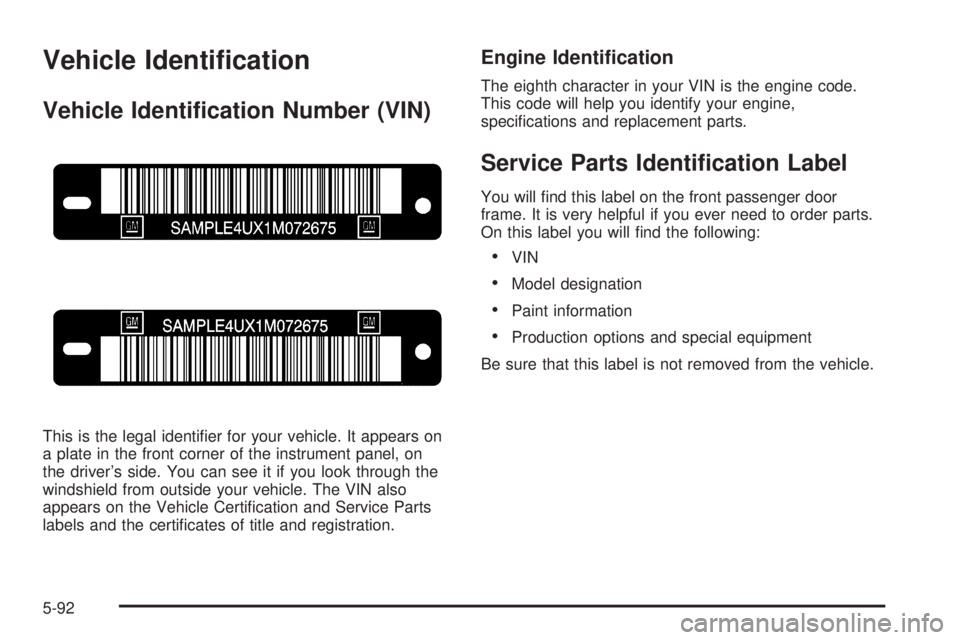
Vehicle Identication
Vehicle Identication Number (VIN)
This is the legal identier for your vehicle. It appears on
a plate in the front corner of the instrument panel, on
the driver’s side. You can see it if you look through the
windshield from outside your vehicle. The VIN also
appears on the Vehicle Certication and Service Parts
labels and the certicates of title and registration.
Engine Identication
The eighth character in your VIN is the engine code.
This code will help you identify your engine,
specications and replacement parts.
Service Parts Identication Label
You will nd this label on the front passenger door
frame. It is very helpful if you ever need to order parts.
On this label you will nd the following:
VIN
Model designation
Paint information
Production options and special equipment
Be sure that this label is not removed from the vehicle.
5-92
Page 334 of 384
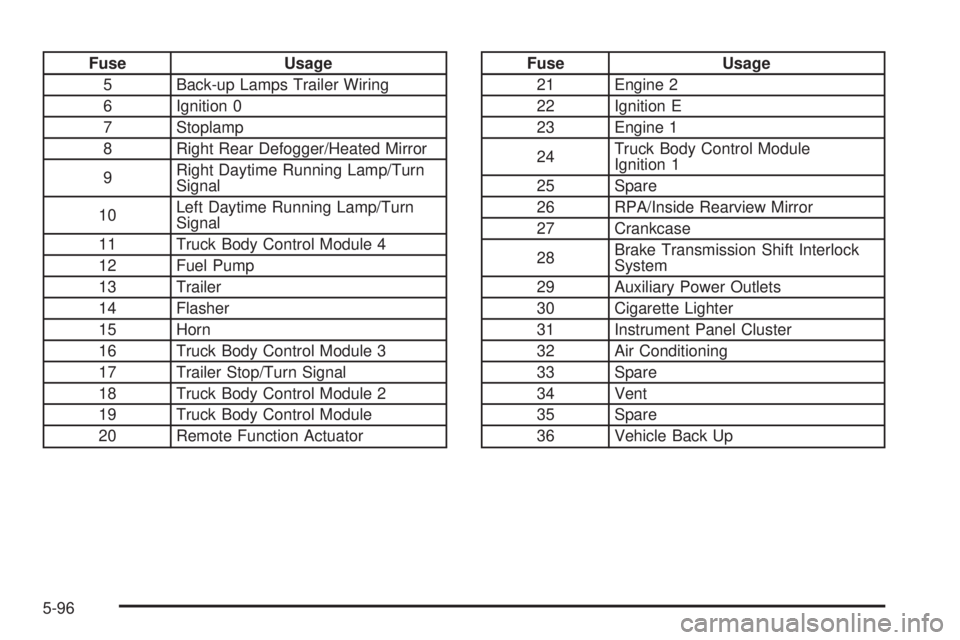
Fuse Usage
5 Back-up Lamps Trailer Wiring
6 Ignition 0
7 Stoplamp
8 Right Rear Defogger/Heated Mirror
9Right Daytime Running Lamp/Turn
Signal
10Left Daytime Running Lamp/Turn
Signal
11 Truck Body Control Module 4
12 Fuel Pump
13 Trailer
14 Flasher
15 Horn
16 Truck Body Control Module 3
17 Trailer Stop/Turn Signal
18 Truck Body Control Module 2
19 Truck Body Control Module
20 Remote Function ActuatorFuse Usage
21 Engine 2
22 Ignition E
23 Engine 1
24Truck Body Control Module
Ignition 1
25 Spare
26 RPA/Inside Rearview Mirror
27 Crankcase
28Brake Transmission Shift Interlock
System
29 Auxiliary Power Outlets
30 Cigarette Lighter
31 Instrument Panel Cluster
32 Air Conditioning
33 Spare
34 Vent
35 Spare
36 Vehicle Back Up
5-96
Page 358 of 384
Customer Assistance and
Information
Customer Satisfaction Procedure
Your satisfaction and goodwill are important to
your dealer and to GMC. Normally, any concerns with
the sales transaction or the operation of the vehicle
will be resolved by your dealer’s sales or service
departments. Sometimes, however, despite the best
intentions of all concerned, misunderstandings can
occur. If your concern has not been resolved to your
satisfaction, the following steps should be taken:
STEP ONE:Discuss your concern with a member of
dealership management. Normally, concerns can
be quickly resolved at that level. If the matter has
already been reviewed with the sales, service or parts
manager, contact the owner of the dealership or
the general manager.STEP TWO:If after contacting a member of dealership
management, it appears your concern cannot be
resolved by the dealership without further help, contact
the GMC Consumer Relations Manager by calling
1-800-GMC-8782 (1-800-462-8782, Customer
Assistance prompt). In Canada, contact GM of Canada
Customer Communication by calling 1-800-263-3777
(English) or 1-800-263-7854 (French).
We encourage you to call the toll-free number in order to
give your inquiry prompt attention. Please have the
following information available to give the Customer
Assistance Representative:
Vehicle Identication Number (VIN). This is available
from the vehicle registration or title, or the plate at the
top left of the instrument panel and visible through
the windshield.
Dealership name and location
Vehicle delivery date and present mileage
When contacting GMC, please remember that your
concern will likely be resolved at a dealer’s facility. That
is why we suggest you follow Step One rst if you
have a concern.
7-2
Page 371 of 384
A
Accessory Power Outlets.................................3-16
Adding Equipment to Your Airbag-Equipped
Vehicle.......................................................1-73
Additives, Fuel................................................. 5-6
Add-On Electrical Equipment............................5-93
Air Cleaner/Filter, Engine.................................5-18
Air Conditioning..............................................3-18
Airbag
Off Light.....................................................3-27
Readiness Light..........................................3-26
Airbag Sensing and Diagnostic Module (SDM)....7-10
Airbag System................................................1-61
Adding Equipment to Your Airbag-Equipped
Vehicle...................................................1-73
Airbag Off Switch........................................1-69
How Does an Airbag Restrain?......................1-67
Servicing Your Airbag-Equipped Vehicle..........1-72
What Makes an Airbag Inate?......................1-67
What Will You See After an Airbag Inates?....1-68
When Should an Airbag Inate?....................1-65
Where Are the Airbags?...............................1-64
All-Wheel Drive...............................................5-43
All-Wheel Drive (AWD) System.........................2-25AM-FM Radio.................................................3-42
Antenna, Fixed Mast.......................................3-74
Anti-Lock Brake System (ABS)........................... 4-7
Anti-Lock Brake, System Warning Light..............3-31
Appearance Care............................................5-84
Aluminum Wheels........................................5-89
Care of Safety Belts....................................5-87
Chemical Paint Spotting...............................5-90
Cleaning Exterior Lamps/Lenses....................5-88
Fabric/Carpet..............................................5-85
Finish Care.................................................5-88
Finish Damage............................................5-90
Glass Surfaces............................................5-86
Instrument Panel.........................................5-86
Interior Plastic Components...........................5-86
Sheet Metal Damage...................................5-90
Tires..........................................................5-90
Underbody Maintenance...............................5-90
Vehicle Care/Appearance Materials................5-91
Vinyl..........................................................5-86
Washing Your Vehicle...................................5-87
Weatherstrips..............................................5-87
Windshield and Wiper Blades........................5-89
Ashtrays........................................................3-17
1
Page 373 of 384
C
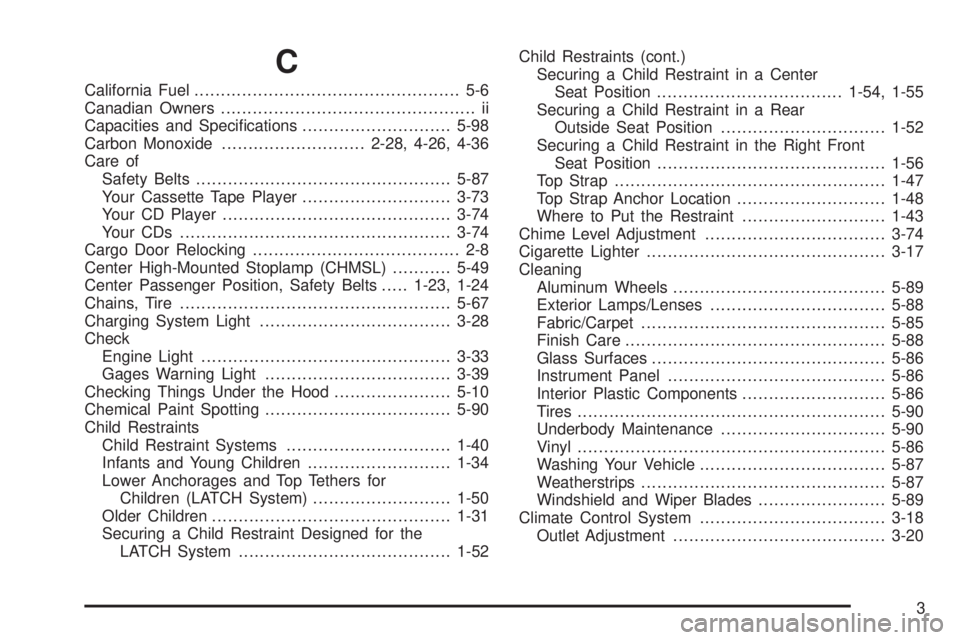
California Fuel.................................................. 5-6
Canadian Owners................................................ ii
Capacities and Specications............................5-98
Carbon Monoxide...........................2-28, 4-26, 4-36
Care of
Safety Belts................................................5-87
Your Cassette Tape Player............................3-73
Your CD Player...........................................3-74
Your CDs ...................................................3-74
Cargo Door Relocking....................................... 2-8
Center High-Mounted Stoplamp (CHMSL)...........5-49
Center Passenger Position, Safety Belts.....1-23, 1-24
Chains, Tire...................................................5-67
Charging System Light....................................3-28
Check
Engine Light...............................................3-33
Gages Warning Light...................................3-39
Checking Things Under the Hood......................5-10
Chemical Paint Spotting...................................5-90
Child Restraints
Child Restraint Systems...............................1-40
Infants and Young Children...........................1-34
Lower Anchorages and Top Tethers for
Children (LATCH System)..........................1-50
Older Children.............................................1-31
Securing a Child Restraint Designed for the
LATCH System........................................1-52Child Restraints (cont.)
Securing a Child Restraint in a Center
Seat Position...................................1-54, 1-55
Securing a Child Restraint in a Rear
Outside Seat Position...............................1-52
Securing a Child Restraint in the Right Front
Seat Position...........................................1-56
Top Strap...................................................1-47
Top Strap Anchor Location............................1-48
Where to Put the Restraint...........................1-43
Chime Level Adjustment..................................3-74
Cigarette Lighter.............................................3-17
Cleaning
Aluminum Wheels........................................5-89
Exterior Lamps/Lenses.................................5-88
Fabric/Carpet..............................................5-85
Finish Care.................................................5-88
Glass Surfaces............................................5-86
Instrument Panel.........................................5-86
Interior Plastic Components...........................5-86
Tires..........................................................5-90
Underbody Maintenance...............................5-90
Vinyl..........................................................5-86
Washing Your Vehicle...................................5-87
Weatherstrips..............................................5-87
Windshield and Wiper Blades........................5-89
Climate Control System...................................3-18
Outlet Adjustment........................................3-20
3
Page 377 of 384
I
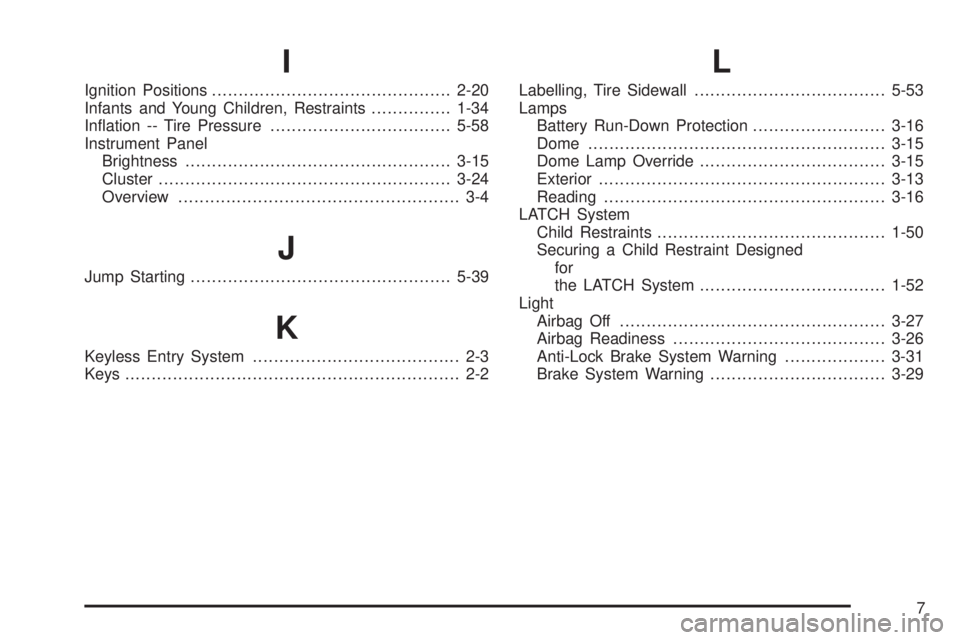
Ignition Positions.............................................2-20
Infants and Young Children, Restraints...............1-34
Ination -- Tire Pressure..................................5-58
Instrument Panel
Brightness..................................................3-15
Cluster.......................................................3-24
Overview..................................................... 3-4
J
Jump Starting.................................................5-39
K
Keyless Entry System....................................... 2-3
Keys............................................................... 2-2
L
Labelling, Tire Sidewall....................................5-53
Lamps
Battery Run-Down Protection.........................3-16
Dome........................................................3-15
Dome Lamp Override...................................3-15
Exterior......................................................3-13
Reading.....................................................3-16
LATCH System
Child Restraints...........................................1-50
Securing a Child Restraint Designed
for
the LATCH System...................................1-52
Light
Airbag Off..................................................3-27
Airbag Readiness........................................3-26
Anti-Lock Brake System Warning...................3-31
Brake System Warning.................................3-29
7