check engine light GMC SAVANA 2007 User Guide
[x] Cancel search | Manufacturer: GMC, Model Year: 2007, Model line: SAVANA, Model: GMC SAVANA 2007Pages: 452, PDF Size: 2.68 MB
Page 233 of 452
Avoid needless heavy braking. Some people drive
in spurts — heavy acceleration followed by heavy
braking — rather than keeping pace with traffic.
This is a mistake. The brakes may not have time to
cool between hard stops. The brakes will wear out
much faster if you do a lot of heavy braking. If you
keep pace with the traffic and allow realistic
following distances, you will eliminate a lot of
unnecessary braking. That means better braking
and longer brake life.
If your vehicle’s engine ever stops while you are
driving, brake normally but do not pump the
brakes. If you do, the pedal may get harder to
push down. If the engine stops, you will still have
some power brake assist. But you will use it
when you brake. Once the power assist is used
up, it may take longer to stop and the brake pedal
will be harder to push.
Adding non-GM accessories can affect your
vehicle’s performance. SeeAccessories and
Modications on page 286.Anti-Lock Brake System (ABS)
Your vehicle has the Anti-Lock Brake System
(ABS), an advanced electronic braking system that
will help prevent a braking skid.
When you start your engine and begin to drive
away, ABS will check itself. You may hear a
momentary motor or clicking noise while this test
is going on. This is normal.
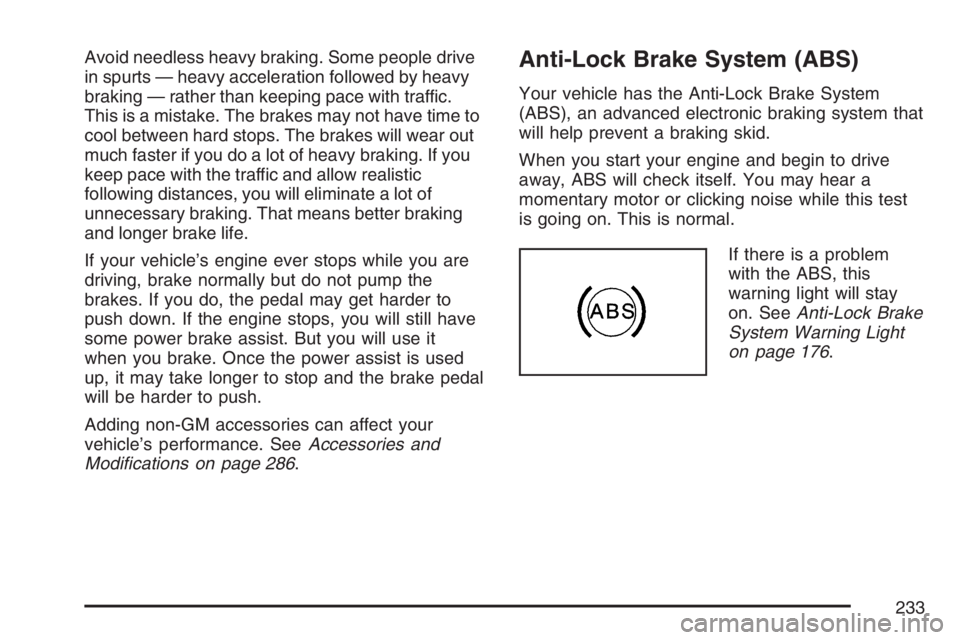
If there is a problem
with the ABS, this
warning light will stay
on. SeeAnti-Lock Brake
System Warning Light
on page 176.
233
Page 250 of 452
Before changing lanes, check your mirrors.
Then use your turn signal.
Just before you leave the lane, glance quickly
over your shoulder to make sure there is not
another vehicle in your blind spot.
Once you are moving on the freeway, make
certain you allow a reasonable following distance.
Expect to move slightly slower at night.
When you want to leave the freeway, move to the
proper lane well in advance. If you miss your
exit, do not, under any circumstances, stop and
back up. Drive on to the next exit.
The exit ramp can be curved, sometimes quite
sharply. The exit speed is usually posted.
Reduce your speed according to your
speedometer, not to your sense of motion.
After driving for any distance at higher speeds,
you may tend to think you are going slower than
you actually are.Before Leaving on a Long Trip
Make sure you are ready. Try to be well rested.
If you must start when you are not fresh — such
as after a day’s work — do not plan to make
too many miles that first part of the journey.
Wear comfortable clothing and shoes you can
easily drive in.
Is your vehicle ready for a long trip? If you keep it
serviced and maintained, it is ready to go. If it
needs service, have it done before starting out.
Of course, you will find experienced and able
service experts in GM dealerships all across
North America. They will be ready and willing to
help if you need it.
Here are some things you can check before a trip:
•Windshield Washer Fluid:Is the reservoir
full? Are all windows clean inside and outside?
•Wiper Blades:Are they in good shape?
•Fuel, Engine Oil, Other Fluids:Have you
checked all levels?
250
Page 257 of 452
{CAUTION:
Snow can trap exhaust gases under
your vehicle. This can cause deadly CO
(carbon monoxide) gas to get inside.
CO could overcome you and kill you.
You cannot see it or smell it, so you might
not know it is in your vehicle. Clear away
snow from around the base of your
vehicle, especially any that is blocking
the exhaust pipe and/or the fuel operated
heater exhaust system, if equipped. And
check around again from time to time to be
sure snow does not collect there. If your
vehicle has a diesel engine and a fuel
operated heater, see “Fuel Operated Heater
(FOH)” in the diesel engine supplement.
Open a window just a little on the side of
the vehicle that is away from the wind.
This will help keep CO out.Run your engine only as long as you must.
This saves fuel. When you run the engine, make it
go a little faster than just idle. That is, push the
accelerator slightly. This uses less fuel for the heat
that you get and it keeps the battery (or batteries)
charged. You will need a well-charged battery
(or batteries) to restart the vehicle, and possibly for
signaling later on with your headlamps. Let the
heater run for a while.
Then, shut the engine off and close the window
almost all the way to preserve the heat. Start
the engine again and repeat this only when you
feel really uncomfortable from the cold. But do it as
little as possible. Preserve the fuel as long as
you can. To help keep warm, you can get out of
the vehicle and do some fairly vigorous exercises
every half hour or so until help comes.
257
Page 282 of 452
Maintenance When Trailer Towing
Your vehicle will need service more often when
you’re pulling a trailer. See the Maintenance
Schedule for more on this. Things that are
especially important in trailer operation are
automatic transmission fluid (don’t overfill), engine
oil, axle lubricant, belt, cooling system and brake
system. Each of these is covered in this manual,
and the Index will help you find them quickly.
If you’re trailering, it’s a good idea to review these
sections before you start your trip.
Check periodically to see that all hitch nuts and
bolts are tight.
Trailer Wiring Harness
The optional heavy-duty trailer wiring package
includes a seven-wire harness assembly at
the rear of the vehicle and a four-wire
harness assembly under the left hand side
of the instrument panel. The seven-wire
harness assembly is taped together and
located in a frame pocket at the driver side
rear left corner of the frame.The seven-wire harness includes a 30-amp feed
wire. Both harnesses come without connectors and
should be wired by a qualified electrical technician.
The technician can use the following color code
chart when connecting the wiring harness to
your trailer and trailer brake controller.
Seven-Wire Harness
•Light Green: Back-up lamps
•Brown: Parking lamps
•Yellow: Left stoplamp and turn signal
•Dark Green: Right stoplamp and turn signal
•Dark Blue: Use for electric trailer brakes
•Red/Black Stripe: Trailer accessory
•White (heavy gage): Ground wire
Four-Wire Harness (Trailer Brake Controller)
•Black: Ground
•Red/White Stripe: Fused Battery
•Dark Blue: Trailer Brake Feed
•Light Blue: Fused Stoplamp/CHMSL
282
Page 290 of 452
Some gasolines that are not reformulated for low
emissions may contain an octane-enhancing
additive called methylcyclopentadienyl manganese
tricarbonyl (MMT); ask the attendant where you
buy gasoline whether the fuel contains MMT.
General Motors recommends against the use of
such gasolines. Fuels containing MMT can reduce
the life of spark plugs and the performance of
the emission control system may be affected. The
malfunction indicator lamp may turn on. If this
occurs, return to your dealer for service.
Fuel E85 (85% Ethanol)
The 8th digit of your Vehicle Identification Number
(VIN) shows the code letter or number that
identifies your engine. You will find the VIN at the
top left of the instrument panel. SeeVehicle
Identication Number (VIN) on page 386.
If your vehicle has the 5.3L V8 engine
(VIN Code Z only), you may use either regular
unleaded gasoline or ethanol fuel containing up to
85% ethanol (E85); also seeFuel on page 288.
In all other engines, use only the unleaded
gasoline described underGasoline Octane on
page 288.Only vehicles that have the 5.3L V8 engine
(VIN Code Z) may use 85% ethanol fuel (E85).
General Motors encourages the use of E85
in vehicles that are designed to use it. The ethanol
in E85 is a “renewable” fuel, meaning it is made
from renewable sources such as corn and
other crops.
Many service stations will not have an
85% ethanol fuel (E85) pump available.
The U. S. Department of Energy has an
alternative fuels website (www.eere.energy.gov/
afdc/infrastructure/locator.html) that can help
you find E85 fuel. Those stations that do have
E85 should have a label indicating ethanol content.
Do not use the fuel if the ethanol content is
greater than 85%.
At a minimum, E85 should meet ASTM
Specification D 5798. By definition, this means
that fuel labeled E85 will have an ethanol content
between 70% and 85%. Filling the fuel tank
with fuel mixtures that do not meet ASTM
specifications can affect driveability and could
cause the check engine light to come on.
290
Page 300 of 452
If you are in an area of extreme cold, where the
temperature falls below−20°F (−29°C), it is
recommended that you use either an SAE 5W-30
synthetic oil or an SAE 0W-30 oil. Both will
provide easier cold starting and better protection
for the engine at extremely low temperatures.
Engine Oil Additives
Do not add anything to the oil. The recommended
oils with the starburst symbol that meet GM
Standard GM6094M are all you will need for good
performance and engine protection.
Engine Oil Life System
(Gasoline Engine)
When to Change Engine Oil
Your vehicle has a computer system that lets you
know when to change the engine oil and filter.
This is based on engine revolutions and engine
temperature, and not on mileage. Based on driving
conditions, the mileage at which an oil change
will be indicated can vary considerably. For the oil
life system to work properly, you must reset the
system every time the oil is changed.When the system has calculated that oil life has
been diminished, it will indicate that an oil change
is necessary. A change engine oil light will
come on. SeeChange Engine Oil Light on
page 183. Change your oil as soon as possible
within the next 600 miles (1 000 km). It is possible
that, if you are driving under the best conditions,
the oil life system may not indicate that an oil
change is necessary for over a year. However,
your engine oil and filter must be changed at least
once a year and at this time the system must
be reset. Your dealer has GM-trained service
people who will perform this work using genuine
GM parts and reset the system. It is also important
to check your oil regularly and keep it at the
proper level.
If the system is ever reset accidentally, you must
change your oil at 3,000 miles (5 000 km)
since your last oil change. Remember to reset the
oil life system whenever the oil is changed.
300
Page 306 of 452
How to Add Automatic
Transmission Fluid
Refer to the Maintenance Schedule to determine
what kind of transmission fluid to use. See
Recommended Fluids and Lubricants on page 409.
Using a funnel, add fluid down the transmission
dipstick tube only after checking the transmission
fluid while it is hot. A cold check is used only
as a reference. If the fluid level is low, add only
enough of the proper fluid to bring the level up to
the HOT area for a hot check. It does not take
much fluid, generally less than one pint (0.5 L). Do
not overfill.
Notice:Use of the incorrect automatic
transmission uid may damage your vehicle,
and the damages may not be covered by
your warranty. Always use the automatic
transmission uid listed inRecommended
Fluids and Lubricants on page 409.
•After adding fluid, recheck the fluid level as
described under “How to Check Automatic
Transmission Fluid,” earlier in this section.
•When the correct fluid level is obtained, push
the dipstick back in all the way; then flip the
handle down to lock the dipstick in place.
Engine Coolant
The cooling system in your vehicle is filled with
DEX-COOL®engine coolant. This coolant is
designed to remain in your vehicle for five years or
150,000 miles (240 000 km), whichever occurs first,
if you add only DEX-COOL
®extended life coolant.
The following explains your cooling system and
how to add coolant when it is low. If you have a
problem with engine overheating, seeEngine
Overheating on page 309.
A 50/50 mixture of clean, drinkable water and
DEX-COOL
®coolant will:
•Give freezing protection down to
−34°F (−37°C).
•Give boiling protection up to 265°F (129°C).
•Protect against rust and corrosion.
•Help keep the proper engine temperature.
•Let the warning lights and gages work as
they should.
306
Page 399 of 452
Scheduled Maintenance
(Gasoline Engine)
This maintenance section applies to vehicles with
a gasoline engine. If your vehicle has a diesel
engine, see the maintenance schedule section in
the DURAMAX
®Diesel Engine Supplement.
When the change engine oil light comes on, it
means that service is required for your vehicle.
Have your vehicle serviced as soon as possible
within the next 600 miles (1 000 km). It is possible
that, if you are driving under the best conditions,
the engine oil life system may not indicate
that vehicle service is necessary for over a year.
However, your engine oil and filter must be
changed at least once a year and at this time the
system must be reset. Your GM Goodwrench
®
dealer has GM-trained service technicians who will
perform this work using genuine GM parts and
reset the system.If the engine oil life system is ever reset
accidentally, you must service your vehicle within
3,000 miles (5 000 km) since your last service.
Remember to reset the oil life system whenever
the oil is changed. SeeEngine Oil Life System
(Gasoline Engine) on page 300for information on
the Engine Oil Life System and resetting the
system.
When the change engine oil light appears, certain
services, checks, and inspections are required.
Required services are described in the following
for “MaintenanceI” and “MaintenanceII.”
Generally, it is recommended that your first service
be MaintenanceI, your second service be
MaintenanceII, and that you alternate
MaintenanceIand MaintenanceIIthereafter.
However, in some cases, MaintenanceIImay be
required more often.
399
Page 400 of 452
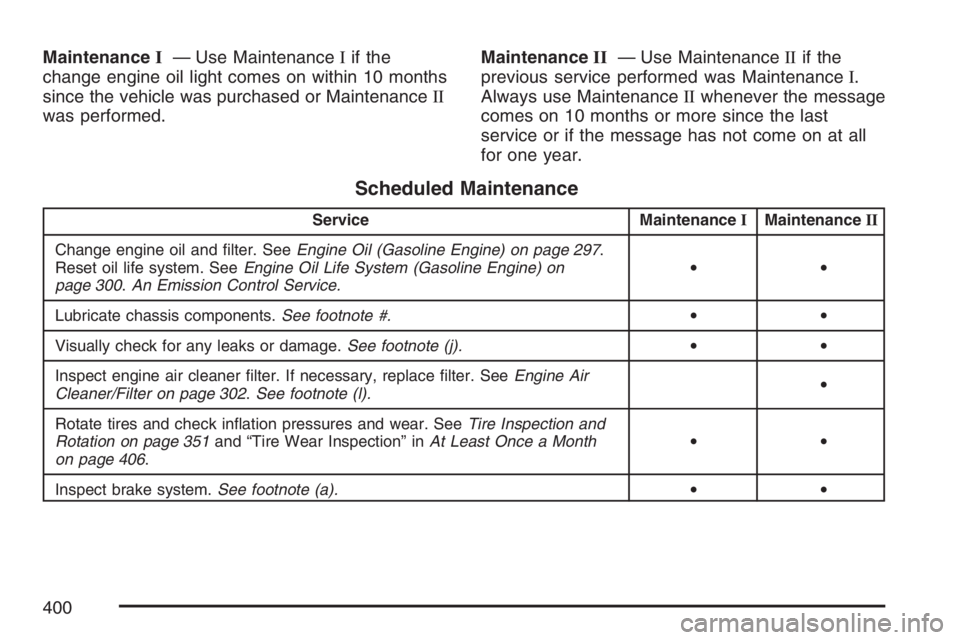
MaintenanceI— Use MaintenanceIif the
change engine oil light comes on within 10 months
since the vehicle was purchased or MaintenanceII
was performed.MaintenanceII— Use MaintenanceIIif the
previous service performed was MaintenanceI.
Always use MaintenanceIIwhenever the message
comes on 10 months or more since the last
service or if the message has not come on at all
for one year.
Scheduled Maintenance
Service MaintenanceIMaintenanceII
Change engine oil and filter. SeeEngine Oil (Gasoline Engine) on page 297.
Reset oil life system. SeeEngine Oil Life System (Gasoline Engine) on
page 300.An Emission Control Service.••
Lubricate chassis components.See footnote #.••
Visually check for any leaks or damage.See footnote (j).••
Inspect engine air cleaner filter. If necessary, replace filter. SeeEngine Air
Cleaner/Filter on page 302.See footnote (l).•
Rotate tires and check inflation pressures and wear. SeeTire Inspection and
Rotation on page 351and “Tire Wear Inspection” inAt Least Once a Month
on page 406.••
Inspect brake system.See footnote (a).••
400
Page 441 of 452
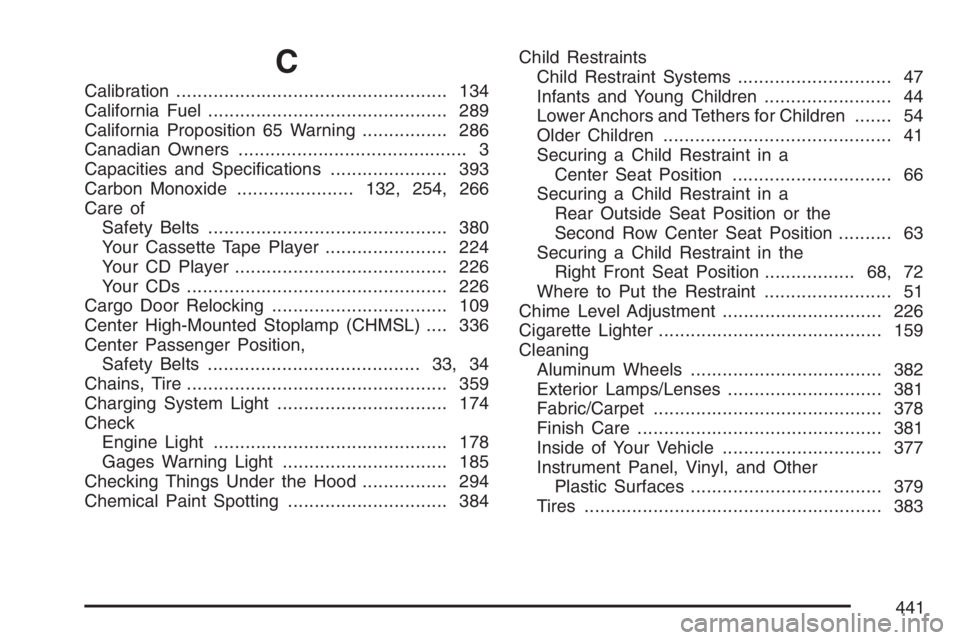
C
Calibration................................................... 134
California Fuel............................................. 289
California Proposition 65 Warning................ 286
Canadian Owners........................................... 3
Capacities and Specifications...................... 393
Carbon Monoxide......................132, 254, 266
Care of
Safety Belts............................................. 380
Your Cassette Tape Player....................... 224
Your CD Player........................................ 226
Your CDs ................................................. 226
Cargo Door Relocking................................. 109
Center High-Mounted Stoplamp (CHMSL).... 336
Center Passenger Position,
Safety Belts........................................ 33, 34
Chains, Tire................................................. 359
Charging System Light................................ 174
Check
Engine Light............................................ 178
Gages Warning Light............................... 185
Checking Things Under the Hood................ 294
Chemical Paint Spotting.............................. 384Child Restraints
Child Restraint Systems............................. 47
Infants and Young Children........................ 44
Lower Anchors and Tethers for Children....... 54
Older Children........................................... 41
Securing a Child Restraint in a
Center Seat Position.............................. 66
Securing a Child Restraint in a
Rear Outside Seat Position or the
Second Row Center Seat Position .......... 63
Securing a Child Restraint in the
Right Front Seat Position................. 68, 72
Where to Put the Restraint........................ 51
Chime Level Adjustment .............................. 226
Cigarette Lighter.......................................... 159
Cleaning
Aluminum Wheels.................................... 382
Exterior Lamps/Lenses............................. 381
Fabric/Carpet........................................... 378
Finish Care.............................................. 381
Inside of Your Vehicle .............................. 377
Instrument Panel, Vinyl, and Other
Plastic Surfaces.................................... 379
Tires........................................................ 383
441