door lock GMC SAVANA 2007 User Guide
[x] Cancel search | Manufacturer: GMC, Model Year: 2007, Model line: SAVANA, Model: GMC SAVANA 2007Pages: 452, PDF Size: 2.68 MB
Page 110 of 452
Rear Door Security Locks
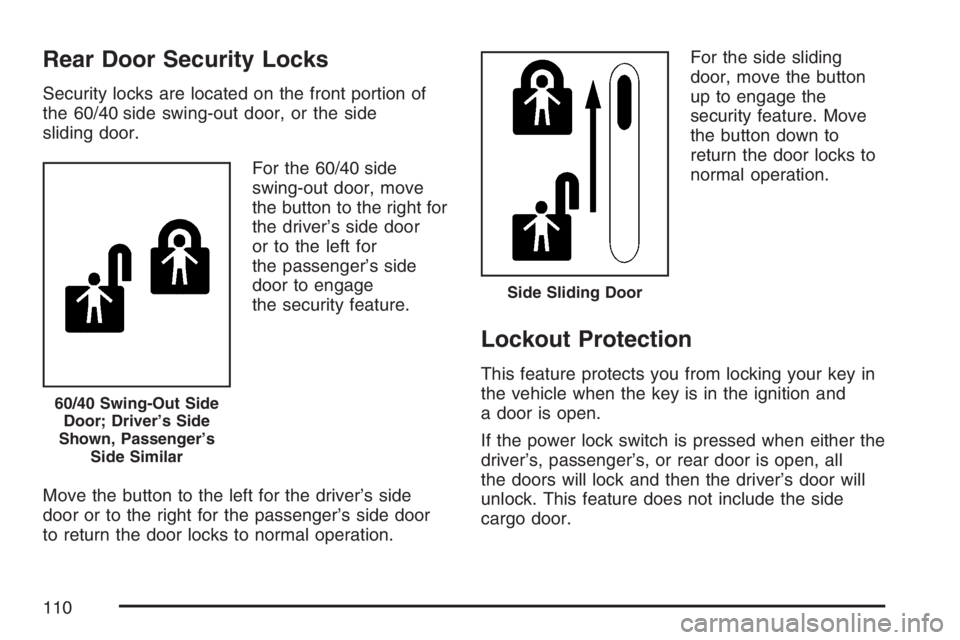
Security locks are located on the front portion of
the 60/40 side swing-out door, or the side
sliding door.
For the 60/40 side
swing-out door, move
the button to the right for
the driver’s side door
or to the left for
the passenger’s side
door to engage
the security feature.
Move the button to the left for the driver’s side
door or to the right for the passenger’s side door
to return the door locks to normal operation.For the side sliding
door, move the button
up to engage the
security feature. Move
the button down to
return the door locks to
normal operation.
Lockout Protection
This feature protects you from locking your key in
the vehicle when the key is in the ignition and
a door is open.
If the power lock switch is pressed when either the
driver’s, passenger’s, or rear door is open, all
the doors will lock and then the driver’s door will
unlock. This feature does not include the side
cargo door.
60/40 Swing-Out Side
Door; Driver’s Side
Shown, Passenger’s
Side Similar
Side Sliding Door
110
Page 114 of 452
Rear Doors
{CAUTION:
Unlocked doors can be dangerous.
Passengers, especially children, can
easily open the doors and fall out of a
moving vehicle. When a door is
locked, the handle will not open it.
You increase the chance of being
thrown out of the vehicle in a crash if
the doors are not locked. So, wear
safety belts properly and lock the
doors whenever you drive.
CAUTION: (Continued)
CAUTION: (Continued)
Young children who get into unlocked
vehicles may be unable to get out.
A child can be overcome by extreme
heat and can suffer permanent injuries
or even death from heat stroke.
Always lock your vehicle whenever
you leave it.
Outsiders can easily enter through an
unlocked door when you slow down
or stop your vehicle. Locking your
doors can help prevent this from
happening.
114
Page 118 of 452
Swing-Out Windows
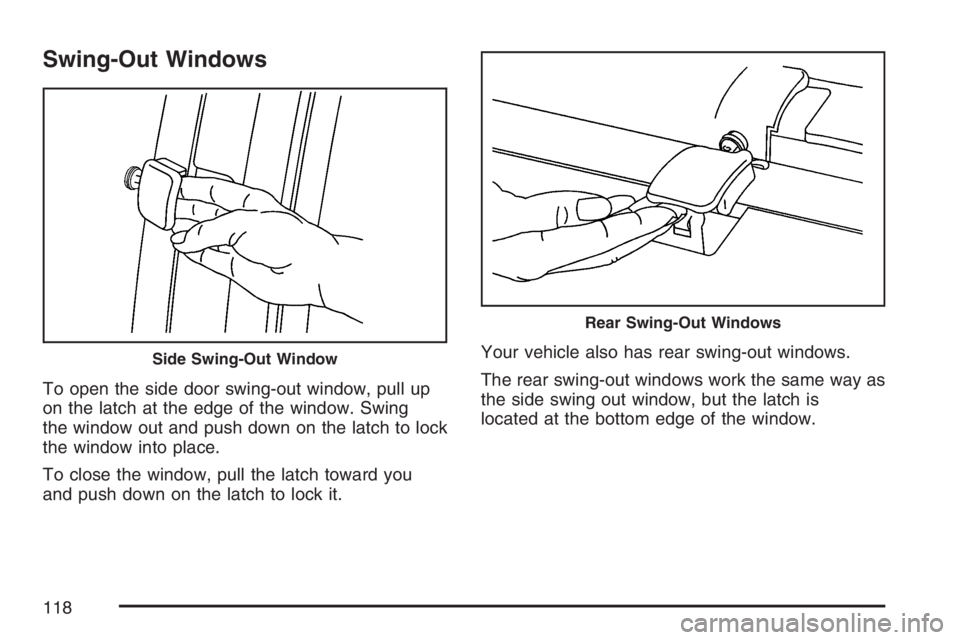
To open the side door swing-out window, pull up
on the latch at the edge of the window. Swing
the window out and push down on the latch to lock
the window into place.
To close the window, pull the latch toward you
and push down on the latch to lock it.Your vehicle also has rear swing-out windows.
The rear swing-out windows work the same way as
the side swing out window, but the latch is
located at the bottom edge of the window.
Side Swing-Out Window
Rear Swing-Out Windows
118
Page 122 of 452
Key In the Ignition
Never leave your vehicle with the keys inside, as it
is an easy target for joy riders or thieves. If you
leave the key in the ignition and park your vehicle,
a chime will sound, when you open the driver’s
door. Always remember to remove your key from
the ignition and take it with you. This will lock
your ignition and transaxle. Also, always remember
to lock the doors.
The battery could be drained if you leave the key
in the ignition while your vehicle is parked.
You may not be able to start your vehicle after it
has been parked for an extended period of time.
Retained Accessory Power (RAP)
The Retained Accessory Power (RAP) feature will
allow certain features on your vehicle to continue
to work for up to 10 minutes after the ignition key is
turned to LOCK or until one of the doors is
opened.
Starting the Engine
Place the transmission in the proper gear.
Move your shift lever to PARK (P) or
NEUTRAL (N). Your engine will not start in
any other position -- this is a safety feature.
To restart when you are already moving, use
NEUTRAL (N) only.
Notice:Do not try to shift to PARK (P) if your
vehicle is moving. If you do, you could
damage the transmission. Shift to PARK (P)
only when your vehicle is stopped.
Starting Procedure
1. With your foot off the accelerator pedal, turn
the ignition key to START. When the engine
starts, let go of the key. The idle speed will go
down as your engine gets warm. Do not
race the engine immediately after starting it.
Operate the engine and transmission gently to
allow the oil to warm up and lubricate all
moving parts.
122
Page 138 of 452
Adjust the mirror by rotating it left or right. Once
the mirror is adjusted to the correct position,
tighten the set screw, located at the end of the
arm, to hold the mirror in place. These mirrors can
also be manually folded in.
On the lower portion of each mirror is a convex
mirror. A convex mirror’s surface is curved so you
can see more from the driver’s seat.
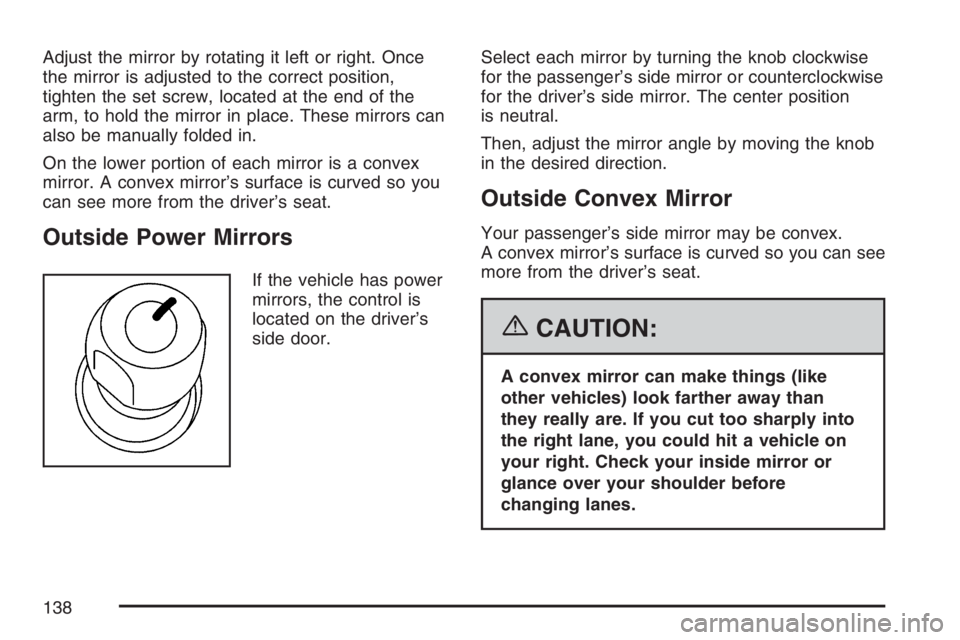
Outside Power Mirrors
If the vehicle has power
mirrors, the control is
located on the driver’s
side door.Select each mirror by turning the knob clockwise
for the passenger’s side mirror or counterclockwise
for the driver’s side mirror. The center position
is neutral.
Then, adjust the mirror angle by moving the knob
in the desired direction.
Outside Convex Mirror
Your passenger’s side mirror may be convex.
A convex mirror’s surface is curved so you can see
more from the driver’s seat.
{CAUTION:
A convex mirror can make things (like
other vehicles) look farther away than
they really are. If you cut too sharply into
the right lane, you could hit a vehicle on
your right. Check your inside mirror or
glance over your shoulder before
changing lanes.
138
Page 156 of 452
Daytime Running Lamps (DRL)
Daytime Running Lamps (DRL) can make it easier
for others to see the front of your vehicle during
the day. DRL can be helpful in many different
driving conditions, but they can be especially
helpful in the short periods after dawn and before
sunset. Fully functional daytime running lamps
are required on all vehicles first sold in Canada.
The DRL system will come on when the following
conditions are met:
•The ignition is on.
•The exterior lamps control is in DRL mode
and not in the defeat position.
When the DRL are on, only the parking lamps will
be on. The other lamps will not be on. The
instrument panel will be lit.
When you turn the headlamp switch off, the
headlamps will go off, and your DRL lamps
(parking lamps) will illuminate.
To turn off the DRL, turn the exterior lamp control
to the off position or shift into PARK (P). The
DRL will stay off until the control is toggled again
or the vehicle is shifted out of PARK (P).
This procedure applies only to vehicles first sold in
the United States.
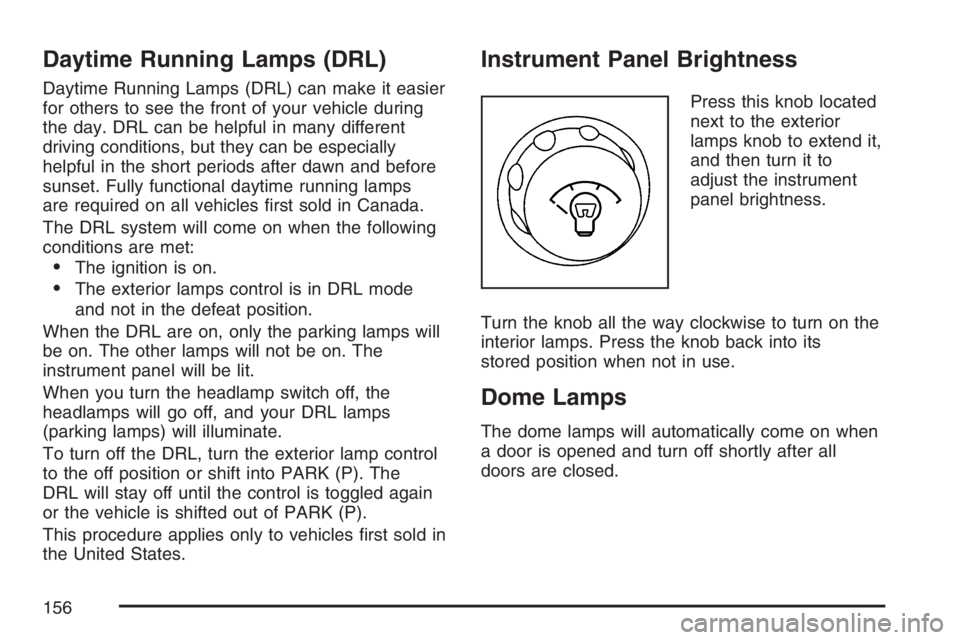
Instrument Panel Brightness
Press this knob located
next to the exterior
lamps knob to extend it,
and then turn it to
adjust the instrument
panel brightness.
Turn the knob all the way clockwise to turn on the
interior lamps. Press the knob back into its
stored position when not in use.
Dome Lamps
The dome lamps will automatically come on when
a door is opened and turn off shortly after all
doors are closed.
156
Page 157 of 452
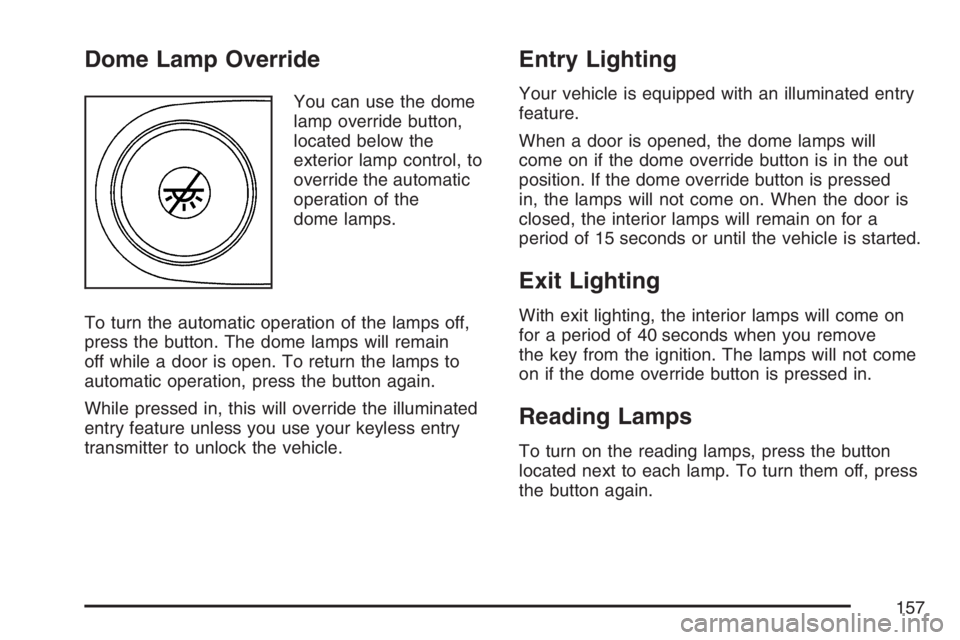
Dome Lamp Override
You can use the dome
lamp override button,
located below the
exterior lamp control, to
override the automatic
operation of the
dome lamps.
To turn the automatic operation of the lamps off,
press the button. The dome lamps will remain
off while a door is open. To return the lamps to
automatic operation, press the button again.
While pressed in, this will override the illuminated
entry feature unless you use your keyless entry
transmitter to unlock the vehicle.
Entry Lighting
Your vehicle is equipped with an illuminated entry
feature.
When a door is opened, the dome lamps will
come on if the dome override button is in the out
position. If the dome override button is pressed
in, the lamps will not come on. When the door is
closed, the interior lamps will remain on for a
period of 15 seconds or until the vehicle is started.
Exit Lighting
With exit lighting, the interior lamps will come on
for a period of 40 seconds when you remove
the key from the ignition. The lamps will not come
on if the dome override button is pressed in.
Reading Lamps
To turn on the reading lamps, press the button
located next to each lamp. To turn them off, press
the button again.
157
Page 159 of 452
Ashtray(s) and Cigarette Lighter
Your vehicle may have this feature. The front
ashtray can be placed in the instrument panel
extension at the center of the instrument panel.
Lift up on the ashtray door to open it.
Notice:If you put papers, pins, or other
ammable items in the ashtray, hot cigarettes
or other smoking materials could ignite
them and possibly damage your vehicle.
Never put ammable items in the ashtray.
To use the cigarette lighter, push it in all the way
and let go. When it’s ready, it will pop back
out by itself.
Notice:Holding a cigarette lighter in while it
is heating will not allow the lighter to back
away from the heating element when it is hot.
Damage from overheating may occur to the
lighter or heating element, or a fuse could be
blown. Do not hold a cigarette lighter in
while it is heating.
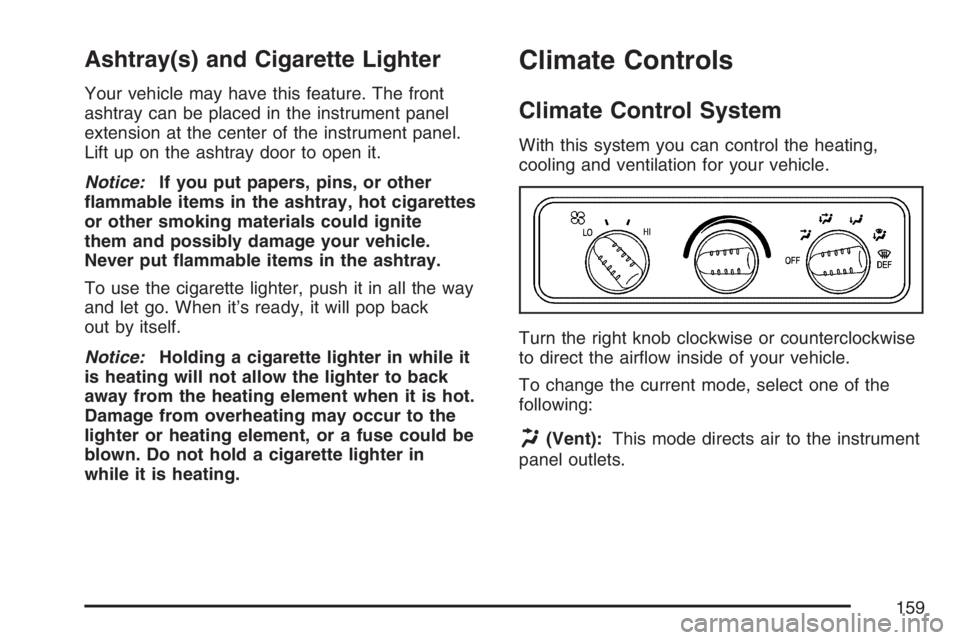
Climate Controls
Climate Control System
With this system you can control the heating,
cooling and ventilation for your vehicle.
Turn the right knob clockwise or counterclockwise
to direct the airflow inside of your vehicle.
To change the current mode, select one of the
following:
H(Vent):This mode directs air to the instrument
panel outlets.
159
Page 259 of 452
Loading Your Vehicle
It is very important to know how much weight
your vehicle can carry. This weight is called the
vehicle capacity weight and includes the weight of
all occupants, cargo, and all nonfactory-installed
options. Two labels on your vehicle show how
much weight it was designed to carry, the Tire
and Loading Information label and the
Certification/Tire label.
{CAUTION:
Do not load your vehicle any heavier than
the Gross Vehicle Weight Rating (GVWR),
or either the maximum front or rear Gross
Axle Weight Rating (GAWR). If you do,
parts on your vehicle can break, and it
can change the way your vehicle handles.
These could cause you to lose control
and crash. Also, overloading can shorten
the life of your vehicle.
Tire and Loading Information Label
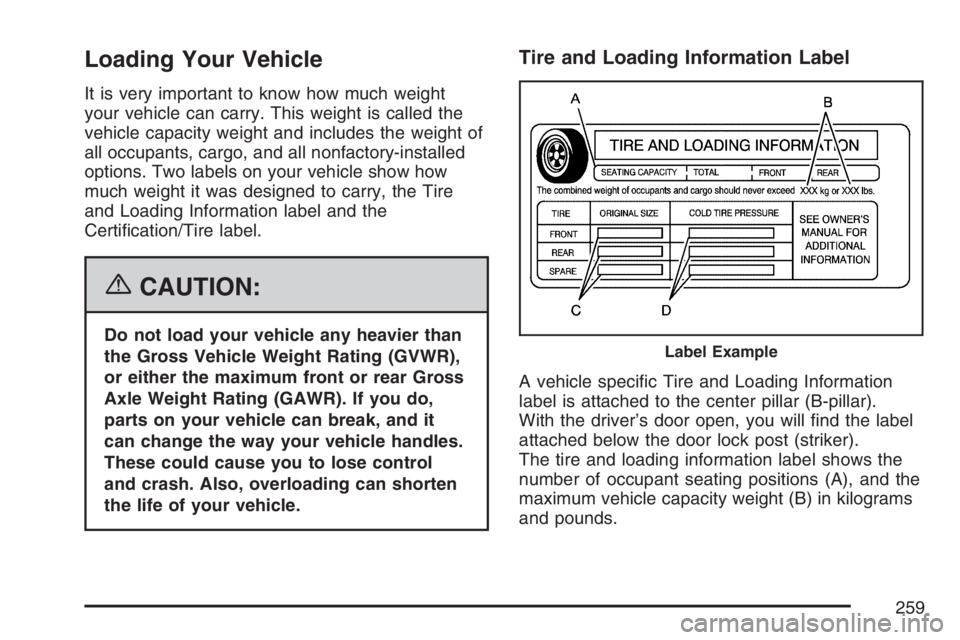
A vehicle specific Tire and Loading Information
label is attached to the center pillar (B-pillar).
With the driver’s door open, you will find the label
attached below the door lock post (striker).
The tire and loading information label shows the
number of occupant seating positions (A), and the
maximum vehicle capacity weight (B) in kilograms
and pounds.
Label Example
259
Page 292 of 452
Filling the Tank
{CAUTION:
Fuel vapor burns violently and a fuel re
can cause bad injuries. To help avoid
injuries to you and others, read and follow
all the instructions on the pump island.
Turn off your engine when you are
refueling. Do not smoke if you are near
fuel or refueling your vehicle. Keep
sparks, ames, and smoking materials
away from fuel. Do not leave the fuel
pump unattended when refueling your
vehicle. This is against the law in some
places. Keep children away from the fuel
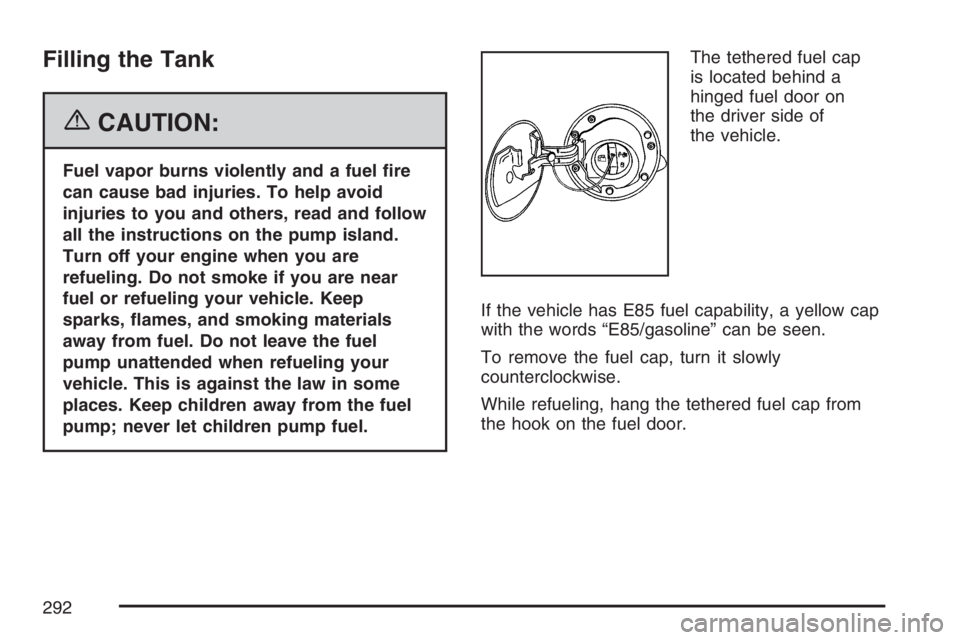
pump; never let children pump fuel.The tethered fuel cap
is located behind a
hinged fuel door on
the driver side of
the vehicle.
If the vehicle has E85 fuel capability, a yellow cap
with the words “E85/gasoline” can be seen.
To remove the fuel cap, turn it slowly
counterclockwise.
While refueling, hang the tethered fuel cap from
the hook on the fuel door.
292